Vietnam's AI Law is in force: what should chatbot businesses do?
This article reads Vietnam's AI Law, Decree 142, Decision 33 and the EU changes to show what businesses using chatbots and AI content should do before March 1, 2027.
A furniture shop put an AI chatbot on its website in January 2026, before the law took effect, and marketing uses AI for posts and photos. The owner asks: what else must the shop do now? This is an illustrative scenario, not a real client.
This article reads the English translation of Vietnam's AI Law, summaries of Decree 142/2026/ND-CP and Decision 33/2026/QD-TTg, the European Commission's AI Act page and a few surveys, checked on November 24, 2026. It is not legal advice.
It answers 3 questions: what Vietnamese law asks, which deadlines are coming, and what the EU just changed if you sell there. Safe AI adoption and personal data law have their own Click Star articles.
Key points
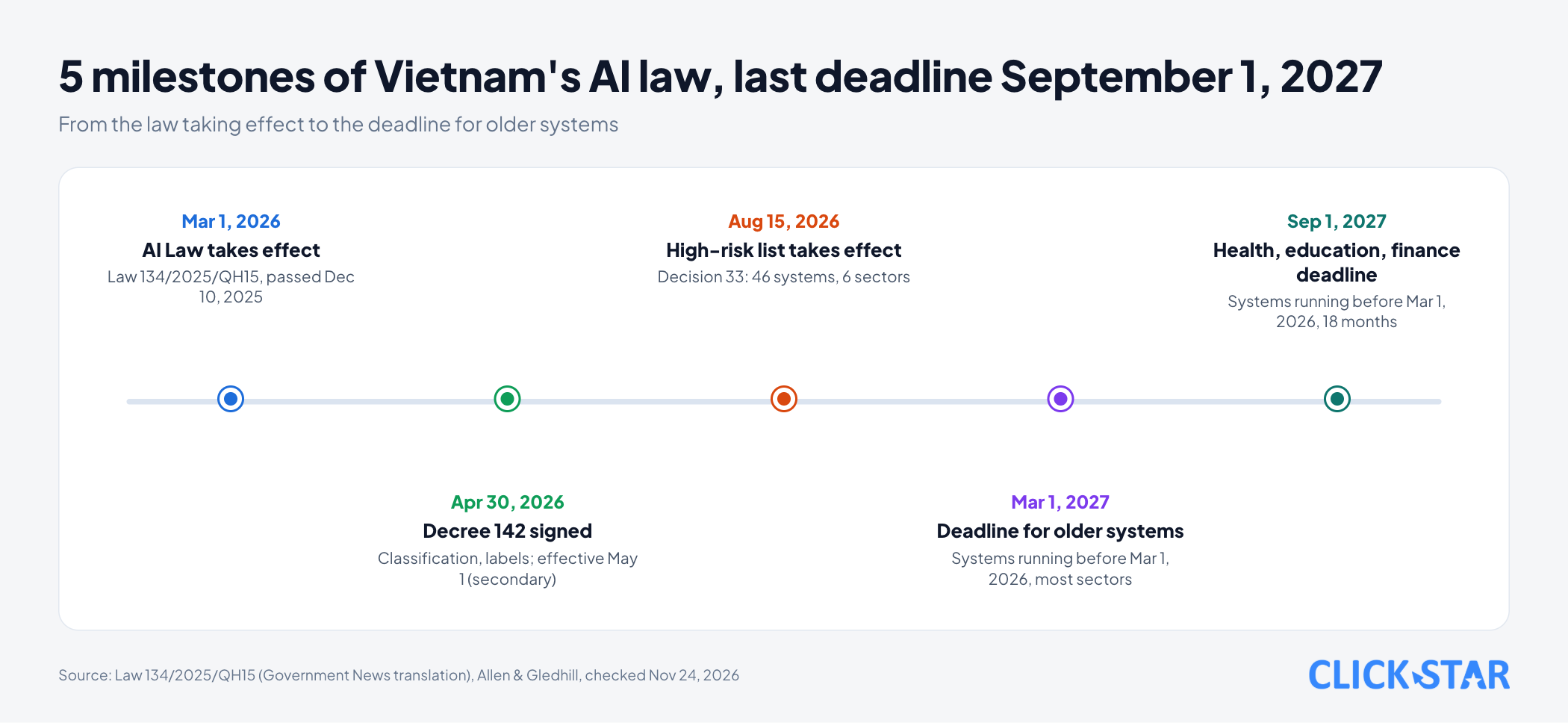
- Law No. 134/2025/QH15 on Artificial Intelligence took effect on March 1, 2026 and sorts AI systems into 3 risk levels: high, medium, low (Article 9, English translation).
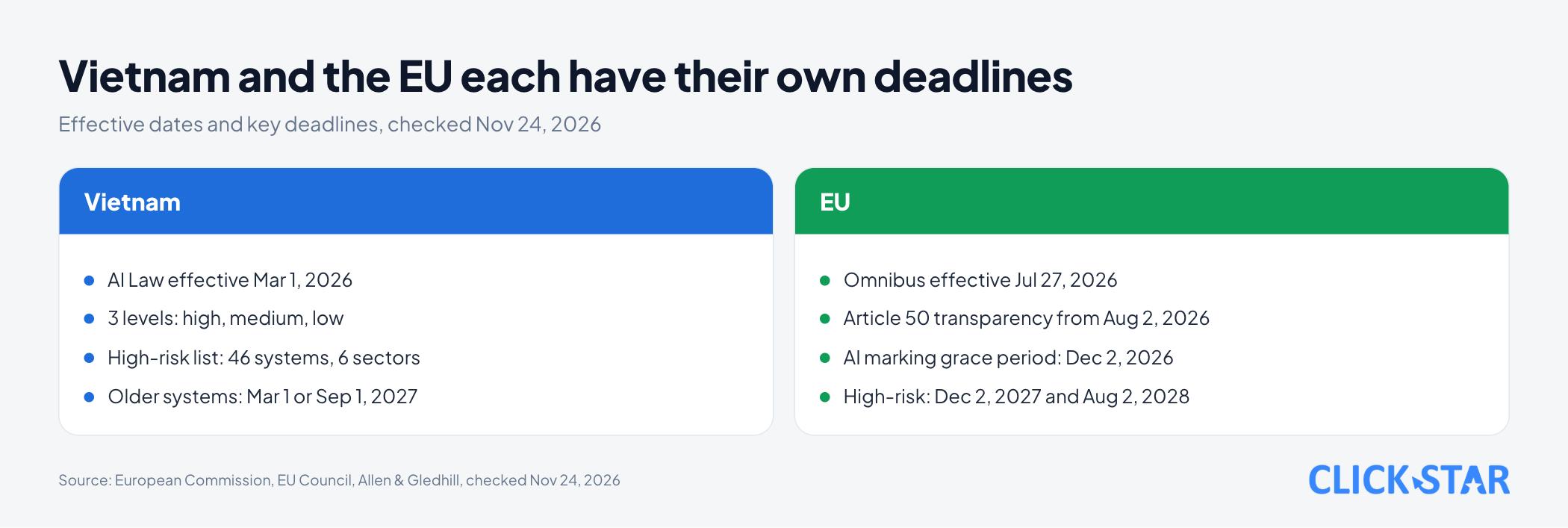
- Systems already running before March 1, 2026 must comply within 12 months (by March 1, 2027); health, education and finance get 18 months (by September 1, 2027), per Article 35, with dates calculated by Click Star.
- Decision 33/2026/QD-TTg, effective August 15, 2026, lists 46 high-risk systems in 6 sectors: education, ethnic and religious affairs, health, banking, judicial proceedings, transport. Retail and marketing are not on the list.
- Article 11, clause 4 of the Law already requires deployers to label AI images, audio and video that imitate a real person's look or voice. Decree 142/2026/ND-CP adds detail and exempts spell-checking, summarizing, translating and internal content (per summaries).
- In the EU, the Omnibus took effect on July 27, 2026, Article 50 transparency rules apply from August 2, 2026, and high-risk rules moved to December 2, 2027 and August 2, 2028.
- AI-use rates cannot be compared across countries because the questions and samples differ: EU 20.0% (2025), US about 20% (early 2026), Vietnam 26% (survey of 1,000 business leaders).
What Vietnam's AI Law says to businesses
The law asks a business to know its role and be transparent. Click Star read the Government newspaper's English translation (en.baochinhphu.vn) (posted July 15, 2026, marked "for reference only"). Article numbers follow that translation.
Article 3 defines roles. A provider puts a system into use under its own name or trademark, built in-house or taken from a third party. A deployer uses a system in professional, commercial or service activities.
Click Star's view: wrapping another company's model into a branded chatbot may make you a provider, not only a deployer. Ask a lawyer.
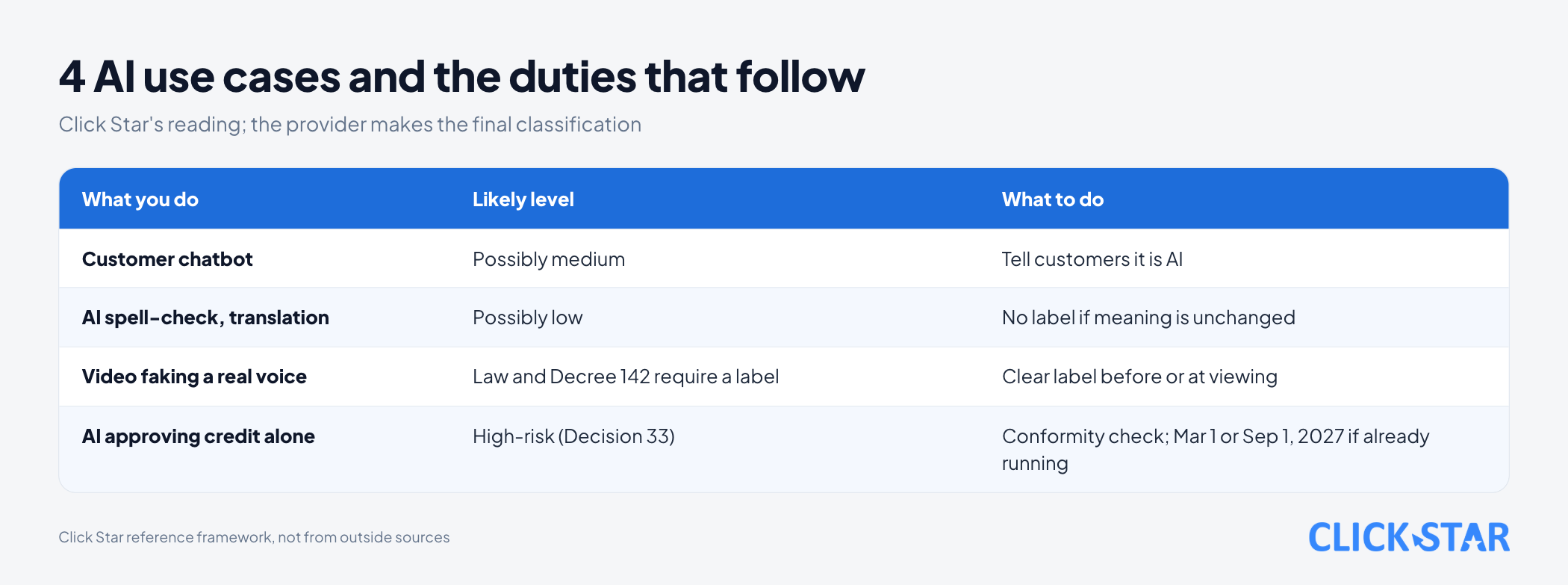
Article 9 sets 3 levels. High: can cause significant harm to life, health or legitimate rights. Medium: can confuse people who cannot tell they are dealing with AI or AI-made content. Low: everything else.
Article 11 touches most businesses. Providers must design systems so users are told they are talking to AI, and mark AI audio, images and video in machine-readable form. Deployers must disclose content that could mislead people about authenticity.
Clause 4 requires deployers to attach a clearly recognizable label to AI-made or AI-edited audio, images and video that imitate a real person's look or voice, or recreate real events. This has applied since the Law took effect.
Where your chatbot and writing tools fall
The provider classifies a system before putting it into use, and the deployer inherits the result (Article 10). If a deployer's changes or integration raise the risk, both sides must reclassify.
Providers must notify the Ministry of Science and Technology of medium and high-risk systems before use. Per a May 8, 2026 article on moc.gov.vn, classification covers AI systems, not stand-alone models, unless a model is a component of a specific AI system.
The table is how Click Star reads 4 common situations, not a legal conclusion; the provider makes the final classification.
What Decree 142 and Decision 33 clarify
Decree 142/2026/ND-CP was signed on April 30, 2026; the law firm Viet An gives May 1, 2026 as the effective date (secondary, updated July 4, 2026). Points below follow summaries.
Per luatvietnam.vn (May 25, 2026) and Báo Pháp luật Việt Nam (July 23, 2026), Article 18 of the Decree details the Law's Article 11 label: AI audio, images and video that imitate a real person's look or voice, or recreate real events so they are easily mistaken for real, need a clear label shown before or when people access them.
There are 4 exemptions (Article 18(4), per Báo Pháp luật Việt Nam):
- Technical edits that do not change the nature of the content.
- Text processed by tools for correction, summarizing, paraphrasing or translation without changing the original meaning.
- Content used only internally, not shown to the public.
- Content made during controlled testing and not published.
Per the law firm Tilleke & Gibbins (July 6, 2026), Decision 33 was issued on June 30, 2026 and took effect August 15, 2026. Allen & Gledhill (August 19, 2026) says its appendix has 46 systems, of which transport 31 and banking 2.
A banking example: AI that scores credit and decides on lending with no independent approval. Not every system in these sectors is high-risk.
Deadlines and penalties
Article 35 gives systems running before March 1, 2026 12 months (to March 1, 2027), and health, education and finance 18 months (to September 1, 2027). They may keep running meanwhile, unless the regulator sees a risk of serious harm and orders a halt.
Article 4 of Decision 33 (via a copy on thuviennhadat.vn) gives listed systems already running before August 15, 2026 two deadlines: before September 1, 2027 for health, education and finance; before March 1, 2027 for the other sectors. Systems put into operation within 6 months after August 15, 2026 get only the March 1, 2027 deadline. Whether banking counts as "finance" is unclear.
Per Viet An (updated July 4, 2026, secondary, original not checked), systems running before March 1, 2026 and covered by the transition must notify the one-stop portal, with a compliance plan, within 60 days of Decree 142 taking effect, meaning before June 30, 2026.
If right, this deadline has passed. A chatbot owner running before March 1, 2026 should ask a lawyer now whether the shop is covered.
On penalties, Click Star found no penalty decree specific to the AI Law.
Decree 401/2026/ND-CP (signed November 4, 2026, effective December 22, 2026, up to 200 million VND for organizations) covers the digital technology industry, per the People's Court Journal (November 10, 2026); it does not say whether it covers AI Law violations.
Decree 330/2026/ND-CP (August 19, 2026) fines individuals 30 to 50 million VND for using AI or deepfakes to fake a face or voice to authenticate accounts (Article 34, clause 2, per luatvietnam.vn, August 24, 2026); that page names no penalty for labels or chatbots.
What changed in the EU after the Omnibus
The European Commission's Article 50 FAQ (read November 24, 2026) says providers outside the EU are still covered by the AI Act if their output is used in the EU.
Per the Commission's AI Act page (read November 24, 2026), the Omnibus took effect on July 27, 2026. High-risk rules moved to December 2, 2027, and for systems built into products to August 2, 2028.
The EU Council's June 30, 2026 release (reposted by the EEAS) cuts providers' grace period for AI-content transparency from 6 months to 3, to December 2, 2026.
Per the Article 50 FAQ, this grace covers only systems placed on the market before August 2, 2026, and only the duty to mark and detect AI content (Article 50(2)).
Article 50 transparency applies from August 2, 2026 (guidelines of July 20, 2026). Chatbots must say they are AI from the first interaction, unless obvious. Providers must mark outputs in machine-readable form. Deployers must label deepfakes (AI images, audio or video passing as real) at the latest at first exposure.
AI-use data: how to read it
Eurostat (December 11, 2025): 20.0% of EU enterprises with 10+ employees used AI in 2025, up from 13.5% in 2024.
In the US, per the Minneapolis Fed (May 29, 2026) citing the Census BTOS survey, about 20% of businesses used AI in early 2026. Since November 2025 the question reads "in any business function", so it does not compare with older figures.
In Vietnam, VCCI posted on October 1, 2026 a Strand Partners report from an AWS event: about 26% of businesses (245,000) use AI, up from 18%, from a sample of 1,000 business leaders and 1,000 citizens.
These 3 figures use different questions and samples, so do not rank countries. The Strand Partners report was not read.
Click Star's view. For small and mid-sized businesses using AI for customer care and content, the near-term duty is transparency: customers know they are talking to AI, and fake lifelike images or voices carry labels. Systems running before March 1, 2026 have a transition period, but Click Star recommends acting early.
The bigger risk is not knowing which AI tools you use and who is responsible. Click Star sells AI integration and automation, so it has an interest; this is not legal advice.
What to do: 12 self-check items in 30 days
This is a Click Star reference framework, not from outside sources. For any item not done, record an owner and date.
System running before March 1, 2026: still in transition (Article 35), but check the 60-day notification step above. System used from March 1, 2026: Article 35 only gives time to systems already running before that date, so meet the transparency duties now. Both are Click Star recommendations; ask a lawyer.
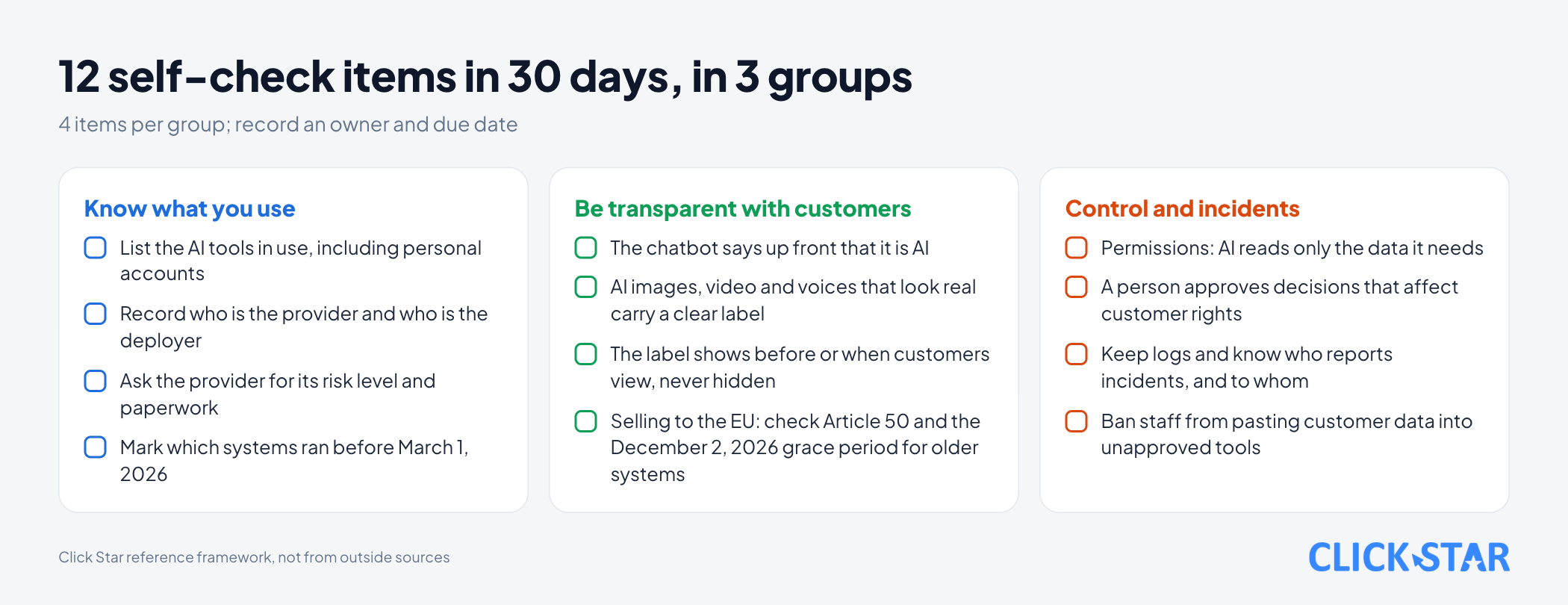
Group 1. Know what you use
- List the AI tools in use, including personal accounts
- Record who is the provider and who is the deployer
- Ask the provider for its risk level and paperwork
- Mark which systems ran before March 1, 2026
Group 2. Be transparent with customers
- The chatbot says up front that it is AI
- AI images, video and voices that look real carry a clear label
- The label shows before or when customers view, never hidden
- Selling to the EU: check Article 50 and the December 2, 2026 grace period for older systems
Group 3. Control and incidents
- Permissions: AI reads only the data it needs
- A person approves decisions that affect customer rights
- Keep logs and know who reports incidents, and to whom
- Ban staff from pasting customer data into unapproved tools
How to measure: 5 indicators
All 5 are Click Star's proposals, with no outside thresholds.
- AI tools with a named owner out of all tools in use.
- Share of chats that open with an AI notice, checked by monthly sample.
- Public content with a label out of content that needs one.
- Time from spotting an incident to telling the responsible person.
- Staff still using unapproved tools.
Common mistakes
- Assuming only the AI's maker is responsible. The law sets separate duties for deployers, and a branded wrapper may make you a provider.
- Labeling everything or nothing. The decree exempts spell-checking, summarizing, translating and internal content, but the Law requires labels when imitating real people.
- Thinking a foreign vendor's AI is outside Vietnamese law. Article 2 covers foreign organizations active in AI in Vietnam.
- Waiting until 2027. March 1, 2027 is the deadline for systems running before March 1, 2026; Article 35 gives newer systems no such period. Telling customers and labeling should happen early, a Click Star recommendation.
- Deciding from a summary alone. Check the original text when money or legal status is at stake.
What is not known
Click Star could not open the original Vietnamese text of the Law, Decree 142 and Decision 33 (thuvienphapluat.vn blocks tools). The Law was read in translation, the other 2 via summaries or a copy.
Click Star found no Decree 142 clause on how a chatbot must say it is AI beyond Article 11, and has not read the original Decree 330. It is unclear which penalty decree applies to AI Law violations, and there are no compliance data for Vietnamese businesses.
EUR-Lex returned no content, so the Omnibus was read via the Commission and the EU Council. Census blocks tools, so US figures are secondary.
Related posts
Need tailored advice for your business?
Click Star helps you build a solution that fits your industry and scale. We answer every question during business hours.