Is GEO new work? Google says it is still SEO, Bing names it
This article reads official Google and Bing documents to see whether GEO is new work or SEO renamed, what changed in November and what can be measured. It separates confirmed facts, secondary sources and inference.
The owner of a furniture shop is offered a "GEO package" to appear in AI answers, priced above the familiar SEO package. The question: is GEO new work, or SEO under a new name? This is an illustrative scenario.
This article reads Google and Bing documentation and blog posts, checked on November 21, 2026. The Bing Webmaster Guidelines page runs on JavaScript and could not be read here, so that part relies on secondary sources (Search Engine Journal, Search Engine Roundtable).
It answers 3 questions: what Google and Bing say about GEO, what changed in November, and what to measure before paying for a "GEO package".
Key points
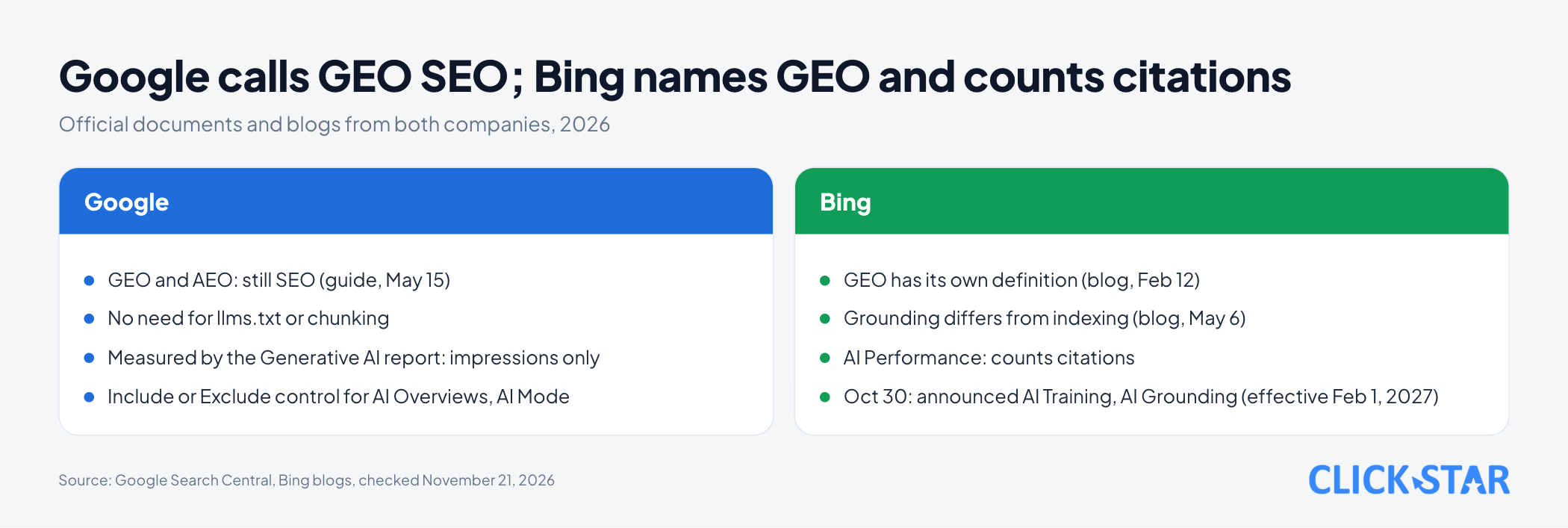
- Google's guide (May 15, 2026) says optimizing for AI search, or GEO, is still SEO; pages need to be indexed and snippet-eligible, and the site not excluded in Search Console.
- Google lists 5 things you do not need, among them
llms.txt, chunking content and writing just for AI. - Bing uses GEO as a name of its own: a February 12, 2026 blog post defines it, AI Performance counts citations, and on October 30, 2026 it announced AI Training and AI Grounding options to replace
NoArchiveandNoCache(effective February 1, 2027). - Search Console's Generative AI performance report counts only impressions, open to all sites since August 31, 2026; November 9 to 11 data has a logging error.
- On November 12, 2026 Google brought Gemini 4 Hydrogen to Search worldwide; "default" comes from Search Engine Journal citing Robby Stein's X thread, not from Google's Search post.
- The Search generative AI control removes a site from AI Overviews and AI Mode; Google says it is no ranking signal.
- Google warns no third-party tool can access its internal ranking or AI systems.
Google says GEO is SEO: 5 things its guide says you can skip
The guide "Optimizing your website for generative AI features on Google Search" (footer: last updated July 10, 2026; read November 21, 2026) says AEO means optimizing for answer engines and GEO for generative engines. In Google's view that is optimizing for the search experience, so still SEO.
John Mueller's blog post "A new resource for optimizing for generative AI in Google Search" and the page "Latest Google Search Documentation Updates" both date the guide to May 15, 2026.
Google's explanation for why SEO still applies: the AI features rest on Search's core ranking systems, which fetch pages from the index, then generate an answer with links (RAG, or grounding).
Per that log, on June 15, 2026 Google added a note clarifying llms.txt, so the llms.txt text below is the post-June 15 version.
The guide's "Mythbusting" section lists 5 things to ignore for Google Search:
llms.txtfiles, special markup or Markdown: Google Search does not use them, so creating them neither harms nor helps rankings.- Chunking content: not required, and there is no ideal page length.
- Writing just for AI: the systems understand synonyms, so no need to cover every long-tail variation.
- Seeking inauthentic "mentions" across the web: Google says it is less helpful than it seems.
- Overfocusing on structured data: no special schema.org markup for AI, though it still helps rich results.
What Google recommends instead
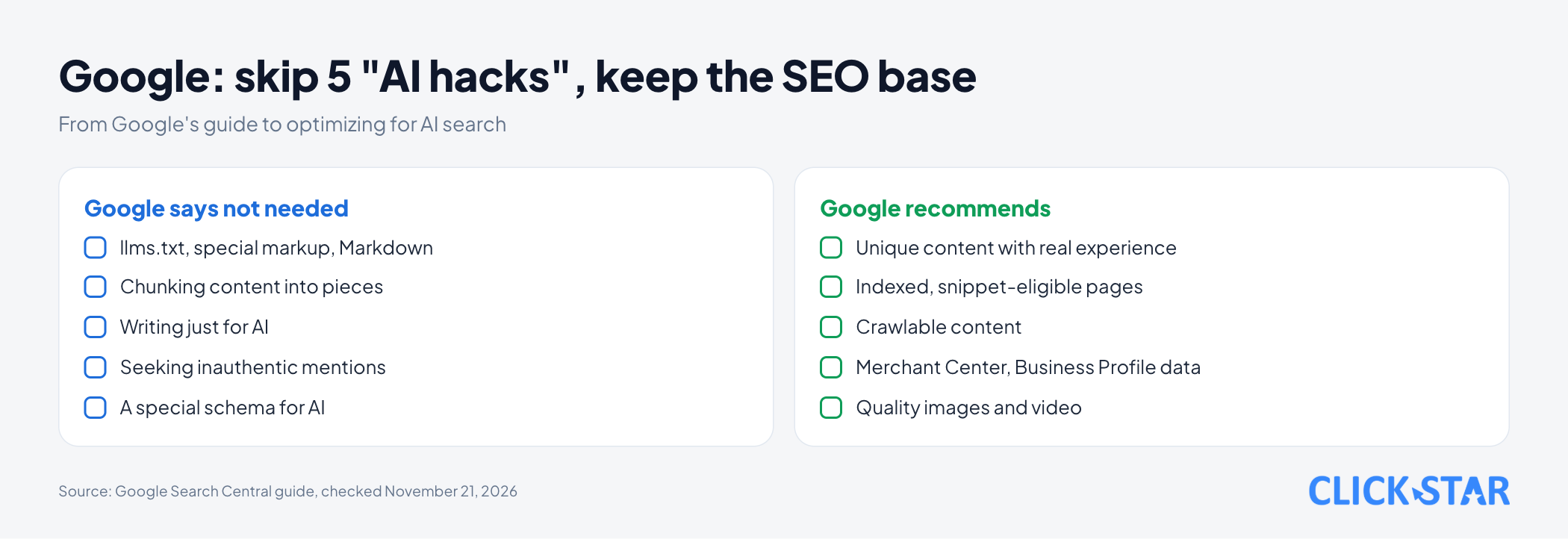
First: content that is hard to replace. Google calls it "non-commodity": not common knowledge anyone could write, with first-hand experience and a distinct viewpoint as examples.
The guide says this will likely matter more over the long run than any other suggestion. The rest is familiar SEO groundwork: crawlable content, Merchant Center and Google Business Profile data, quality images or video.
One limit is explicit: creating many pages per question variation, fan-out queries included, mainly to influence rankings or AI answers violates Google's spam policy.
Bing names GEO and measures it by citations
The post "Elevating the Role of Grounding on the AI Web" (February 12, 2026) by Jordi Ribas, Corporate Vice President, Search & AI at Microsoft, defines GEO as understanding how content participates in AI-driven experiences.
Per Search Engine Journal (February 27, 2026, secondary), the rewritten Bing Webmaster Guidelines name GEO, say citations are not guaranteed, and suggest clear facts, consistent entity names, 1 topic per URL and key points near the top.
Search Engine Roundtable (February 26, 2026, secondary) differs: a small update, no word GEO in its excerpts. The original page was unreadable, so this stays unsettled.
Official milestones from February 12 to November 12, 2026
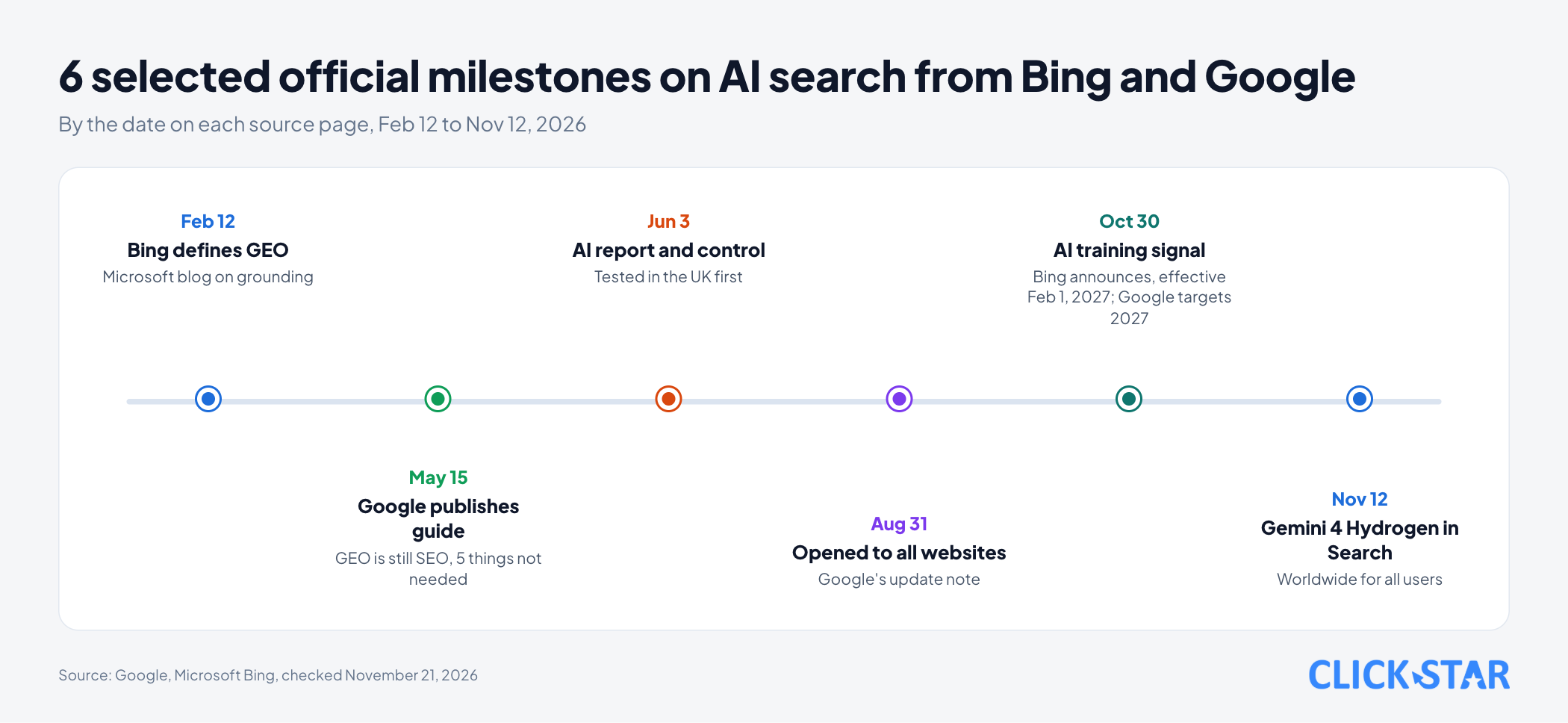
On June 3, 2026 Google announced the AI report and the control in Search Console, first for a group of UK sites (post "New opportunities, control and insights for website owners"). A note dated August 31, 2026 says it reached all websites.
What can and cannot be measured
The Generative AI performance report (Search) in Search Console counts how often links to your site appeared in AI Overviews and AI Mode. In the total chart, several results from one site in one answer count as 1 impression (help page, read November 21, 2026).
The report can be viewed by page, country, date and device. The table by page aggregates by page, so table totals can differ from the chart total.
The page lists no clicks or queries. Clicks from AI are counted within the regular Performance report, Web search type (page "AI features and your website", read on November 21, 2026).
The page "Data anomalies in Search Console" (read on November 21, 2026) lists a logging error that lowered impressions in this report for November 9 to 11, 2026.
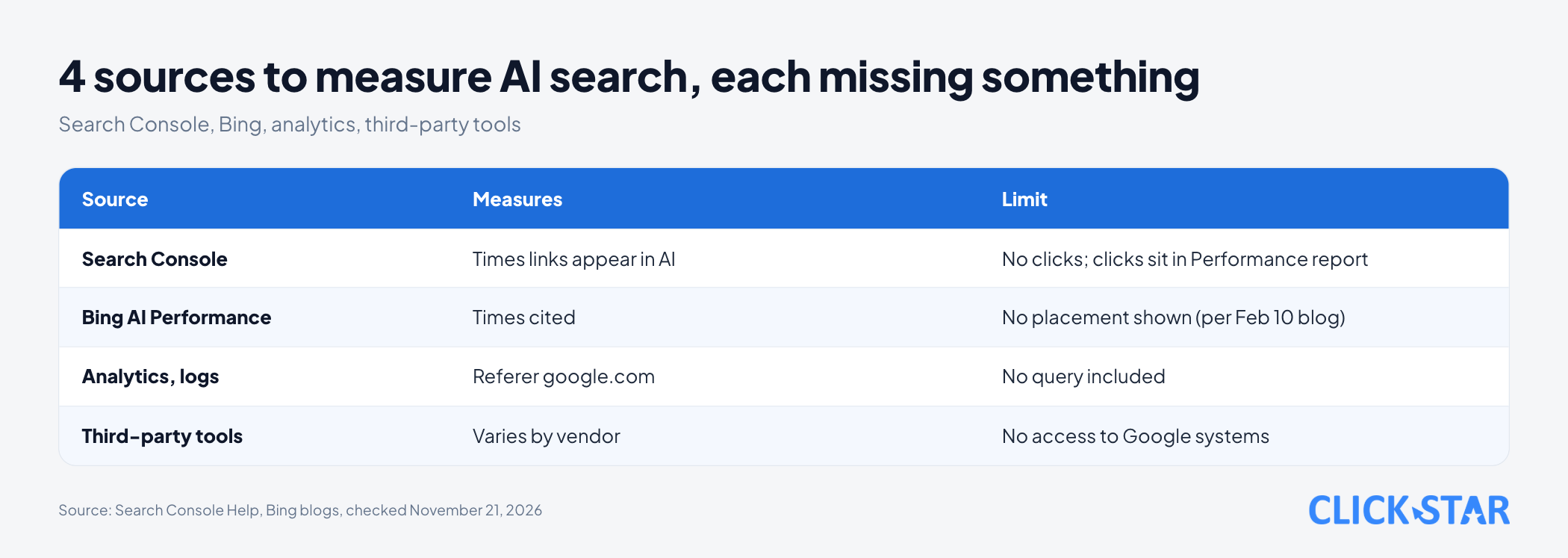
Bing has AI Performance (blog, February 10, 2026) with total citations, the "grounding queries" the AI used to find content, and citations per URL. Grounding queries are a sample, and citation counts come without placement in an answer.
Bing later added Intents, Topics, Citation Share and Compare ("New AI Visibility Insights in Bing Webmaster Tools", June 16, 2026, preview) and Topics Portfolio ("Introducing Topics Portfolio (Beta) in AI Performance", October 13, 2026).
For analytics, the page "Identify Google Search traffic" (added November 12, 2026) says web Search sends a Referer of https://www.google.com/ or a local domain, without the query, and does not mention AI Overviews or AI Mode.
Search Engine Roundtable (October 30, 2026) and Search Engine Journal (November 9, 2026), both secondary, recount Cyrus Shepard's test on 1 site: AI impressions of about 8 to 10% (the 2 differ), an estimated CTR of 0.9%, against about 0.4% for the whole site (per Search Engine Journal).
Per Search Engine Roundtable, when AI was switched off, organic clicks also dropped (a halo effect, cause unclear). Shepard calls it directional, on 1 site.
Gemini 4 Hydrogen and links in AI answers
Gemini 4 Hydrogen is Google's fast model for everyday work ("Introducing Gemini 4 Hydrogen", November 12, 2026). Per "Google Search gets a major upgrade with Gemini 4 Hydrogen" (Robby Stein, November 12, 2026), it is in Search worldwide for all users.
Google's post does not use the word "default", does not mention AI Overviews and has no guidance for website owners. Search Engine Journal (November 12, 2026, secondary) writes that Hydrogen is the default model in AI Mode, citing Robby Stein's X thread (said to add that Hydrogen serves hard AI Overviews questions), which could not be opened here.
The AI opt-out control and the training signal
The page "Search generative AI control" (Search Console Help, read November 21, 2026) offers a setting under Settings in Search Console: Include (default), Exclude or Inherit from parent. It covers AI Overviews, AI Mode and Discover's AI features.
Exclude means no impressions or traffic from those features, usually within a few days. Google says it is not a ranking signal for other Search results and does not affect AI training.
The post "Supporting a shared AI training control for websites" (John Mueller, October 30, 2026) says Google plans to support a shared AI-training opt-out signal in robots.txt, based on the IETF's AIPREF working group; a draft, targeted for 2027.
The same day, Bing's post "Your content, your choice" (October 30, 2026) replaced NoArchive and NoCache with 2 options: AI Training (set in robots.txt or per page) and AI Grounding (per page, Disallow or DisallowExtended).
Bing gives 3 dates: December 15, 2026 (temporary grounding options open in Bing Webmaster Tools for sites using NoArchive or NoCache), February 1, 2027 (new options take effect as it crawls), March 1, 2027 (deadline to keep old restrictions; otherwise the default is allow).
Do Google and Bing contradict each other?
This article's inference: Google's "no chunking" and Bing's "1 topic per URL" (via Search Engine Journal) need not conflict: one concerns tiny pieces for machines, the other a page staying on 1 topic.
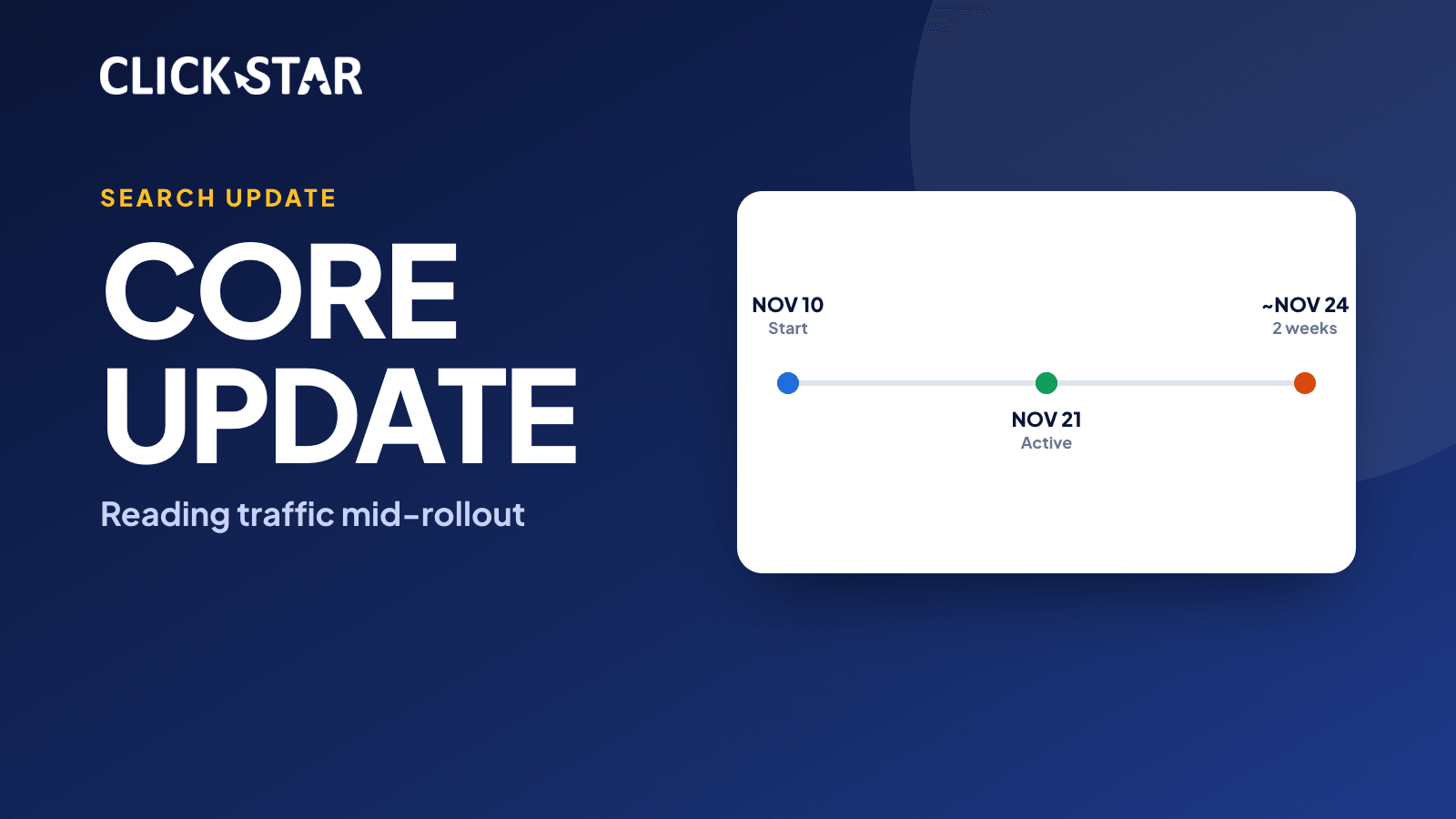
This week's numbers mix several changes. Per the Search Status Dashboard (read on November 21, 2026), the November core update began on November 10, 2026 (Pacific time), may take up to 2 weeks and lists no end time. Add the November 9 to 11 logging error and Hydrogen on November 12.
Google's "Core updates" page advises waiting a full week after completion. This article's inference: impression changes since November 9 cannot yet be credited to GEO work.
What to watch
- This week: in Search Console, open Settings, check that Search generative AI is set to Include (unless chosen otherwise), and see whether the Generative AI performance report appears.
- This week: note November 9 to 11 (logging error), 10 (core update) and 12 (Hydrogen) beside weekly impressions.
- This week: in Bing Webmaster Tools, open AI Performance to see which pages are cited; grounding queries are a sample, and citation counts show no placement.
- On a "GEO package" quote: check each item against the 5 things Google says you do not need, and ask how results are measured; neither Google nor Bing guarantees rankings or citations.
- Coming up: Bing's temporary grounding options open December 15, 2026, new options are honored from February 1, 2027, deadline March 1, 2027; the core update has no end date yet; Google targets a shared training signal for 2027.
Common mistakes
- Treating GEO as a separate trade because the name differs. Google says it is still SEO.
- Building
llms.txtor chunking pages to "rank in AI". Google Search neither needs nor uses them. - Reading AI impressions as clicks. The AI report has no click counts; the 0.9% CTR is one test on 1 site.
- Changing strategy on November 9 to 11 numbers or mid core update, after Google confirmed a logging error.
- Trusting a GEO tool's "correlation" figures without opening the method.
What is not known
The Bing Webmaster Guidelines page could not be read (JavaScript, blank page), so claims about it come via Search Engine Journal; Search Engine Roundtable says its excerpts lack the word GEO. Whether the live page uses it is unchecked.
Robby Stein's X thread, where Search Engine Journal says the word "default" appears, could not be confirmed; Google's post does not use it. It is unclear whether Google will add clicks or queries to the AI report.
No measurement specific to Vietnamese websites on impressions or clicks from AI search was found, and GEO vendors' "correlation" or "uplift" figures are not used because their methods could not be opened. It is unknown when the core update ends.
Related posts

Need tailored advice for your business?
Click Star helps you build a solution that fits your industry and scale. We answer every question during business hours.