Should you fix a traffic drop while Google's core update runs?
This article reads Google's status dashboard and documentation to set out what is confirmed about the November core update and how to read traffic correctly. Third-party data is reference only.
On the morning of November 21, an online shop sees fewer visitors from Google than last week. The owner hears Google is running a core update and wonders whether to change the site right away. This is an illustrative scenario.
This article draws on the Search Status Dashboard (Google's official status page for Search), Search Central documentation and Search Console Help. Community news comes via Search Engine Roundtable (secondary source). Checked on November 21, 2026.
It answers 4 questions: whether to fix the site right away, what Google confirmed about the November update, how long earlier ones took, and how to read traffic.
Key points
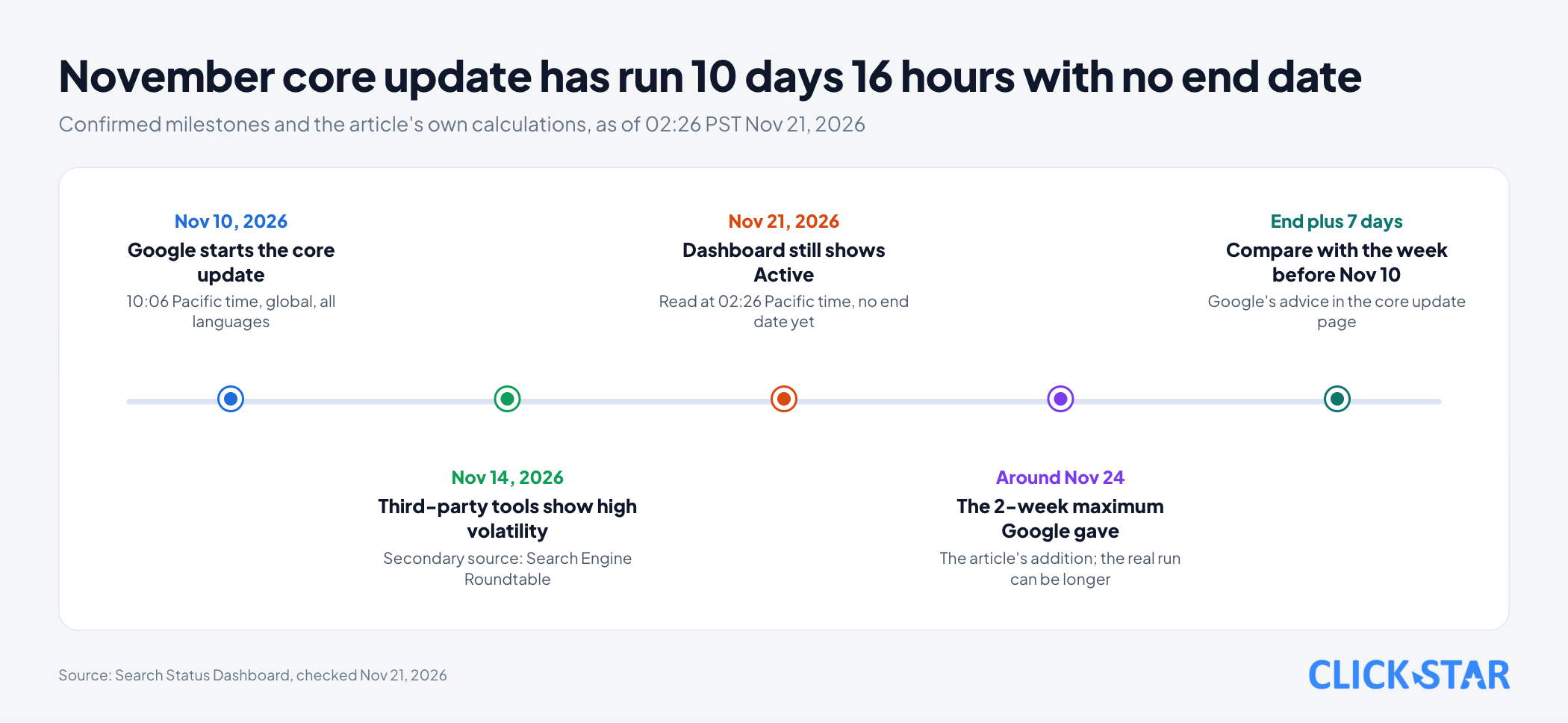
- Google lists the "November 2026 core update" as starting November 10, 2026 at 10:06 a.m. Pacific time (01:06 on November 11 in Vietnam, the article's conversion), global, all languages.
- When read (02:26 on November 21, Pacific time), the dashboard still shows Active with no end date. Google says it can take up to 2 weeks, so around November 24 (the article's addition).
- On the history page, 15 core updates from May 2022 to May 2026 have a median duration of 15 days, from 6 days 4 hours to 45 days.
- Short answer: do not rush to fix based on the chart alone. Google advises waiting until the update ends, waiting at least 1 more full week before analyzing, and avoiding "quick fixes". Technical or security faults are a different matter: check now (the article's view).
- Small drop (for example position 2 to 4): avoid big changes. Large, lasting drop (for example 4 to 29): assess the whole site.
- Tracking-tool and forum numbers are reference only. Search Console can split branded queries; since November 16, 2026 the filter is also in the Search Analytics API, for eligible properties.
What Google has confirmed about the November update
Per the Search Status Dashboard (read November 21, 2026), the "November 2026 core update" entry sits under Ranking and began on November 10, 2026 at 10:06 a.m. Pacific time (PST). Its only note, posted at 10:07 that day, says it is global, covers all languages and may take up to 2 weeks.
When read, at 02:26 on November 21 (PST), the page still shows Active; the incident's only note is still the one from 10:07 on November 10. By the Ranking history page, this is the 3rd core update of 2026 after March and May (the article's count, excluding the separate Discover update).
A core update is a large, broad change to ranking systems. Google's "Google Search's Core Updates" page (last updated December 10, 2025) says they happen several times a year and do not target specific sites or pages. A page that drops is not necessarily at fault: other pages may simply have moved above it.
No guidance written for this update was found: the Search Central documentation changelog and blog feed (read November 21, 2026) have no November entry on core updates, and no page gives impact figures.
How long earlier updates took
The Ranking history page (read November 21, 2026) lists each duration. For 15 core updates from May 2022 to May 2026, the median is 15 days, the shortest 6 days 4 hours (December 2024), the longest 45 days (March 2024); 8 ran longer than 14 days (the article's own calculation from the table).
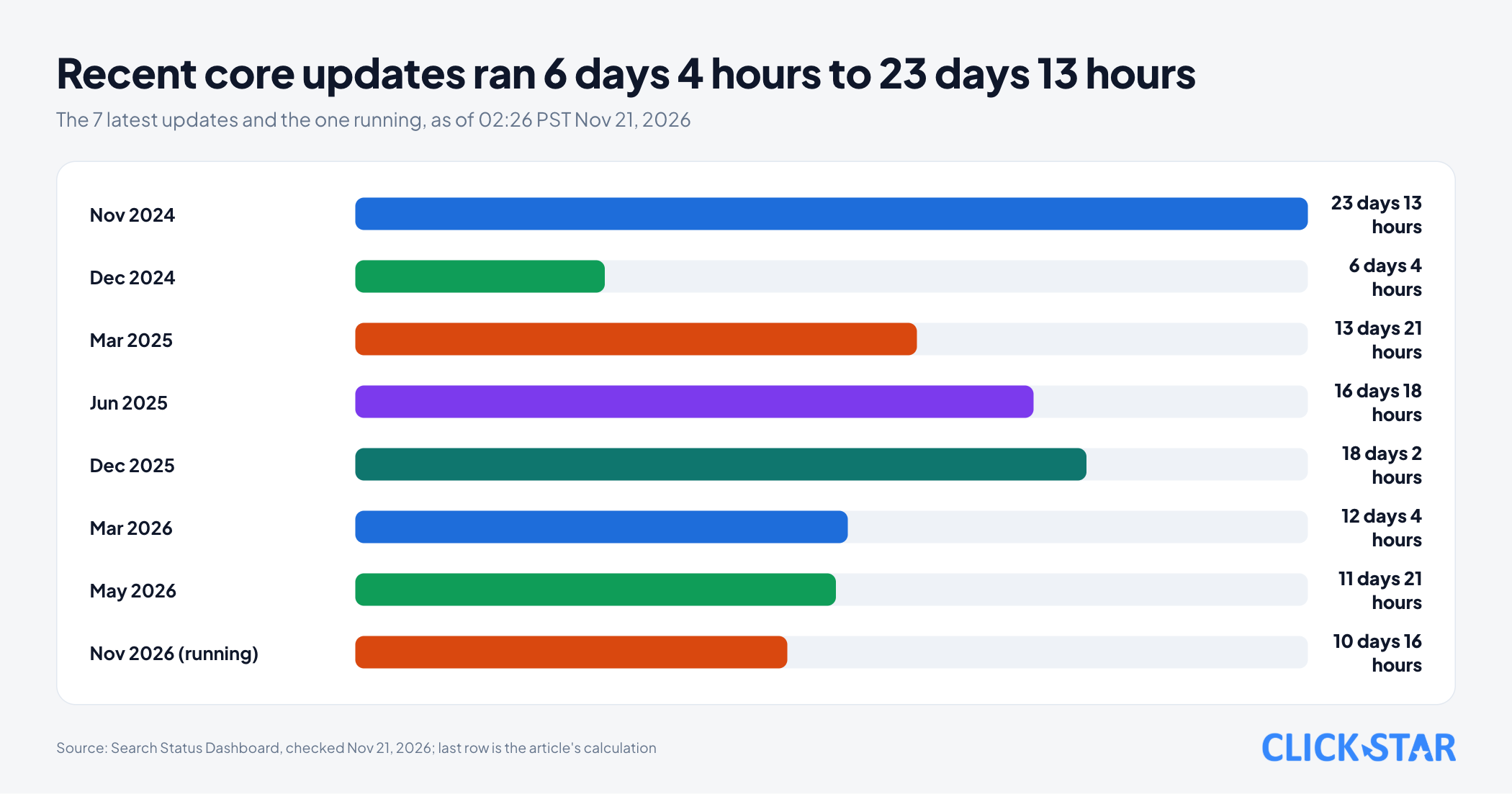
The article's inference: the 2-week window is an estimate and history varies widely, so do not fix an analysis date at November 24. The dashboard's completion note, as earlier updates received, is a more reliable signal. It offers RSS.
What third-party data says, and its limits
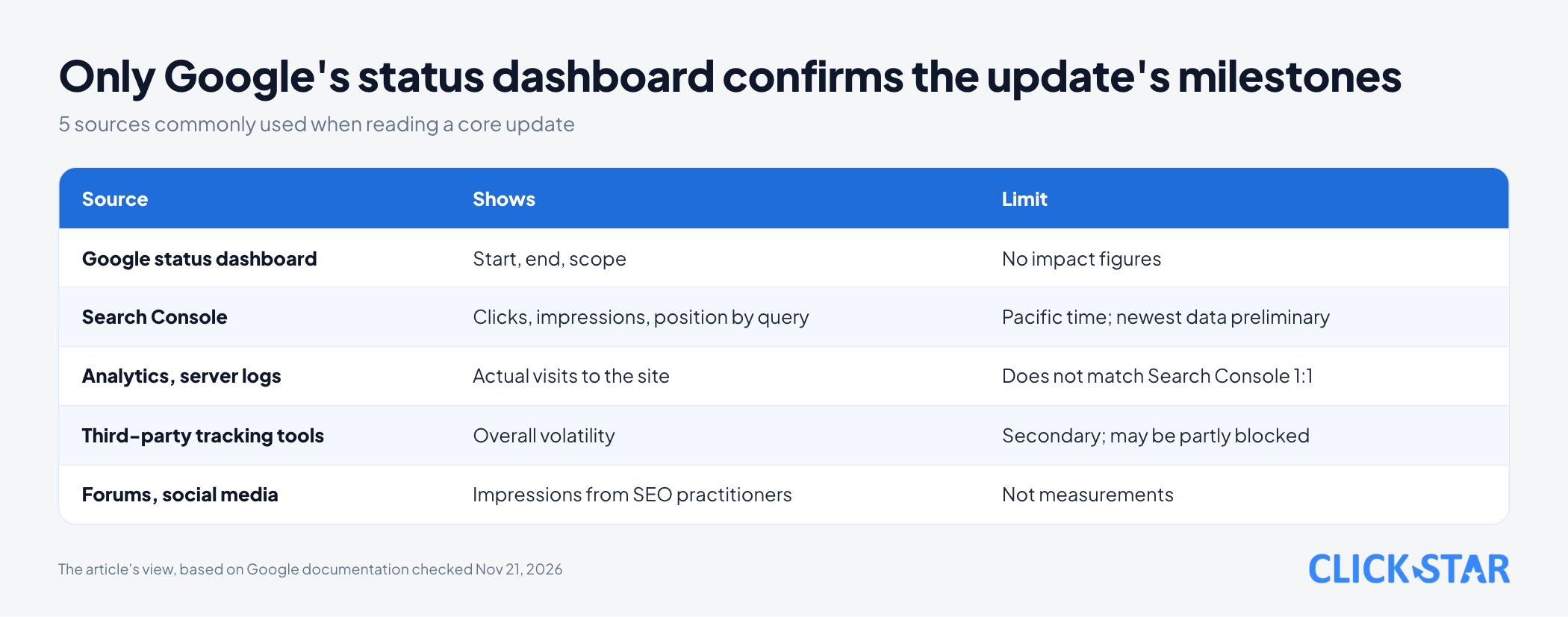
Keep 3 layers apart: what Google confirms, third-party measurement, and inference. This section is the second layer, read via Search Engine Roundtable (secondary source).
The post "Google November 2026 Core Update Ranking Flux - What We're Seeing" (November 16, 2026) says chatter about this update is quieter than usual. The author guesses third-party tracking tools are partly blocked. Combined, the tools showed more volatility on Saturday, November 14. That is the author's view.
The author also notes that replies on X included charts and data from before the update began.
The post "Google: We Do Not Roll Out Updates Prior To The Announcement" (August 19, 2026, secondary source) reports John Mueller of Google saying on LinkedIn that Google does not roll out before announcing.
The article's inference: per Mueller's words (via a secondary source), an official update does not start before its announcement, so a drop before November 10 is unlikely to come from it; Google still says small core updates happen without announcement.
Why wait before comparing numbers
Per Google's core update page, once the dashboard shows the update has finished, wait at least 1 full week before analyzing in Search Console, then compare that week with the 1 week just before the update began.
Illustrative example, not a forecast: if the dashboard shows completion on November 24, wait until after December 1, then compare the latest 7 days with November 3 to 9.
The Search Console Help page "Performance report (Search results): Dimensions and data groupings" (no date shown, read November 21, 2026) says report dates use Pacific time (except the 24-hour view). Vietnam is 15 hours ahead in November (the article's calculation: UTC+7 against UTC-8), so days may not match tools on local time.
The "Data anomalies in Search Console" page (no date shown, read November 21, 2026) lists known data errors. Its only November 2026 entry is a logging error that lowered impressions in the Generative AI performance report in Search, November 9 to 11.
Not on that page: the post "Google Search Console Performance Reports Showing Weird Spike In Clicks For Some Sites" (November 3, 2026, secondary source) says some sites saw clicks jump while impressions stayed flat. Those affected suspected bots or AI agents; the author had no reply from Google.
The article's inference: the week of November 3 to 9 sits close to days with reported anomalies, so check impressions too and compare with the same period last year.
How to read traffic step by step
Steps combining the core update page and "Debug Google Search Traffic Drops" (last updated December 10, 2025, read November 21, 2026):
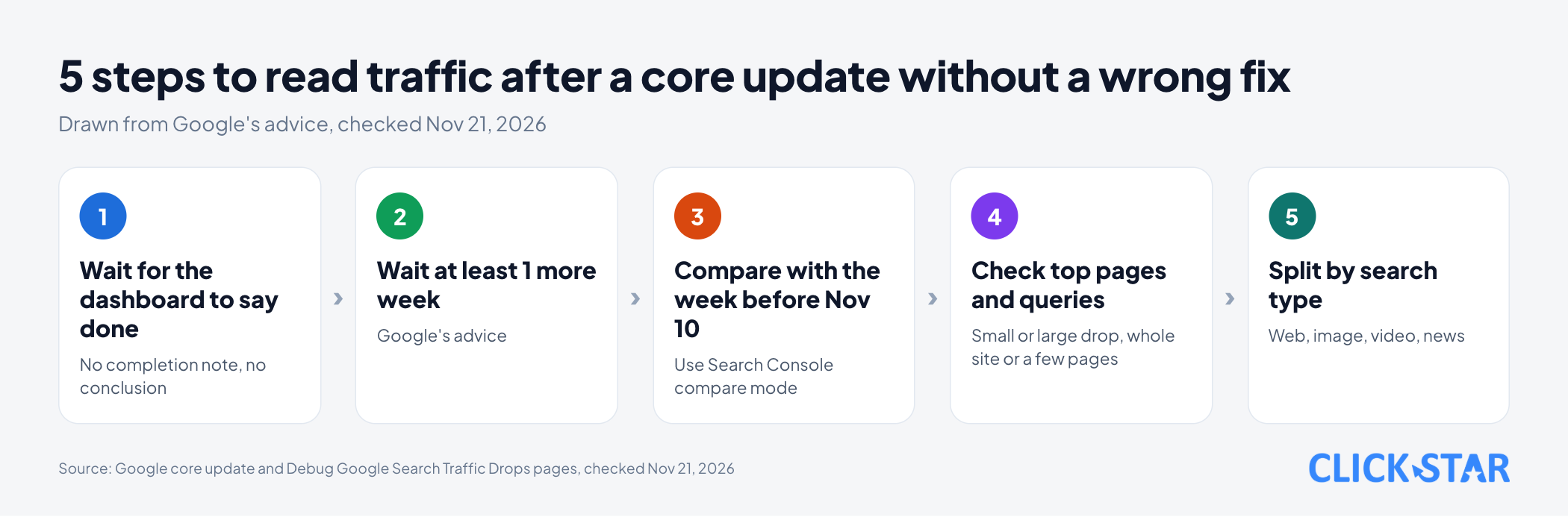
- Wait for the dashboard to report completion: no completion note, no conclusion yet.
- Wait at least 1 more week: Google's recommendation.
- Compare 1 week with the 1 week before November 10: use Search Console's compare mode.
- Check top pages and queries: small or large drop, whole site or a few pages.
- Split by search type: web, image, video, news.
Splitting branded queries and other data layers
A branded query is a search that includes the business name, a misspelling or its own product. Per the Search Central blog "Introducing the branded queries filter in Search Console" (November 20, 2025), these usually have a higher click-through rate, while non-branded queries show new people finding you. The filter classifies with AI, so it can be wrong.
The same post says the filter exists only for top-level properties (not URL-path or subdomain ones) and sites with enough impressions; its March 11, 2026 update opens it to all eligible sites.
On November 16, 2026 the Search Central blog said the Search Analytics API added 3 things: grouping by brandedClassification; type set to webMultimodal; and filterLists to filter by several countries or devices in 1 request.
webMultimodal returns data from Google Lens, Circle to Search on Android and image uploads in Google Search. brandedClassification works for eligible properties only; other properties return no rows.
Analytics and Search Console are not the same measurement. The page "Identify Google Search Traffic in Analytics and Logs" (updated November 12, 2026) says Search Console counts at the click, while Analytics records after the page loads and runs its tag; the Referer header can be blank due to private modes or blockers. Numbers often do not match 1:1.
Small or large drop: what Google advises
Per the core update page, a small drop (for example position 2 to 4) needs no drastic action, and Google advises against changing content that already performs well. For a large, lasting drop (for example 4 to 29), read the self-assessment: is the whole site helpful, reliable and people-first.
Avoid "quick fixes", such as removing a page element because you heard it hurts SEO; deleting content is a last resort. Changes can take days to months, sometimes until the next core update, and Google stresses there is no guarantee.
The "Debug Google Search Traffic Drops" page also lists causes to check: technical issues, security, spam policy violations or manual actions, seasonality, and site moves. The article's view: for technical or security faults, check right away without waiting for the update to end.
Changes on your own site also skew the numbers
The Search Central blog post "Moving to a CDN without overwhelming your origin (or blocking Googlebot)" (November 11, 2026) warns that when moving to a CDN, a network of servers near visitors, blanket bot protection without exempting verified bots can block Google's crawler, and pages can drop out of results.
The article's inference: this incident is not a core update but can make a traffic chart look like a core update drop; year-end promotions also move traffic, so log every change since November 3 in your comparison sheet.
What to watch
- This week, save the baseline: export Search Console data for November 3 to 9 (and the last 16 months), and note site and campaign changes since November 3.
- This week, set up tracking: subscribe to the dashboard RSS and check the Data anomalies page.
- This week, prepare the splits: filter by search type, by device, and by branded queries if your property is eligible.
- Around November 24: the 2-week mark. If it passes with no completion note, keep waiting; the history page shows 8 of 15 updates ran longer than 14 days.
- 7 days after the dashboard reports completion: only then compare the new week with the week before November 10, then decide whether to assess deeper.
Common mistakes
- Drawing conclusions before the update ends. The dashboard still shows Active, and Google advises waiting 1 more week after it finishes.
- Comparing today with yesterday, or weekdays with weekends and promotion weeks. Google advises comparing 1 week with 1 week; same-length ranges are the article's suggestion.
- Blaming every swing before November 10 on this update, even though a secondary report describes unusual clicks early in the month.
- Deleting content in bulk or "quick fixing" the moment a drop appears. Google's page treats deleting content as a last resort.
- Treating third-party tool numbers or forum comments as your own site's numbers, and treating Analytics and Search Console as the same measurement.
What is not known
It is not known when the dashboard will report completion, or which kinds of sites are affected. Google has published no impact figures or separate guidance beyond its general page. There are no figures for Vietnamese websites.
It is unclear what caused the November 14 volatility: that is only the secondary author's view. The cause of the early-month spike in clicks is unclear, and Google has not confirmed one.
The article did not open the LinkedIn post by John Mueller that Search Engine Roundtable quotes.
Related posts

Need tailored advice for your business?
Click Star helps you build a solution that fits your industry and scale. We answer every question during business hours.