Claude updates in October 2026: the 5.5 models, Dashboards, Fast mode and what to do
A summary of official Claude updates from September 22 to October 16, 2026: the three 5.5 models, API prices, Dashboards and Motion, Fast mode and Claude Code, with a checklist of what to do.
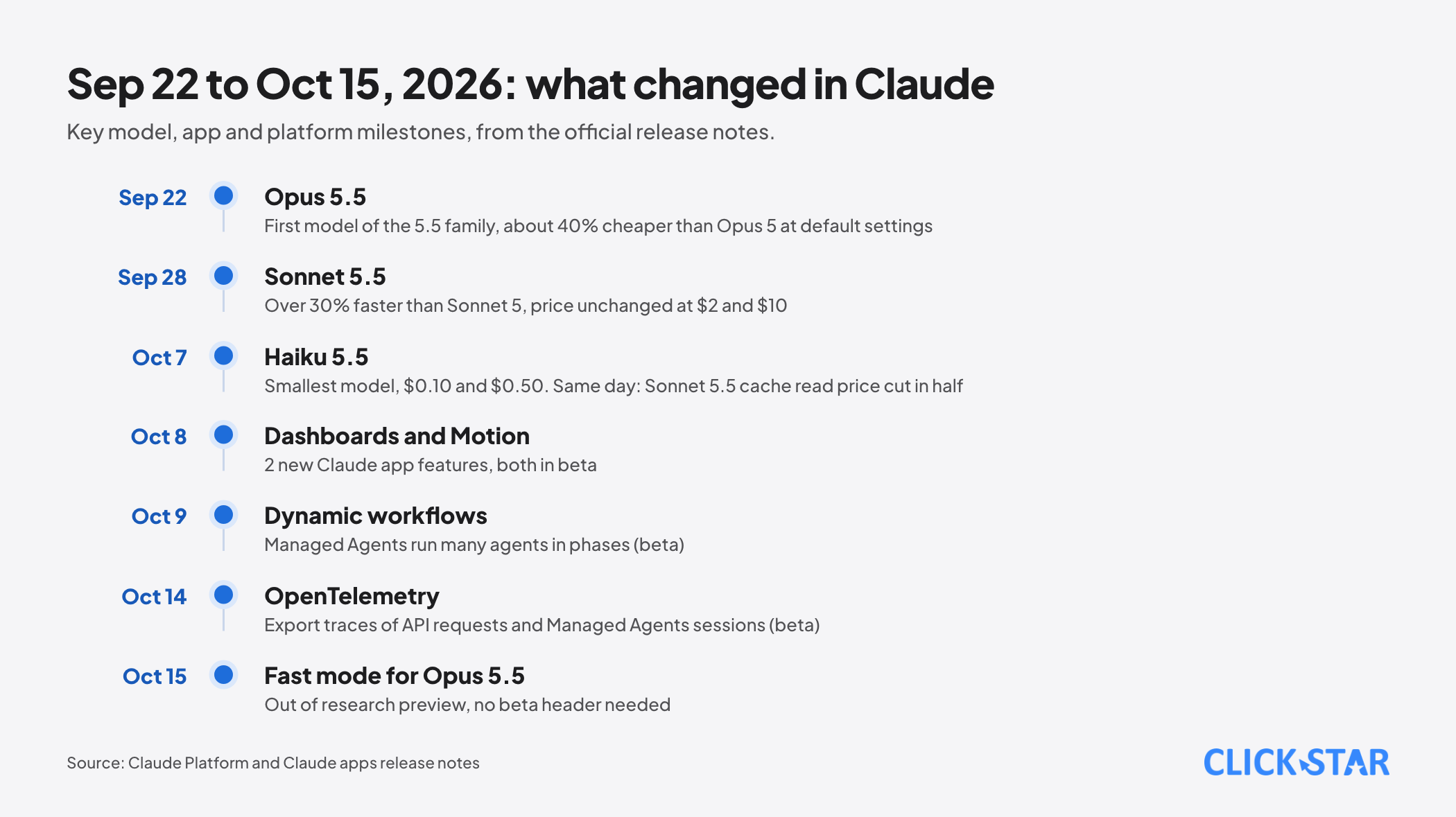
In under a month, Anthropic released all 3 models of the Claude 5.5 family and added features across the Claude app, the API platform and Claude Code. This article summarizes the changes officially announced between September 22 and October 16, 2026. It says which items are generally available, which are still in beta, and what a business should check before switching.
Key points
- 3 new models arrived in quick succession: Opus 5.5 (Sep 22), Sonnet 5.5 (Sep 28) and Haiku 5.5 (Oct 7).
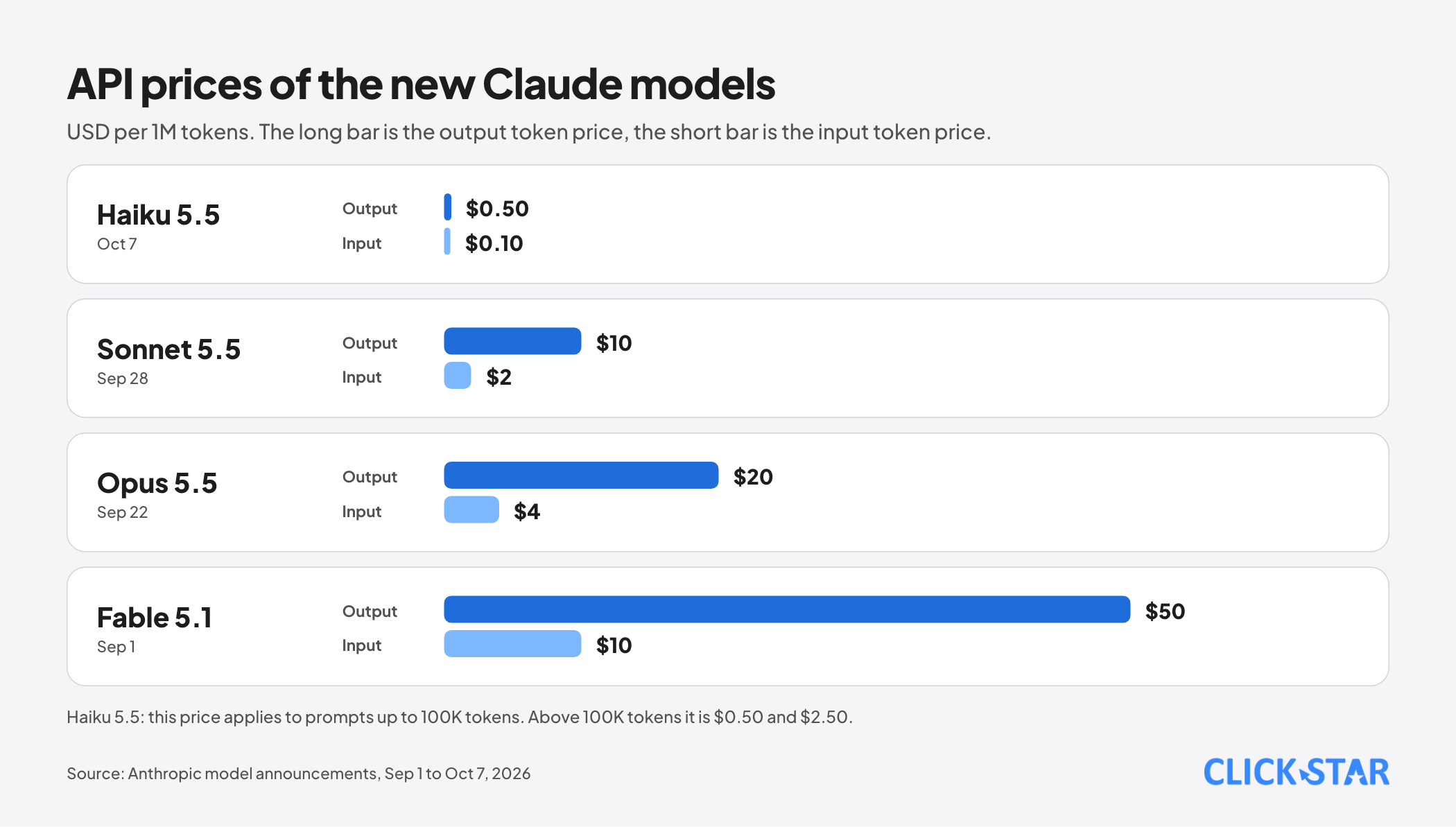
- API prices per 1M tokens: Opus 5.5 is $4 input and $20 output, Sonnet 5.5 is $2 and $10, Haiku 5.5 is $0.10 and $0.50.
- From October 7, the cache read price of Sonnet 5.5 dropped from $0.20 to $0.10 per 1M tokens.
- Fast mode for Opus 5.5 left research preview on October 15 and no longer needs a beta header.
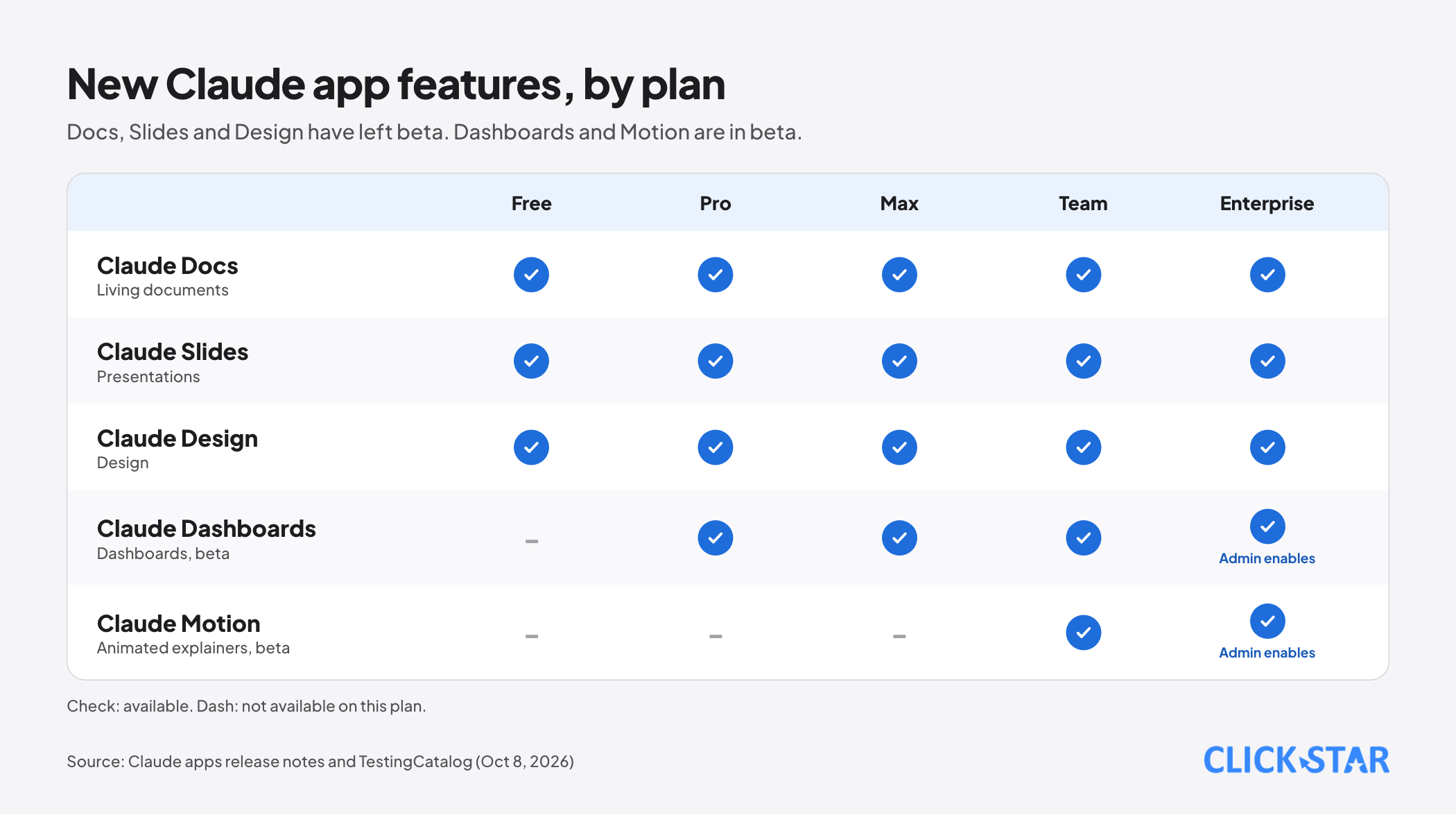
- In the Claude app, Docs, Slides and Design are on every plan. Dashboards is in beta on paid plans and Motion is in beta on Team and Enterprise.
- Act early: Claude Sonnet 4.5 will be retired on the API on November 30, 2026, and Anthropic recommends moving to Sonnet 5.5.
1. The Claude 5.5 family: 3 models in 3 weeks
Opus 5.5 (Sep 22). This is the first model of the 5.5 family. Anthropic says it performs about the level of Fable 5.1 on most work while costing about 40% less to run than Opus 5 at default settings, and its output is more than 30% faster than Opus 5. It has a 1M token context window, up to 128K output tokens, and thinking is always on and cannot be turned off.
Sonnet 5.5 (Sep 28). Anthropic describes it as a faster, lower-cost complement to Opus 5.5. Output is more than 30% faster than Sonnet 5, it typically uses fewer tokens for the same task, and in Anthropic's testing cost per task is up to 30% lower than Sonnet 5. The list price stays at $2 and $10.
It is also the first Sonnet model with dedicated safeguards for higher-risk cybersecurity tasks: those requests fall back to Sonnet 5, while routine bug fixing is not affected.
Haiku 5.5 (Oct 7). Anthropic calls it the cheapest, fastest and most capable small model it has released. It targets high-volume, cost-sensitive work such as summarization, context compaction, database queries and classification. It is also the first Haiku model with an adjustable effort setting from low to max.
Pricing is $0.10 input and $0.50 output for prompts up to 100K tokens, and $0.50 and $2.50 for longer prompts. It has a 1M token context window and up to 128K output tokens.
What numbers Anthropic published
The figures below are published by Anthropic in each model announcement. Each benchmark has its own effort setting, so check the original page for a detailed comparison.
- Opus 5.5: Terminal-Bench 4.0 at 66.4% (Fable 5.1 scores 55.8%, Opus 5 scores 52.3%). Humanity's Last Exam with tools at 67.7%. OSWorld 2.1 (partial) at 81.8%.
- Sonnet 5.5: Terminal-Bench 4.0 at 70.6% (Sonnet 5 scores only 10.3%). OSWorld 2.1 (partial) at 80.1%.
- Haiku 5.5: per the table in the Haiku announcement, OSWorld 2.1 (offline subset) is 72.4% against 83.9% for Sonnet 5.5, and Terminal-Bench 4.0 is 39.2% against 70.6% for Sonnet 5.5.
3 things to read alongside these numbers. First, in Anthropic's own table a competitor model still leads on a few tests, for example Terminal-Bench-Science (64.6% against 58.7% for Opus 5.5). Second, Anthropic itself notes that benchmark margins are a less reliable guide than real-world differences.
Third, Anthropic says Haiku 5.5 costs about 75% less than Haiku 4.5 on average, specifically 90% less for requests up to 100K tokens and 50% less for longer ones, after accounting for the new tokenizer and slightly higher token counts. Calculate against your own usage rather than relying on a single general figure.
2. Which model for which job
Anthropic positions the 3 models as follows, which is also a sensible way to split work when you start testing:
- Haiku 5.5: high-volume repeated work that needs fast, cheap responses: message classification, conversation summaries, extracting information from text, the first tier of customer support. Anthropic also notes Haiku 5.5 can act as a subagent next to Opus 5.5 and Sonnet 5.5.
- Sonnet 5.5: the balanced choice for internal assistants, content writing, multi-step automation and everyday coding.
- Opus 5.5: long, complex work with many unknowns at the start, such as analyzing many data sources, or reviewing and migrating large codebases. Anthropic says Opus 5.5 remains stronger than Sonnet 5.5 on open-ended, complex work.
To see the cost gap, take an illustrative example calculated from list prices: a block of work that uses 10 million input tokens and 2 million output tokens, before caching or batch discounts.
- Opus 5.5: 10 x 4 + 2 x 20 = $80.
- Sonnet 5.5: 10 x 2 + 2 x 10 = $40.
- Haiku 5.5 (prompts under 100K tokens): 10 x 0.10 + 2 x 0.50 = $2.
This is unit-price arithmetic, not a measured result. Each model line uses a different tokenizer, so the token count for the same job is not equal. A more reliable approach is to run the same set of real samples from your business on 2 or 3 models, then compare cost and quality per completed task.
3. Cost and speed: 3 changes worth noting
Sonnet 5.5 cache read price cut in half (Oct 7). From $0.20 to $0.10 per 1M tokens, with other prices unchanged. Anthropic says this cuts cost by about 20% on most agentic tasks. If your system resends the same long context many times, turning on prompt caching pays off clearly.
Fast mode for Opus 5.5 leaves research preview (Oct 15). It gives up to 2.5x speed at $8 input and $40 output per 1M tokens. Since October 15 no beta header is needed. Fast mode for Opus 5 and Opus 4.8 is still a research preview and still needs the header.
Monthly API credits for Max and Team plans (Oct 7). Max 5x gets $100 per month, Max 20x gets $200, and Team gets up to $500 pooled across the team, usable on any model. Max users claim them in Settings > Billing, and Team admins claim them in Organization settings > Billing by linking a Claude Console organization.
4. In the Claude app: documents, dashboards and explainer videos
Cowork merged into every conversation (Sep 16). Users no longer pick a mode first. You can ask a quick question or hand over a larger task such as a report, spreadsheet or presentation in the same conversation. Chats, Cowork tasks, projects, connectors and skills carry over.
Docs, Slides and Design on every plan. From September 16, users create and edit designs (Claude Design), presentations (Claude Slides) and living documents (Claude Docs) in any conversation, including in Claude Code and the Artifacts tab. As reported on October 8, these three have left beta and are on every plan including Free.
For Enterprise they are on by default from October 15. The standalone Claude Design site will close on December 14, 2026, and chats, comments and public project links from the standalone version will not be kept.
Claude Dashboards (beta, Oct 8). You ask in plain language, and Claude builds a dashboard from your data and keeps it updated as the source data changes. Data sources include Redshift, BigQuery, ClickHouse, Databricks and Snowflake, plus connectors such as Salesforce.
Each chart shows its refresh time and lets you open the query behind it. It is for paid plans (Pro, Max, Team, Enterprise). Export to BI tools such as Looker, monday.com and Tableau is listed as coming soon.
Claude Motion (beta, Oct 8). It turns reports, charts or product walkthroughs into short animated explainers. Claude writes code for text, shapes, charts and timing and does not use a video model, so every word, number and timing can be edited, then exported as MP4. Motion is available on Team and Enterprise only.
On Enterprise, admins must switch Dashboards and Motion on under Organization settings > Artifacts because both are off by default.
2 smaller updates in the same period: Salesforce in Claude (beta, Sep 15) brings account, opportunity and pipeline data into Claude with 37 prebuilt sales skills, and the plugin developer portal (Sep 25) lets developers submit plugins to the Claude directory for review and see usage analytics.
5. For technical teams: the API platform and Claude Code
API platform:
- Dynamic workflows for Managed Agents (beta, Oct 9): an agent can write a program that runs many agents in phases and combines the results.
- OpenTelemetry export (beta, Oct 14): trace Messages API requests and Managed Agents sessions in your existing observability backend. The SDKs emit spans in 7 languages.
- SDK classes for computer use and browser use (beta, Oct 7): the Python and TypeScript SDKs run these tools against your own automation.
- On-demand compaction (beta, Sep 14): the compaction parameter summarizes earlier messages into a signed block that later requests can reuse.
- Cache diagnostics (generally available, Sep 23): no beta header needed, add the diagnostics object to a request to turn it on.
Claude Code (versions 2.1.293 to 2.1.302):
- Haiku 5.5 becomes the default Haiku model.
- Idle compaction: a conversation over 200K tokens that has been idle for about 54 minutes is compacted before the one-hour prompt cache expires. Turn it off with
"idleCompaction": falsein settings.json. - The
CLAUDE_CODE_AUTO_MODE_MODELenvironment variable selects the model for the client-side auto mode classifier. - Hooks support
onFailure: "block": if a hook cannot start, times out or exits unexpectedly, the action is blocked. - The
/advisorcommand on Claude Platform on AWS, and new interface APIs for mods such as notifications, buttons and multi-line inputs.
6. Changes that can break a system already running
- Sonnet 4.5 will be retired on the Claude API on November 30, 2026. Anthropic announced this on September 30 and recommends Sonnet 5.5 as the replacement.
- Opus 5.5 cannot turn thinking off. The
anyandtooltool choices return errors. - Haiku 5.5 returns a 400 error if a request uses manual thinking budgets, sampling parameters, prefill or some ways of replaying thinking blocks. Thinking text only appears when
thinking.displayis set to"summarized". - Sonnet 5.5: if you run Sonnet with thinking off, you must switch to the
between_toolssetting. Thinking blocks only work in the account that produced them or a linked account.
If you use Claude through the API, read the migration guide for each model before changing model names in your configuration.
7. What to do this week
- List where you use Claude: which model, through the API or the app, and which tasks take the most cost.
- Move off Sonnet 4.5 before November 30, 2026. Test Sonnet 5.5 on a set of your real samples.
- Try Haiku 5.5 for repeated work such as classification, summarization and extraction. Compare cost per task, not just price per token.
- Turn on prompt caching if you resend the same long context many times, because the cache read price of Sonnet 5.5 just dropped.
- If you are on Max or Team, claim the monthly API credits in the billing section.
- Data analysis teams: try Dashboards on a small data source and check the query behind each chart before using it for official reports.
- Enterprise admins: decide whether to switch Dashboards and Motion on, since they are off by default.
Related posts


Need tailored advice for your business?
Click Star helps you build a solution that fits your industry and scale. We answer every question during business hours.