Where Claude Fable 5.2 beats Opus 5.5, and what double the price means
This article reads Anthropic's official pages and the independent Artificial Analysis evaluation to see where Fable 5.2 beats Opus 5.5 and what double the price means per task. It also covers changes that can break a running system.
A team of 5 runs a coding assistant on Claude Opus 5.5. This morning the model picker shows Fable 5.2 at double Opus's list price, and the question is whether to switch. This is an illustrative scenario, not a measurement.
This article reads Anthropic's official pages (the November 9, 2026 announcement, docs, pricing, help center) and Artificial Analysis's independent evaluation, checked on November 18, 2026. The article's timeline runs from October 6 to November 30, 2026, centered on the November 9 launch.
It answers 3 questions: where Fable 5.2 beats Opus 5.5 by the vendor's numbers and by independent evaluation, what double the price means per task, and which changes can break a running system. It does not advise buying or switching.
Key points
- Fable 5.2 and Mythos 5.2 launched on November 9, 2026 on the same underlying model. Fable is open to all API customers; Mythos needs Anthropic's verification, and 2 official pages disagree on whether individuals can get it.
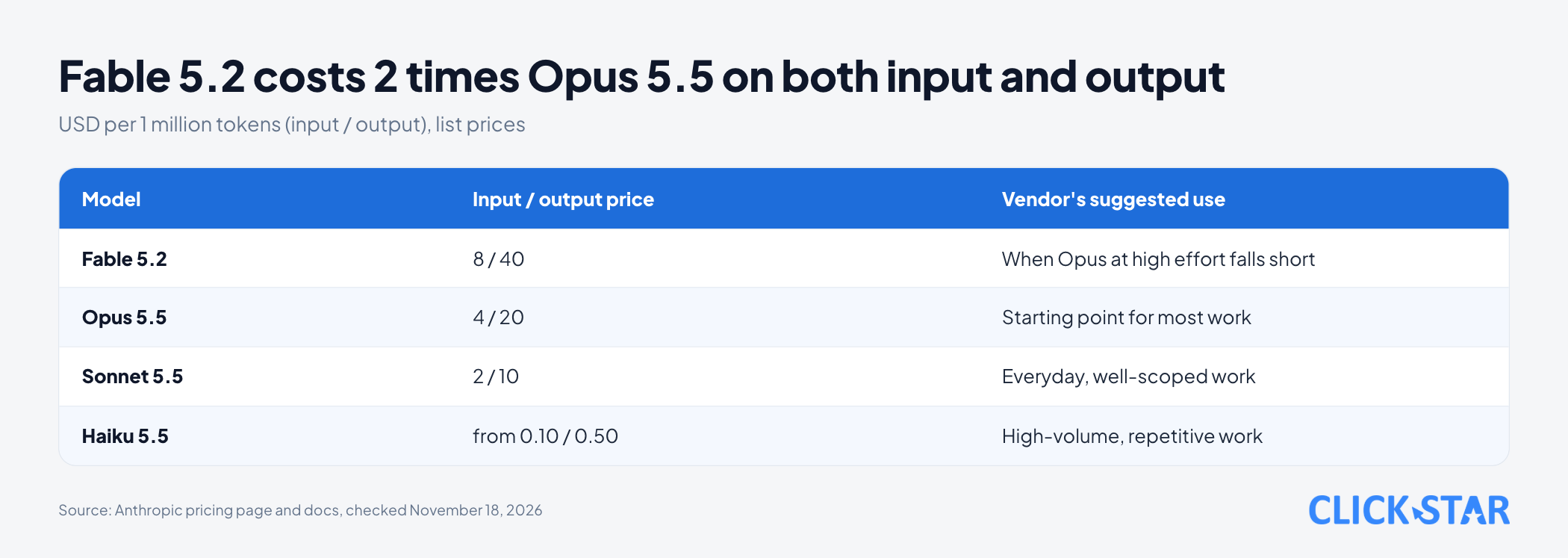
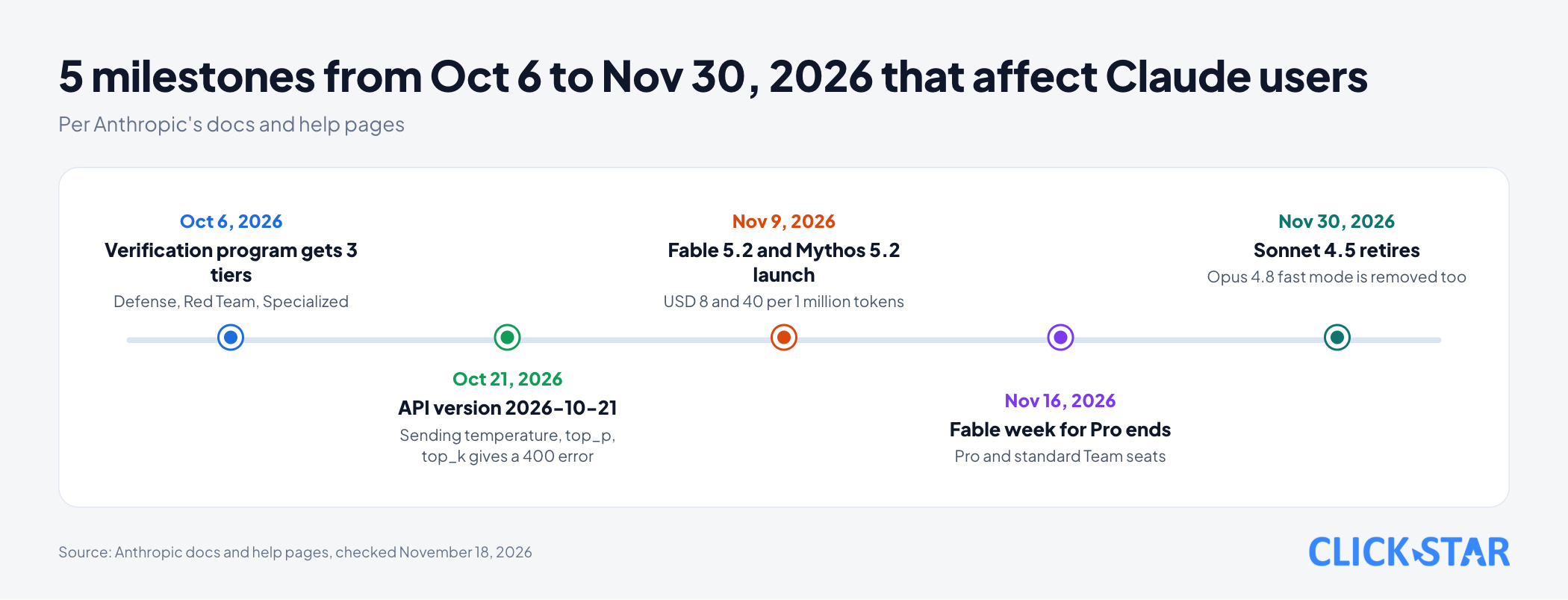
- Fable 5.2 lists at USD 8 input and USD 40 output per 1 million tokens, 2 times Opus 5.5 (USD 4 and 20) and below Fable 5.1 (USD 10 and 50).
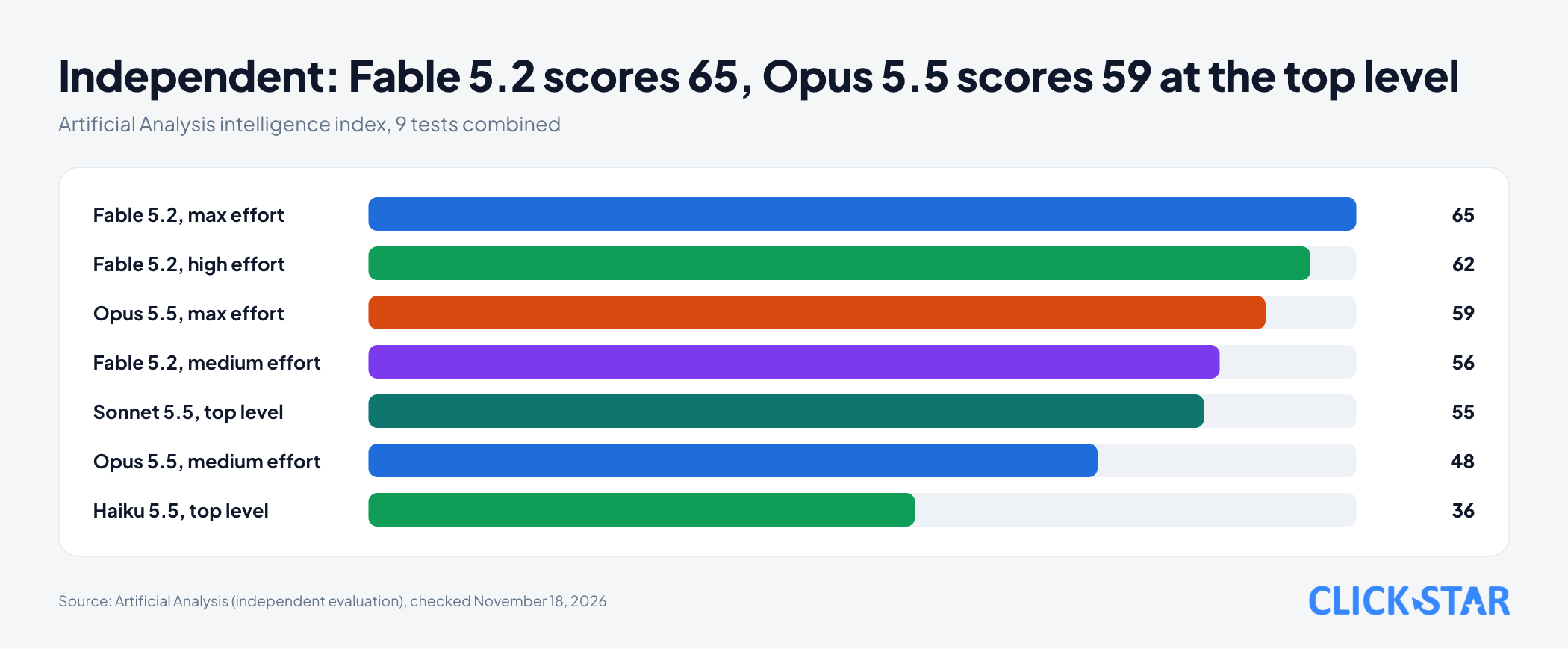
- Per Artificial Analysis (independent), at the highest effort (effort is how long Claude may think) Fable 5.2 scores 65 and Opus 5.5 scores 59; each task in the test suite costs USD 26.54 against USD 10.04.
- Anthropic's table (vendor-published) has Fable 5.2 ahead of Opus 5.5 on most tests, some by a wide margin; but on AutomationBench, Gemini 4 Carbon (a rival in the table) scores 53.9% against 51.4%.
- Versus Fable 5.1, Fable 5.2 has 4 changes that can cause a 400 error or lose reasoning context. Turning thinking off and forcing tool calls are not changes if you run Opus 5.5, Fable 5.1 or Mythos 5.1.
- On November 30, 2026, Sonnet 4.5 will retire on Anthropic's API and Opus 4.8 fast mode will be removed.
What is new in Fable 5.2 and Mythos 5.2
Fable (the premium model line open to all users) and Mythos are the same underlying model, per the November 9, 2026 announcement. Fable has strong cybersecurity and biology blocks. Mythos drops some of those blocks and is for parties verified in cybersecurity or life sciences.
Anthropic says 5.2 generates text up to 30% faster than 5.1 and costs less than Fable 5.1 (pricing page, November 18, 2026).
What Anthropic reports, and the limits of those numbers
These numbers are published by the vendor, by default at each model's highest effort (scale: low, medium, high, xhigh, max) unless noted: Fable 5.2's FrontierCode is at xhigh, RLI at High.
The rivals are GPT-6 Astra and Gemini 4 Carbon (the article infers OpenAI and Google; the page names no company). That is Anthropic's comparison, and configurations may differ.
- FrontierCode 2.0 (whether AI-written code would be accepted by maintainers): Fable 5.2 scores 49.1% at xhigh, Opus 5.5 scores 45.5%, GPT-6 Astra scores 42.8%.
- AutomationBench (business workflows): Fable 5.2 scores 51.4%, Opus 5.5 scores 42.5%, Gemini 4 Carbon scores 53.9%.
- Remote Labor Index (remote work tasks): 41.3% at High against 21.3% for Opus 5.5.
A test name in different versions cannot be compared: the Opus 5.5 announcement of September 22, 2026 used FrontierCode v1.1, while the new table uses version 2.0. OpenAI now lists GPT-6.2 Astra as its flagship (Models page of OpenAI's API docs, read November 18, 2026); Anthropic's table uses GPT-6 Astra.
On cost, the vendor says that on FrontierCode 2.0, Fable 5.2 at High matches Opus 5.5's top score (45.3% against 45.5%) at about 50% of the cost per task. The vendor also cites about 40% of the cost at Medium (WANDR) and under 1/10 at Low (HLE).
What the independent evaluation shows
Artificial Analysis ranks Fable 5.2 first of 91 models on its 9-test intelligence index when read (November 18, 2026). Fable 5.2 scores 65 at max, 62 at xhigh, 62 at high, 56 at medium and 54 at low. Opus 5.5 scores 59, 57, 52, 48 and 35 at the same levels.
The same site gives Sonnet 5.5 55 and Haiku 5.5 36 at their highest level (each model's page, read November 18, 2026). The article's inference: Fable 5.2 at high (62 points, 14.6 minutes per task) scores higher and runs faster than Opus 5.5 at max (59 points, 24.6 minutes).
The page gives no per-task cost for each effort level, so the article draws no conclusion on money. At max, Fable 5.2 takes USD 26.54 and 40.8 minutes per task, Opus 5.5 USD 10.04 and 24.6 minutes.
Limits: a general suite, not your work; the page does not explain the "Default Fallback" configuration.
What double the price means per task
Fable 5.2's list price is exactly 2 times Opus 5.5 on both input and output (the article's division from the pricing page, read November 18, 2026).
Real cost depends on tokens per task, not only price per token. The vendor says Fable 5.2 at lower effort can match Opus 5.5's top score at a lower cost per task on some tests, while Artificial Analysis shows that at max it costs more than 2.6 times Opus 5.5 (26.54 divided by 10.04, the article's division).
API defaults differ: Opus 5.5 is medium, Fable 5.2 is high (Choosing the right model page, read November 18, 2026), so comparing defaults compares 2 effort levels.
Mythos 5.2 and being blocked
Fable 5.2 has classifiers that block high-risk cyber work and most biology research. When blocked, the answer comes from Opus 4.8 (cyber) or Opus 5 (biology). The vendor says early testing shows about 55% fewer blocks than Fable 5.1.
The Cyber Verification Program has had 3 tiers since October 6, 2026 (Defense, Red Team, Specialized). Per the Cyber Verification Program page of the Claude Help Center (updated October 6, 2026, read November 18, 2026), Red Team allows up to 75 users and Specialized up to 25.
30-day data retention and plans
Fable 5.2 and Mythos 5.2 are Covered Models (models with extra safeguards). The Covered Models page (undated, read November 18, 2026) says prompts and outputs are kept at least 30 days, then deleted. ZDR (zero data retention) is unavailable, except temporarily for eligible customers.
In the Claude apps, the page Claude Fable models on your plan (undated) says Max, Ultra and Team premium seats include Fable, up to 50% of weekly limits. Pro and standard Team seats use usage credits.
Per the Claude Fable 5.2 launch offers page (read November 18, 2026), the November 9 to 16, 2026 launch week for Pro has ended.
Which model for which job
This section is the article's inference: criteria, not a ranking. Anthropic advises starting with Opus 5.5, then moving up to Fable or down to Sonnet 5.5 or Haiku 5.5 by scope and difficulty. The docs say tuning effort is often more effective than switching models.
- Haiku 5.5: from USD 0.10 input and 0.50 output. The vendor describes it for high-volume, repetitive, cost-sensitive work.
- Sonnet 5.5: USD 2 and 10. The vendor says it suits everyday, well-scoped work.
- Opus 5.5: USD 4 and 20, the vendor's starting point for most coding and knowledge work.
- Fable 5.2: USD 8 and 40. The docs say move to it when Opus at higher effort still falls short (the model-choice page says xhigh or max).
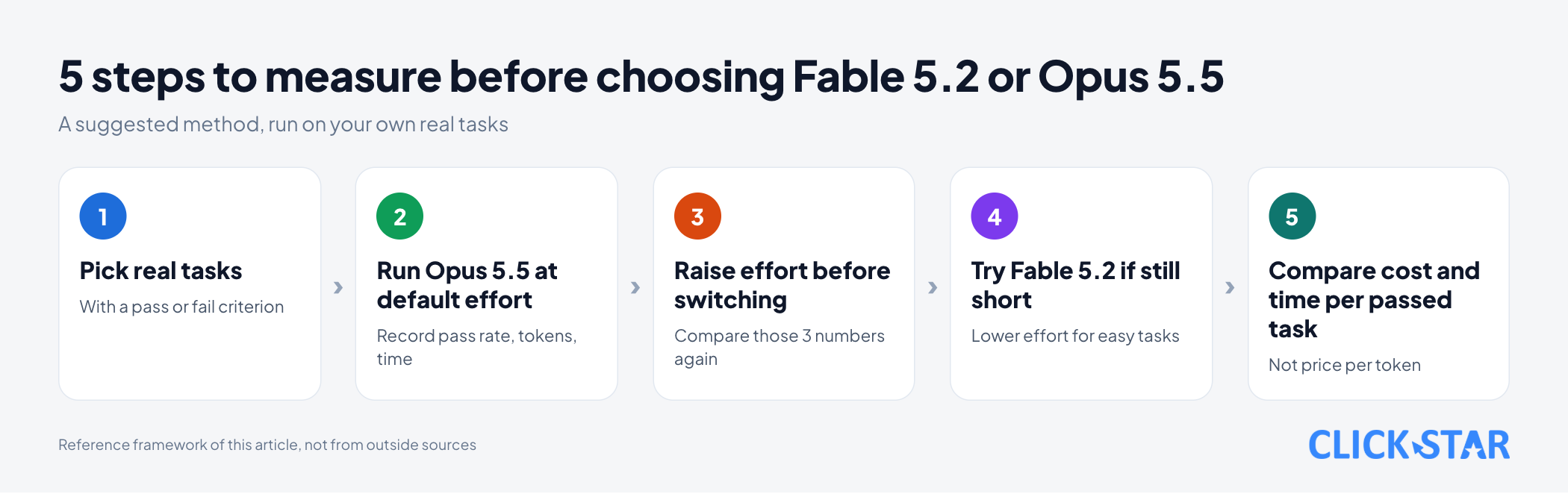
A suggested way to measure (the article's framework, not from outside sources) has 5 steps: pick real tasks with a pass or fail criterion; run Opus 5.5 at default effort, recording pass rate, tokens and time; raise effort before switching models; try Fable 5.2 if still short, lowering effort for easy tasks; compare cost and time per passed task, not price per token.
Changes that can break a running system
On the prefix check, if Claude Code, claude.ai, Managed Agents or the Agent SDK builds your requests, the docs say nothing changes. If you write your own API code, check these 7 points before switching to claude-fable-5-2 (What's new in Claude Fable 5.2, read November 18, 2026). The first 4 are changes from Fable 5.1.
- Prefix check: editing the system prompt, tools or earlier messages, then resending thinking blocks (the reasoning the API returns), returns a 400 error.
drop_block(beta) is a stopgap. - Switching models mid-conversation: only Fable 5.2 and Mythos 5.2 read Fable 5.2's thinking blocks; moving to another model, Opus 5.5 included, loses that reasoning.
- Old computer tool:
computer_20251124returns a 400 error except on Amazon Bedrock; usecomputer_toolset_20260801. - Advisor tool (beta): a Fable 5.2 executor accepts only Fable 5.2 or Mythos 5.2 as advisor.
- Turning thinking off:
thinking: {"type": "disabled"}andbudget_tokensreturn a 400 error; tune witheffort. Not a change if you come from Opus 5.5, Fable 5.1 or Mythos 5.1; from Opus 5 or earlier it is. - Forced tool calls:
tool_choiceof typeanyortoolreturns a 400 error; useautowithstrict: true. Same starting points as above, but from Fable 5 or Mythos 5 it is still a change. - 30-day retention (from Opus 5.5): if you run Opus 5.5 under ZDR, enable 30-day retention or contact Anthropic before switching, or every request to Fable 5.2 returns a 400 error. Fable 5.2's rate limit is separate and lower than Opus 5.5's at each tier.
The deprecations table (read November 18, 2026) lists Sonnet 4.5 retiring on November 30, 2026, replaced by claude-sonnet-5-5. Release notes of October 30, 2026 say Opus 4.8 fast mode will be removed on November 30, 2026.
Per the Migrating to API version 2026-10-21 page (read November 18, 2026), from API version 2026-10-21 (release notes of October 21, 2026) sending temperature, top_p or top_k returns a 400 error, even at default values.
Where the sources do not match
- Default effort: the announcement says Medium is the default in Claude apps and Claude Code; the API docs say high for Fable 5.2.
- Mythos 5.2: the Help Center page above lets individuals (such as independent researchers) apply for Defense Access and says every tier includes Mythos 5.2 and 5.1 (its opening note says from 5.1); the API docs say only verified organizations.
What to watch
- This week, run a measurement: run a real task set on Opus 5.5 and Fable 5.2 at the same effort, then another; record pass rate, tokens, time and cost per passed task.
- This week, scan your code: search for
claude-sonnet-4-5-20250929,temperature, disabledthinking, forcedtool_choiceandcomputer_20251124. - November 30, 2026: Sonnet 4.5 retires and Opus 4.8 fast mode is removed as scheduled.
- Keep watching: wide availability of EFS (safety monitoring with data kept in the customer's infrastructure), other independent evaluations of Fable 5.2.
Common mistakes
- Reading "double the price" as "double the cost per task". Cost also depends on effort and token counts.
- Treating the vendor's benchmark scores as independent fact, or comparing scores across different versions of a test.
- Changing the model name in code without checking the changes that cause 400 errors.
- Using Fable for everything instead of lowering effort for easy work.
- Thinking Mythos is a stronger version anyone can buy. Per the API docs it has Fable 5.2's capabilities and requires going through a verification program.
What is not known
The article did not read the Fable 5.2 system card, so test methods are unchecked. The article found no second independent evaluation besides Artificial Analysis.
There is no Artificial Analysis cost per task below max effort, and no date for wide EFS availability. The article's inferences are untested on readers' data.
Related posts


Need tailored advice for your business?
Click Star helps you build a solution that fits your industry and scale. We answer every question during business hours.