What is a CRM? When small and medium businesses should start using one
CRM is both a strategy and software for managing customer relationships; this article explains the 5 core kinds of data, the context of small and medium businesses in Vietnam, 3 starting levels and a minimum setup usable in 14 days.
Owners of small businesses often hear 2 opposite pieces of advice about CRM: "start as early as possible" and "you don't need it yet, a spreadsheet is enough." Both are right at some stage. The more useful question is what a CRM really is, and what signs say it is time to start, and at what level.
This article explains what a CRM is (a strategy and a piece of software), what kinds of data it holds, the context of small and medium-sized businesses in Vietnam, the starting levels from a spreadsheet to free and paid CRMs, and a minimum setup you can use in 14 days.
Sources include documentation from Microsoft, Salesforce, HubSpot, Pipedrive, Zoho and Bitrix24, and figures from VCCI and the General Statistics Office, read on October 21, 2026.
Click Star already has an article on whether a CRM really matters to a business (8 signs you need one, 8 selection criteria, a 90-day plan) and one on CRM and CDP. This one fills the missing part: the concept from scratch and how to start small for a business with no CRM yet.
Key points
- CRM has 2 meanings: a strategy for managing customer relationships, and the software that carries it out (according to Microsoft). Buying software does not create a strategy.
- The core data in a CRM comes in 5 kinds of objects: contacts, companies, deals, tickets and activities (calls, notes, meetings, emails, messages).
- About 98% of active enterprises in Vietnam are small and medium-sized (VCCI, February 28, 2025, quoting the Ministry of Planning and Investment). Click Star found no reliable figure for the share of small and medium businesses using a CRM.
- No survey with a documented method shows a threshold of "how many customers before a spreadsheet stops being enough." The starting levels in this article are Click Star's judgment, and you should choose by the problem you face, not by general figures.
- You can start free: HubSpot (2 users, 1,000 contacts), Zoho (3 users), Bitrix24 (1 to 2 users). Limits can change, so check the official pages.
- The minimum setup: 1 pipeline, stages named after observable milestones, 4 required fields (owner, source, next step, consent to be contacted) and one review session a week.
What a CRM is: a strategy and software
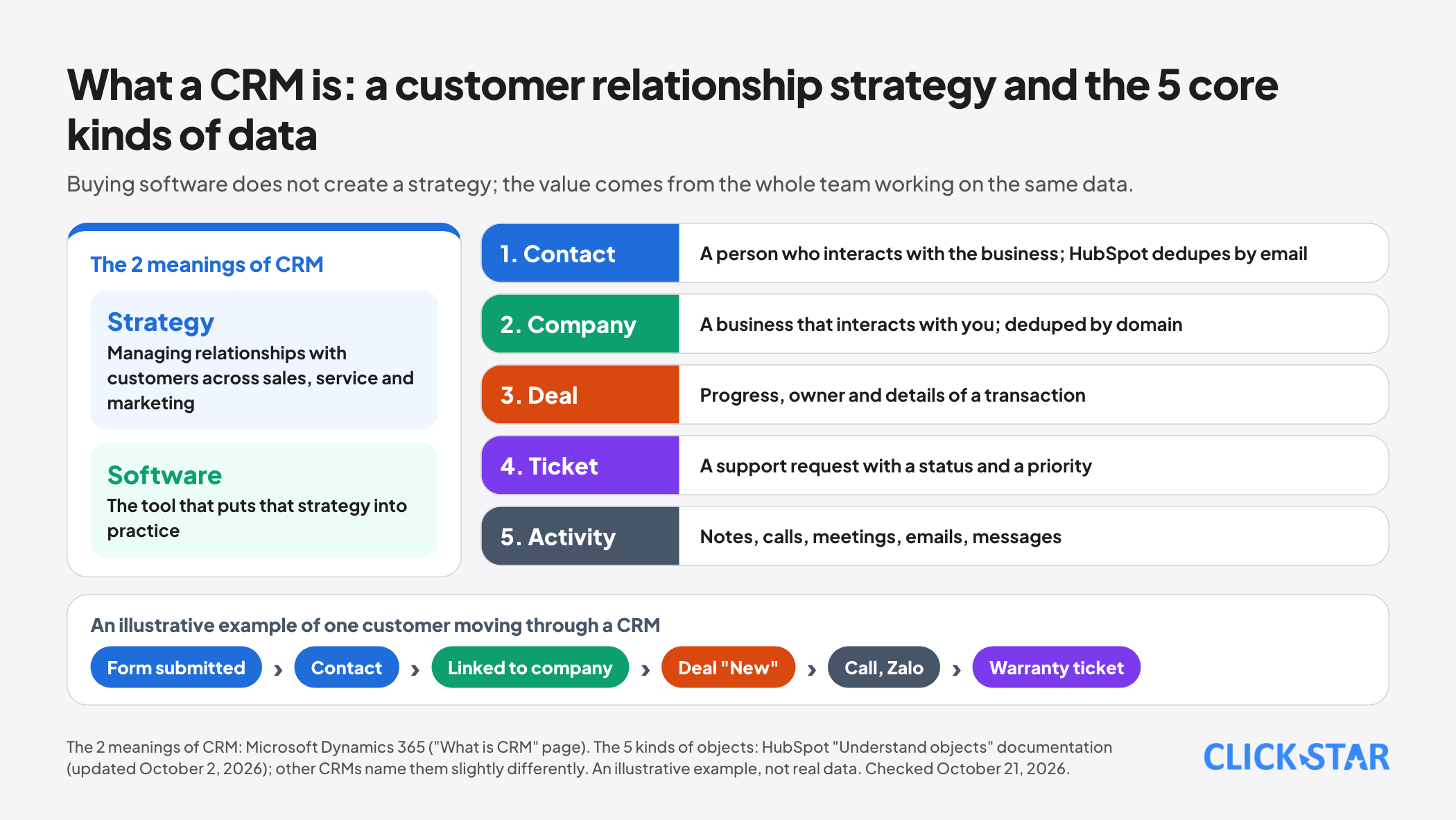
According to Microsoft's explainer, CRM (Customer Relationship Management) has 2 meanings. The first is a strategy for managing relationships with customers across sales, service and marketing. The second is the software that puts that strategy into practice.
HubSpot describes CRM as a system for managing customer relationships that tracks prospects and customer activity. Salesforce describes it as a system that unifies a company's data about customers, with functions for contact management, sales pipeline tracking, service, marketing and reporting. These are vendor descriptions and should be read as product introductions.
An academic study (Reimann, Schilke and Thomas, Journal of the Academy of Marketing Science, 2010) surveyed many industries and found no direct effect of CRM on business results. The effect runs through the business differentiating itself and controlling costs better. Click Star could read only a summary of the study, but it fits something easy to see: a CRM is a tool, and the value comes from how people work.
The 5 core kinds of data in a CRM
HubSpot's documentation (updated October 2, 2026) calls the groups of data "objects." Other CRMs name them a little differently, but these 5 groups appear almost everywhere.
- Contact: any person who interacts with the business. HubSpot deduplicates contacts by email.
- Company: a business that interacts with you. HubSpot deduplicates by domain.
- Deal: tracks the progress, owner and details of a transaction.
- Ticket: a support request with a status and a priority.
- Activity: notes, calls, meetings, emails and messages, logged on the records above.
An illustrative example: a customer who submits a form on the website becomes a contact, is linked to the customer's company, opens a deal at the "New" stage, each call and Zalo message is an activity, and if warranty service is needed after the purchase there is also a ticket. The whole chain is kept in one place, visible to everyone on the team.
Small and medium businesses in Vietnam: many, but little measurement
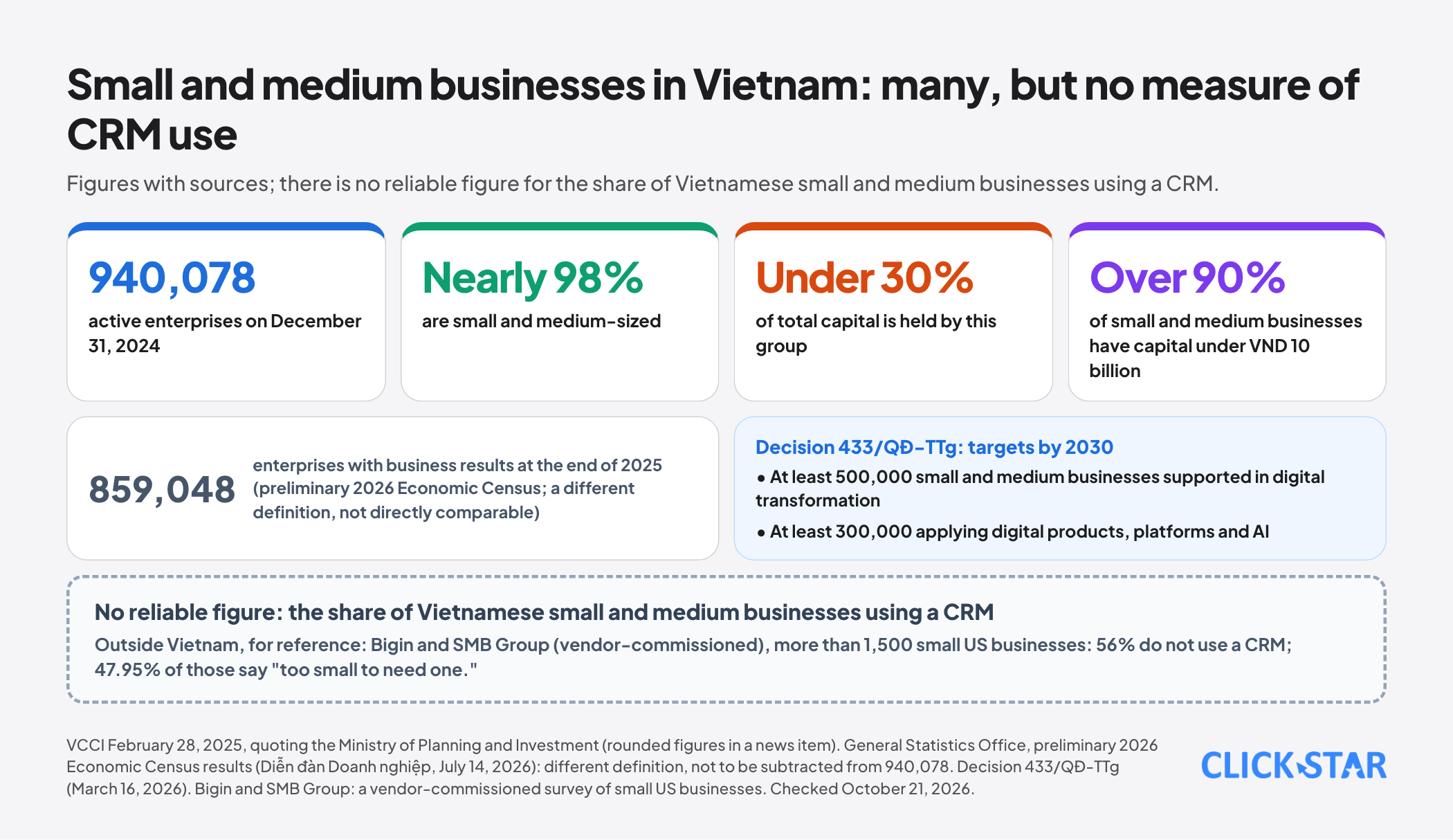
According to VCCI (February 28, 2025), quoting figures from the Ministry of Planning and Investment, Vietnam had about 940,078 active enterprises on December 31, 2024, up about 2%, of which nearly 98% are small and medium-sized. This group holds under 30% of total capital, and over 90% have capital under VND 10 billion. This is a rounded figure in a news item, not an original statistical table.
According to the General Statistics Office (Ministry of Finance), preliminary results of the 2026 Economic Census recorded 859,048 enterprises with business results at the end of 2025, up 2.4% on 2024, averaging 20.5 workers per enterprise. The figures 940,078 and 859,048 use different definitions and sources, so they cannot be subtracted or read as a fall in businesses.
On policy, Decision 433/QĐ-TTg (signed March 16, 2026) approved a digital transformation scheme for small and medium enterprises for 2026 to 2030, with targets by 2030 of at least 500,000 businesses supported and at least 300,000 applying digital products, digital platforms and AI.
What Click Star did not find is the share of Vietnamese small and medium businesses using a CRM. Some circulating tables state "87% of small and medium businesses use a cloud CRM" but give no year or sample size and look like global vendor aggregates, so this article does not use them.
When to start, and at what level
No survey with a documented method says "at X customers a spreadsheet is no longer enough." A survey commissioned from SMB Group by Bigin (a Zoho product) of more than 1,500 small US businesses (up to 100 employees, year not stated, vendor-sponsored) found 56% do not use a CRM, and nearly half of those (47.95%) said the company is "too small to need one."
In other words, many small businesses consider themselves not yet in need, and sometimes that is right. The 3 levels below are Click Star's judgment, not research thresholds.
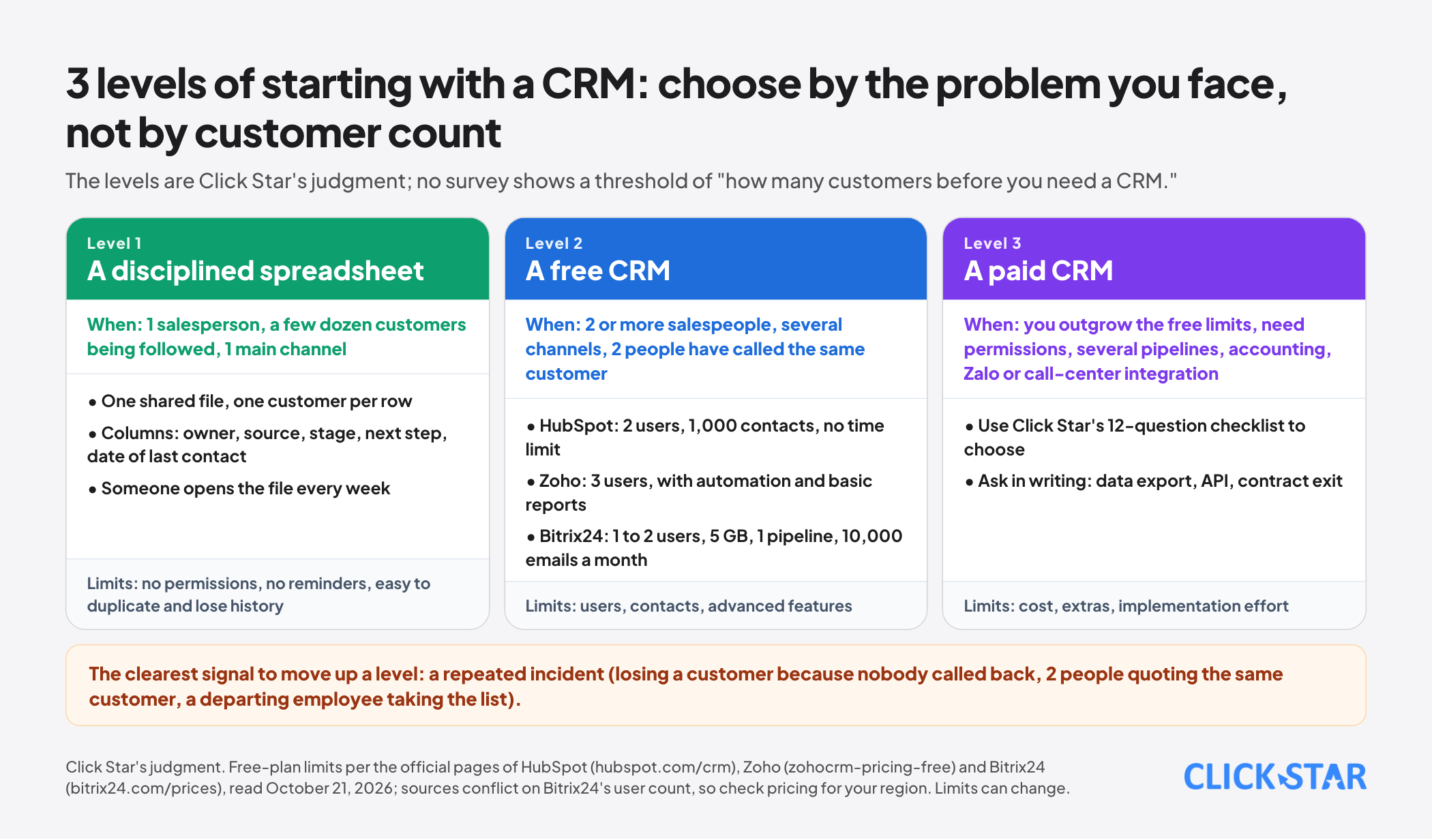
Level 1: a disciplined spreadsheet. Suitable with 1 salesperson, a few dozen customers being followed and one main channel. Conditions: one shared file, one customer per row, columns for owner, source, stage, next step and date of last contact, and someone who opens it every week.
Level 2: a free CRM. Suitable when you start to have 2 or more salespeople, customers from several channels, or have had 2 people call the same customer. Current free plans: HubSpot allows up to 2 users and 1,000 contacts (no time limit); Zoho allows up to 3 users, with workflow automation and basic reports; Bitrix24 gives 1 to 2 users, 5 GB, 1 pipeline and 10,000 emails a month.
Sources conflict on Bitrix24's user limit, so check pricing for your region.
Level 3: a paid CRM. Suitable when you outgrow the free limits and need permissions, several pipelines, advanced reports, or integration with accounting, Zalo or a call center. At that point use the 12-question checklist Click Star has published to choose a vendor.
Click Star's view. The clearest signal to start is not the number of customers but a repeated incident: losing a customer because nobody called back, 2 people quoting the same customer, or a departing employee taking the list. If none has happened, a disciplined spreadsheet is a reasonable choice.
On effectiveness. Nucleus Research published in 2023 (study X148, based on 63 case studies) that each USD 1 spent on CRM returns USD 3.10, down 37% from USD 4.90 10 years earlier. The page gives no ROI definition and Click Star could not confirm who sponsored it, so use it only as a cautious reference. The USD 8.71 figure from 2014 is out of date.
The minimum setup
HubSpot's guide (updated September 29, 2026) advises using one pipeline unless processes truly differ, and including both Won and Lost stages so reports do not break. Pipedrive's guide (September 23, 2026) advises naming stages after observable milestones, not vague labels such as "Interested" or "In progress," and writing entry and exit criteria for each stage.
On fields, Pipedrive suggests collecting by stage: owner, source and basic context at creation; budget, authority, need and fit at qualification; next steps and timeline later. Every deal has a clear owner from the start.
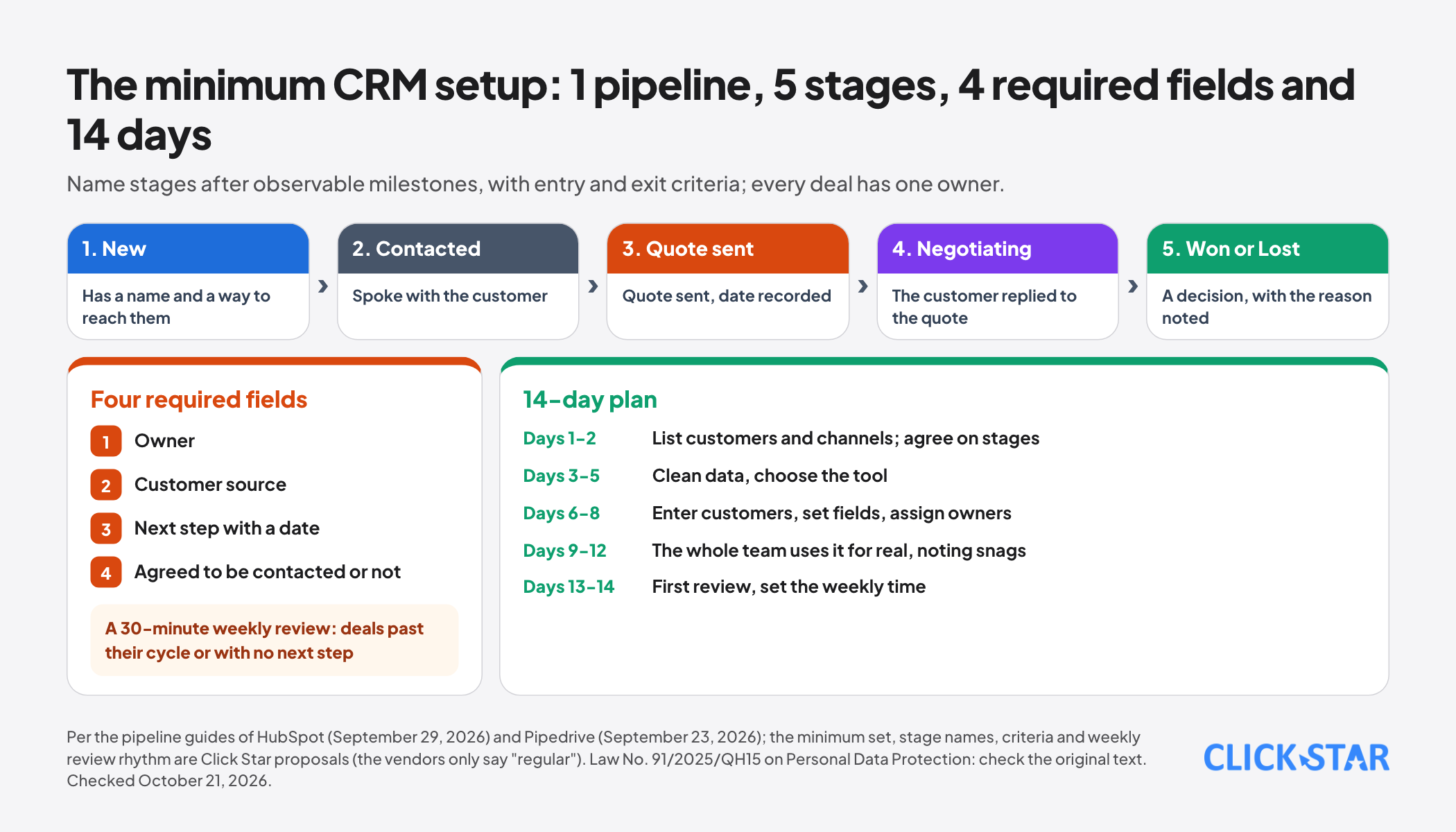
Click Star proposes the following minimum, drawn from those guides. One pipeline with 5 stages (New, Contacted, Quote sent, Negotiating, Won or Lost). 4 required fields: owner, customer source, next step with a date, and whether the customer agreed to be contacted. A 30-minute review each week to look at deals past their cycle or with no next step.
A weekly rhythm is Click Star's recommendation; the vendors only say "regular."
The consent field should exist from day one. According to a summary, the Law on Personal Data Protection No. 91/2025/QH15 (in effect January 1, 2026) treats consent as the main legal basis, and small businesses are exempt from some duties for 5 years but not from the duties on consent. Check the original text.
A 14-day plan
- Days 1 to 2: list the customers you are following and the channels they come from; agree on 5 stages and the entry and exit criteria of each.
- Days 3 to 5: clean old data (remove duplicates, standardize phone numbers), choose the tool (spreadsheet, free or paid CRM).
- Days 6 to 8: enter the customers being followed, set the 4 required fields, assign an owner to each deal.
- Days 9 to 12: the whole team uses it for real in daily work, noting where they get stuck.
- Days 13 to 14: the first review session, settle adjustments, set the weekly review time.
After 14 days, track 3 simple metrics: new customers per week by source, the number of overdue deals with no next step, and the time from when a customer leaves details to the first contact.
What is not known
Click Star has no reliable figure on the share of Vietnamese small and medium businesses using a CRM, and no independent survey on the threshold for moving from a spreadsheet to a CRM. The Bigin and SMB Group survey was commissioned by a vendor, and its scope is small US businesses.
Free-plan limits change over time and by region. The Nucleus Research study does not state its method clearly. Gartner's documentation could not be read, so this article does not quote Gartner's definition.
Common mistakes
- Buying software before having a clear sales process.
- Setting too many required fields, so staff stop entering data.
- Naming stages vaguely, such as "Interested," with no entry or exit criteria.
- Having no owner for each deal.
- Having no regular review session, so data gradually goes stale.
- Ignoring the consent field from the start.
- Assuming "the business is too small to need one" without revisiting it after repeated incidents.
Related posts
Need tailored advice for your business?
Click Star helps you build a solution that fits your industry and scale. We answer every question during business hours.