The new MCP specification has 4 changes to check before upgrading
The new MCP specification drops sessions, adds a way to ask users mid-task, tightens authorization and marks 6 items for removal. The article reads the project's official documents and lists what a business should do when upgrading.
A retail company runs an MCP server that connects an AI assistant to order data. Its software vendor recommends upgrading to the new MCP specification. The owner wants to know whether it breaks anything and how urgent it is. This is an illustrative scenario, not a real client.
This article reads the MCP specification 2026-07-28, its changelog, the project's official blog, SDK documentation (libraries for writing MCP servers or clients) and a Linux Foundation announcement, checked on November 16, 2026.
It answers 3 questions: what changes (4 main changes), what a business should do, and what is unclear.
Key points
- The current MCP specification is 2026-07-28, published on July 28, 2026 after a May 21, 2026 release candidate (MCP blog).
- Change 1: the opening handshake and the protocol-level session are gone. Each request carries what it needs, so a server can run behind an ordinary load balancer.
- Change 2: to ask the user mid-task, the server returns an input request and the client retries with the answer (MRTR). Tasks and MCP Apps are optional extensions.
- Change 3: authorization adds an
isscheck (against mixing up authorization servers), ties registration data to the issuer, and phases out dynamic registration. - Change 4: 6 items are marked for removal. Roots, Sampling, Logging and dynamic registration: earliest a release on or after July 28, 2027;
includeContextfollows Sampling, and HTTP+SSE has its own date. The next specification targets March 30, 2027. - Old servers were not switched off on July 28, 2026 (MCP blog, June 29, 2026), but per the compatibility matrix, a new-only client cannot use an old server.
What MCP 2026-07-28 is and where it stands
MCP (Model Context Protocol) is an open standard that connects AI applications to outside data and tools. Per the MCP Versioning page (read November 16, 2026), a version name is a date, changed only for backward-incompatible changes.
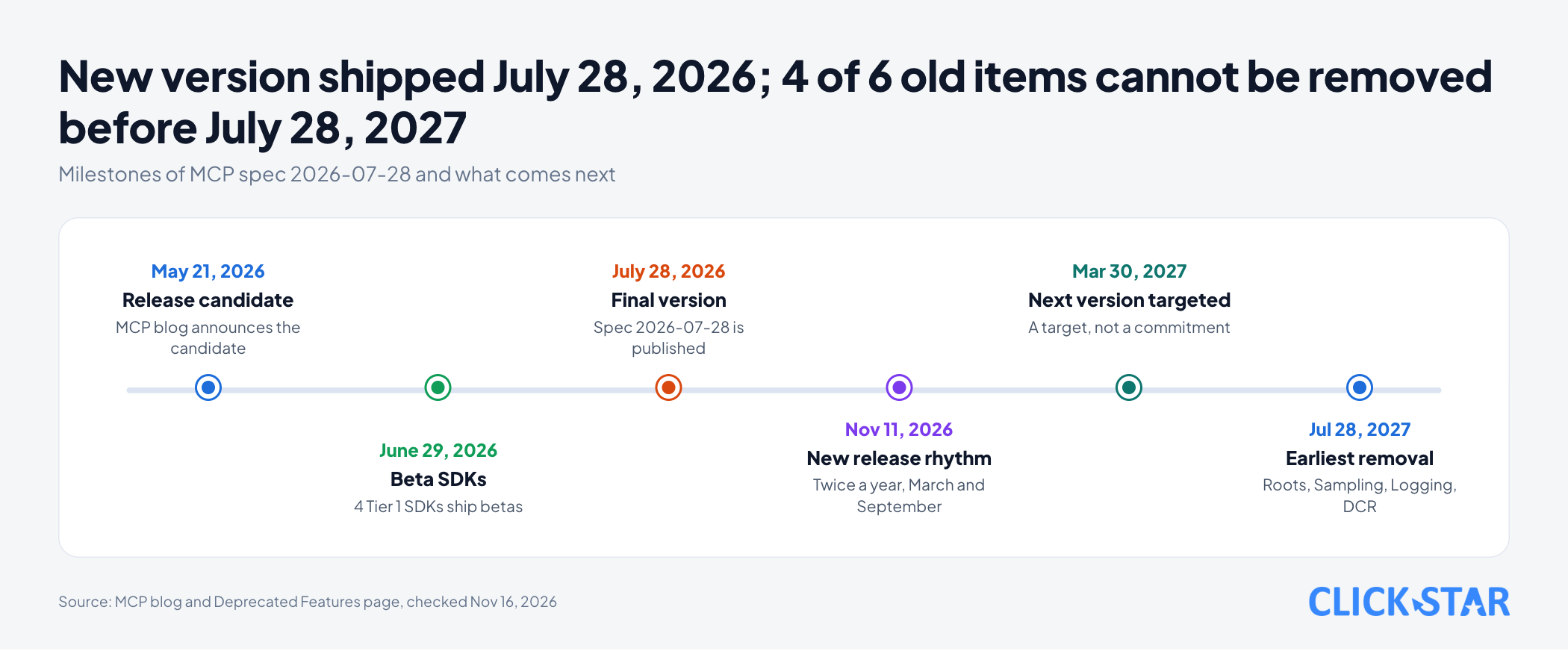
The current version is 2026-07-28, replacing 2025-11-25. Per the MCP blog, the release candidate came on May 21, 2026, beta SDKs on June 29, 2026 and the final version on July 28, 2026.
On December 9, 2025, Anthropic donated MCP to the Agentic AI Foundation, a Linux Foundation fund, as 1 of 3 founding projects with goose and AGENTS.md.
Change 1: no handshake and no session, MCP becomes stateless
In short: every MCP request now carries what it needs, so any server instance can handle it.
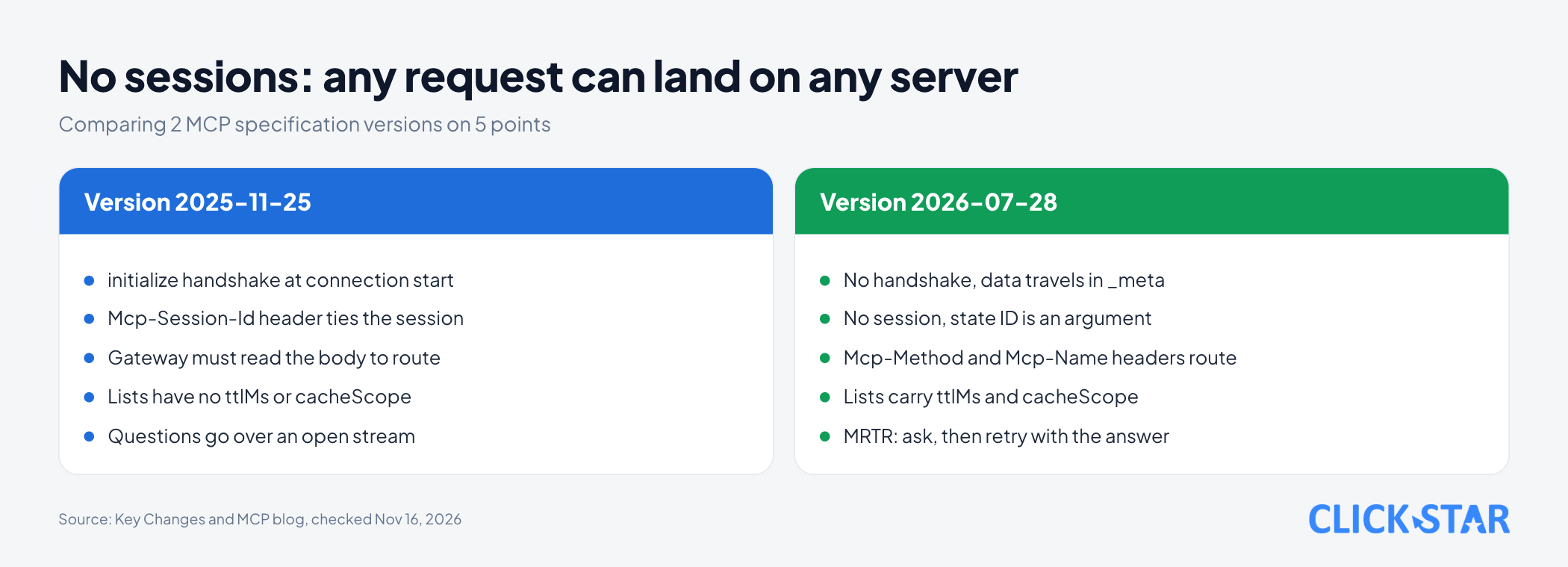
Per the changelog (Key Changes, read November 16, 2026), the initialize handshake and the Mcp-Session-Id header are removed. The protocol version and client capabilities travel in _meta on each request, and a server must offer server/discover to describe itself.
Per the Streamable HTTP page (read November 16, 2026), every HTTP request must carry Mcp-Method; tools/call, resources/read and prompts/get must also carry Mcp-Name, so a gateway can route without reading the body.
Tool lists carry ttlMs (how long they stay fresh) and cacheScope so clients can cache them. State is still possible: the server issues an identifier, such as a basket ID, and the AI model sends it back as an ordinary argument.
The Security Best Practices page (read November 16, 2026) calls the risk State Handle Hijacking. Holding a basket ID does not make you its owner.
A server that implements authorization must verify every inbound request and must not treat holding a handle as authentication; the page also recommends (SHOULD) hard-to-guess handles bound to the user authenticated from the token.
Change 2: mid-task questions, long-running tasks and interfaces in the chat
In short: when a tool needs the user's confirmation, the server no longer holds a connection open. The MCP blog (May 21, 2026) gives the example "Delete 3 files?": the server returns input_required with the question, and the client retries the original request with the answer.
This is called Multi Round-Trip Requests (MRTR). Per the MRTR page (read November 16, 2026), servers must use it for every server-to-client request; the old way is unsupported and the page calls this a breaking change.
requestState passes through the client, so the specification treats it as tamperable: if it affects permissions or business logic, the server must protect its integrity (HMAC or AEAD).
Long-running tasks (Tasks) moved into the io.modelcontextprotocol/tasks extension. Per the Tasks page (read November 16, 2026), the server returns a task ID, the client checks progress with tasks/get, and the ID survives a disconnect.
MCP Apps lets a server return an interactive HTML interface (a chart, a form) inside the chat, in an isolated iframe (MCP Apps page, read November 16, 2026). Extensions are all optional.
Change 3: tighter authorization, with the iss parameter and client registration
In short: authorization has 3 points of change, only for MCP servers on HTTP. The Authorization page (read November 16, 2026) says authorization is optional; for stdio, where the server runs on the user's own machine, it says not to follow this mechanism.
Point 1 is the iss check. Scenario: a client uses 2 authorization servers and 1 is controlled by an attacker, who could trick the client into handing over a code issued by the honest one (RFC 9207 calls this a mix-up attack). The server returns iss (the issuer's name) and the client compares it before exchanging the code for a token.
Precisely: an authorization server should (SHOULD) return iss, and a client must (MUST) compare it when present. If the server declares authorization_response_iss_parameter_supported as true and iss is missing, the client rejects the response. "Should" is expected to become "must" later.
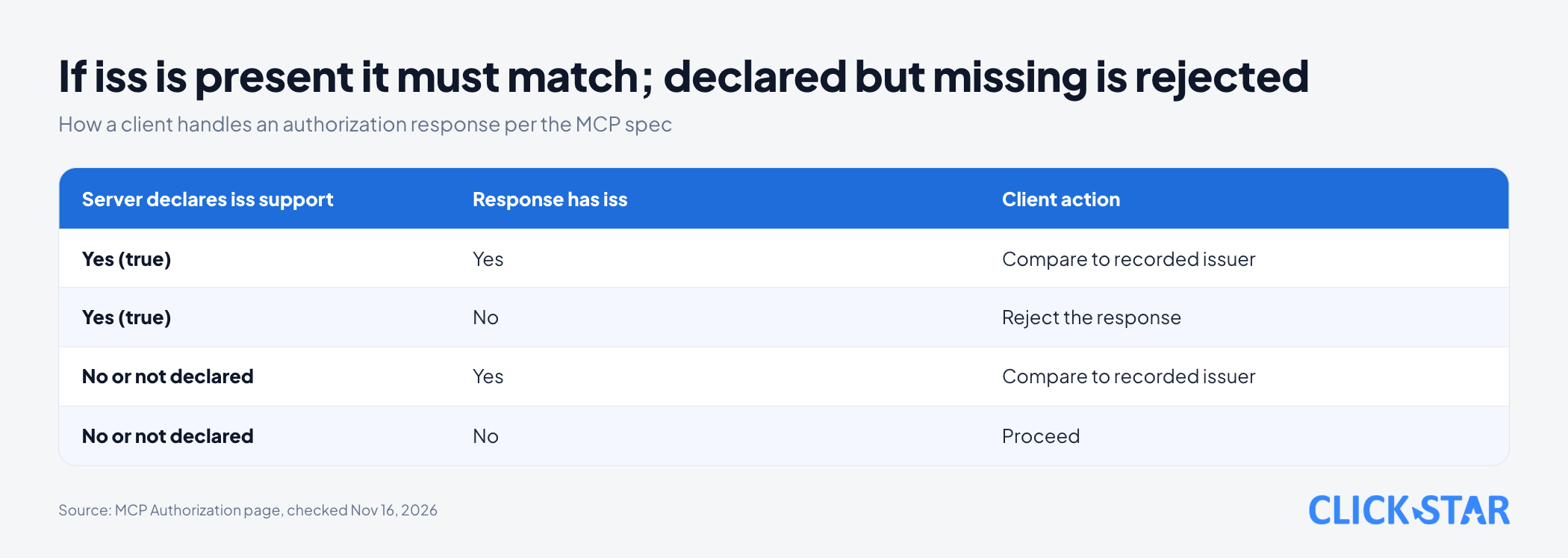
Point 2: a client must store registration data per issuer and never reuse it with another authorization server (changelog).
Point 3: dynamic client registration (DCR) is marked for removal in favor of Client ID Metadata Documents (CIMD), where the client uses an HTTPS address pointing to a JSON file describing it. The Client Registration page (read November 16, 2026) says CIMD fits when the sides have no prior relationship.
Change 4: 6 items marked for removal and a new release rhythm
In short: nothing is removed yet, but new systems should avoid these 6 items. The Deprecated Features page (read November 16, 2026) lists each migration path:
- Roots: pass directories or files through tool parameters, resource URIs or server configuration.
- Sampling: call the model provider's API directly.
- Logging: write to
stderrwith stdio, or use OpenTelemetry. - Dynamic Client Registration: move to Client ID Metadata Documents.
includeContextset tothisServerorallServers: drop the field or usenone.- The HTTP+SSE transport: move to Streamable HTTP.
MCP's feature lifecycle policy (read November 16, 2026) sets a minimum 12-month deprecation period, with an exception down to a minimum of 90 days for an active security risk.
Roots, Sampling, Logging and DCR can be removed no earlier than a release on or after July 28, 2027; includeContext follows Sampling. That only makes removal allowed; maintainers decide, possibly later.
HTTP+SSE differs: the Deprecated Features page sets 3 months after SEP-2596 reaches Final (the SEP-2596 page, read November 16, 2026, now says Final), while the MCP blog of July 28, 2026 describes a year-long transition. The 2 sources state different milestones.
The SEP-2596 page lists only a creation date, April 17, 2026, so this article does not know when it reached Final; check that page. Click Star suggests moving off HTTP+SSE first.
The release rhythm changes too. The MCP blog of November 11, 2026 says specifications will ship twice a year, usually on the last Tuesday of March and September; the next targets March 30, 2027.
How far Vietnamese businesses are affected
In short: it depends on your role. Click Star found no public data on MCP usage in Vietnam, so this section is inference.
- You only use a ready-made AI assistant with third-party services: you change no protocol, just ask the provider which version it supports.
- You run your own MCP server: you need an upgrade plan, especially if the code depends on sessions or server-initiated requests.
- You are choosing technology for a new project: build for 2026-07-28, because older features are already marked for removal.
Upgrade risks
In short: the biggest risk is a client and server mismatch. The compatibility matrix on the Versioning and Compatibility page (read November 16, 2026) shows:
- A new-only client connecting to an old server: fails. A client that speaks both falls back to the old handshake.
- An old client connecting to a new-only server: fails, because it has no fallback.
- A server can speak both versions on the same address so parties can move gradually.
Other risks: there is some migration cost, especially for code that depends on session IDs (MCP blog, July 28, 2026); the "resource not found" error code changed from -32002 to -32602 (changelog).
Click Star's view. The most useful operational change is dropping the session, since an MCP server becomes ordinary HTTP load. The gain is large for multi-server systems and small for 1 server, so upgrading on a schedule is reasonable.
Permissions and logs matter more than new features: tokens issued to the right audience, identifiers bound to users, risky actions approved. Click Star sells AI integration and AI automation, so it has a commercial interest; this view rests only on the documents read.
What to do: a 5-step roadmap
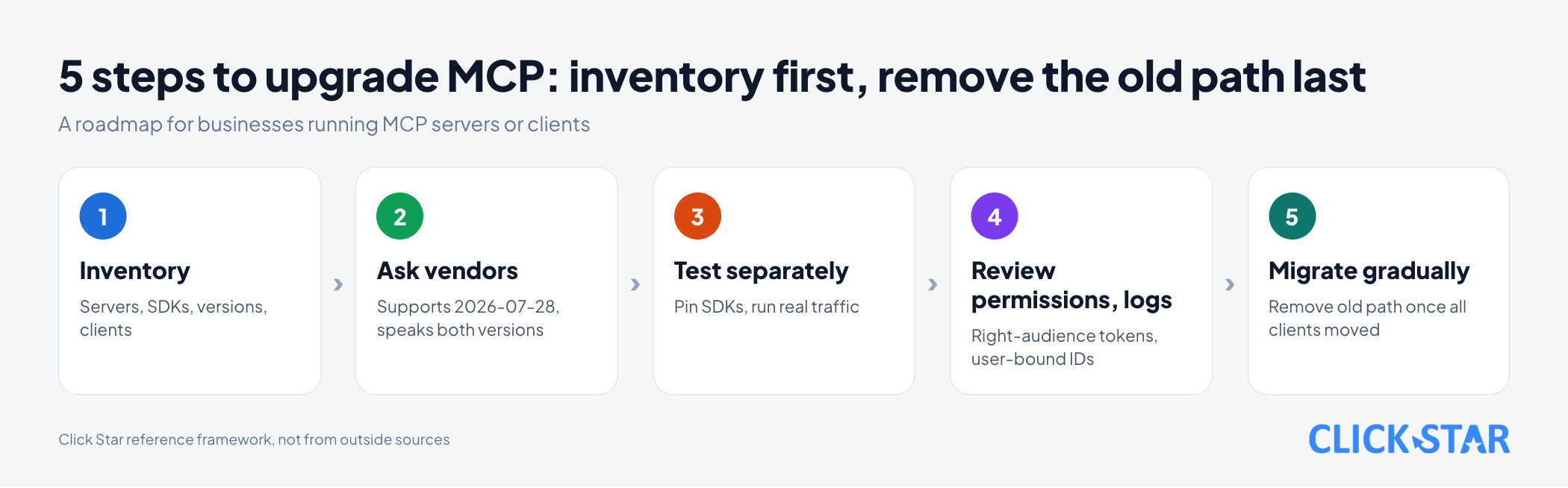
This is a Click Star reference framework, not taken from outside sources.
Step 1. Inventory. List MCP servers, operators, SDKs, protocol versions and clients.
Step 2. Ask vendors. Does each party support 2026-07-28, speak both versions, and plan for the 6 items marked for removal, above all HTTP+SSE?
Step 3. Test separately. Pin SDK versions, run real traffic in a test environment, and check error codes, headers, caching and the iss flow.
Step 4. Review permissions and logs. Tokens only for the right server, minimum scope, identifiers bound to users, risky actions logged.
Step 5. Migrate gradually. Enable both versions, watch errors, remove the old path once every client has moved.
How to measure after upgrading
Click Star's suggestion, with no industry threshold: count requests rejected with UnsupportedProtocolVersionError (code -32022), clients still on the old version (MCP-Protocol-Version header), and, for self-built clients, authorization failures from an iss mismatch (only the client sees these).
Common mistakes
- Treating July 28, 2026 as a cut-off for old servers; the MCP blog (June 29, 2026) says it was not.
- Upgrading an SDK major version and assuming the new protocol is on. In TypeScript and Go, enabling it is a separate choice (MCP blog, June 29, 2026, beta stage).
- Treating a state identifier as proof of ownership instead of checking the caller.
- Trusting descriptions of tool behavior (such as annotations) as fact; the Specification page (read November 16, 2026) treats them as untrusted unless the server is trusted.
What is not known
Click Star found no public data on MCP usage in Vietnam, and has not read each client application's documentation (Claude, ChatGPT, VS Code and others) on 2026-07-28 support.
It is unclear which SDK is mature enough for production load: Click Star has not tested them.
No real removal date exists yet for the marked items. Most sources are documents and blogs written by the MCP team itself, with no independent assessment yet of how stable the new version is. The MCP documentation carries a line aimed at AI; Click Star did not follow it.
Related posts

Need tailored advice for your business?
Click Star helps you build a solution that fits your industry and scale. We answer every question during business hours.