Meta's Pixel may count more purchases, but will real orders rise?
This article reads the official help pages, documentation and blogs of Meta and Google Ads on November changes: the on-device Pixel setting and its conditions, paused terms, API v27.0, Data Manager and the invalid traffic card. It separates what is officially confirmed from what is not.
A shop owner opens Ads Manager on November 13 and sees more Meta purchases than the week before, while website orders barely moved. Should the budget go up, or the counting be checked? This is an illustrative scenario, not a measurement.
This article reads official pages of Meta and Google Ads on November changes, checked on November 21, 2026. News found only in trade press or a copy of a company email is labeled secondary.
It answers 3 questions: which changes are officially confirmed, which are not, and what to note so numbers are not misread before Black Friday. Black Friday this year is Friday, November 27, 2026 (the article's own calendar count).
Key points
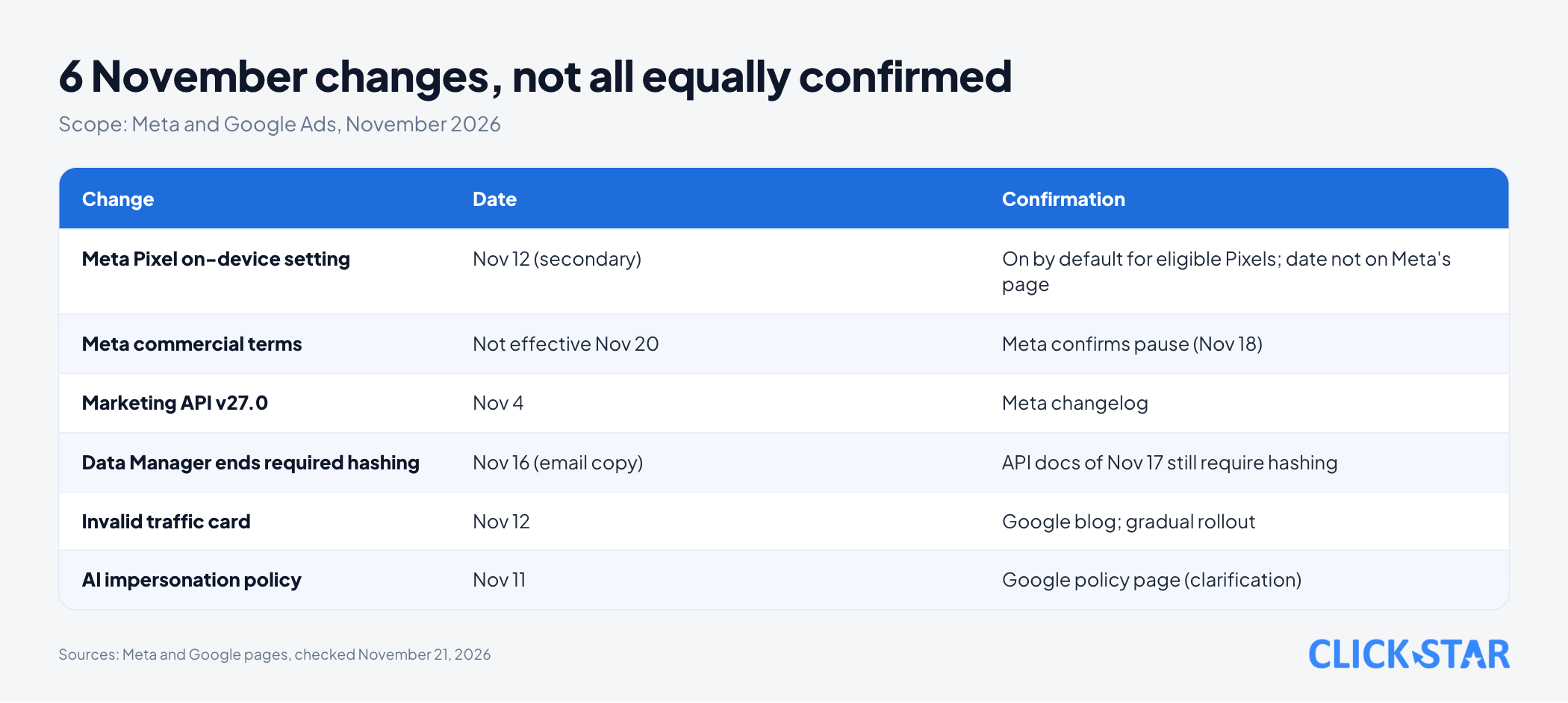
- Meta's help page says the Pixel setting "Measure conversions on customer devices" is on by default for eligible Pixels, except for people in the EU and UK. The November 12, 2026 date is only in a secondary source.
- Meta says the attribution window and model do not change; only more conversions become measurable. Reported numbers can rise while orders do not.
- Meta's new commercial terms will not take effect on November 20, 2026; current terms still apply and no new date is set (Meta help page; Meta newsroom, November 18, 2026).
- Marketing API v27.0 arrived on November 4, 2026; the changelog has 6 items, and the article covers 4 highlights (2 new defaults, 2 retired items).
- News that Google Data Manager stops requiring hashing from November 16 is only in a copy of an email; API docs updated on November 17 still describe hashing.
- Google Ads added an "Invalid traffic" card to the Overview page (Google blog, November 12, 2026), rolling out gradually.
Meta Pixel measuring conversions on the customer's device: what Meta's page says
The Meta Pixel is a website snippet that sends events such as "purchase" to Meta. The help page "About measuring conversions on customer devices" (undated, read November 21, 2026) describes a new Events Manager setting that matches a purchase to an ad on the customer's own device.
The setting uses information the customer already gave the business, such as an email, plus temporary non-identifying device data. Meta only receives confirmation that a purchase happened and which campaign gets credit.
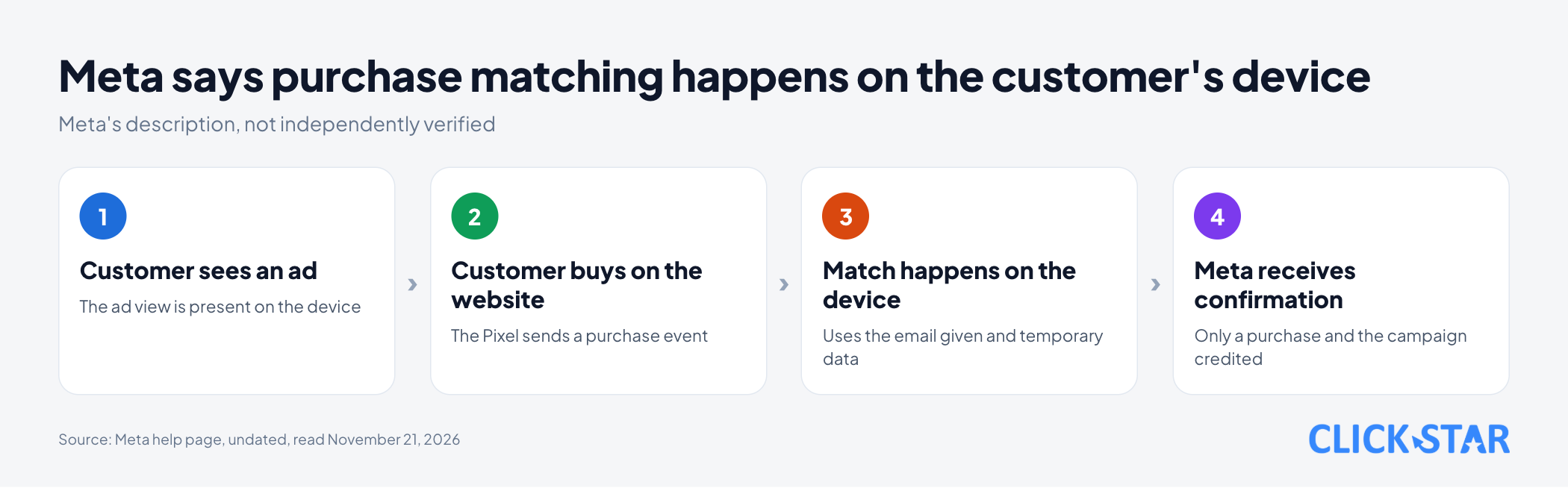
The setting runs alongside the Pixel and Conversions API, not instead of them. The attribution window and model stay the same: only which conversions can be measured changes.
The help page "How to turn on measuring conversions on customer devices" (undated, read November 21, 2026) says the setting is on by default for eligible Pixels and not active for people in the EU and UK.
Before turning it on, the page requires: a Pixel installed directly on the page, not in an iframe or as an image-only pixel, and a website that requires login with an email or mobile phone number.
The article's inference: if these requirements also define "eligible", shops allowing purchase without an account may not qualify.
On timing, PPC Land (October 27, 2026, secondary) describes a Pixel settings line "Measurement starting November 12, 2026" for datasets already sending events, and reports it can be turned off per dataset.
Does a higher reported number mean more orders?
Not necessarily. Meta's page lists more conversions in campaign reporting and a "stronger signal" as benefits, but does not say whether the extra conversions feed delivery optimization. According to the page, Meta only receives confirmation that a purchase happened and which campaign gets credit.
The article's inference: if orders stay flat while Meta's number rises, the gap may come from counting, not from ads selling more. Whether ads caused purchases takes a separate experiment.
Meta's commercial terms: not taking effect on November 20
The help page "Updates to Meta's Commercial Terms, Product Catalog Terms, Self-Serve Ad Terms and Ad Creative Generative AI Terms Will Not Take Effect on November 20, 2026" (undated, read November 21, 2026) says these 4 sets of terms are paused and will not take effect on November 20, 2026. Existing terms remain in effect.
Meta's newsroom (November 18, 2026) cites publishers' concerns about its web crawlers and plans more engagement in early 2027.
Marketing API v27.0: 4 highlights
The v27.0 changelog (Meta for Developers, November 4, 2026) has 6 items; the article covers 4 highlights from the blog "Introducing Graph API v27.0 and Marketing API v27.0" (Meta for Developers, November 4, 2026). The other 2 are the retirement of meta_moment_maker_spec and a phone OTP verification option for lead forms.
The "Marketing API changelog" page (Meta for Developers, read November 21, 2026; page data shows an update of May 21, 2026) lists v24.0 as expired since November 10, 2026, v25.0 available until February 23, 2027, and v26.0 and v27.0 with no end date.
First, new Sales ad sets in campaigns that do not use the Mobile App conversion location, and that target by user_device or user_os, turn on "Reach more people across other mobile devices" if device is omitted. Set device to 0 to keep the old behavior; running ad sets are unchanged, and the setting does not apply to Special Ad Categories.
That blog says the default reaches all versions around February 2027, date unconfirmed. Second, Meta may turn on Product showcase for creatives lacking that setting when confident a product set matches; opt out with enroll_status set to OPT_OUT.
Third, creating a Lookalike audience no longer accepts country and location_spec from v27.0 (other versions after about 90 days); existing audiences are unchanged. Fourth, the Catalog Batch API (POST /{catalog-id}/batch) is deprecated; use the Catalog Items Batch API.
Google Data Manager: the news about no hashing, and where the docs disagree
Data Manager is Google's tool and API for sending customer data to Google Ads. Hashing turns an email or phone number into a one-way string.
According to PPC Land's article "Google Ads Data Manager stops requiring hashed customer data November 16" (October 18, 2026, secondary), a copy of an undated Google email, posted on LinkedIn, says that from November 16, 2026 Data Manager no longer requires SHA-256 hashing and accepts encrypted data by default.
The article found no official notice. The help page "Prepare your data for import" (Google Ads Data Manager Help, undated, read November 21, 2026) still says private data should be hashed, and the tool hashes with SHA-256 for you on file upload.
The Data Manager API pages "Format user data" and "Encrypt user data" (both showing "Last updated 2026-11-17 UTC", read November 21, 2026) still require SHA-256 hashing and say to encrypt the hashed value. After November 16, the docs do not yet reflect what the email is said to claim.
The page "Confidential matching with encryption" (Google Ads Data Manager Help, undated, read November 21, 2026) says confidential matching is the default for Customer Match and conversion data, and processing encrypted data is optional; this differs from the email's "encrypted by default".
The article cannot say which side is right; the email does not say whether hashed files keep working. Inference: keep hashing in a workflow that runs well; test unhashed data on a small list.
Google Ads: the invalid traffic card, policies and seasonality adjustments
Google's blog post "Google Ads invalid traffic transparency tool" (November 12, 2026) introduces the Invalid Traffic Overview Card. Google says it does not charge for invalid traffic; the card shows the amount saved and credits issued, where appropriate and possible, for later-found activity.
The help page "About invalid traffic" (Google Ads Help, undated, read November 21, 2026) says the card shows 2 numbers, estimated savings and credited cost, and is rolling out gradually, so it may not be in your account yet.
Credits do not retroactively adjust campaign metrics; use the Invalid Activity Credit Report (page "About the Invalid Activity Credit Report", Google Ads Help, undated, read November 21, 2026), available for Search and Performance Max.
On policy, 2 pages of Google's Advertising Policies Help were posted on November 11, 2026. "Updates to Unacceptable Business Practices (November 2026)" clarifies that ads using AI to impersonate public figures are not allowed even with an AI disclosure; Google says it does not change enforcement.
"Update to the Personalized Advertising Policy (November 2026)" clarifies that targeting users by interest in categories prohibited on Google's network is not allowed.
Ahead of Black Friday, Google's blog post "Win the holiday shopping season with November's Demand Gen Drop" (November 18, 2026) says Smart Bidding (Target CPA or Target ROAS) with Seasonality Adjustments is now in Demand Gen.
The help page "About seasonality adjustments" (Google Ads Help, undated, read November 21, 2026) says it suits events of 1 to 7 days, may work less well beyond 14 days, and fits only when you expect a major conversion rate change.
Dates from November 4 to early 2027
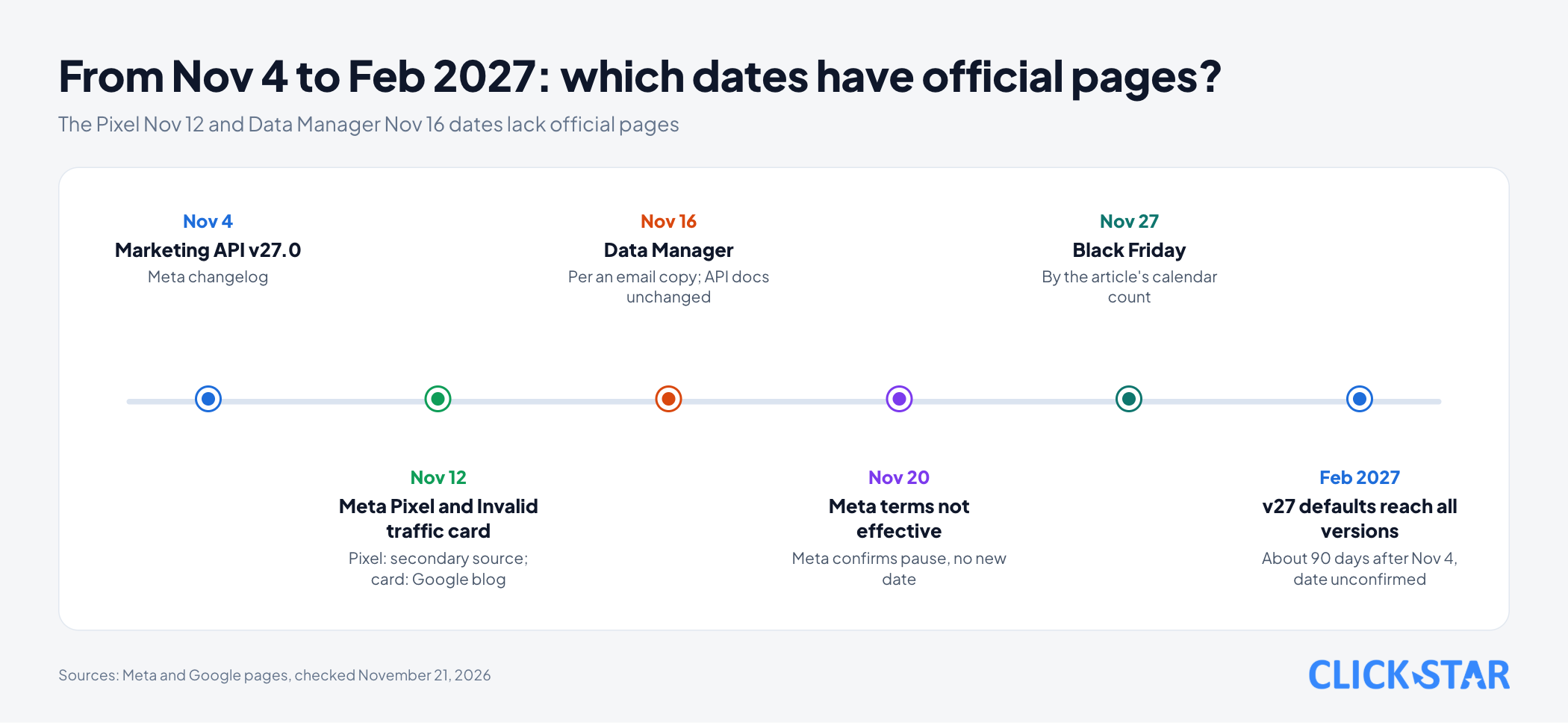
How to annotate and compare numbers before Black Friday
This section is the article's own inference, not from outside sources.
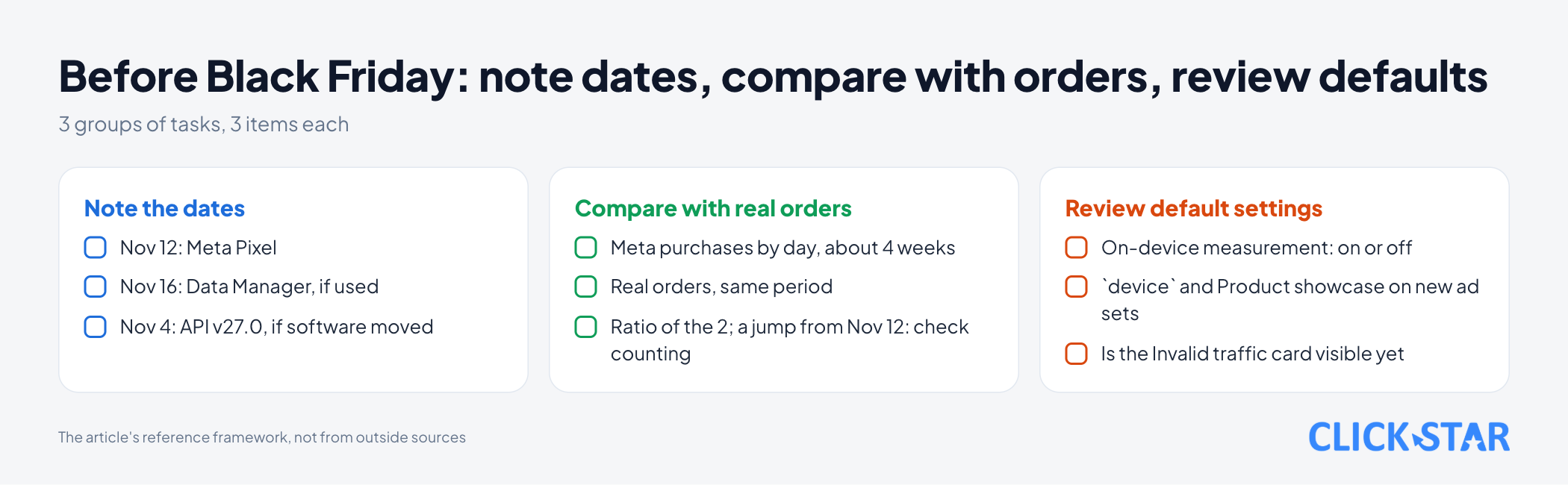
Group 1 is to note in the report November 12 (Meta Pixel), November 16 (Data Manager, if used) and November 4 (if your software uses API v27.0).
Group 2 is to compare Meta purchases with real orders by day, from about 4 weeks back, and watch the ratio. If it jumps from November 12 while orders do not, a counting change is one explanation to consider.
Group 3 is to review default settings (on-device measurement, device, Product showcase, the Invalid traffic card) and not change budgets or bids based only on the extra difference; for a real assessment, use a holdout test.
What to watch
- This week: open Events Manager, find "Measure conversions on customer devices" in the Pixel dataset and record its state and the date.
- This week: tabulate 4 weeks of Meta purchases against real orders by day, marking November 12, before changing any Black Friday budget.
- If you upload customer lists to Google Ads: keep hashing; test unhashed data only on a small list.
- Watch Meta's terms page for a new date.
- Ask your agency or vendor which Marketing API version it uses and how v27.0 defaults affect new ad sets.
Common mistakes
- Seeing Meta purchases rise from November 12 and raising the budget at once, before comparing with real orders.
- Treating November 12 as an official Meta date; the page is undated and the date is from a secondary source.
- Believing Meta's new terms took effect on November 20; Meta says they will not and the old terms still apply.
- Dropping hashing because of one copy of an email, while API docs updated on November 17 still require it.
- Reading the "Invalid traffic" card as ad performance; it shows estimated savings and credits only.
What is not known
- The Meta pages read here do not say whether order value travels with the confirmation, whether extra conversions feed delivery optimization (Meta names only a stronger signal), or how customers who declined cookies are handled.
- Meta has not said how "eligible" Pixels are determined per shop (for example, shops allowing purchase without an account); November 12 is still only in a secondary source.
- There is no measurement of the reporting increase for Vietnamese advertisers, and the rollout date in Vietnam is unclear.
- It is unclear whether the Data Manager email reached every account, why the API docs have not changed, and how match rates change.
- Meta has not published the revised terms or a new effective date.
Related posts

Need tailored advice for your business?
Click Star helps you build a solution that fits your industry and scale. We answer every question during business hours.