Buy a ready-made AI agent or build one? 6 questions first
This article compares pricing, permissions, logs, vendor lock-in and Vietnamese support of ready-made agents and custom builds, using official pricing pages and documentation from Microsoft, Salesforce, IBM, OpenAI and Anthropic, with a 6-question framework.
A distribution company with 40 staff wants an AI agent to answer customers and look up orders. One adviser suggests a ready-made platform, another a custom build with a programming toolkit. This is an illustrative scenario, not a real client.
This article reads the pricing pages and documentation of Microsoft Copilot Studio, Salesforce Agentforce, IBM watsonx Orchestrate, the agent toolkits of OpenAI and Anthropic, and the IBM and Microsoft announcement of November 10, 2026. All figures were checked on November 16, 2026.
It answers 1 question: when to buy, build or combine. The result is Click Star's 6-question framework. Click Star already has separate articles on AI agents and MCP, so definitions are not repeated here.
Key points
- Ready-made agents are usually billed by usage: Microsoft in Copilot Credits, Salesforce in Flex Credits (20 credits per action), IBM in monthly plans from USD 578.
- Cost per turn varies widely on the same platform: Microsoft's documentation lists a scripted answer at 1 credit, while 1 reasoning-model turn in its own example costs 141 credits.
- Building with an SDK (a programming toolkit) gives full design control, but your team runs the servers, state storage, human approval steps and logs.
- Microsoft lists Vietnamese (vi-VN) with no preview label; Salesforce announced Vietnamese for Agentforce Service and Employee Agent on December 11, 2025. No quality measurements found in the sources read, so test it yourself.
- Click Star found no Vietnam data splitting ready-made agents from custom ones. VnEconomy (secondary, September 30, 2026) reports 26% of businesses use AI; within that group, 8% have fully integrated it (figures presented by AWS Vietnam).
- Click Star's 6 questions: data and permissions, logs, pricing model, exit path, maintainer, Vietnamese and channels.
Buy, build or combine: what differs
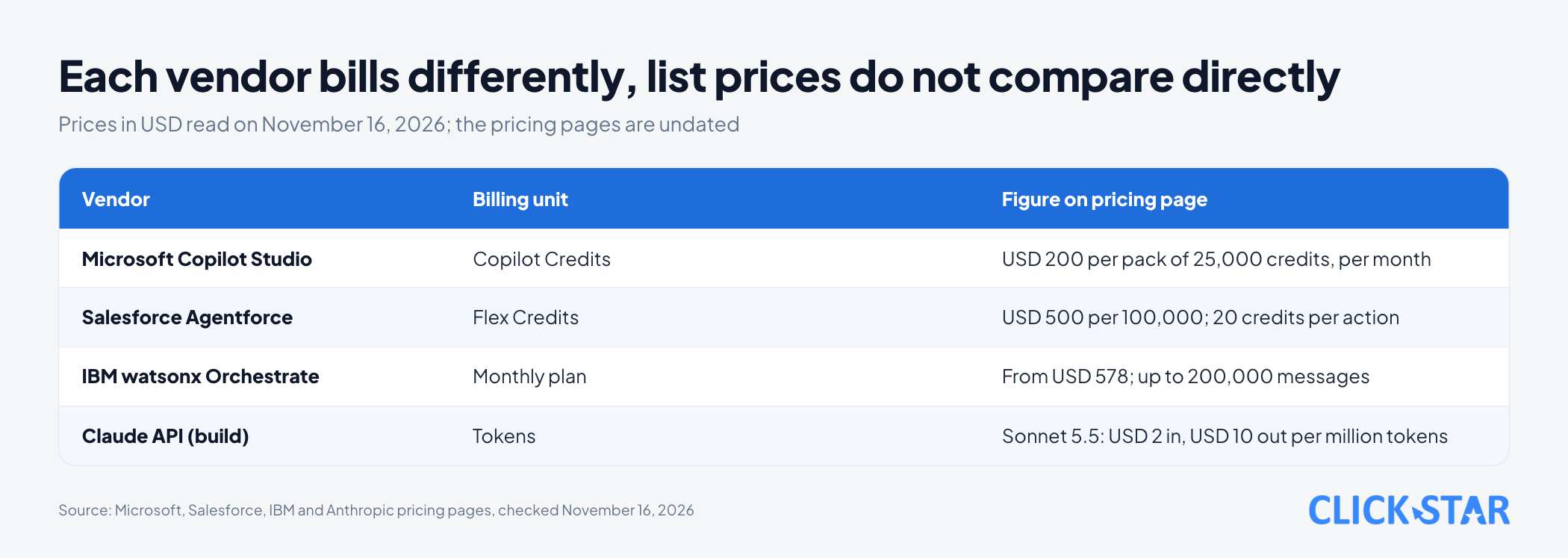
A ready-made agent is software you rent and configure, while the vendor runs the servers, the AI model and the governance tools. Building means your team, or a partner, writes the agent with an SDK.
According to OpenAI's Agents SDK page (undated), the SDK runs inside your application: your server handles deployment, tools, state storage and approval decisions. Its Agents API runs on OpenAI's own service.
Anthropic's Agent SDK overview (undated) also runs in a process you operate, while Managed Agents is a hosted harness whose sandbox is run by Anthropic or by you.
Path 3 is to combine: a platform for the standard part, your own code for the specific part, linked by open protocols. Copilot Studio documentation (updated August 26, 2026) says agents can connect to MCP servers, currently tools and resources.
What the IBM and Microsoft announcement of November 10, 2026 shows
Sometimes "buying" means buying the delivery service too. According to the November 10, 2026 announcement, the Imagine Enterprise platform combines more than 6,000 prebuilt agents and assets from IBM Consulting with Microsoft tools such as Foundry and Copilot Studio.
This comes from the 2 companies themselves. Clients can use it through IBM Consulting, with self-management options and engineer support for qualifying engagements. It gives no price or broad release date, and SEI is only exploring.
The 6,000 figure says nothing about quality; ask whether you are buying software, templates or engineer hours.
How ready-made platforms charge
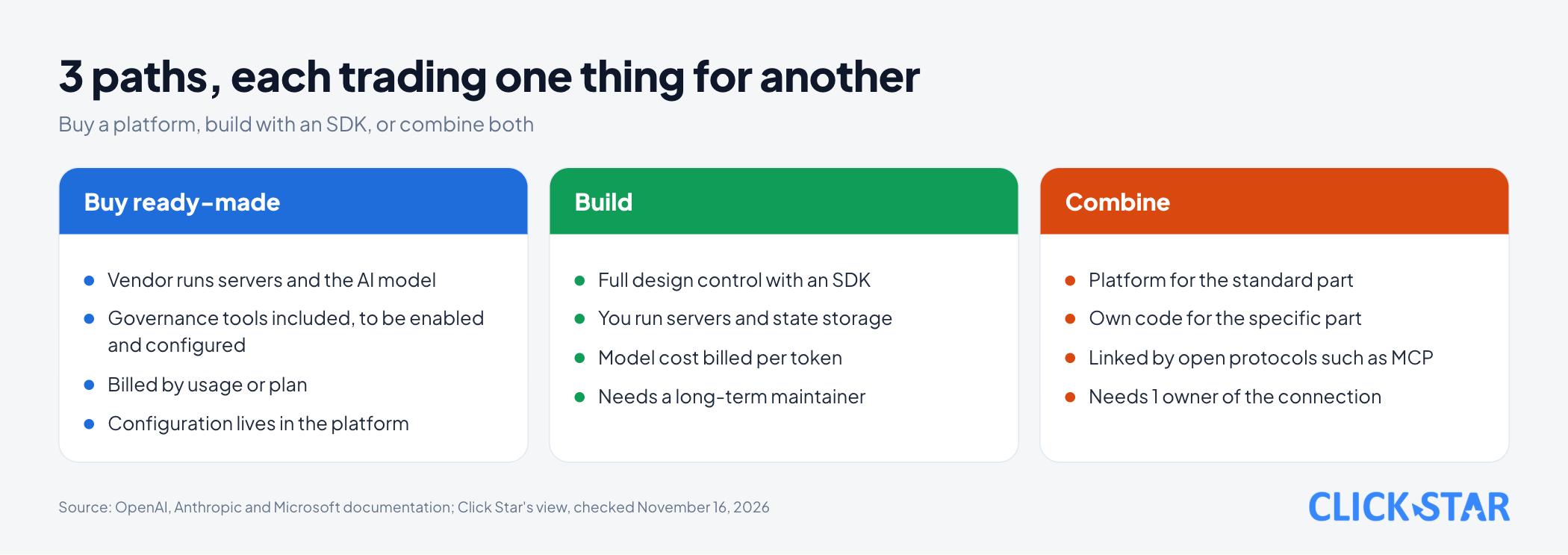
Each vendor has its own unit, so do not compare list prices mechanically. Microsoft's Copilot Studio pricing page (undated) lists a capacity pack at USD 200 per pack per month with 25,000 Copilot Credits; pay-as-you-go is billed at month end through Azure with no upfront commitment.
Microsoft's Azure page showed an empty price cell ("$-"), so no pay-as-you-go per-credit price is given here. For packs alone, 200 divided by 25,000 is USD 0.008 per credit (Click Star's calculation).
Microsoft's Standard harness licensing page (November 4, 2026) says unused credits do not roll over to the next month. Its rates page (October 30, 2026) says that at 125% of purchased capacity agents are blocked, unless the environment is linked to a pay-as-you-go plan.
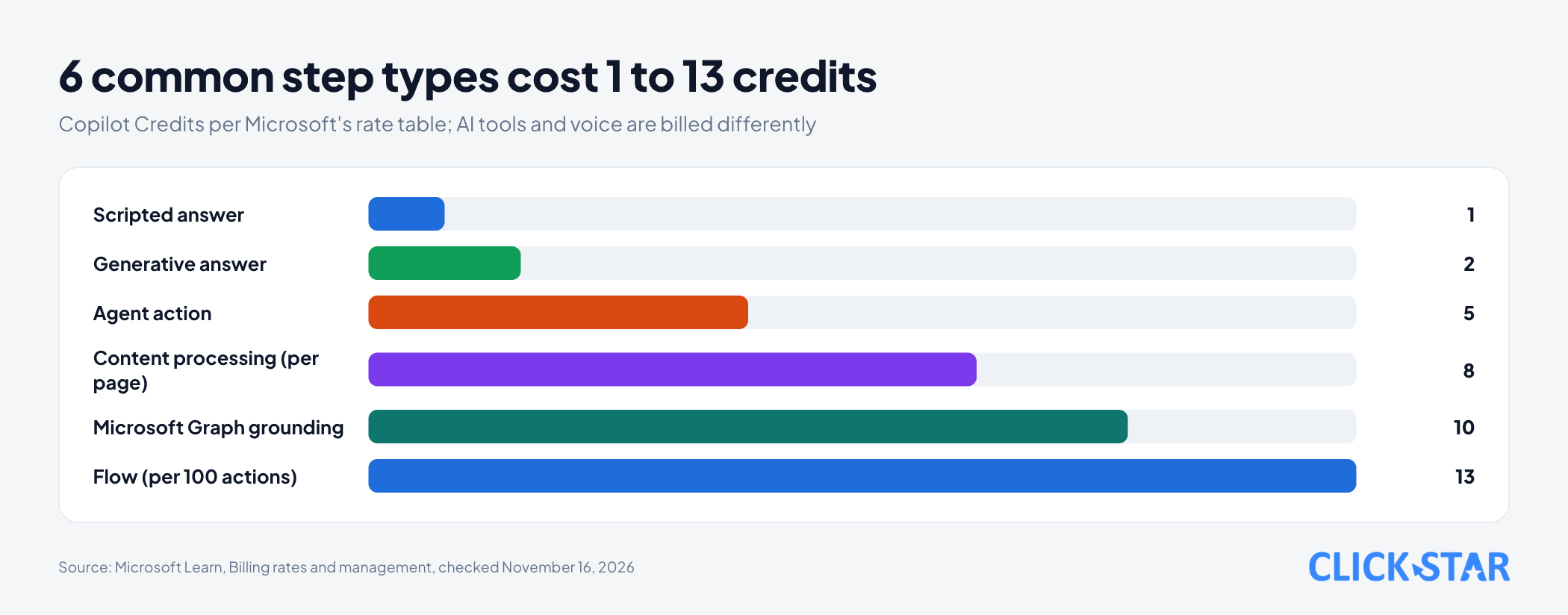
Microsoft gives an illustrative example: a support agent with 900 customers a day, each getting 4 scripted and 2 generative answers, uses 7,200 credits a day. Over 30 days that is 216,000 credits, about USD 1,728 at the pack price, or USD 1,800 if you buy 9 whole packs (Click Star's calculation, illustrative, before tax).
Another Microsoft example: 1 reasoning-model turn with 14,100 billed tokens costs 141 credits for the model alone, before feature charges.
Salesforce's Agentforce Pricing page (undated) lists USD 500 per 100,000 Flex Credits, 20 credits per agent action and 30 per voice action.
The page also lists Conversations at USD 2 each, optimized for customer-facing agents, and per-user licensing; the same org cannot use both models.
IBM's watsonx Orchestrate pricing page (undated, USD, "indicative", excluding taxes) lists Essentials from USD 578 a month with 4,000 monthly active users and up to 200,000 messages. Standard starts at USD 6,360 with 40,000 monthly active users and up to 2,000,000 messages. Premium requires contacting sales.
Building: what it costs
The visible part is model spend. On Anthropic's API pricing page (USD, undated), Claude Sonnet 5.5 costs USD 2 per million input tokens and USD 10 per million output tokens.
Illustrative example, not a measurement: 20,000 input and 1,000 output tokens on Sonnet 5.5 cost USD 0.05 of model spend.
The rest is on no price list: servers, state storage, human approval steps, logs, testing and engineer time. SDKs supply pieces such as OpenAI's guardrails (checks on inputs and outputs) and tracing, but assembling them into a safe process is your team's job.
Data, permissions and logs: the hard part of both paths
The hardest question is whose permissions the agent runs with, and who can review what it did. Click Star already has separate articles on AI permissions and prompt injection.
Microsoft's Copilot Studio security documentation (September 24, 2026) lists built-in layers: data policies for knowledge sources, actions and channels; logs in Microsoft Purview and Sentinel; tools that run with the user's own sign-in; and Agent 365 as a shared control plane for organizations that onboard it.
Click Star could not read Salesforce's help pages on the Trust Layer, so it states nothing about data masking or logs; ask the vendor.
When you build, these layers are yours. OpenAI's documentation says its SDK can pause before risky steps for human review; Anthropic's says permissions decide which tools run automatically and which need approval.
Vendor lock-in, Vietnamese and the Vietnam market
Click Star's view: agent configuration and workflows usually stay inside the platform, and open protocols do not carry them out. Ask the vendor how export works.
On Vietnamese, Microsoft's documentation (ms.date June 29, 2026) sorts support into general availability, preview and none. Vietnamese (vi-VN) is listed for the agent authoring interface, generative answers and voice with no preview label; event triggers list only English (United States). This is vendor-stated support, not a quality measurement.
Salesforce announced on December 11, 2025 that Agentforce Service and Employee Agent work in Vietnamese. Its multi-language guide (January 7, 2026) says customers must check quality themselves for beta languages; Click Star could not confirm which level Vietnamese holds.
On the market, VnEconomy on September 30, 2026 (secondary, citing a Strand Partners report presented by Eric Yeo, AWS Vietnam's general manager) says 26% of Vietnamese businesses use AI, up from 18%.
Among those using AI, about 61% are only exploring or testing and 8% have fully integrated it. On AI agents, 38% have heard of them and 46% of those plan to use them. The article gives no sample size.
The 6 questions before you pay
This is Click Star's reference framework, not taken from outside sources. Answer each question with documentation or a test, for both the buy and the build option.
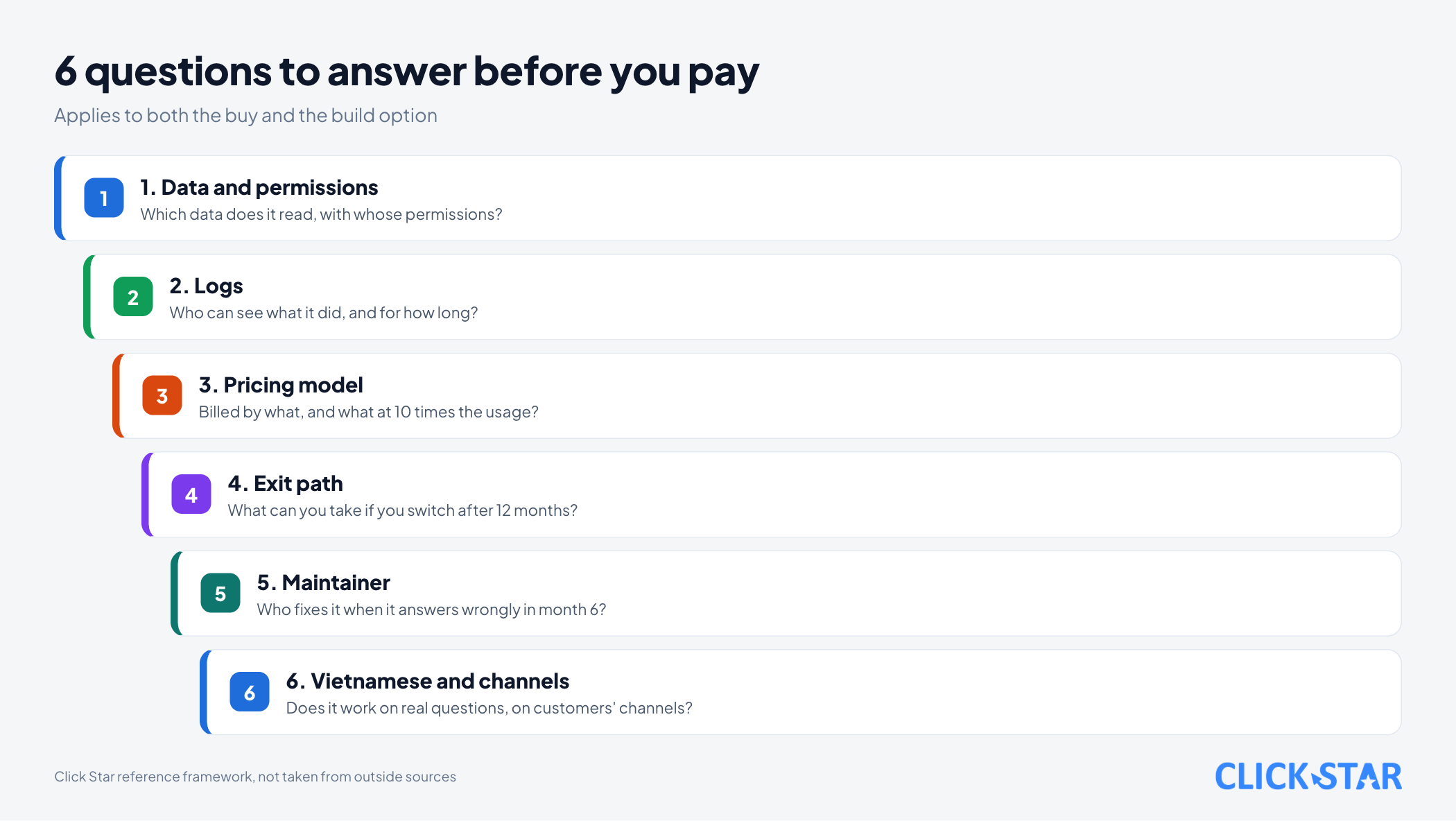
- Data and permissions: which data does the agent read, and whose permissions does it run with?
- Logs: who can see what the agent did, for how long, and where can it be exported?
- Pricing model: is it charged per user, action, token or plan, and what happens at 10 times the usage?
- Exit path: if you change vendors after 12 months, which configuration, data and workflows can you take?
- Maintainer: who fixes the agent when it answers wrongly in month 6?
- Vietnamese and channels: does it work well with real Vietnamese questions on the channels customers use?
How to read the result: if question 1 or 2 cannot be answered, stop, even for the buy option. If question 5 is weak but 1 and 2 pass, lean toward buying. If questions 4 and 1 matter and a technical team exists, lean toward building.
Click Star's view. For a small or mid-sized company without a technical team, a sensible path is usually to try a ready-made platform on 1 narrow process with a spending cap before any long commitment. Building suits data and processes that are too specific.
Permissions, logs and human review must be switched on, configured and tested on both paths. Click Star offers AI integration and AI automation services, so it has a related interest.
What to do: a 5-step plan
This is a reference plan from Click Star, not an industry standard.
Step 1. Pick 1 narrow process. For example order status lookup, with clear data and a low cost of error.
Step 2. Answer the 6 questions for 2 options.
Step 3. Test for 2 weeks with real Vietnamese questions. Use about 30 questions from customer messages, with personal data removed.
Step 4. Set a spending cap and turn on logs. Keep permissions read-only until results are stable.
Step 5. Decide after 30 days.
How to measure: 5 indicators
All 5 indicators are Click Star's proposals, with no industry threshold.
- Average cost per completed task.
- Share of tasks finished without a person fixing them.
- Number of handovers to a person.
- Credits or tokens actually used compared with the forecast.
- Hours people spend each week on maintenance and fixing errors.
Common mistakes
- Comparing vendors' list prices when the billing units differ (credits, actions, monthly plans, tokens).
- Treating the number of prebuilt agents as proof of quality.
- Granting broad permissions first and thinking about logs later.
- Buying from an English demo without testing Vietnamese.
- Building without counting the maintainer's time.
- Not setting a spending cap, so the bill grows with usage.
What is not known
Click Star found no Vietnam data splitting businesses using ready-made agents from those building their own. VnEconomy's figures are secondary, presented by an AWS Vietnam representative, give no sample size, and Click Star has not read the original report.
Click Star does not know Microsoft's per-credit pay-as-you-go price, could not open Gemini Enterprise Standard and Plus prices, has not checked OpenAI pricing, and could not read Salesforce's help pages on the Trust Layer and languages.
Real Vietnamese quality is unclear because the documentation read only states support levels, and no quality measurements were found.
Related posts
Need tailored advice for your business?
Click Star helps you build a solution that fits your industry and scale. We answer every question during business hours.