How cheap are new AI models, and what to measure before switching?
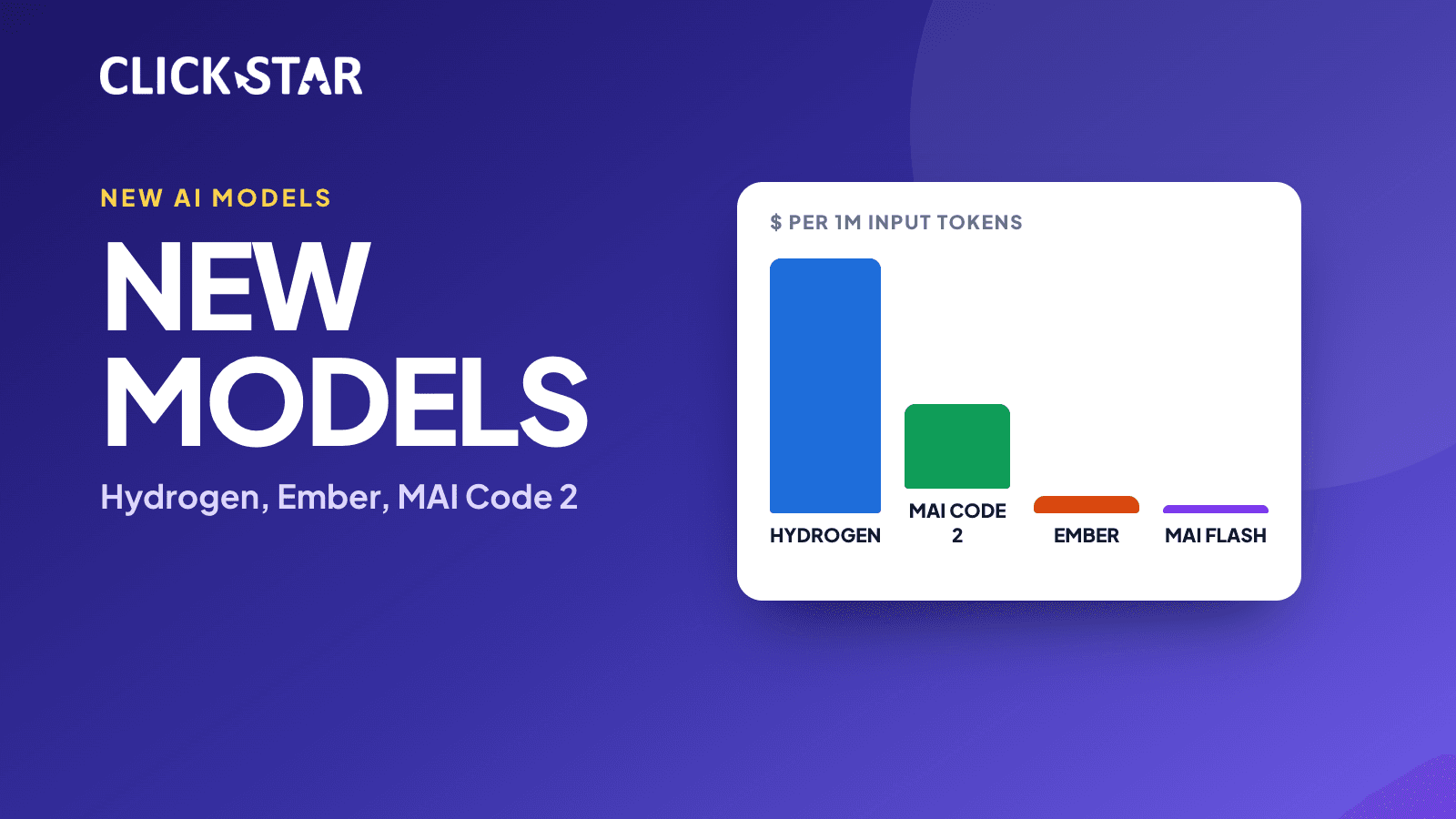
This article reads announcements from Google, Meta and Microsoft, plus pricing pages and an independent evaluator, to compare price, availability and vendor-published scores of 3 new models. It does not rank them; it offers a way to test on real samples.
A small operations team runs thousands of repetitive jobs a day: pulling details from contracts, fixing small code bugs, sorting support tickets. This week they noticed 3 new model names and asked which is cheap yet still does the work. This is an illustrative scenario, not a measurement.
This article reads announcements from Google (Gemini 4 Hydrogen), Meta (Muse Ember) and Microsoft (MAI Code 2 and MAI Code 2 Flash), plus pricing pages, GitHub Copilot documentation and Artificial Analysis, an independent evaluator. Figures checked on November 18, 2026.
It covers what each model is, what it costs, who each vendor compares itself with, and how to test. It does not rank models or recommend a vendor.
Key points
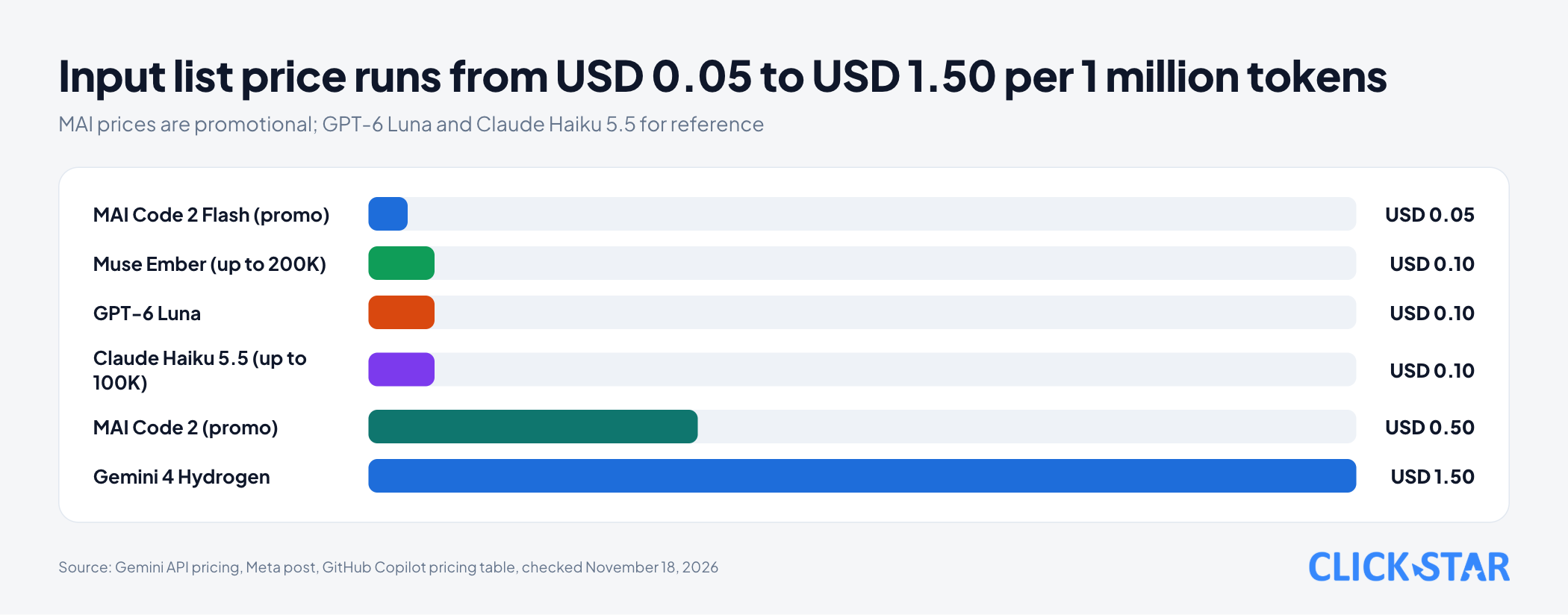
- The 3 vendors each released a model for everyday coding and agent work, but list input prices are far apart: from USD 0.05 (MAI Code 2 Flash, promotional) to USD 1.50 (Gemini 4 Hydrogen) per 1 million tokens.
- Google released Hydrogen on November 12, 2026 at USD 1.50 input and USD 7.50 output. Artificial Analysis scores it 51 at high and 54 at xhigh, matching the figures Google cites.
- Meta released Muse Ember on November 9, 2026 at USD 0.10 input and USD 0.50 output. In Meta's own table, Ember leads on 7 of 10 rows against Anthropic's Claude Haiku 5.5 and OpenAI's GPT-6 Luna, ties on 2 and trails on 1 (this article's count).
- Microsoft released MAI Code 2 and Flash on November 17, 2026 in GitHub Copilot. The "98% of the performance at 40% of the cost" figure is an average of 4 benchmarks Microsoft published (3 run in-house), at a 50% promotional price.
- Each vendor picked its own rivals, benchmarks and settings, so the scores cannot be lined up into a ranking.
- Price per token is not cost per task. Artificial Analysis lists USD 3.16 per task for Hydrogen (xhigh) and USD 0.14 for Ember (max), but with scores of 54 and 36.
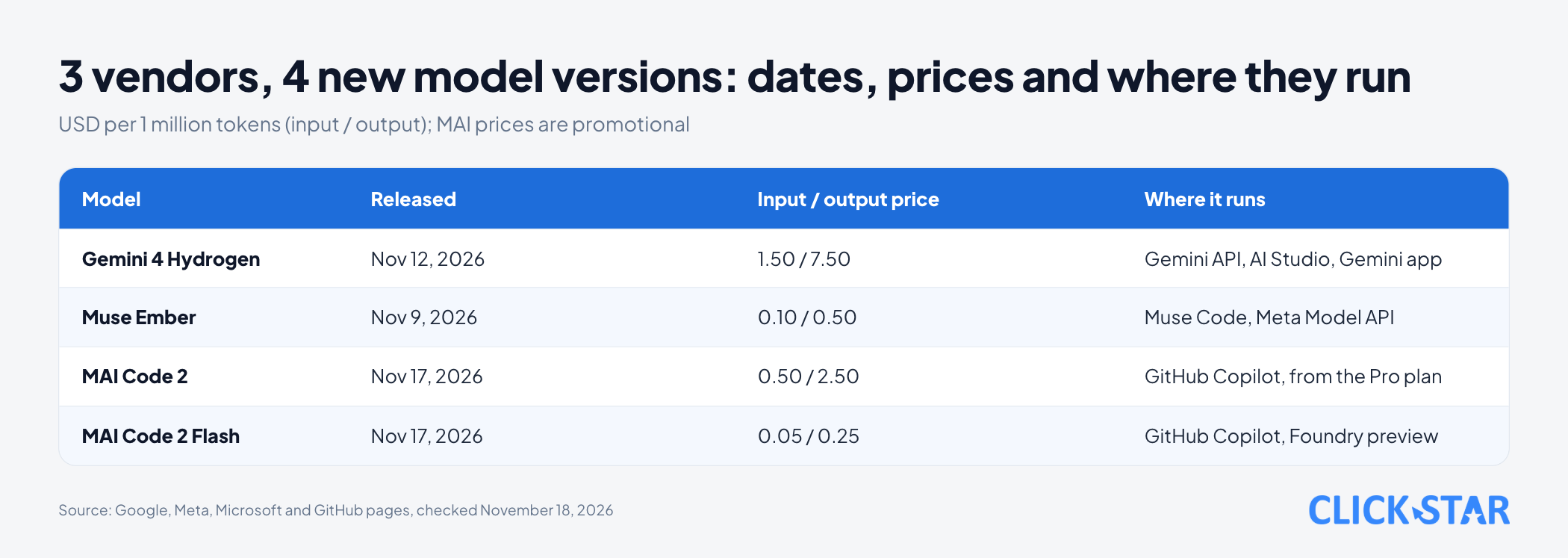
What the 3 models are and where they run
Hydrogen is Google's workhorse. Per Google's blog (posted November 12, 2026), it is for daily use in agent workflows, meaning AI software that calls tools and works through many steps. Carbon and Argon, 2 larger Gemini 4 models, target deep reasoning.
The Google DeepMind model card (November 12, 2026) says Hydrogen is adapted from Carbon and takes text, images, audio and video, with up to 1 million tokens of context. Per Google's blog, it is in the Gemini API, Google AI Studio, the Gemini app, Google Search and Google Antigravity (Google's agentic development platform; paid plans).
Muse Ember is Meta's smallest and most efficient model, per Meta's post of November 9, 2026, aimed at agent work repeated all day.
It has a 1 million token context and up to 512K output, and is on Muse Code (Meta's command-line coding tool), the Meta Model API, Google Cloud and Oracle Cloud.
MAI Code 2 is a coding model for everyday enterprise work, per Microsoft AI (November 17, 2026): deep debugging, multi-file changes, repository-wide reasoning. MAI Code 2 Flash targets volume: code explanations, targeted edits, routine fixes.
The GitHub changelog (November 17, 2026) lists MAI Code 2 for Copilot Pro, Pro+, Max, Business and Enterprise; Flash also covers Free and Student. Flash is also in Microsoft Foundry as a limited-access preview.
List prices and price-change dates
Prices are USD per 1 million tokens, read on November 18, 2026: Hydrogen from the Gemini API pricing page, Ember from Meta's post, MAI from the GitHub Copilot pricing table.
- Gemini 4 Hydrogen (paid, standard): 1.50 input, 7.50 output, flat across the whole 1 million token context; thinking tokens count as output.
- Muse Ember: 0.10 input, 0.50 output for prompts up to 200K; longer prompts 0.30 input, 1.50 output.
- MAI Code 2: 0.50 input, 2.50 output is a promotional price until May 17, 2027; then 1.00 and 5.00, per GitHub.
- MAI Code 2 Flash: 0.05 input, 0.25 output is a promotional price until May 17, 2027; then 0.10 and 0.50, per GitHub.
Microsoft's page gives no absolute price. For reference, the GitHub table lists GPT-6 Luna and Claude Haiku 5.5 (lightweight tier) both at 0.10 input and 0.50 output. In the same table, Claude Opus 5.5 and GPT-6.1 Sol are the powerful tier, Claude Sonnet 5.5 and GPT-6.1 Terra the versatile tier.
Vendor-published scores: each compared against whom
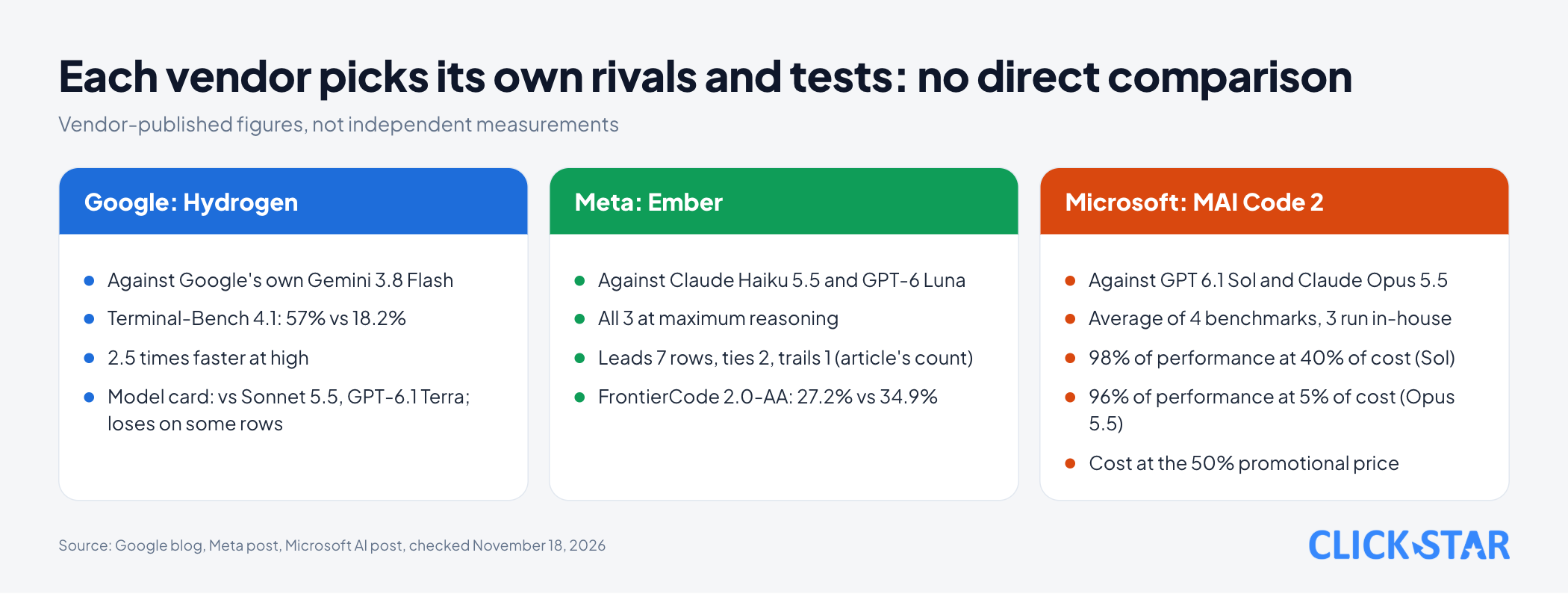
All 3 score tables are vendor-published, and each picks its own rivals.
Google's blog compares Hydrogen with Gemini 3.8 Flash, its own earlier Flash model: Terminal-Bench 4.1 at 57% versus 18.2%, 2.5 times faster at default high, and fabricated claims cut by more than 5 times.
The model card adds a 10-row table against Claude Sonnet 5.5 and GPT-6.1 Terra. Hydrogen leads on 7 rows, such as HLE-Diamond (58.8% versus 53.3% and 47.3%). Still Google's own comparison; settings may differ.
Hydrogen trails Sonnet 5.5 on 3 rows: Terminal-Bench 4.1, cheating-adjusted (57.0% versus 63.9%; no Terra figure), OSWorld-2.1, offline subset (77.6% versus 83.9%), and Terminal-Bench-Science 0.1 (51.4% versus 59.9% and 58.3%).
Meta compares Ember with Claude Haiku 5.5 and GPT-6 Luna, all 3 at maximum reasoning. Ember leads on 7 rows, such as AutomationBench-AA (37.8% versus 13.9% and 20.2%). It ties on 2 (each equal to 1 of the 2 rivals) and trails on FrontierCode 2.0-AA (27.2% versus Haiku's 34.9%).
Of the 7 leading rows, 4 are Meta internal evaluations: Agents' Last Exam, Personal Superintelligence Index, OSWorld 2.1, PerceptionBench. Meta says Ember matches Haiku's top score at about a third of the cost per task.
Microsoft averages 4 benchmarks: DeepSWE 1.1, Terminal Bench 2.1 and SWE-Atlas ran on MSBench (its internal evaluation platform) with GitHub Copilot CLI and no subagents; FrontierCode v1.1 scores and costs come from Artificial Analysis. Maximum reasoning. No per-benchmark scores are given.
Per Microsoft, MAI Code 2 reaches 98% of GPT 6.1 Sol's performance at 40% of the cost, and 96% of Claude Opus 5.5's at 5% of the cost. Costs use the 50% promotional price.
For Flash, Microsoft cites comparable performance to GPT-6 Luna and Haiku 5.5 at 65% and 20% of the cost, on the first 3 benchmarks only; the page does not pair each figure with a model.
This article's inference: the 5% cannot come from token price alone. In the GitHub table, MAI Code 2's promotional input price (0.50) is 12.5% of Opus 5.5's (4.00), so tokens per task may explain the rest.
Also this article's inference, in the other direction: GPT-6.1 Sol is 2.00 input and 10.00 output, so MAI's promotional price is 25% of Sol's, below the 40% Microsoft cites; against Sol, MAI may use more tokens. Both sums assume Microsoft used GitHub's prices; it does not explain its method.
What independent evaluation adds
The Artificial Analysis page for Gemini 4 Hydrogen (read November 18, 2026; Intelligence Index v5.0.1, 9 evaluations) shows 54 on xhigh, 51 on high, 41 on medium and 27 on low. That matches Google's claim that Hydrogen edges past Argon (51 versus 50) at high.
On xhigh, Hydrogen costs USD 3.16 and 14.9 minutes per task. The page calls it slower than average and very verbose against comparable models.
For Ember, the Artificial Analysis Muse Ember page (read November 18, 2026) shows 36 at max, USD 0.14 and 3.1 minutes per task, 449 tokens per second, matching Meta's figures. No Artificial Analysis page for MAI Code 2 was found, so it has no independent figure here.
Risks and changes that can break a system
- Promotional prices end. Per the Gemini API pricing page, Carbon and Argon are 2.00 input and 10.00 output until November 30, 2026, then 4.00 and 20.00. Gemini 3.8 Flash is 0.75 and 3.75 until December 31, 2026, then 1.50 and 7.50, so until then it costs half of Hydrogen.
- Limits and safety results Google states itself. The model card says Hydrogen may hallucinate, can be slow or time out, and may use more tokens at higher thinking levels. Unjustified refusals of benign or borderline prompts are up 5.57 percentage points versus Gemini 3.8 Flash (automated, worst on multimodal prompts).
- Hydrogen's Safety and Security Report (PDF, 78 pages). Google says Hydrogen does not reach the biological or cybersecurity critical capability levels (targeted assessment) but does reach the alert thresholds for both; chemical, radiological and nuclear results are carried from Gemini 4 Argon. Google adds that Hydrogen resists hidden instructions in web pages and emails better than Gemini 3.8 Flash. Mostly Google's own assessment.
- GitHub Copilot turns new models on. Business and Enterprise administrators control MAI access through the model policy; new models switch on automatically unless the global default is off.
- Microsoft says not yet tuned for hard work. The 2 models are not tuned for problems like fundamental science research or very long agent tasks.
- Meta assessed Ember's safety itself. Meta says Ember stays below the high-risk thresholds of its own framework; its data terms are unclear.
Changing models also changes behavior: tool calls, output format, answer length. This is the article's inference, so test before replacing anything in a live workflow.
Which to use for what: a framework for testing
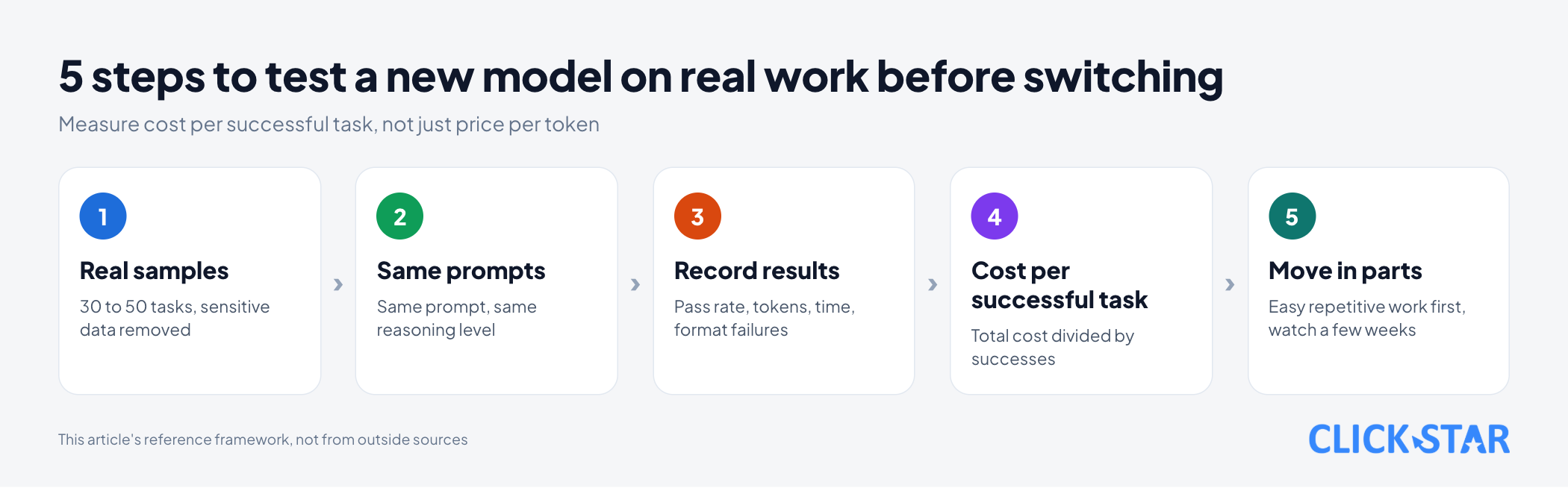
The framework below is this article's inference, not from outside sources. It gives 5 steps to measure real work by difficulty, cost per successful task, latency and data risk, not a verdict on which model is better.
- Step 1, real samples: pick 30 to 50 real tasks with sensitive data removed, both easy and hard.
- Step 2, same prompts: run identical prompts on the current model and 1 to 2 new ones, same reasoning level.
- Step 3, record: note pass rate, input and output tokens, time and format failures.
- Step 4, cost per successful task: divide total cost by the number of successful tasks, not price per token.
- Step 5, move in parts: easy repetitive work to the cheaper model, hard work stays put; watch for a few weeks before widening.
What to watch
- This week: run the 5-step sample test on at least 1 new model, and check whether your Gemini plan is free or paid, since the data terms differ.
- November 30 and December 1, 2026: Carbon and Argon prices double; recheck costs if a workflow pairs them with Hydrogen.
- Hydrogen's Safety and Security Report: a PDF is now available; read the detailed sections, and note the model card's 5.57-point rise in unjustified refusals versus 3.8 Flash.
- May 17, 2027: MAI promotional prices end.
Common mistakes
- Reading "98% of the performance at 40% of the cost" as independent fact. It is an average of 4 benchmarks Microsoft published, 3 run in-house, at a 50% promotional price.
- Lining up the 3 vendors' scores.
- Choosing by price per token. Hydrogen (xhigh) costs USD 3.16 per task and Ember (max) USD 0.14, but scores of 54 and 36 are different tiers.
- Missing price-change dates and data terms. Several prices change on set dates, and the Gemini API free tier uses content to improve products.
What is not known
No source gives figures specific to Vietnamese or Vietnamese businesses for any of the 3 models.
microsoft.ai gives no absolute MAI price. It is unclear whether MAI Code 2 is in Foundry, since the page names only Flash.
This article read only the summary (pages 1 to 5) of the Safety and Security Report, not the detailed sections, which mention external red teaming with Gray Swan and domain experts; no independent safety evaluation was read.
Ember's data policy is unclear. The inferences about the cost ratios and the 5-step framework are not verified with data.
Related posts

Need tailored advice for your business?
Click Star helps you build a solution that fits your industry and scale. We answer every question during business hours.