What AI call analysis is and what sales teams use it for
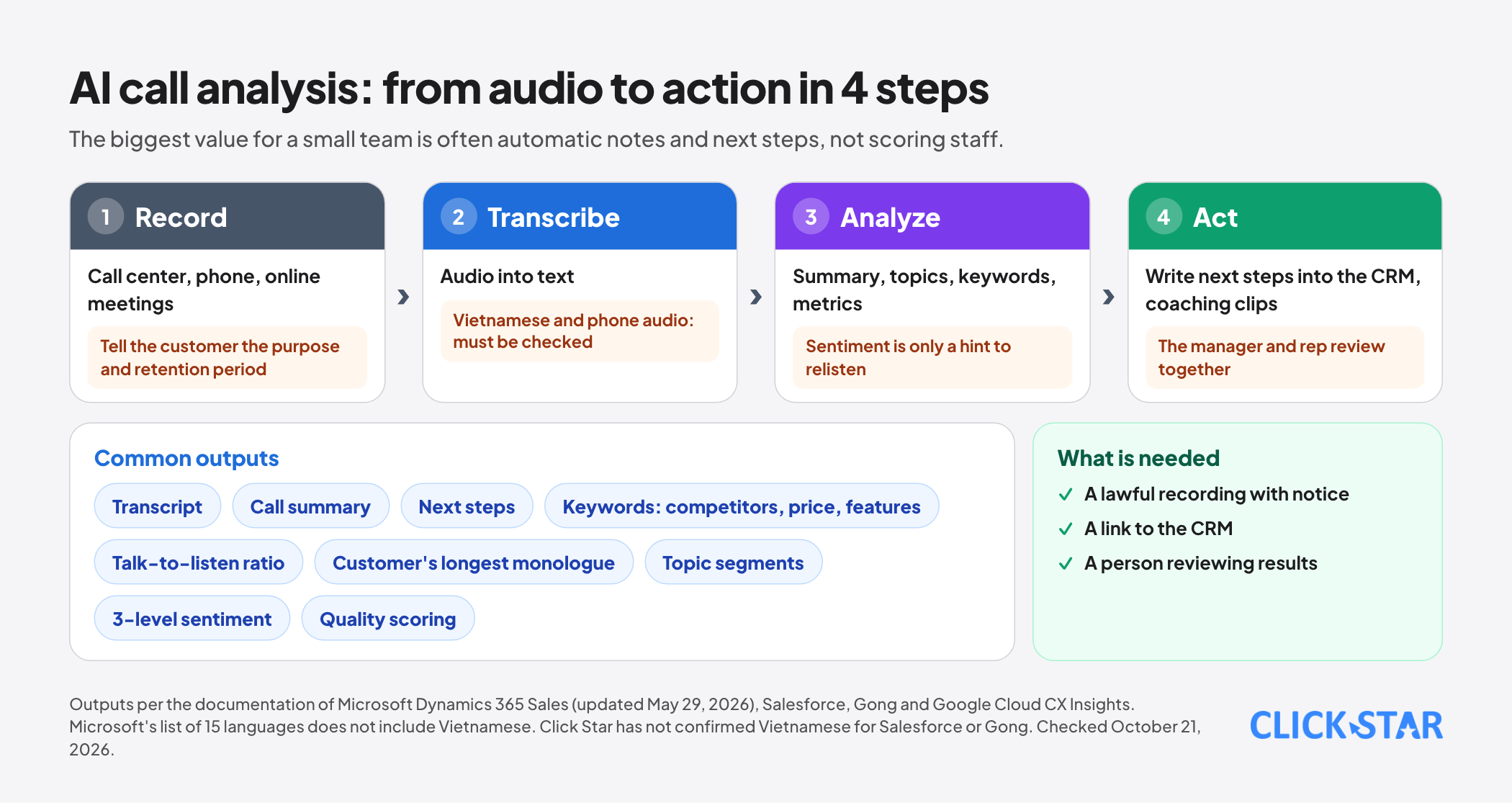
AI call analysis has 4 steps from recording to action; this article covers the 6 jobs sales teams use it for, accuracy on Vietnamese and phone audio, and the privacy points to weigh.
A sales team talks to customers on dozens of calls a day, yet what is left after each call is often a few hurried lines in the CRM, or nothing. AI call analysis aims to keep what is missing: who said what, what the customer cares about and what the next step is.
This article explains what the technology does, which jobs a sales team uses it for, how accurate it is on Vietnamese and phone audio, and what to consider on privacy and on staff. Sources include the documentation of Microsoft Dynamics 365 Sales, Salesforce, Gong and Google Cloud, the original Whisper paper and published studies, read on October 21, 2026.
3 limits need saying plainly. Microsoft's list of supported languages does not include Vietnamese. Click Star found no published accuracy figures for Vietnamese for most products. And Click Star found no Vietnamese rule specific to recording phone calls.
Key points
- AI call analysis has 4 steps: record, transcribe into text, analyze (summary, keywords, metrics) and act (write the next step into the CRM, coach). For a small business the biggest value is often the automatic notes, not scoring staff.
- The list of 15 languages in Dynamics 365 Sales conversation intelligence (updated May 29, 2026) does not include Vietnamese. Click Star could not confirm Vietnamese for Salesforce or Gong from the official documentation it could read.
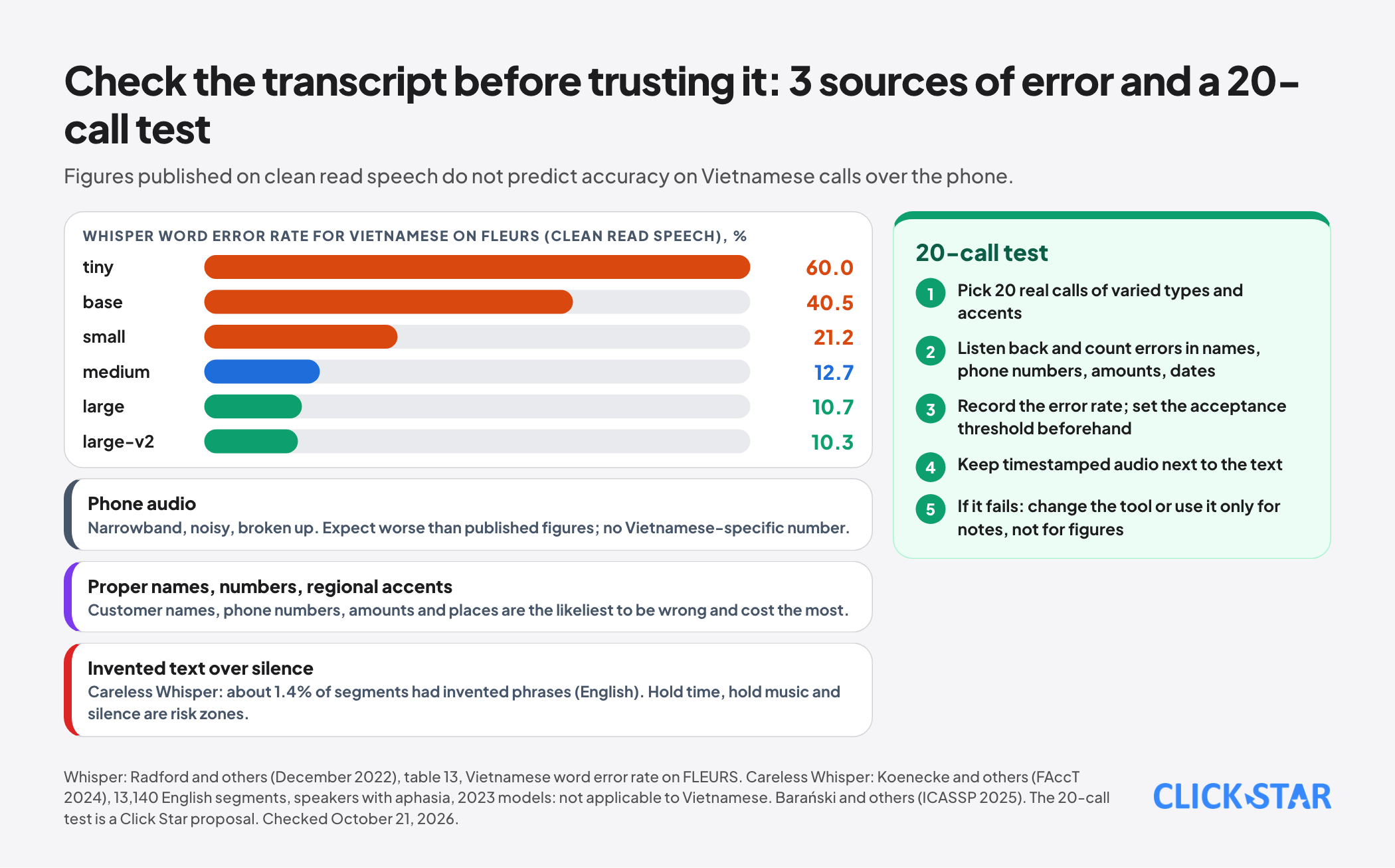
- On the FLEURS dataset (clean read speech), Whisper's word error rate for Vietnamese runs from 60.0% for the smallest model to 10.3% for large-v2. Phone audio is narrower and noisier, so expect worse than the published figures.
- Transcription models can invent text, especially over silence or noise. The "Careless Whisper" study (2024) found about 1% of transcriptions contained whole invented phrases in an English dataset; do not apply that figure to Vietnamese.
- Independent evidence on impact is thin: a randomized field study at a fintech company found AI coaching helped mid-ranked agents most, and worked best when a human manager relayed the feedback.
- A call recording is personal data when tied to an identifiable person. Tell the customer, limit the purpose and retention, and do not use the results to decide pay, bonuses or employment.
What AI call analysis is
A call recording only stores audio. AI call analysis (conversation intelligence) turns that audio into structured data: text, a summary, topics, tracked keywords and metrics about how the 2 sides talk.
According to Microsoft's documentation (page updated May 29, 2026), Dynamics 365 Sales gathers data from sellers' call recordings and from the CRM itself, then shows metrics by team, by seller and by call.
Microsoft's call summary page (November 5, 2024) lists: the seller's talk-to-listen ratio, talking speed, number of switches, average pause, the customer's longest monologue, notes with suggested action items, tracked keywords (competitors, products, questions), a transcript with translation, and a timeline with topic segments and positive, neutral or negative sentiment.
Salesforce Conversation Insights produces call summaries (objections, pricing, next steps, decision makers), insights from custom keywords, coaching clips and draft follow-up emails. Salesforce says the product does not record calls but only processes recordings, so a recording source and a link to the CRM are needed.
Gong's call page includes a transcript, an AI outline, a recap and next steps, a talk-time bar and Q&A with an assistant. Google Cloud CX Insights records the sentiment of caller and agent, call topics and a quality score for every conversation.
What a sales team uses it for: 6 jobs
1. Automatic notes and next steps. This is the clearest value for a small team: staff do not retype the call, and the CRM holds enough for someone else to take over.
2. Coaching with real call segments. Managers replay the key moments (when the customer objects, when the price is given) instead of whole calls. Salesforce calls these coaching clips.
3. Keyword tracking. Counting calls that mention price, a competitor or a feature. This tells marketing and product what customers really care about.
4. Quality control at scale. Instead of listening to a 2% sample of calls, the system scores every call against a set of criteria. Google calls this feature Quality AI.
5. Finding why deals are lost. Gather the calls of lost deals to see which objections repeat.
6. Training new staff. A labeled library of calls lets newcomers hear how the team handles each situation.
Common metrics and how to read them
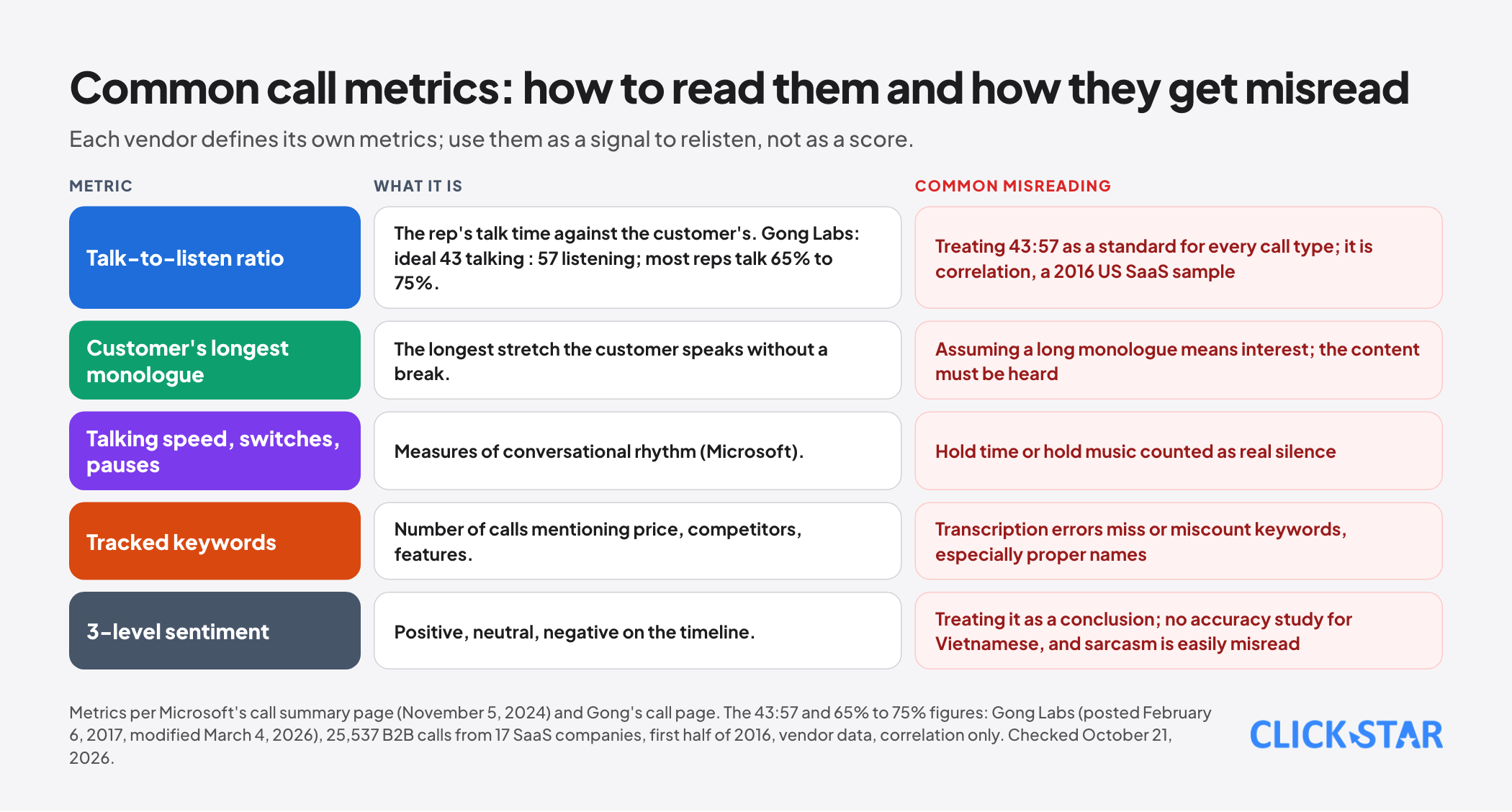
Each vendor defines metrics in its own product, and Click Star found no neutral standard. Microsoft lists talk-to-listen ratio, the customer's longest monologue, talking speed, number of switches and pause length. Gong lists talk ratio and longest monologue.
The most quoted figure is the talk-to-listen ratio. According to Gong Labs (post of February 6, 2017, modified March 4, 2026), across about 25,537 B2B sales calls from 17 mostly mid-market SaaS companies in the first half of 2016, the ideal ratio was 43 talking to 57 listening, and most reps talked 65% to 75% of the time.
This figure needs a careful read. It is vendor data, it shows only correlation, the page states no controls, statistical tests or definition of "high-performing," and the sample is US SaaS in 2016.
Click Star's view. Use the talk-to-listen ratio as a signal to replay a call, not as a score. A technical-support call and a closing call have very different suitable ratios.
On sentiment, Microsoft shows only 3 levels, positive, neutral and negative, on the timeline. Click Star found no study on the accuracy of sentiment analysis in call centers or in Vietnamese, and text sentiment analysis struggles with sarcasm (Sykora and others, Big Data & Society, 2020). Treat it as a hint to relisten, not a conclusion.
Vietnamese and phone audio: real-world accuracy
Language support. The list for Dynamics 365 Sales conversation intelligence has 15 languages (Arabic, Simplified Chinese, Danish, Dutch, English, Finnish, French, German, Hebrew, Italian, Japanese, Norwegian, Portuguese, Spanish, Swedish) and does not include Vietnamese.
Salesforce's Trailhead says results vary widely between languages, and Click Star did not see Vietnamese named. Click Star could not confirm Vietnamese for Salesforce or Gong.
Transcription engines. Google Cloud Speech-to-Text supports vi-VN in version V2, but its official page publishes no error rate and Click Star could not read its price list. For Whisper, the original paper (Radford and others, December 2022) publishes the Vietnamese word error rate on the FLEURS set: tiny 60.0%, base 40.5%, small 21.2%, medium 12.7%, large 10.7% and large-v2 10.3% (table 13).
FLEURS is clean read speech in a quiet setting, not a call center. A study on narrowband audio (arXiv 1909.02667, not Vietnamese) found that a model trained only on wideband speech had a clearly higher error rate on telephone audio. So expect real results to be worse than the published figures, and there is no figure to give for Vietnamese over the phone.
Price. OpenAI's pricing page (read October 21, 2026) lists transcription at about USD 0.006 per minute for whisper-1 and gpt-4o-transcribe (a per-minute estimate) and USD 0.003 for gpt-4o-mini-transcribe.
Under Click Star's assumption, 1 rep making 20 calls a day of 5 minutes each over 22 days is 2,200 minutes, about USD 13 a month for transcription alone, excluding analysis, storage and the platform.
Hallucination in transcription. The "Careless Whisper" study (Koenecke and others, FAccT 2024) analyzed 13,140 English segments from the AphasiaBank set and found about 1.4% of segments contained whole invented phrases (1.7% for people with aphasia, 1.2% for the control group).
Among the invented transcriptions, about 19% contained violent content, 13% false associations and 8% false authority. More silence made invention more likely.
The study's limits: English only, speakers with aphasia, 2023 models. Systems from Google, Azure, AWS, AssemblyAI and RevAI showed no comparable hallucination in its test. Do not use the 1% figure for Vietnamese calls.
Another study (Barański and others, ICASSP 2025) shows that stretches of silence or noise can trigger invented text. In a call center, hold time, hold music and silence are risk zones; keep timestamped audio next to the text so a person can check.
Legal and privacy points
Click Star does not give legal advice. This section rests on summaries and needs checking against the original text.
A recording is personal data when tied to an identifiable person. The Law on Personal Data Protection No. 91/2025/QH15 (in effect January 1, 2026) defines personal data as information that identifies or helps identify a specific individual. Article 2 does not mention voice specifically. Click Star's inference, not a legal conclusion: a recording linked to a name or phone number is personal data.
According to EY Vietnam, Decree 356/2025/NĐ-CP allows consent to be given by voice or a recorded call. Article 32 of the law covers recording in public places, not phone calls. Click Star found no Vietnamese rule specific to recording calls, so it cannot state a specific rule.
A careful approach. Tell the customer at the start of the call that it is recorded and why, use it only for the stated purpose, set a retention period, and be able to delete on request. Microsoft and Salesforce both put the duty to obtain consent and give notice on their customers.
In the US, federal law requires one party's consent, but about 11 states require all parties (according to compliance blogs, not statutes).
Staff need protection too. Microsoft says plainly that the feature is not for decisions on employment, pay or rewards. The meta-analysis by Siegel, König and Lazar (2022, 70 samples, 233 effect sizes) on electronic monitoring at work found a small rise in stress, a small fall in job satisfaction and no link to performance.
That is research on monitoring in general, not AI call analytics specifically. A meta-analysis of 94 studies (Ravid and others) found that transparent, less invasive monitoring is better received. Tell staff what the calls are used for.
Evidence of impact
Independent evidence is very limited. The study by Luo, Qin, Fang and Qu ("AI Coaches for Sales Agents," Journal of Marketing; AMA release of November 19, 2020) comprised 3 randomized experiments at a fintech company with 429, 100 and 451 agents, using voice-analysis AI for coaching.
Mid-ranked agents gained the most. Bottom-ranked agents were overloaded with information, top-ranked agents resisted the AI, and the most effective approach was a human manager relaying the AI's feedback. The release does not say explicitly that call recordings were used.
The study "Generative AI at Work" (Brynjolfsson, Li and Raymond, QJE 2025) recorded about 14% more issues resolved per hour (34% for novices) across 5,179 support agents. That is a real-time AI assistant for chat agents, not post-call analytics, so it is only adjacent evidence.
A 30-day rollout
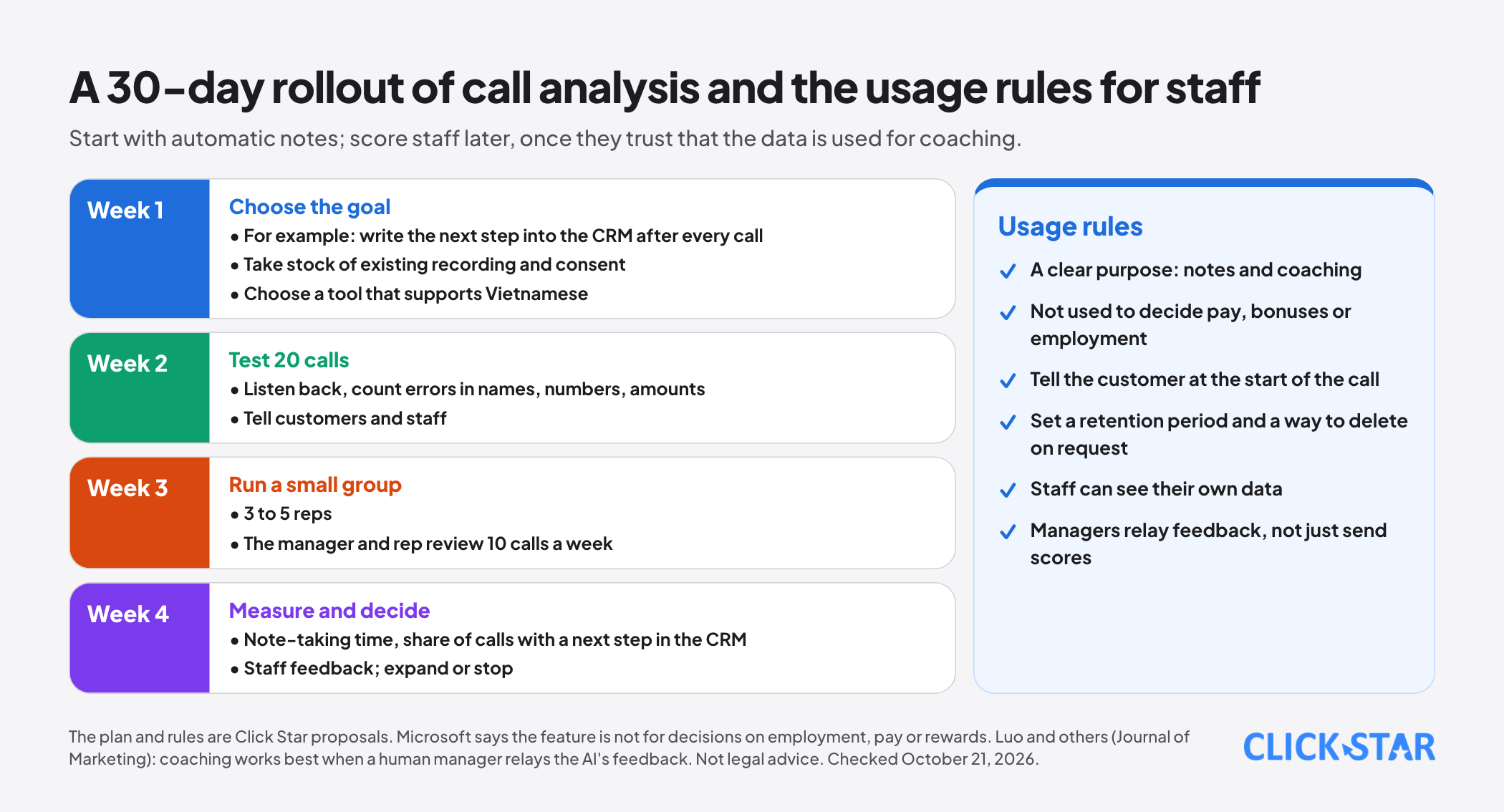
- Week 1: choose one goal (for example, write the next step into the CRM after every call), take stock of existing recording and consent, choose a tool that supports Vietnamese.
- Week 2: test 20 real calls, listen back and count errors in names, phone numbers and amounts; tell customers and staff what the calls are used for.
- Week 3: run with 3 to 5 reps, with the manager and the rep reviewing 10 calls a week.
- Week 4: measure note-taking time, the share of calls with a next step in the CRM and staff feedback; decide whether to expand or stop.
Click Star's view. Start with automatic notes and next steps, because that is the part staff see the benefit of right away. Scoring staff can come later, and only once they trust that the data is used for coaching.
What is not known
Click Star has no independent measurement of Vietnamese accuracy for any call-analysis product, has not confirmed that Salesforce, Gong and Azure support Vietnamese, and could not read Google's and Azure's prices.
It is unclear what Vietnamese rules apply to recording customer-care calls. There is no independent research on the accuracy of sentiment analysis in Vietnamese.
Common mistakes
- Trusting a transcript as exact text without checking names and numbers against the original audio.
- Using figures published on clean read speech to predict accuracy over the phone.
- Recording without telling the customer the purpose and retention period.
- Using call scores to decide pay, bonuses or dismissal.
- Rolling out to the whole team at once, without testing a small group and 20 real calls.
- Treating sentiment analysis as a conclusion instead of a hint to relisten.
- Choosing a tool that has not been confirmed to support Vietnamese.
Related posts
Need tailored advice for your business?
Click Star helps you build a solution that fits your industry and scale. We answer every question during business hours.