6 tech stories, Nov 9-15: which have real numbers, which are claims?
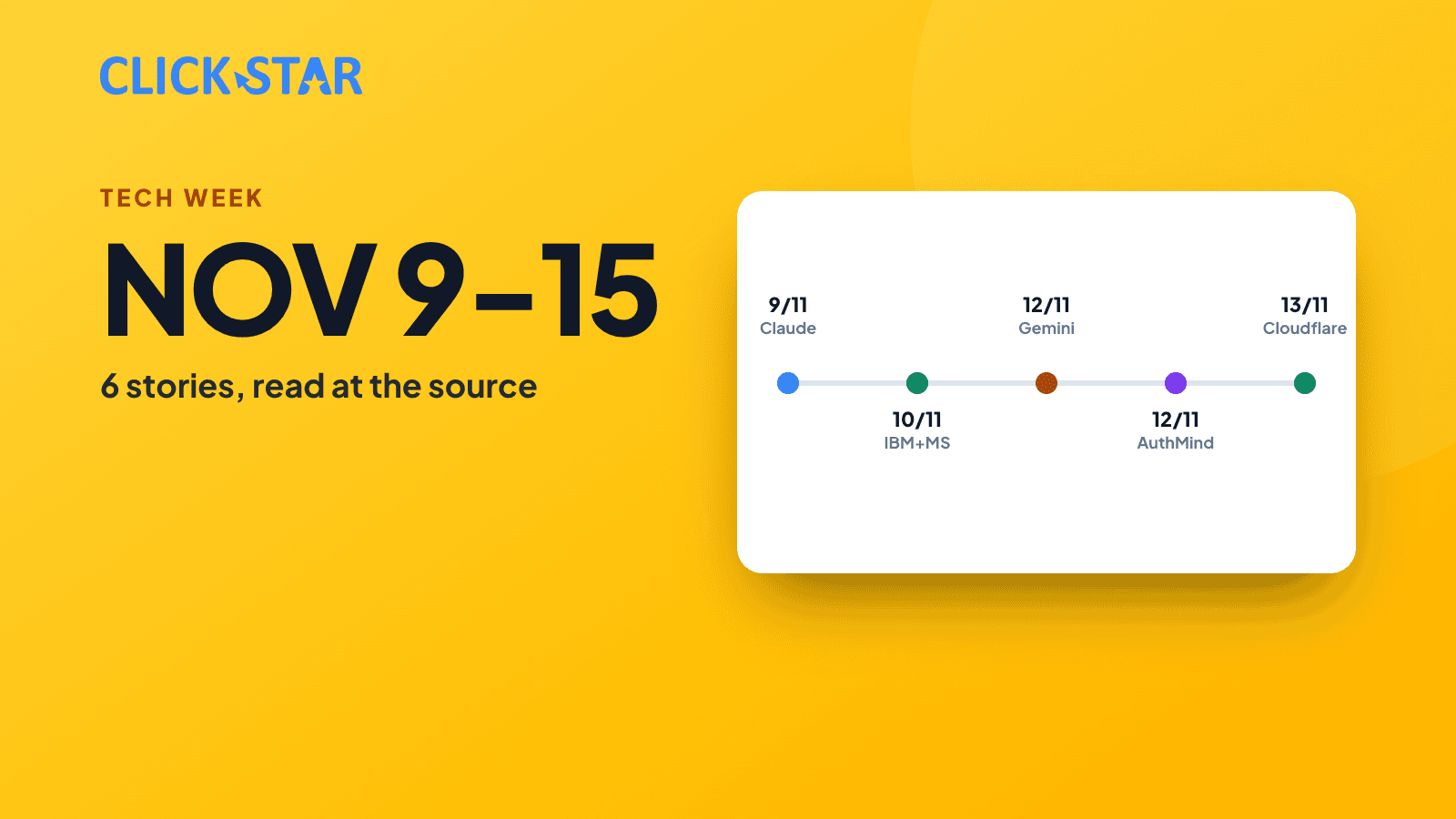
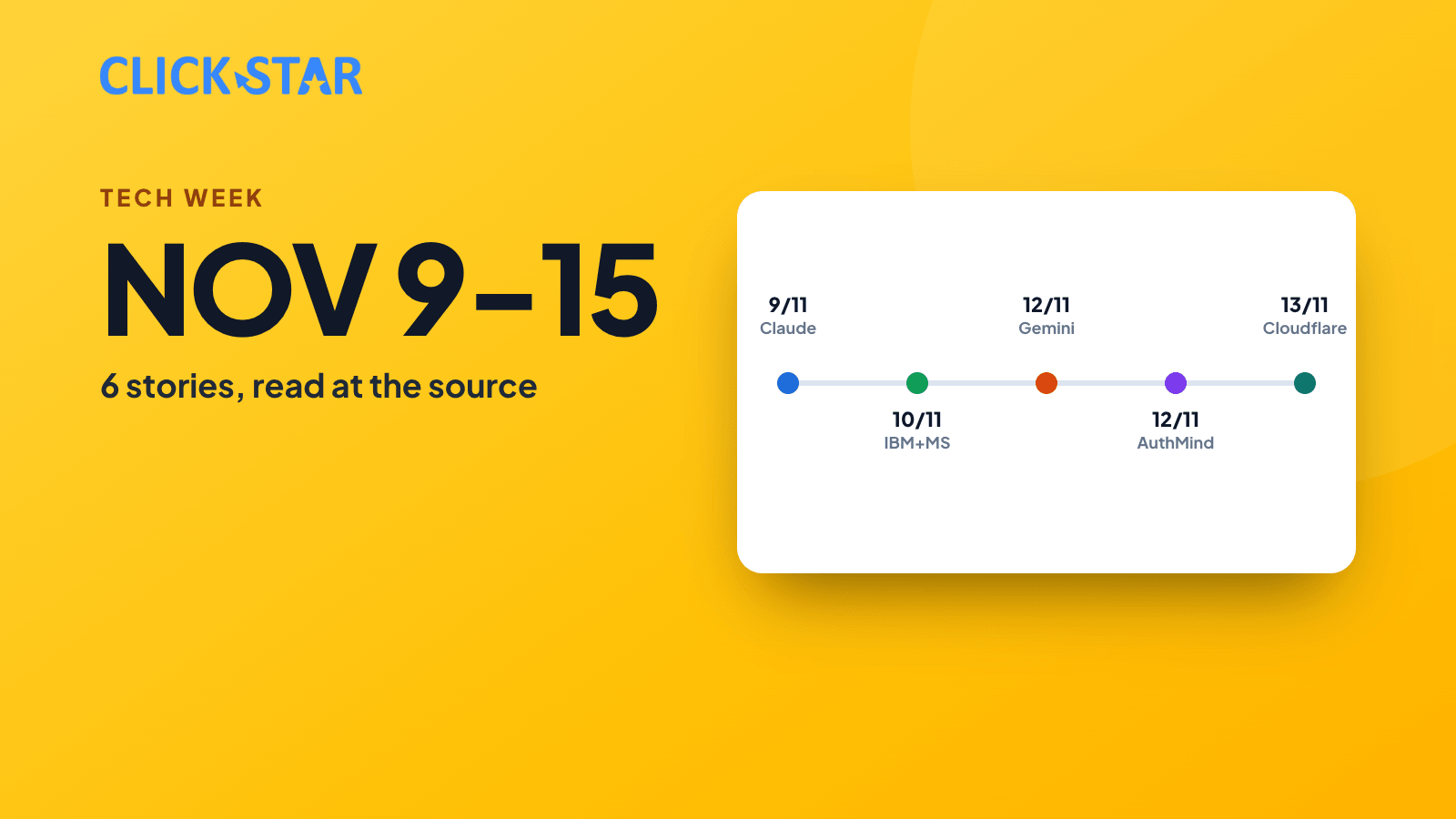
6 tech stories from Nov 9-15, separating what companies claim from what has independent numbers, plus 4 tasks a business can do now.
Over this week, a business owner sees 3 announcements in a row: an agent platform from IBM and Microsoft, a new model from Google, and a new model from Anthropic. Does anything need to change? This is an illustrative scenario, not a real client.
This article reads 6 stories from the week of November 9 to 15, 2026, checked on November 16, 2026. Each story was opened at the company's own page.
It answers 3 questions: what was checked, what is only the company's own claim, and what a business can do this week.
Key points
- Anthropic released Claude Fable 5.2 and Mythos 5.2 (Nov 9) at $8 and $40 per million tokens. A third-party site measured Fable 5.2 only, not Mythos 5.2: it ranks Fable 5.2 first of 80 models in its summary, but running its test also costs the most.
- Google released Gemini 4 Hydrogen (Nov 12) at $1.50 and $7.50 per million tokens. The scores Google cites match the third-party site. On speed and tokens, Google writes that it is often faster and uses fewer output tokens, while the measuring site calls it "very verbose"; Click Star does not arbitrate.
- IBM and Microsoft launched Imagine Enterprise (Nov 10) with more than 6,000 pre-built agents and assets. The release says it is available through IBM Consulting engagements, but gives no price, region or wider availability date, and there is no independent check yet.
- IBM acquired AuthMind and listed 5 steps for governing agents (Nov 12): register, delegate, authorize, audit, revoke. This is a direction IBM states for itself, with no sale date.
- Cloudflare reports AI pentest tools sending 30 times more requests since Oct 1 (Nov 13). Cloudflare observed this itself, and it sells the products it recommends.
- Cloudflare launched Spend Management in beta (Nov 13) to set spending caps. It currently covers only Workers and Durable Objects.
How to read this: company claims versus independent checks
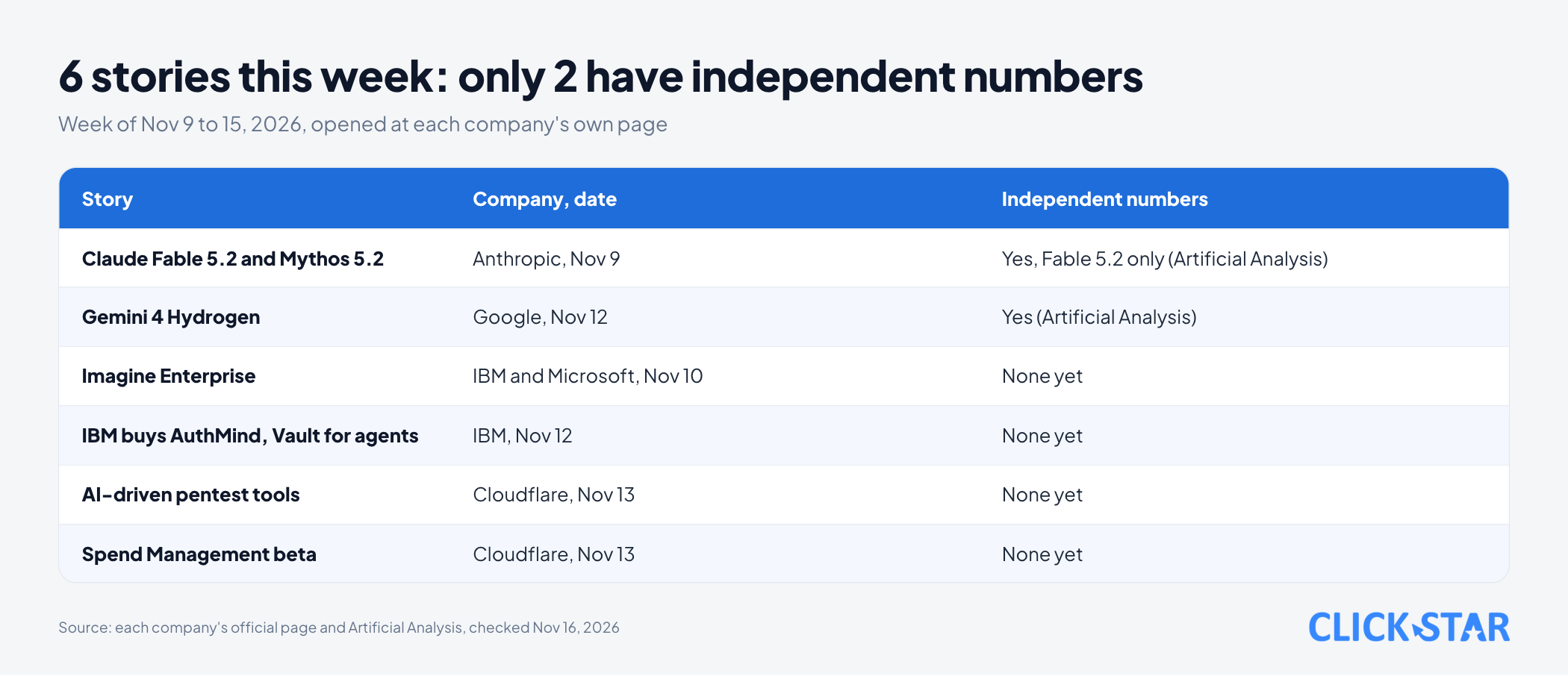
All 6 stories this week are the company's own press releases or posts. A number in a release shows what the company wants to say, not what the product can do.
This article uses 2 labels. "Company claim" means what the company's official page says. "Independently checked" is used only when a third party measured and published its own numbers.
Of the 6 stories, only 2 have third-party numbers, from Artificial Analysis (a site that evaluates AI models, read on November 16, 2026): Fable 5.2 and Gemini 4 Hydrogen. Mythos 5.2 has no page there. The other 4 stories have no third-party numbers.
Group 1: AI models and products
Claude Fable 5.2 and Mythos 5.2 are a single underlying model with different safeguards. According to Anthropic's page (Nov 9, 2026), Fable blocks high-risk cybersecurity and biology use, so it is open to all users; Mythos is for organizations in a verification program.
Anthropic lists $8 per million input tokens and $40 per million output tokens. Fast mode generates text up to 2.5 times faster at $16 and $80. A token is the unit of text a model reads and writes; prices are in USD.
One detail matters for security teams: Anthropic writes that Fable 5.2 blocks high-risk cybersecurity work, including penetration testing. A blocked query is answered by Opus 4.8 instead.
Gemini 4 Hydrogen is Google's model for everyday work. According to Google's post (Nov 12, 2026; page shows "last updated" Nov 13), Hydrogen has a 1 million token context window at a flat $1.50 and $7.50 per million tokens.
What was cross-checked: Google says Hydrogen scores 51 at its default reasoning level and 54 at the highest on the Artificial Analysis index. Artificial Analysis's own page shows 54, 51, 41 and 27 across the 4 levels, and the same $1.50 and $7.50 prices.
On speed, Google writes that Hydrogen often finishes tasks faster and uses fewer output tokens than some models in its class (no benchmark named), and finishes 2.5 times faster than Gemini 3.8 Flash, Google's earlier model, at its high default setting.
Artificial Analysis records 14.8 minutes per task at Xhigh and 8.4 at High (the default); median 13.3. Hydrogen produced 304 million output tokens at Xhigh (High: 110 million), against a median of 77.3 million, and the page calls it "very verbose".
The 2 sources differ on tokens, but against different comparisons; Click Star does not arbitrate.
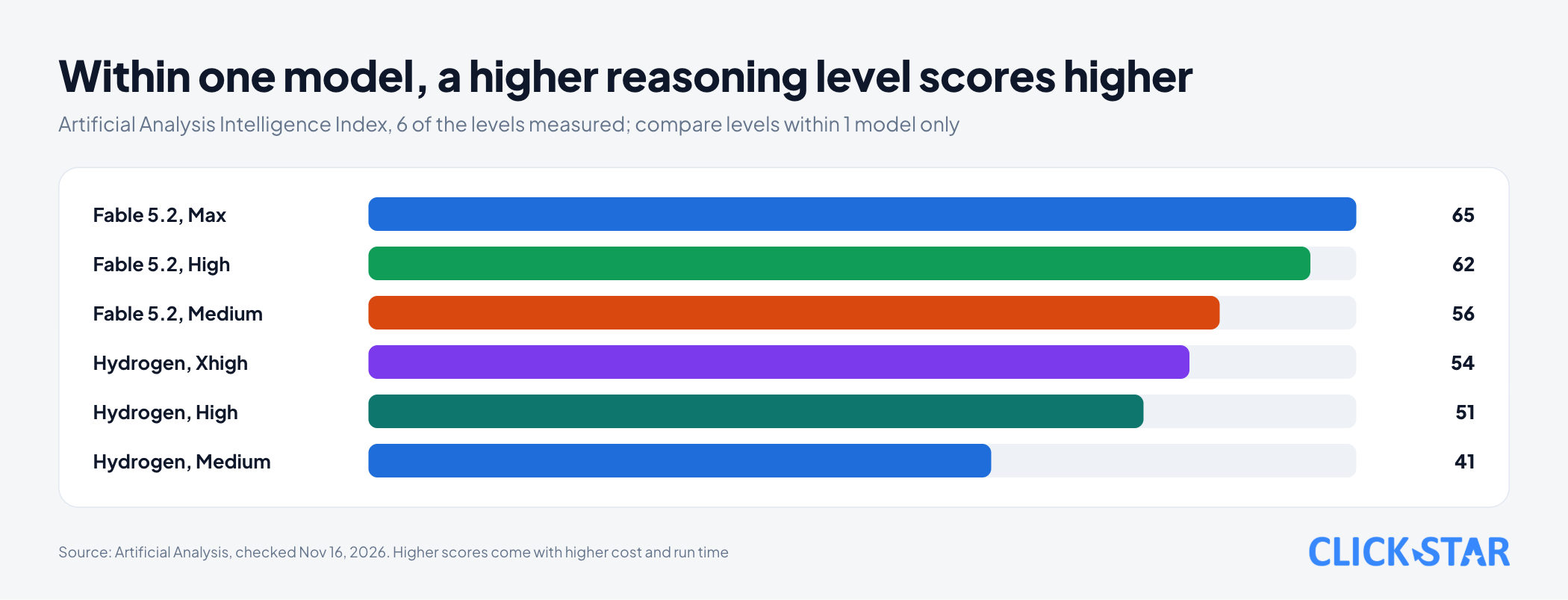
For Fable 5.2, Artificial Analysis gives 65 at Max, rank 1 of 80 in the page's summary. At Max, each task in the suite costs $26.54 and takes 44.5 minutes; Hydrogen at its top level costs $3.16 and 14.8 minutes.
These 2 settings are not equivalent, so they cannot be compared directly. A high score comes with cost and run time, so price per token alone is not enough to pick a model.
Group 2: enterprise agent platforms
Imagine Enterprise is a platform to build, run and govern industry-specific agents. An agent here is AI software that carries out a chain of tasks on its own. According to IBM's release (Nov 10, 2026), IBM Consulting contributes more than 6,000 pre-built agents and assets, and Microsoft provides the AI, data, cloud and security layer.
The first industry frameworks cover financial services, insurance and retail. The release says it is available to clients through IBM Consulting engagements (deployed and run on the client's behalf, or built together), and self-management options also exist.
The release gives no price, region or wider availability date. The named client, SEI, is exploring agentic technologies with IBM Consulting and using some other technologies from the 2 companies; the release gives no operating results.
Read the 6,000 figure carefully: the release words it inconsistently, "agents and assets" in one place and "6,000 AI agents" in another; Click Star reads it cautiously as not 6,000 agents that run out of the box. CIO Dive (trade press, secondary, Nov 10, 2026) quotes no independent analyst on the platform and treats the number as the vendor's.
The second story is IBM's acquisition of AuthMind, a company that monitors how identities use their access. According to IBM's post (Nov 12, 2026), AuthMind will add to HashiCorp Vault, IBM's store for keys and secrets.
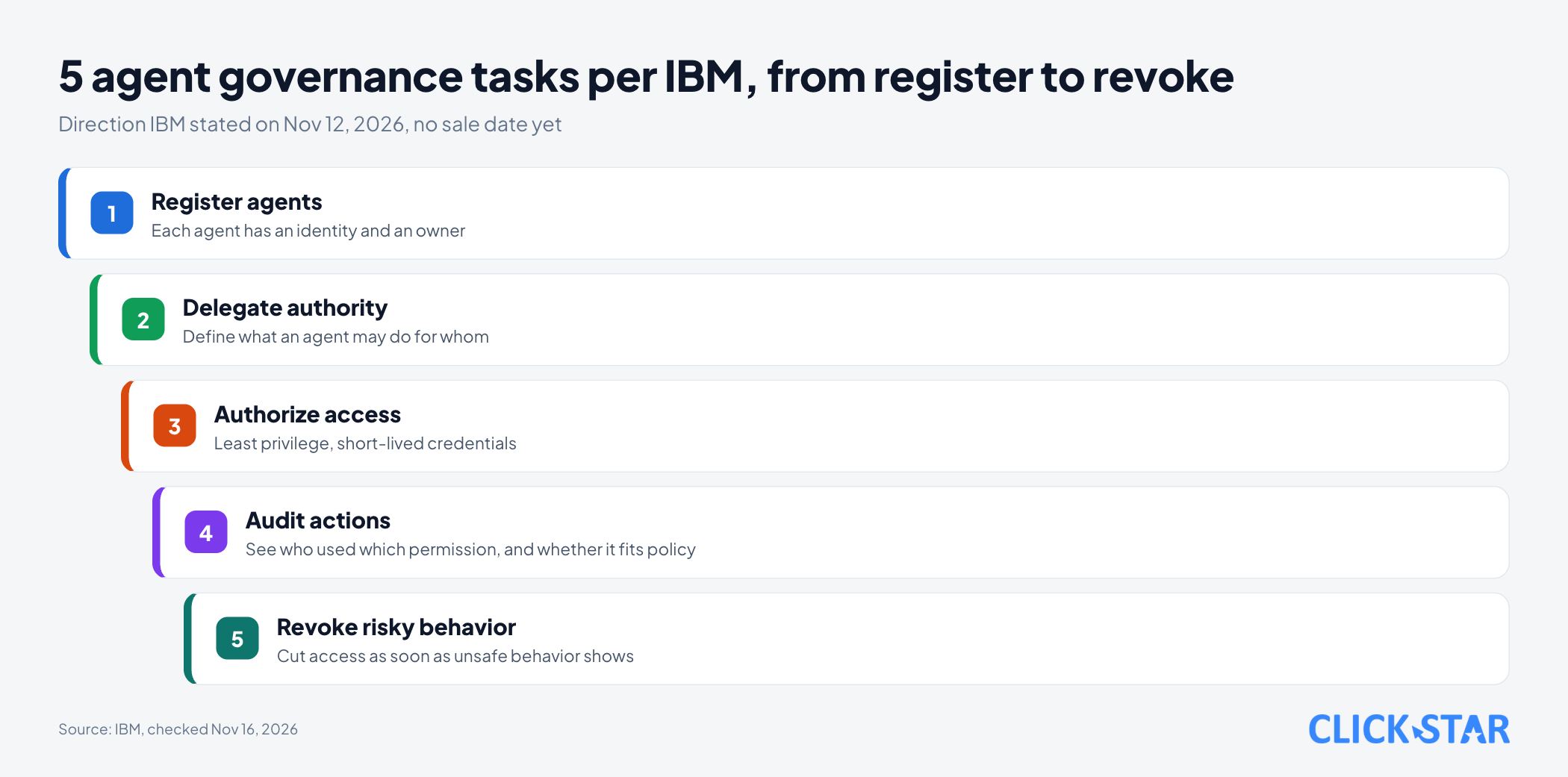
IBM lists 5 things it wants for agents: register, delegate, authorize, audit, revoke. The post gives no sale date, price or deal terms.
Group 3: infrastructure and security
Cloudflare warns that AI-driven penetration testing tools are spreading. According to Cloudflare's post (Nov 13, 2026), in the last 3 days it saw more than 50 tool families trying to scan its customers, and daily requests to such tools are up 30 times since Oct 1.
The post says the open-source tool ARTEX was taken down by its author on Oct 8, yet there are now more than 12,000 repositories in this ecosystem, several hundred of them direct forks. These are Cloudflare's own observations, not yet checked by a third party.
The most usable part is an incident case. Cloudflare writes that ARTEX gained access to a compromised account-level API token, previously used for CI/CD (the automated pipeline that ships code), with no IP restriction or rate limiting.
Across several incidents, it also saw attackers repeatedly compromise static, non-expiring tokens in such pipelines.
With that token, the tool created many Workers scripts, sent more than 69 requests per minute and 400 database dump requests in an hour. Cloudflare believes much of the activity was only lightly guided by a human operator.
Cloudflare proposes 6 pillars, from a web application firewall to identity-based access. It sells these products, so read this as a vendor's view.
Cloudflare's second story is closer to the wallet. Spend Management, in beta, lets pay-as-you-go customers set spending thresholds, and when a limit is reached Cloudflare blocks code invocations that incur cost (Cron Triggers and Queue consumers pause, static assets are still served). It covers only Workers and Durable Objects for now.
Cloudflare says spend updates in near real time, under 10 minutes, and the block is enforced asynchronously. Click Star infers that spend can slightly exceed the limit before the block takes effect (an inference; the post does not state the overshoot).
What this means for businesses in Vietnam
The pages read contain no Vietnam-specific numbers and do not state Vietnamese language support for Hydrogen, Fable or Imagine Enterprise.
Real cost depends on text volume and the reasoning level. A benchmark score does not replace testing with your own Vietnamese documents.
Click Star's view. Worth separating: reading the score and reading the real running cost. A high-scoring model that runs long and uses many tokens can cost more than a slightly lower-scoring one.
The agent stories are more useful for their points on permissions and logs than for the count of pre-built agents. Click Star offers AI integration services, so it has a related interest.
One of the 6 stories is a product of Anthropic, the company that develops the Claude models; figures about it come from Anthropic's page and Artificial Analysis. This view rests on the sources named.
What to do this week: 4 tasks
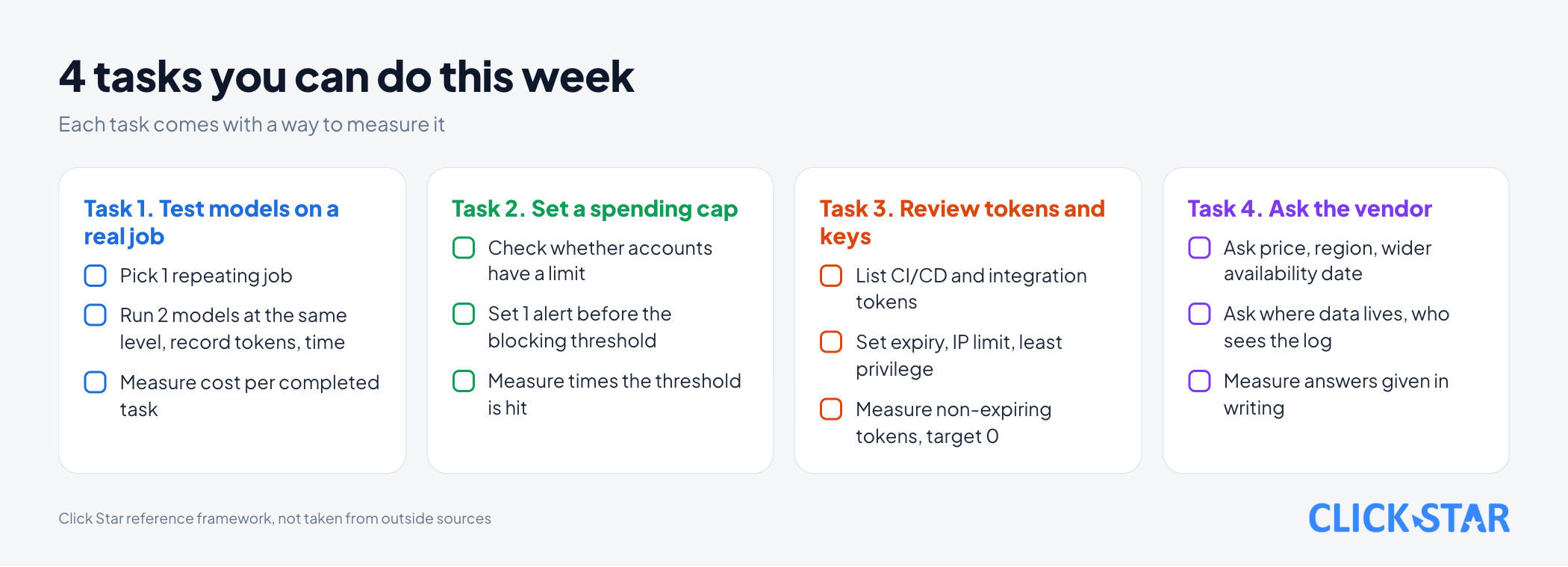
This is a Click Star reference framework, not taken from outside sources. Each task has a way to measure it.
Task 1. Test models on a real job.
- Pick 1 repeating job, such as drafting customer replies or summarizing contracts.
- Run 2 models at the same reasoning level and record tokens and time.
- Measure: cost per completed task, not price per million tokens.
Task 2. Set a spending cap.
- Check whether the AI and cloud accounts have a limit or spend alert.
- Set 1 alert threshold before the blocking threshold, with a recipient email.
- Measure: times the threshold was hit in the billing cycle, and actual spend against the limit.
Task 3. Review tokens and automation keys.
- List the API tokens used in CI/CD and integrations.
- Set an expiry, an IP restriction and least privilege for each token.
- Measure: tokens without expiry still in use, with a target of 0.
Task 4. Ask the vendor before buying a pre-built agent.
- Ask for price, region and wider availability date, and require answers in writing.
- Ask where company data is stored and who can see the action log.
- Measure: number of questions answered in writing before signing.
Common mistakes
- Switching models because of release scores, without testing on your own Vietnamese data.
- Comparing price per token while ignoring how many tokens the model produces for the same job.
- Reading "more than 6,000 agents and assets" as "6,000 agents that run immediately".
- Treating numbers a security vendor observed itself as an industry-wide measurement.
- Issuing non-expiring tokens to automation "for convenience", then forgetting to revoke them.
What is not known
The release names both consulting engagements and self-management options. Unclear: price, region (Vietnam or not), wider availability date, what self-management includes, and what the 6,000 agents do. No independent measurement yet.
It is unclear when IBM will sell the new Agent Identity features, and what the AuthMind deal terms are. For Cloudflare, no third party has checked the 30 times and 12,000 repositories figures.
Some other stories on this week's list could not be verified at the source, so they are not in the main article. OpenAI's pages block the tool, so its ChatGPT Wallet and Businesses in ChatGPT posts were not opened; only a 1-line description in OpenAI's official news feed was read (Nov 16, 2026).
Oracle's blog also blocks the tool, so the Oracle and LangChain story is unverified.
Prices and features can change after the reading date.
Related posts
Need tailored advice for your business?
Click Star helps you build a solution that fits your industry and scale. We answer every question during business hours.