Is AI taking young people's first jobs? What the data says
Stanford finds employment of 22 to 25 year olds in AI-exposed jobs 19% lower, mainly from fewer hires. The article compares Stanford, the Dallas Fed, Yale, NACE, PwC and the ILO on Vietnam.
A recent graduate sends dozens of applications for customer support and junior developer roles, and almost nobody calls back. This is an illustrative scenario, not a measurement.
This article re-reads Stanford's "Canaries in the Coal Mine?" study (August 2026 version, news page dated August 12, 2026) and sets it beside data from the Dallas Fed, Yale Budget Lab, NACE, PwC and an ILO report on Vietnam, checked on November 15, 2026. Most of the data is from the US.
It answers 3 questions: what the 19% figure measures, how far the evidence points to AI as the cause, and where Vietnam stands. It does not give career advice.
Key points
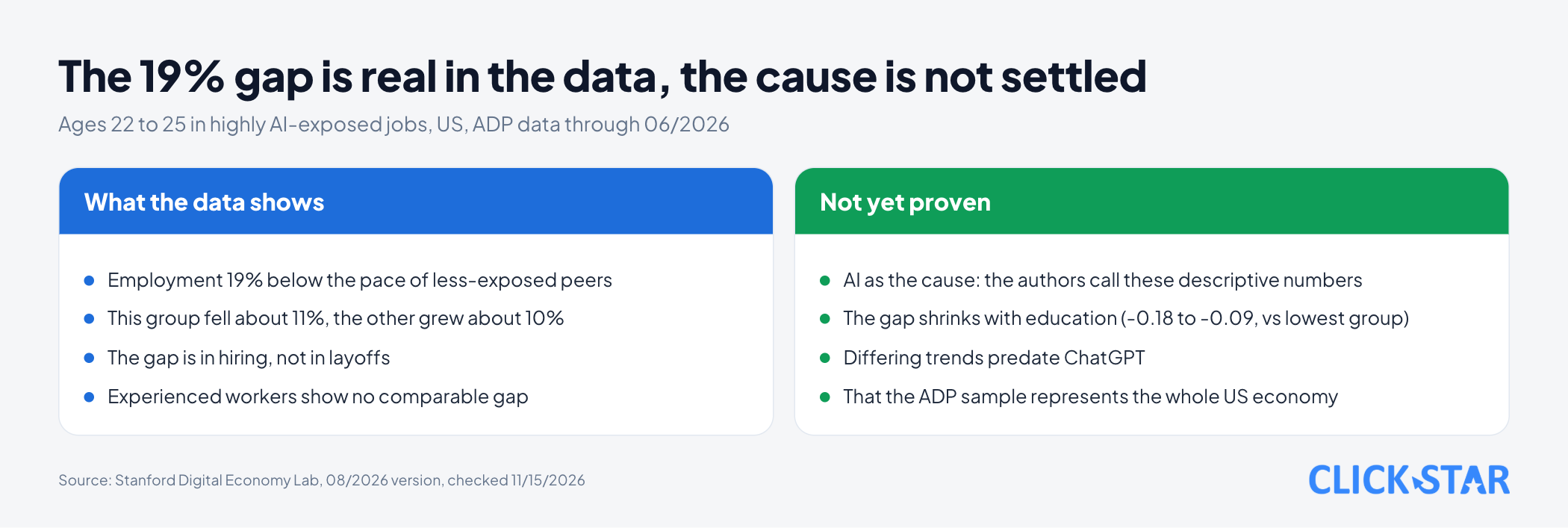
- According to Stanford, employment of workers aged 22 to 25 in highly AI-exposed occupations is 19% below where it would be had it kept pace with less-exposed peers (data through June 2026). Experienced workers show no comparable gap.
- The authors do not see widespread, economy-wide job loss. The gap comes mainly from fewer young people being hired, not from more layoffs.
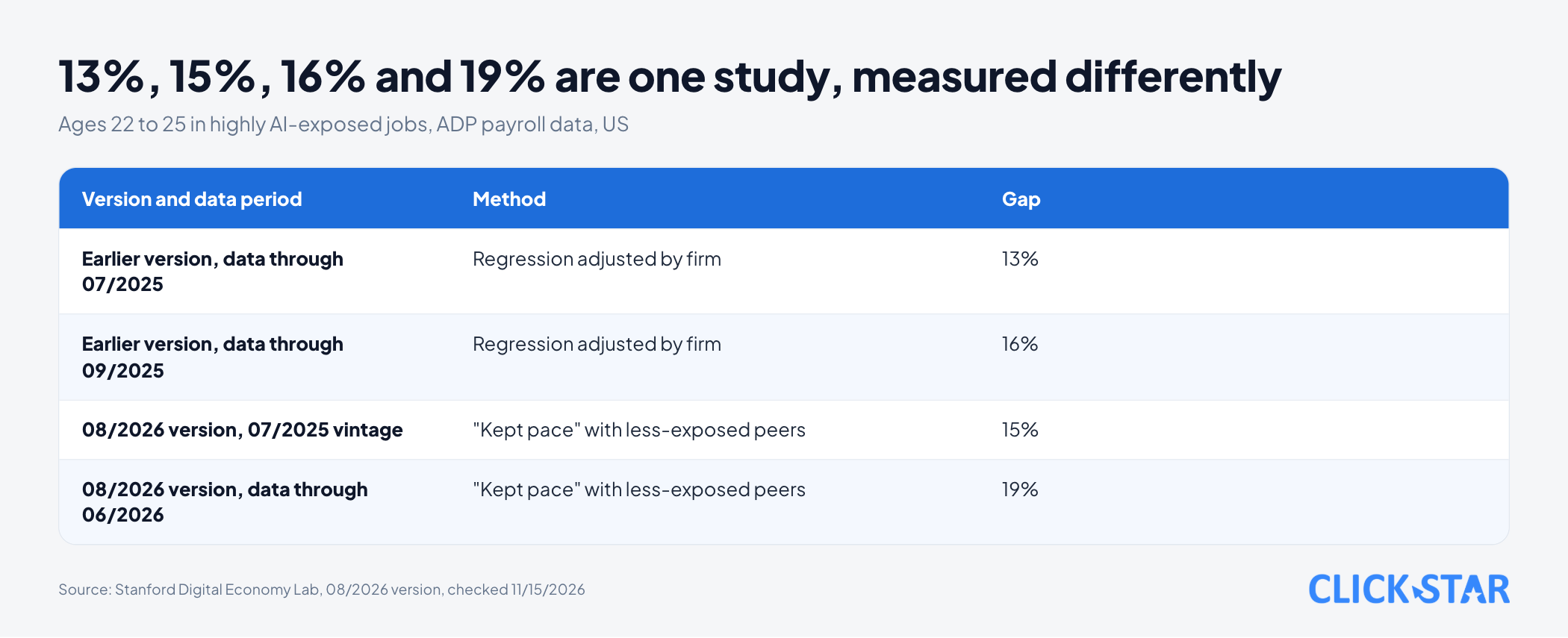
- The figures 13%, 15%, 16% and 19% come from the same study but use different methods and data periods. They are not 4 independent results.
- These are descriptive numbers, not causal estimates. The gap shrinks once education is accounted for, and differing trends predate ChatGPT.
- Other sources see no broad effect: the Dallas Fed calculates that if all of the job decline of 20 to 24 year olds in highly exposed jobs became unemployment, overall unemployment would rise only 0.1 percentage point. Yale sees no clear signal yet.
- In Vietnam, the ILO (April 2026) found no clear evidence of fewer opportunities for highly educated young workers in exposed sectors in 2022 to 2024.
What Stanford's 19% actually measures
The 19% is a comparison, not a count of people who lost jobs. It compares employment of 22 to 25 year olds in highly AI-exposed jobs with what it would be had they grown like same-age workers in less-exposed jobs.
According to the study itself (PDF, August 2026, read November 15, 2026), Brynjolfsson, Chandar and Chen use payroll data from ADP, which runs payroll for firms employing over 26 million US workers. The sample is firms observed continuously from January 2021 to June 2026, with 3.5 to 5 million employees each month.
Each occupation is scored for AI exposure (Eloundou et al., 2024 scale) and split into 5 groups. "Highly exposed" means the top 2 groups, "less exposed" the other 3.
From November 2022 to June 2026, employment of 22 to 25 year olds in the 2 most exposed groups fell about 11%, while in the other 3 it grew about 10%. The paper puts the gap at 19% relative to the growing group.
In the same period the whole ADP sample grew about 6%, while 22 to 25 year olds overall were about 2% below their November 2022 level.
Why one study has 13%, 15%, 16% and 19%
The figures differ because the method and data period differ. According to the August 2026 version (read November 15, 2026), earlier versions headlined a regression adjusting for firm-level shocks: 13% with data through July 2025 and 16% with data through September 2025.
The new version emphasizes the simpler "kept pace" measure described above. With it, the gap is 15% at the July 2025 data vintage and 19% as of June 2026. After improved data processing, results are qualitatively similar, but firm-adjusted estimates are more sensitive to the change than raw descriptive figures.
Dallas Fed (January 6, 2026) cites 13%, while NACE (May 13, 2026) cites 16%.
Fewer hires, not more layoffs
According to the Stanford paper, the gap opens at the hiring stage. Since 2022, both hiring rates and separation rates (workers leaving a firm, whether laid off or quitting) have fallen across ages. Among young workers, separation rates in highly exposed jobs fell no less than in less exposed ones, the opposite of a replacement story.
The Dallas Fed (January 6, 2026, read November 15, 2026) used a different source, the US Current Population Survey with about 100,000 people. It found that employment of 20 to 24 year olds in highly exposed jobs fell mainly because fewer people moved from outside the labor force into jobs, not because of layoffs.
The Dallas Fed calculated that if all of that decline became unemployment, overall unemployment would rise by only 0.1 percentage point since November 2022. This is a hypothetical, and the Dallas Fed says the pattern may not be causal.
Inference of this article: that is why the effect is hard to see in unemployment news, as young people may not be laid off, just unable to get in.
Why it could be AI: hypothesis and data
According to the study itself (PDF, August 2026), the authors suggest AI reproduces written-down knowledge well (textbooks, procedures), while tacit knowledge gained through practice and mentoring is harder to replace.
The study also uses data on how people use AI assistants from the Anthropic Economic Index (March 2025 release). Employment fell in jobs where AI is used mostly to automate tasks, and was flat or rising where it is used to assist. Inference of this article: the data comes from 1 company, so it reflects only part of how AI is used.
PwC (press release June 15, 2026, read November 15, 2026) looks at job ads. Based on 2.4 million US entry-level roles analysed, those most exposed to AI are 7 times more likely to ask for skills usually expected of senior staff (leadership, creativity, face-to-face work). Such roles grew 35% since 2019, while other entry-level roles shrank 10%.
Inference of this article: the 2 sources use different data but both hint that the first rung is moving up, as repetitive work that once taught the job shrinks. Neither source says this.
Limits of the evidence
The Stanford authors themselves name 3 weaknesses. First, once the education level of the occupation is accounted for, the gap shrinks: in the main sample (firms observed continuously since January 2018), the estimate for ages 22 to 25 in the most exposed group falls from -0.18 to -0.09, still significant at the 10% level.
In the sample observed from January 2021 it falls from -0.19 to -0.06 and is not significant. This compares top with bottom group, unlike the 19%.
Second, differing trends predate ChatGPT. Highly exposed occupations boomed relative to others during the pandemic, then declined. By November 2022 they were back near their 2018 to 2019 position, and the later decline pushed the gap below the old baseline.
Third, the ADP sample may not be representative. For 2022 to 2024 the gap is -0.132 in ADP but -0.022 in the American Community Survey (ACS), with a confidence interval of -0.055 to +0.011. The authors say the direction is consistent but the size is specific to ADP.
A February 9, 2026 note from the Stanford Digital Economy Lab (written for the November 2025 version) says that under the broadest controls (by firm and time), the decline becomes significant only from 2024. Inference of this article: earlier declines may have several causes. The authors say causality is uncertain.
What other sources say
The sources below measure different things. According to Yale Budget Lab (read November 15, 2026, no update date visible), the occupational mix is not yet changing in ways that clearly match AI entering workplaces (only the page's key points could be read).
NACE (May 13, 2026) cites its employer survey: over 1/4 say AI has reduced the need for tasks done by entry-level roles. NACE judges that mass displacement of early-career workers in the next few years is unlikely.
Vietnam: what exists and what does not
No open source seen has a Vietnamese series of employment by age and occupation like ADP's data. What exists is the ILO's exposure estimate, which measures how likely tasks are to be affected by AI, not jobs already lost.
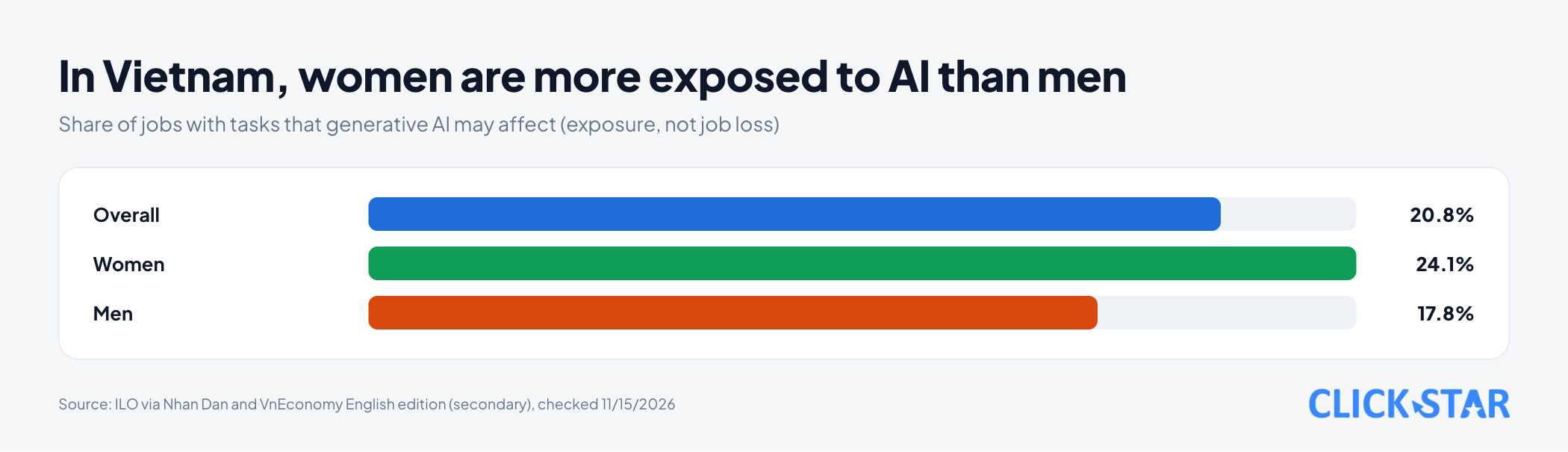
According to the Nhan Dan newspaper's report on the ILO brief (April 16, 2026), about 11.5 million workers, 1 in 5, are in occupations whose tasks may be affected by generative AI. Only about 1 million are in jobs both highly susceptible and highly standardized (under 2%).
Clerical support workers are most exposed, nearly 2/3. Women's exposure rate is 24.1%, men's 17.8%. The ILO says there is no clear evidence of fewer job opportunities for highly educated young workers in exposed sectors in 2022 to 2024.
VnEconomy's English edition (en.vneconomy.vn, April 19, 2026, translated from the Vietnamese article, secondary source) gives 20.8% of total employment. The original ILO brief could not be opened (403 error), and no open source seen splits exposure by age group.
ManpowerGroup surveyed 285 employers in Vietnam from July 1 to 31, 2026: 57% say they are hiring more entry-level talent than in 2025.
This is a survey of intentions, not a count of people hired. The ILO period (2022 to 2024) ended before the US gap widened to its June 2026 level, so the 2 pictures cannot be combined into one conclusion.
What to watch
These are indicators worth tracking, not career advice.
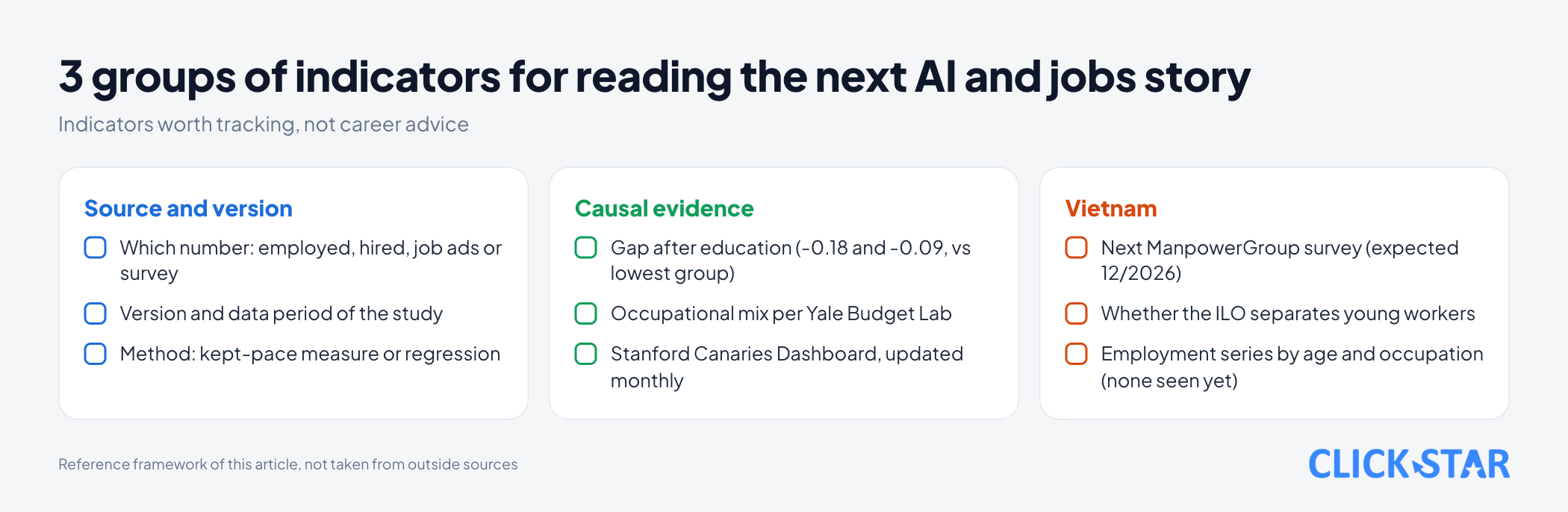
- Stanford's Canaries Dashboard, updated monthly: look at the hiring rate of ages 22 to 25 in highly exposed jobs, together with the version and data period.
- Whether the gap remains after accounting for education (-0.18 versus -0.09 in the current version, top versus bottom group), the biggest point of dispute.
- Which kind of number it is: people employed, people hired, job ads or an intentions survey, since each answers a different question.
- Updates from Yale Budget Lab, to see whether the occupational mix has shifted in line with AI use.
- For Vietnam: the next ManpowerGroup survey (expected December 2026) and whether the ILO separates young workers.
Common mistakes
- Reading "19% below" as "19% of young people lost jobs". It is a comparison, and total employment of ages 22 to 25 fell only about 2%.
- Quoting a number without asking which version: 13%, 15%, 16% and 19% all belong to the same study.
- Writing "AI caused this" when the authors say these are descriptive numbers, not causal estimates.
- Applying US numbers to Vietnam. ADP data is American, and the ILO numbers measure exposure, not jobs lost.
- Equating "AI exposure" with "will lose the job". The ILO says the more likely outcome is changed tasks within jobs.
- Looking only at overall unemployment. When the issue is fewer hires, young people who cannot get in do not appear in layoff news.
What is not known
It is unclear how much of the gap AI explains. Stanford says it cannot yet answer that, and does not know whether the trend will accelerate, stabilize or reverse.
It is unclear how representative the ADP sample is for the whole US economy.
Evidence on jobs outside the US is thin: in "AI and Labor Markets: What We Know and Don't Know" from the Stanford Digital Economy Lab (October 10, 2025), Chandar cites 2 studies on the UK and Denmark and writes that he knows of no evidence from elsewhere.
There is no Vietnamese series by age and occupation to compare with the US, and the original ILO report could not be read. NACE also says the next 5 years cannot be predicted with certainty.
Related posts

Need tailored advice for your business?
Click Star helps you build a solution that fits your industry and scale. We answer every question during business hours.