Nearly half of U.S. adults use chatbots; 16% expect AI to help society
Pew finds 49% of U.S. adults ever use chatbots, yet only 16% expect AI to have a positive impact on society over 20 years and 40% expect a negative one. The article reads the figures, their limits, and related Gallup and Vietnam surveys.
Someone asks a chatbot to draft work emails every week, yet still says AI is moving too fast. This is an illustrative scenario, not a real person.
This article reads the Pew Research Center report "Americans and AI 2026" (published June 17, 2026), a survey of 5,119 U.S. adults from February 17 to 23, 2026. It adds Gallup surveys and 1 urban survey from Vietnam, checked on November 15, 2026.
In short: in the U.S., chatbot use has risen sharply, but expectations about AI's effect on society still lean negative. U.S. numbers do not transfer to Vietnam.
Key points
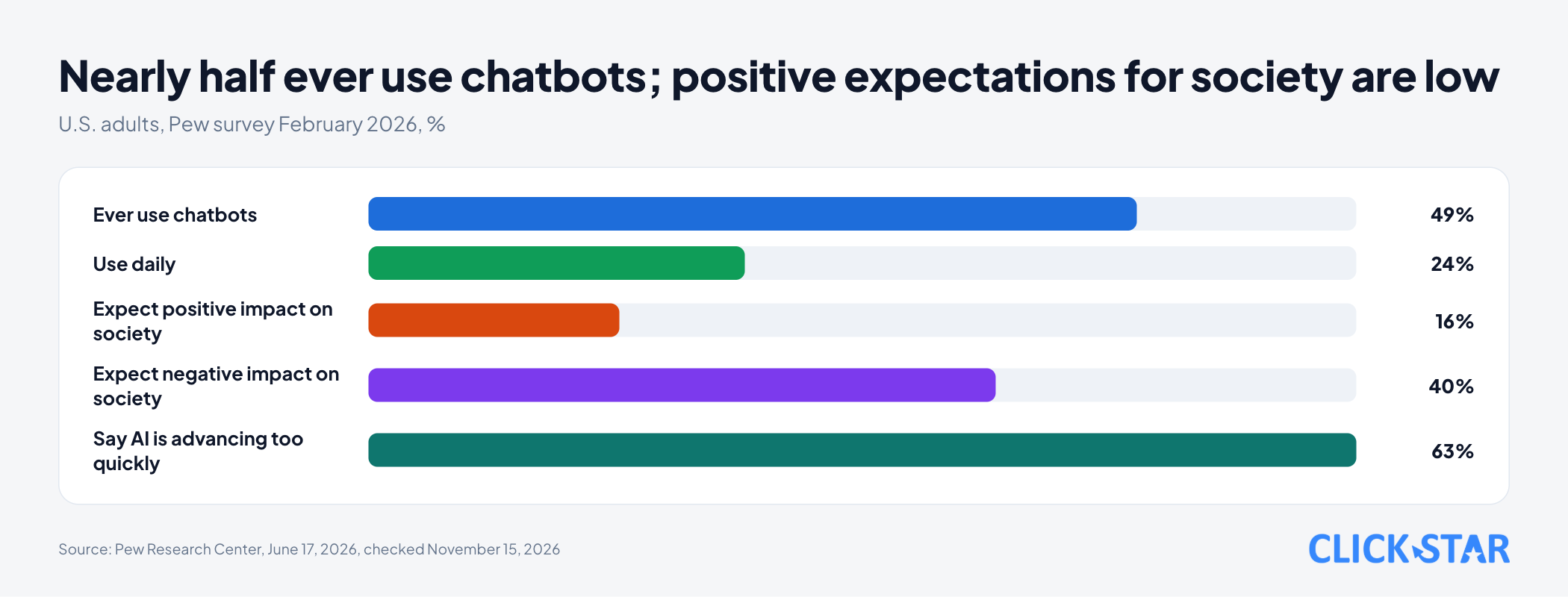
- According to Pew, 49% of U.S. adults say they ever use AI chatbots (such as ChatGPT, Gemini, Copilot) in 2026, up from 33% in 2024 (the 2024 question was asked only of people who had heard of chatbots). About 24% use them daily.
- On AI's impact on society over the next 20 years, 40% expect a negative effect, 16% a positive one, and 31% say positive and negative equally.
- 63% say AI is advancing too quickly, 71% say it will make their personal information less secure, and 67% have little or no confidence in the U.S. government to regulate AI effectively.
- Users see concrete benefits: 30% of U.S. adults say chatbots help how productive they are, 5% say they hurt. But only 16% expect a positive impact on society, below the 23% who expect one for themselves.
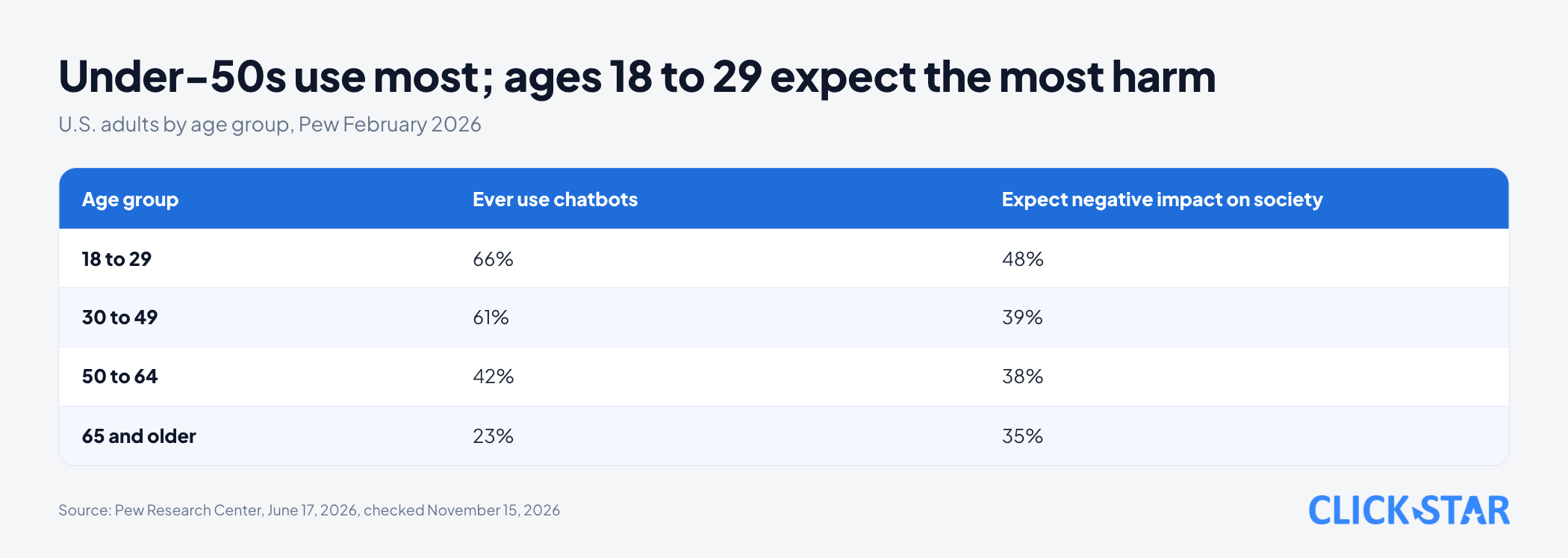
- Adults under 50 use chatbots most (66% at ages 18 to 29, 61% at 30 to 49), and ages 18 to 29 are the most likely to expect a negative impact on society (48%).
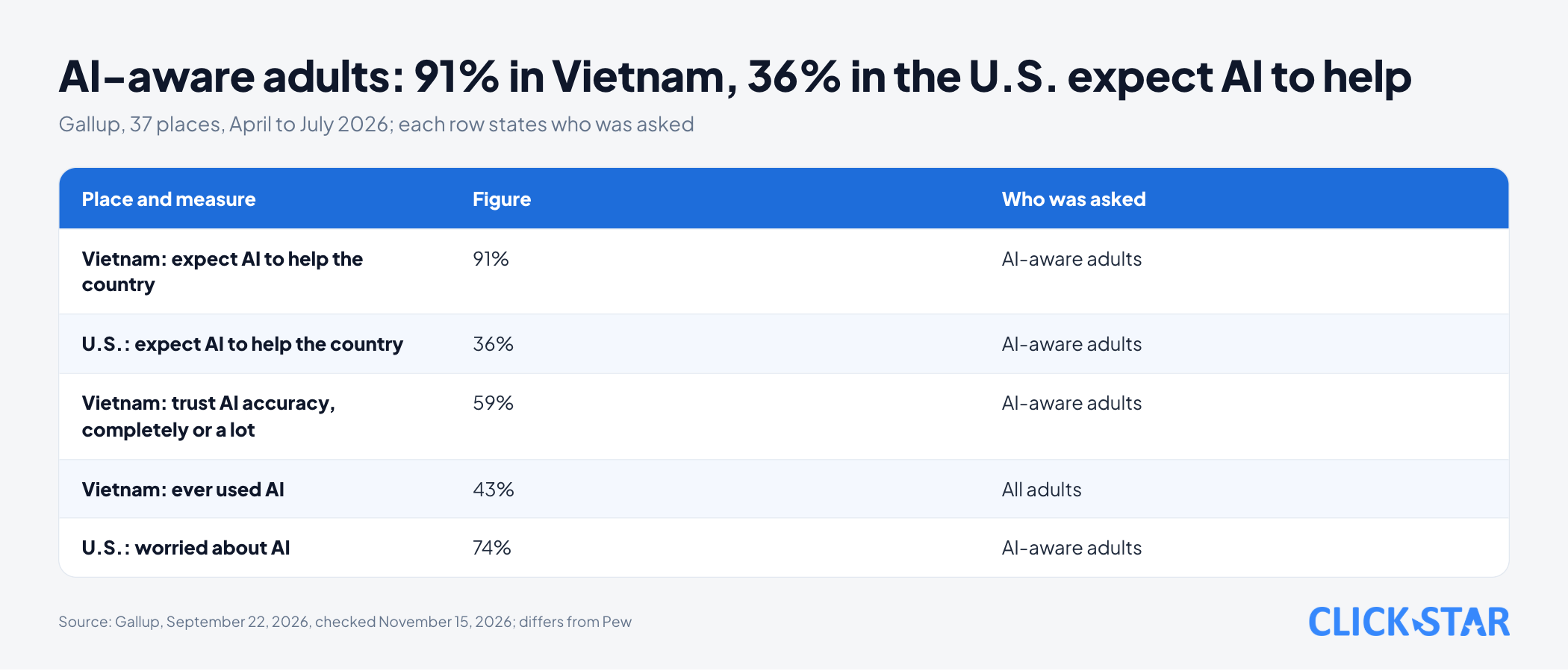
- For Vietnam, Gallup (September 22, 2026) reports 91% of AI-aware adults expect AI to help the country, while 43% of all adults have ever used it. This is a different survey from Pew's.
What is happening: chatbots have reached half of U.S. adults
According to Pew (report published June 17, 2026, read November 15, 2026), 49% of U.S. adults say they ever use chatbots and 51% do not.
Pew also asked how often: 12% use them several times a day, 8% about once a day, 4% almost constantly, and 25% several times a week or less. The 3 daily groups add up to 24%.
By product, ChatGPT leads with 44% of U.S. adults, then Gemini 24%, Copilot 17%, Meta AI 14%, Grok 8% and Claude 6%.
What the numbers say and where they stop
This is a survey on Pew's American Trends Panel, fielded by SSRS, with 5,119 respondents and a margin of error of plus or minus 1.6 percentage points at 95% confidence (Pew's Methodology page, read November 15, 2026).
3 limits matter. First, the 33% for 2024 was asked only of people who had heard at least a little about chatbots (a note under the chart in Pew's main report), so the rise to 49% is an approximate comparison.
Second, "ever use" (49%) is not "use often" (24%). Third, these are self-reports, not measured behavior.
For the help-or-hurt questions, Pew notes that people who do not use chatbots are not shown. Each item's 3 options add up to about 49%, the share of users (the article's arithmetic).
What chatbots are used for, and what users report
The most common use is looking up information: 42% of U.S. adults say they use chatbots for this. Among employed adults, 38% use them for work tasks.
Next come entertainment 25%, creating or editing images and video 24%, medical advice 20%, news 13% and emotional support 10%.
Users see more help than harm (shares are of all U.S. adults). Productivity: 30% say it helps, 5% hurts. How informed they are: 28% helps, 5% hurts. Creativity: 21% helps, 11% hurts. For happiness and relationships, the most common answer is no effect (36% and 35%).
Using more, expecting less: the gap inside Pew's own numbers
Asked about the next 20 years, Americans lean negative. For society: 40% expect a negative impact, 16% positive, 31% positive and negative equally, 13% not sure. For themselves: 31% negative, 23% positive, 27% equally, 19% not sure.
Americans expect more positive effect for themselves than for society (23% versus 16%) and more negative effect for society (40% versus 31%). This is the article's comparison of Pew's figures.
On pace, 63% say AI is advancing too quickly (19% about right). On personal data, 71% say AI will make their information less secure (3% more secure).
On oversight, 67% have little or no confidence in the U.S. government to regulate AI effectively (62% in 2024), and 59% have little or no confidence in U.S. companies to develop AI responsibly (59% in 2024).
Pew says this skepticism is common in both parties, but among Democrats and those leaning Democratic it rose to 74% from 54% in 2024, while among Republicans it fell from 70% to 61%.
The generation and gender gaps
Younger groups use chatbots more but are not more optimistic. In Pew's chapter "How Americans' opinions and use of AI differ by age" (published June 17, 2026, read November 15, 2026), ever-use is 66% for ages 18 to 29, 61% for 30 to 49, 42% for 50 to 64 and 23% for 65 and older.
In the same chapter, 48% of those aged 18 to 29 expect a negative impact on society, against 39%, 38% and 35% in the older groups.
On gender, the chapter "The gender gap in AI in the US" (published June 17, 2026, read November 15, 2026) shows 50% of men and 47% of women ever use chatbots, narrowed from 39% and 28% in 2024 (same note on the 2024 question). On society, 43% of women expect a negative impact versus 36% of men. Pew does not explain the cause in the pages read.
Why non-users hold back, and how trust in accuracy tracks use
Pew asked non-users why. The chapter "Why don't Americans use chatbots?" (published June 17, 2026, read November 15, 2026) shows 83% are not interested (60% call it a major reason), 79% worry about how their personal information would be used, 76% do not trust chatbots to be accurate and 55% do not know how to use them.
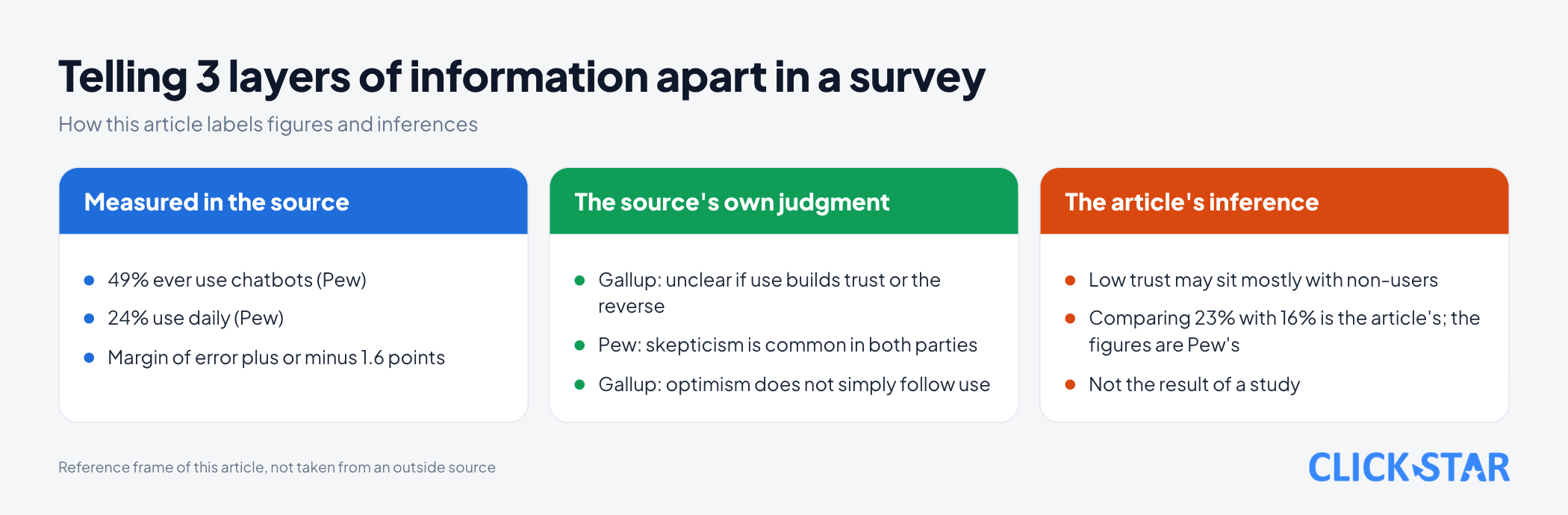
According to Gallup (published September 22, 2026, read November 15, 2026), trust in accuracy is tied to use: in the U.S. 45% of AI-aware adults who use it daily trust its accuracy completely or a lot, versus 8% of AI-aware adults who never used it. Gallup says the survey cannot tell whether use builds trust, trust drives use, or both.
Expectations differ: Gallup writes that optimism about AI does not simply track current use (Vietnam: 91% expect AI to help the country, 43% have ever used it).
The article's inference from 2 different data sets: "use more, trust less" is not necessarily a contradiction, since low trust may sit mostly with non-users. But the 18 to 29 group above (most use, most negative) shows this is not enough. This is not the result of a study.
What other sources say, and where they differ
Another survey points the same way but measures differently. Gallup, in the Bentley-Gallup survey of 3,270 U.S. adults on May 4 to 11, 2026 (published July 28, 2026), found 39% say AI does more harm than good, up from 31% in 2025. Another 52% say equal harm and good.
These figures should not be compared directly because the questions differ, though the broad direction (leaning cautious) is consistent.
Vietnam: figures exist, but not of the same kind as Pew
Pew's report covers only U.S. adults. Gallup describes its samples as nationally representative in each place, but words questions differently, so the article found no Vietnamese figure in Pew's wording (social impact over 20 years, all adults).
2 sources come closest. Gallup (published September 22, 2026, research with Microsoft) surveyed the first 37 places to finish 2026 fieldwork, about 1,000 people aged 15 and older in each, from April to July 2026, by phone, face to face or online.
In Vietnam, 91% of AI-aware adults expect AI to help the country and 59% trust AI accuracy completely or a lot. The 43% is the share of all adults asked who have ever used AI, and it is also the median across the 37.
In the same article Gallup places the U.S. among the lowest on expectation (36% of AI-aware adults), and 74% of AI-aware adults there say they feel worried.
Gallup's 36% and Pew's 16% are hard to compare directly. Pew asked all adults about society over 20 years, with an "equally" option (31%), in February 2026. Gallup asked AI-aware adults whether AI will mostly help or harm people in their country, in April to July, with other interview methods. This is the article's judgment, not the sources'.
The second source is a Vietnam Investment Review report (published May 18, 2026) on the WIN World AI Index, where DXL Research surveyed 900 urban residents in 4 major cities from November to December 2025. These numbers describe urban residents, not the whole country.
According to the report, Vietnam's overall score was almost unchanged (58.4 versus 58.5 a year earlier): trust and acceptance of AI rose, while interest in AI and comfort with its role in society fell.
The same report says daily AI use rose from 13% to 19%, while high concern about misinformation rose from 36% to 65%, about privacy from 52% to 68%, and about job loss from 48% to 61%. This is a secondary source for the WIN index; the article did not read the original report.
What this means for everyday life
The article's inference: many people use a tool they do not fully trust, so checking answers matters, especially for health or money. Pew reports 20% of U.S. adults use chatbots for medical advice, but the pages read do not report whether they verify the answers.
For society, the data show 3 worries: oversight (67% have little confidence in the government), personal data (71%) and jobs (79% of U.S. adults expect AI to reduce jobs over the next 10 years, per Gallup on July 28, 2026). This is a U.S. picture, and the article draws no similar conclusion for Vietnam.
What to watch
- The gap between ever-use (49%) and daily use (24%) in Pew's next survey.
- Adults aged 18 to 29, who both use the most and expect the most negative impact: whether that changes.
- The gap between positive expectations for oneself (23%) and for society (16%).
- Trust in oversight: 67% little confidence in government, 59% in companies.
- Vietnamese figures in Pew's wording (all adults, 20 years out), or Gallup's next round to see whether the 91% changes.
Common mistakes
- Reading "49% use chatbots" as 49% using them regularly. Pew shows only 24% use them daily.
- Writing "only 16% trust AI to help" as if it were general trust. The figure is the share expecting a positive impact on society over 20 years, and 31% say positive and negative equally.
- Comparing 33% (2024) with 49% (2026) as identical measures, when the 2024 question applied only to people who had heard of chatbots.
- Applying U.S. numbers to Vietnam. The Vietnamese figures above come from other surveys with other samples and cannot be merged with Pew's.
- Concluding that heavy use erodes trust, or the reverse. The surveys only show 2 things appearing together, not a cause.
What is not known
It is not known whether users verify chatbot answers, since the Pew pages read do not report it. It is not known why younger adults both use and doubt more, since the pages read give no cause.
It is not known how Vietnamese adults would answer in Pew's wording, since Gallup words it differently and the article read only 1 round. The WIN figures were read only through a secondary report. It is not known whether Pew's next survey will show daily use rising or flat.
Related posts
Need tailored advice for your business?
Click Star helps you build a solution that fits your industry and scale. We answer every question during business hours.