Smart and effective prompting in marketing: a 6-part framework, ready templates and a control process
A 6-part framework for marketing prompts based on Anthropic, Google and OpenAI documentation, 6 ready templates, keeping brand voice, controlling errors and data, and a process from brief to verified content.
With the same AI tool, 2 marketers can get completely different results: a generic draft that must be rewritten from scratch, and a draft close enough to tweak in a few places and publish. The difference almost always lies in the request, the prompt.
But an effective marketing prompt is not a magic phrase; it is a way of presenting context, goal, criteria and examples clearly enough that a colleague who knows nothing about your business could still understand what to do.
This article gathers the principles from the official documentation of Anthropic, Google and OpenAI, turns them into a 6-part framework for marketing, with 6 ready-to-use templates, how to keep the brand voice, how to control errors and data, and a process from brief to verified content.
Click Star already has a separate article on how to use GPT in general, so this one goes into what is specific to marketing. The principles rest on documentation checked as of October 20, 2026; the prompt templates and the process are Click Star's own proposals.
Key points
- The golden rule in Anthropic's documentation: show your prompt to a colleague who knows little about the task and ask them to follow it; if they would be confused, the AI will be too. Treat the AI as a brilliant new employee who does not yet know your rules and workflows.
- The 3 things that improve a prompt most clearly: state a specific goal and constraints, explain the reason behind the request so the AI generalizes correctly and give examples. Anthropic recommends 3 to 5 examples that are relevant, diverse and clearly framed; Google writes that examples should always be included.
- For complex work, break it down: Google advises one instruction per prompt and chaining the steps so that the output of one is the input of the next. This matches the marketing workflow: brief, outline, draft, critique.
- OpenAI, in its guidance for the GPT-6 family, advises stating the outcome and letting the model complete the work and deliver a result that can be reviewed, rather than guiding every small step.
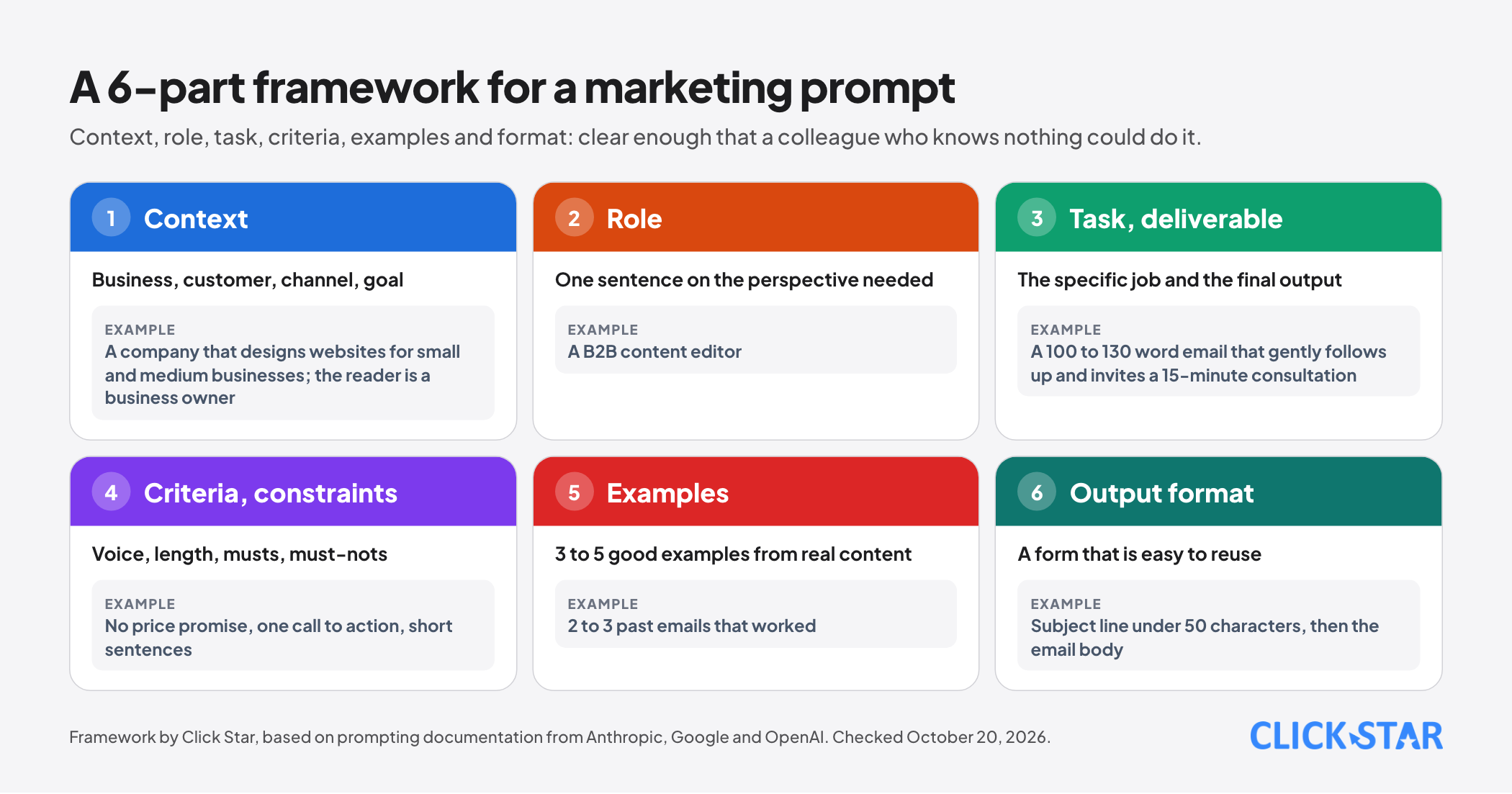
- A 6-part framework for marketing: context, role, task and deliverable, criteria and constraints, examples, output format.
- A good prompt does not replace verification. Every figure, claim and comparison in marketing content must be checked against a source, and customers' personal data should not be entered into a tool the business has not assessed.
Principles from the official documentation
Clear and specific. Anthropic's documentation on prompting Claude says the model responds well to clear, explicit instructions, and that if you want "above and beyond" behavior you should request it directly rather than wait for the model to infer it from a vague request.
It proposes testing with the "golden rule" above, and using numbered lists when the order of steps matters.
Explain why. Also according to Anthropic, giving the context or motivation behind an instruction helps the model understand the goal and answer more precisely. The documentation's example: instead of forbidding ellipses, say that the answer will be read aloud by a text-to-speech engine so ellipses should not be used.
For marketing this means saying where the content will be published, who reads it and what they read it for.
Examples. Anthropic calls examples one of the most reliable ways to steer format, tone and structure, and recommends 3 to 5 examples that are relevant to the real use, diverse so the model does not copy an unintended pattern, and wrapped in their own tags to separate them from instructions.
Google's prompt documentation likewise advises always including few-shot examples, using specific and varied examples with consistent formatting and starting with a few because too many can make the model over-fit.
Structure. Anthropic advises consistently named XML tags (such as tags for instructions, context and input data) when a prompt mixes several kinds of content, so the model does not confuse them. Google advises one consistent delimiter style and, for long documents, putting the instructions at the end after the supplied material.
Break the work down. Google's documentation advises splitting a prompt into components: one instruction per prompt, chaining sequential steps, or running independent tasks in parallel and aggregating the results.
Fresh data and calculation. Google advises using search grounding for recent or obscure facts and code execution for arithmetic and counting. For marketing this means do not ask the AI to "remember" market figures or compute ROI in its head; supply the data and ask it to use only that data, or use a suitable tool to calculate.
The outcome, not the steps. OpenAI's guidance for the GPT-6 family advises letting the model infer intent and scope, complete the authorized work and deliver a concrete result that can be reviewed, and using clear, concise writing with few nested lists. Click Star noted in its GPT article that old prompts should be trimmed when changing models rather than copied across.
A 6-part framework for marketing prompts
Click Star's view. This is how Click Star gathers the principles above into one easy-to-remember framework for marketing:
- Context: what the business does, the product or service, the target customer, where the content will be published and its goal (awareness, lead capture, closing).
- Role: one short sentence on the perspective needed, such as a B2B content editor or a performance advertiser. One sentence is enough; do not try to build an elaborate persona.
- Task and deliverable: the specific job and the final output, such as 5 headline variants, a 120-word email or a 5-criteria comparison table.
- Criteria and constraints: length, tone, musts and must-nots (do not promise what does not exist, do not use figures from outside the supplied material) and what counts as good.
- Examples: 3 to 5 good examples (and, if you have one, a bad example with the reason) taken from your real content.
- Output format: text, list, table or a fixed structure that is easy to feed into another tool.
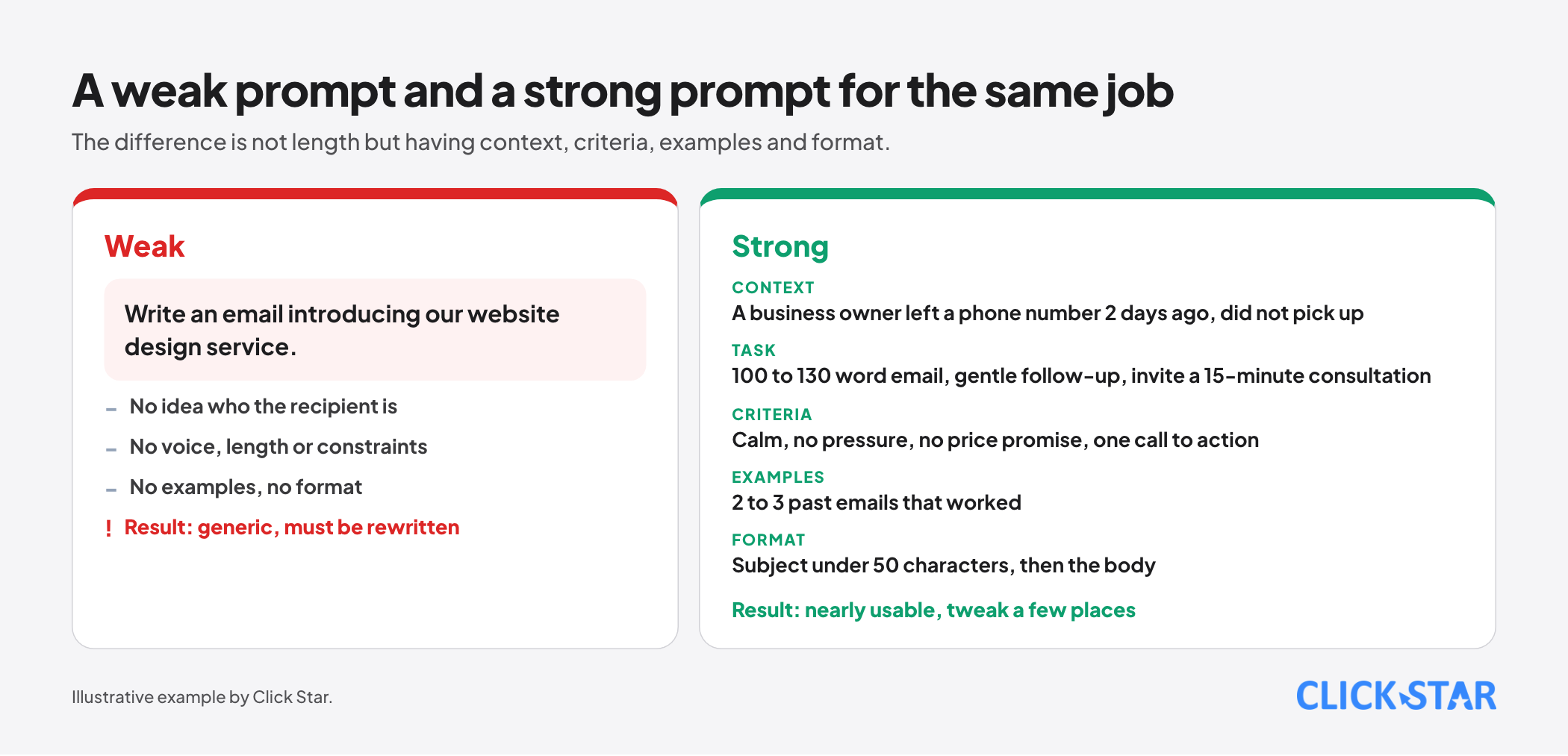
Below is a comparison of a weak and a strong request for the same job. For Vietnamese output, add the instruction to write natural Vietnamese in short sentences.
Weak:
Write an email introducing our website design service.

Strong:
<context>
My company designs websites for small and medium businesses in Vietnam. The recipient is a business owner who left a phone number on the quote page 2 days ago but did not answer our call.
The email is sent under a consultant's personal name and read on a phone.
</context>
<task>
Write a 100 to 130 word email that gently follows up and invites them to book a 15-minute consultation.
</task>
<criteria>
Polite, calm tone, no pressure, no "shock offer" wording. Do not promise a specific price or timeline. One single call to action. Natural, short sentences.
</criteria>
<examples>
[paste 2 to 3 past emails you found effective]
</examples>
<format>
A subject line under 50 characters, then the email body.
</format>
6 templates ready to use
The templates below use square brackets for what you fill in. Replace them with your real information and test with 3 to 5 examples before putting them into a workflow.
1. Build customer profiles from your own data. Use interview or survey notes with personal information removed.
Below are notes from [number] conversations with customers, with names and contact details removed.
<notes>[paste notes]</notes>
Group them into 2 to 3 customer groups. For each group state: the job they are trying to get done, what blocks them, phrases they often use (quoted verbatim from the notes) and their buying criteria.
Use only information in the notes. If an item has no data, write "no data" instead of guessing.
2. An article outline built from user questions.
Goal: a blog article that answers the question "[main question]" for [audience], to generate leads for [service].
Propose a title and an outline of 6 to 8 sections, each section a question the reader really asks, with a direct answer under 30 words and the kind of evidence needed (figures, example, process).
Do not write the article. Do not state specific figures; only mark where a source needs to be found.
3. Ad copy variants.
Product: [description]. Audience: [description]. Strengths that are real and verifiable: [list]. Things we must not say: [list].
Write 8 headlines and 4 descriptions for a [platform] ad. Respect the platform's current character limits (tell me the limits you are assuming so I can check them).
Each variant uses a different angle (benefit, pain, proof, question). Label the angle of each variant.
4. A nurture email sequence.
Write a sequence of 4 emails for people who downloaded [document] but have not booked a consultation, sent on days 1, 3, 7 and 14.
Each email has a single goal and a single call to action. Email 1 gives value, email 2 answers a common concern, email 3 shares a real example that I will supply, email 4 invites a conversation.
Under 120 words each. Example of the desired voice: [paste a sample paragraph].
5. Analyze campaign results.
Below is campaign data as a table: [paste the table, personal data removed].
Please: (1) compute cost per conversion for each ad group using exactly the figures in the table, (2) point out 3 anomalies, (3) propose 3 hypotheses that could explain them and how to test each.
Use only the data in the table. Separate the "figures" part from the "speculation" part.
6. A critique before publishing.
Below is a draft post. Play the role of a demanding reader who is [description].
<draft>[paste content]</draft>
List: claims without evidence, sentences that could be misread, places that sound like over-the-top advertising and 3 questions the reader would ask that the post does not answer. Do not rewrite the post.
Keeping the brand voice
Brand voice is what AI most easily distorts.
Write a one-page brand voice document and include it every time: 3 to 5 traits of the voice (for example calm, specific, not exaggerated), 5 things to do, 5 things not to do (clichés, forms of address, how to talk about competitors), a table of preferred and avoided words and 3 representative sample paragraphs.
For Vietnamese, state the forms of address (what the business calls itself and what it calls the customer), how to use English technical terms and require natural writing, not machine translation. Real sample paragraphs work better than describing the voice with adjectives.
Quality and risk controls
- Figures and claims: every number, comparison and commitment in advertising or sales content must have a source and be checked by a person. Ask the AI to use only the numbers in the material you supply and to mark everything it is unsure of.
- Voice and culture: someone on the team rereads to remove clichés, wrong forms of address and phrasing that does not suit Vietnamese readers.
- Claims in advertising: review so as not to promise what cannot be guaranteed.
- Copyright and originality: do not paste other people's content and ask for a rewrite; use AI to generate ideas and draft from your own material.
- Personal data: according to the summaries of Luat Viet An and Tilleke & Gibbins, the Law on Personal Data Protection and Decree 356/2025/ND-CP, in force since January 1, 2026, set duties on consent and on conditions for transferring data abroad. Do not paste customer lists, phone numbers, emails or purchase history into a tool the business has not assessed; mask or replace sample data. Click Star has a separate article updating this law for 2027.
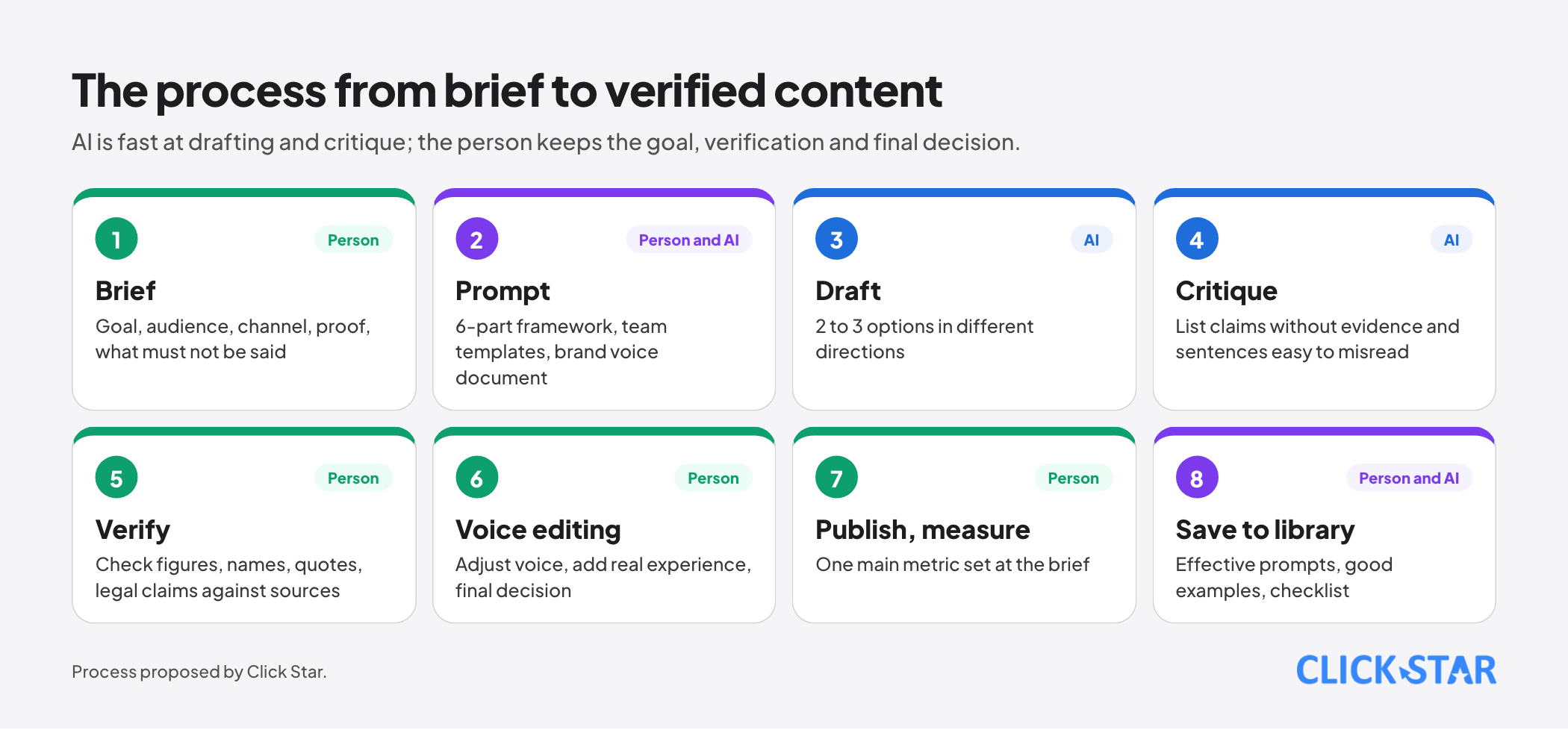
A process from brief to verified content
- Brief: goal, audience, channel, main message, available proof and what must not be said.
- Prompt: build it with the 6-part framework, using the team's templates and the brand voice document.
- Draft: take 2 or 3 options in different directions, not one final.
- Critique: use template 6 to expose claims without evidence.
- Verification: a person checks figures, proper names, quotations and legal claims against sources.
- Voice editing: a person adjusts the voice, adds real experience and makes the final decision.
- Publish and measure: track results with the one main metric set at the brief.
- Save to the library: put effective prompts, good examples and the checklist into the shared library.
Building a prompt library for the whole team
A shared library is how individual skill becomes team capability. Each template should have: a name and purpose, an owner, version and update date, the fields to fill in, 3 to 5 examples of good output, the accompanying verification checklist and a note on what data may be entered.
Review templates whenever the model or tool changes, and drop those that no longer work. Measure results by time saved, the share needing rework and the performance of the content after publishing.
Common mistakes
- Writing a one-line request and then blaming the AI for a generic answer.
- Handing the whole final version to the AI and publishing straight away without verification.
- Giving no examples, so the AI picks its own voice and format.
- Cramming everything into one long prompt instead of splitting it into steps.
- Asking the AI to "remember" market figures or calculations instead of supplying data and a calculation tool.
- Pasting real customer data into a tool that has not been assessed.
- Not saving effective prompts, so each person learns from scratch.
- Copying templates from this article without testing and adapting them to your real work.
Related posts
Need tailored advice for your business?
Click Star helps you build a solution that fits your industry and scale. We answer every question during business hours.