Patch Outlook, WordPress, PHP, Chrome: 5 IT jobs for late November
This article picks the late-November patches and support deadlines a business should handle: Outlook, Chrome, WordPress, PHP and expiring Microsoft software, based on each vendor's primary sources.
An illustrative scenario, not a real client: a 30-person company uses Outlook on office PCs and a WordPress website on shared hosting. On Tuesday the owner sees 4 update notices and cannot tell which is urgent.
This article reads the Zero Day Initiative's Patch Tuesday review, CISA notices, WordPress.org and PHP news pages, the Chrome release log and Microsoft's lifecycle pages. Checked on November 24, 2026.
It answers: which jobs must be done this week, which can be scheduled, and how to measure the result. This one covers only what is new this round.
Key points
- Microsoft's November 10, 2026 Patch Tuesday fixed about 1,090 flaws per the Zero Day Initiative (ZDI), but only 1 was exploited: CVE-2026-124194 in Outlook, CVSS 6.5.
- A low CVSS score does not mean it can wait: the Outlook flaw leaks a login hash when a user opens a malicious message file.
- WordPress: CISA added CVE-2026-119977 to its exploited-vulnerabilities catalog on November 3, 2026. Version 7.1.4 (October 28) fixed it, and 7.1.5 (November 18) lists 20 more security items.
- The first update from an unpatched WordPress version still runs the old updater. Picus Security advises blocking web access to
wp-content/upgrade/before updating. - PHP released security versions 8.2.36, 8.3.37, 8.4.28 and 8.5.13 on November 19, 2026. PHP 8.2 gets security fixes only until December 31, 2026.
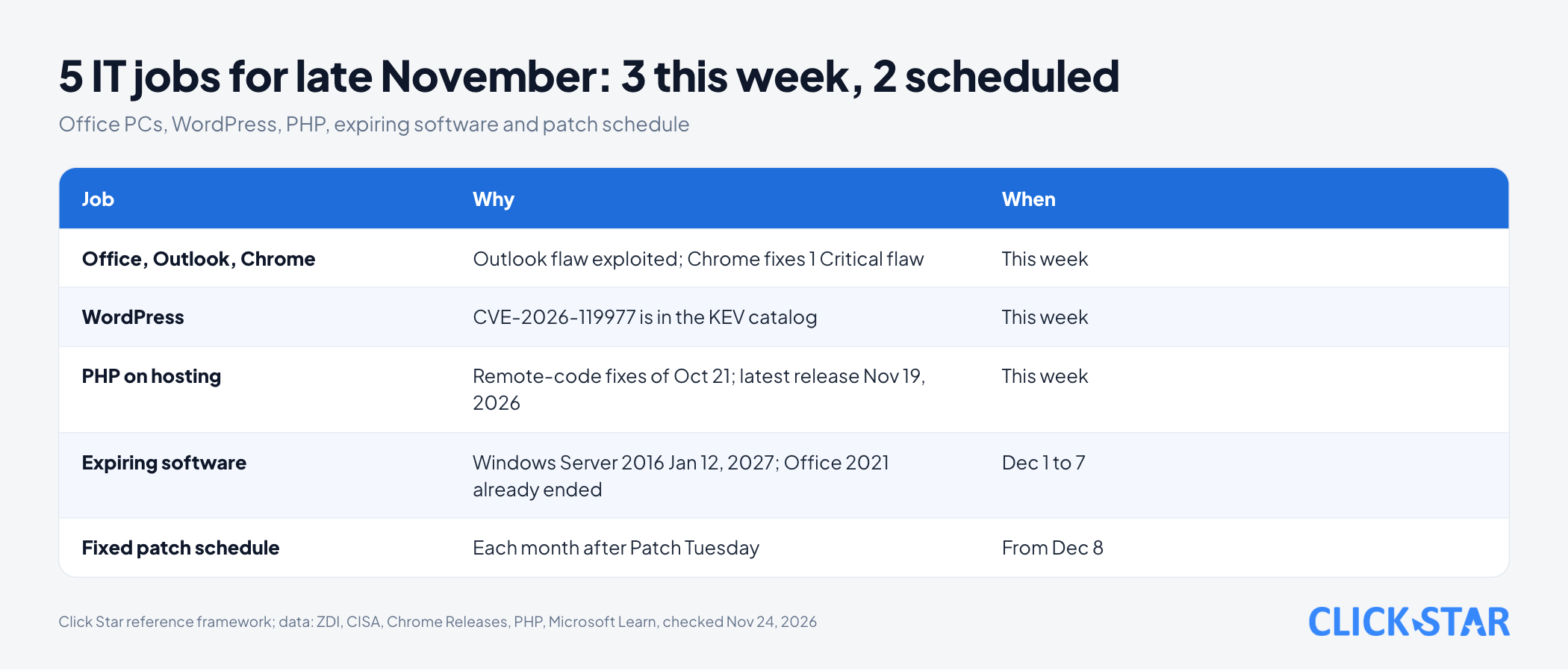
- Click Star's 5-job weekly framework: patch office PCs, patch WordPress, ask the host about PHP, inventory expiring software, set a fixed patch schedule.
Outlook and Windows: what the November patches say
The only exploited flaw in this release is in Outlook, and its score is low. According to ZDI (November 10, 2026), the release had about 1,090 CVEs, fewer than the roughly 1,400 of October, and none was publicly known before the patch.
CVE-2026-124194 is a spoofing flaw in Outlook. Per ZDI, an attacker sends a crafted message file; when the user opens it, Outlook connects to an attacker-controlled network location without the usual external-content warning.
That connection leaks the NTLMv2 hash, a one-way scramble of the Windows login credentials, which the attacker can use to sign in as the user. ZDI says the Preview Pane is not an attack path; ZDI and CISA do not say who is attacking or at what scale.
According to VnReview (secondary, which Click Star could not open), affected products include Office LTSC 2021, Office LTSC 2024 and Microsoft 365 Apps for Enterprise. Click Star also could not open Microsoft's MSRC page. Note that Office LTSC 2021 left support on October 13, 2026 (Microsoft Learn), so updating is no way out.
For companies that run their own mail server, ZDI lists 2 more flaws scored 9.8. CVE-2026-116928 (Windows Search) can be triggered through Exchange Server when it indexes an attachment, with no action by the recipient. CVE-2026-119958 is in LDAP, worst for servers that manage accounts.
Chrome: the November 23 update
The new Chrome fixes 1 Critical flaw, so restart the browser. Per the Chrome Releases log (November 23, 2026), Stable desktop is 158.0.8127.88/.89 on Windows and Mac and 158.0.8127.88 on Linux.
The flaw is CVE-2026-134401, improper input validation in the Variations component. The post does not say it was exploited.
WordPress: updating also needs preparation
If your site runs WordPress, move to 7.1.5, but block the temporary folder before updating from an old version. CISA (notice "CISA Adds One Known Exploited Vulnerability to Catalog", November 3, 2026) listed CVE-2026-119977 (a race condition in WordPress core) in its exploited-vulnerabilities catalog.
According to Picus Security's analysis (updated November 9, 2026, CVSS 8.1), WordPress unpacks the new package into wp-content/upgrade/ before copying it over the site. During that window, the temporary installer setup-config.php asks for no login and cannot see the real site configuration.
If an attacker wins the race, they can plant their own configuration pointing to their database, create the first admin account and upload a plugin that runs PHP code. Picus says it affects WordPress 2.7.0 through 7.1.3.
WordPress 7.1.4 (October 28, 2026) fixes it and was backported to branch 4.7. Per Picus, 2.7 through 4.6 have no fix.
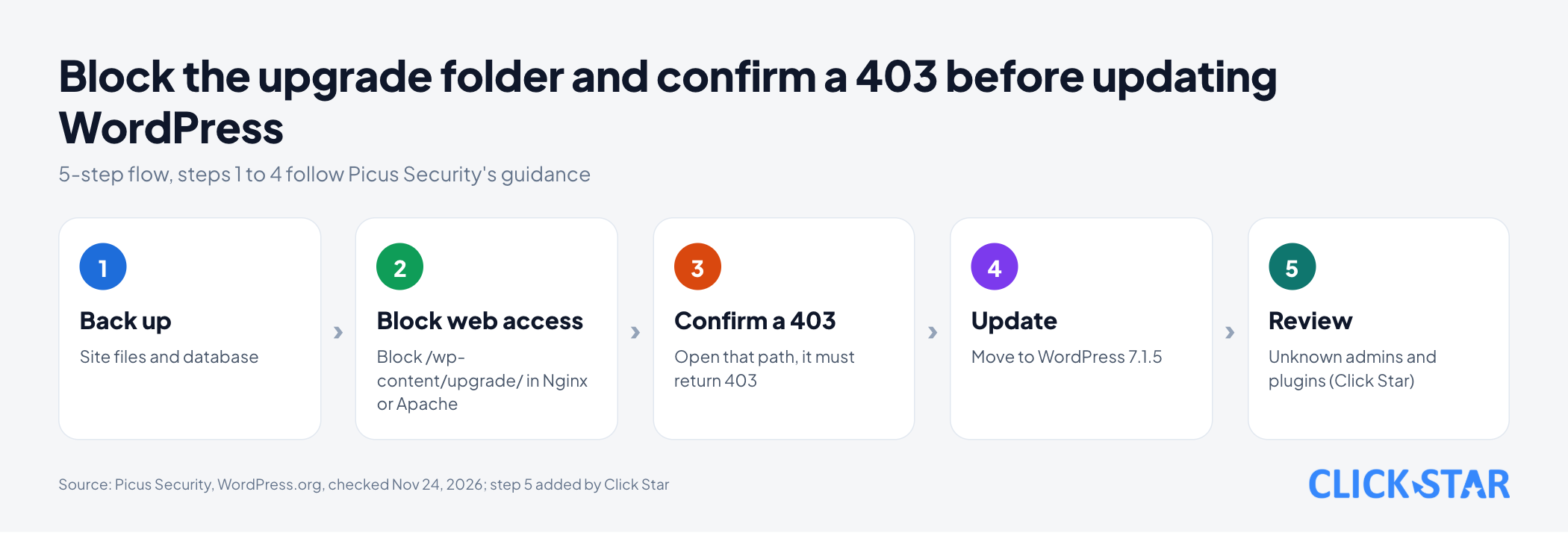
The hard part is the first update: old code does the unpacking, so the path stays guessable. Picus gives 2 safe options.
- Block web access to
wp-content/upgrade/, then confirm it returns 403 before updating. On Nginx:location ^~ /wp-content/upgrade/ { deny all; }. On Apache, in the root.htaccess, above the WordPress rewrite block:RedirectMatch 403 ^/wp-content/upgrade/. - Or update manually: download the new release outside the web folder, back up first, and leave
wp-config.phpandwp-contentuntouched.
Picus warns against placing .htaccess inside wp-content/upgrade/, because the old updater empties that folder first. Click Star has not run these lines; test on a copy.
Version 7.1.5 (November 18, 2026) lists 20 more security items, including SQL injection (commands slipped into a database query) in WP_Meta_Query and an unauthenticated privilege escalation that could lead to code execution. Version 7.2 is planned for December 8, 2026.
WordPress.org says backports for older branches are in progress, so an old branch may not yet have an equivalent of 7.1.5.
PHP: the November 19 patches and PHP 8.2's deadline
WordPress runs on PHP, so the host's PHP version matters just as much. Per PHP's advisory (October 21, 2026), versions 8.5.12, 8.4.27, 8.3.36 and 8.2.35 fix 2 critical flaws, CVE-2026-109618 and CVE-2026-109619, that can allow remote code execution without login on any PHP installation serving web requests.
PHP says the risk is highest with mod_php and that only updating is safe. WordPress.org (October 21, 2026) says there is no separate WordPress release for this.
On November 19, 2026, PHP released further security versions 8.5.13, 8.4.28, 8.3.37 and 8.2.36. The November 18 notice says the highest severity is Critical, but those issues need non-default configuration or uncommon setups.
PHP's Supported Versions page (read November 24, 2026) shows PHP 8.2 with security support until December 31, 2026, 8.3 until December 31, 2027, 8.4 until December 31, 2028, 8.5 until December 31, 2029.
On shared hosting you cannot patch PHP yourself. Ask the provider which PHP version the site runs, and whether it is on at least those 4 October 21 fixes, ideally November 19, 2026.
PHP 8.1 and older no longer get updates from the PHP project, per PHP and WordPress.org; some LTS vendors backport fixes. Click Star advises hosts at that level to act this week, not wait for December 31.
Support deadlines: which dates are coming
Per Microsoft Learn's Ending Support in 2026 page (no update date shown, read November 24, 2026), November 10, 2026 was the deadline for .NET 8 (LTS), PowerShell 7.4 (LTS) and Windows 11 Enterprise and Education version 23H2.
Per the Ending Support in 2027 page, Windows Server 2016, IIS 10 on it and .NET Framework 4.6.2 end support on January 12, 2027. The Windows Server 2016 lifecycle page lists the first year of paid security updates (ESU) from January 13, 2027; Click Star found no price.
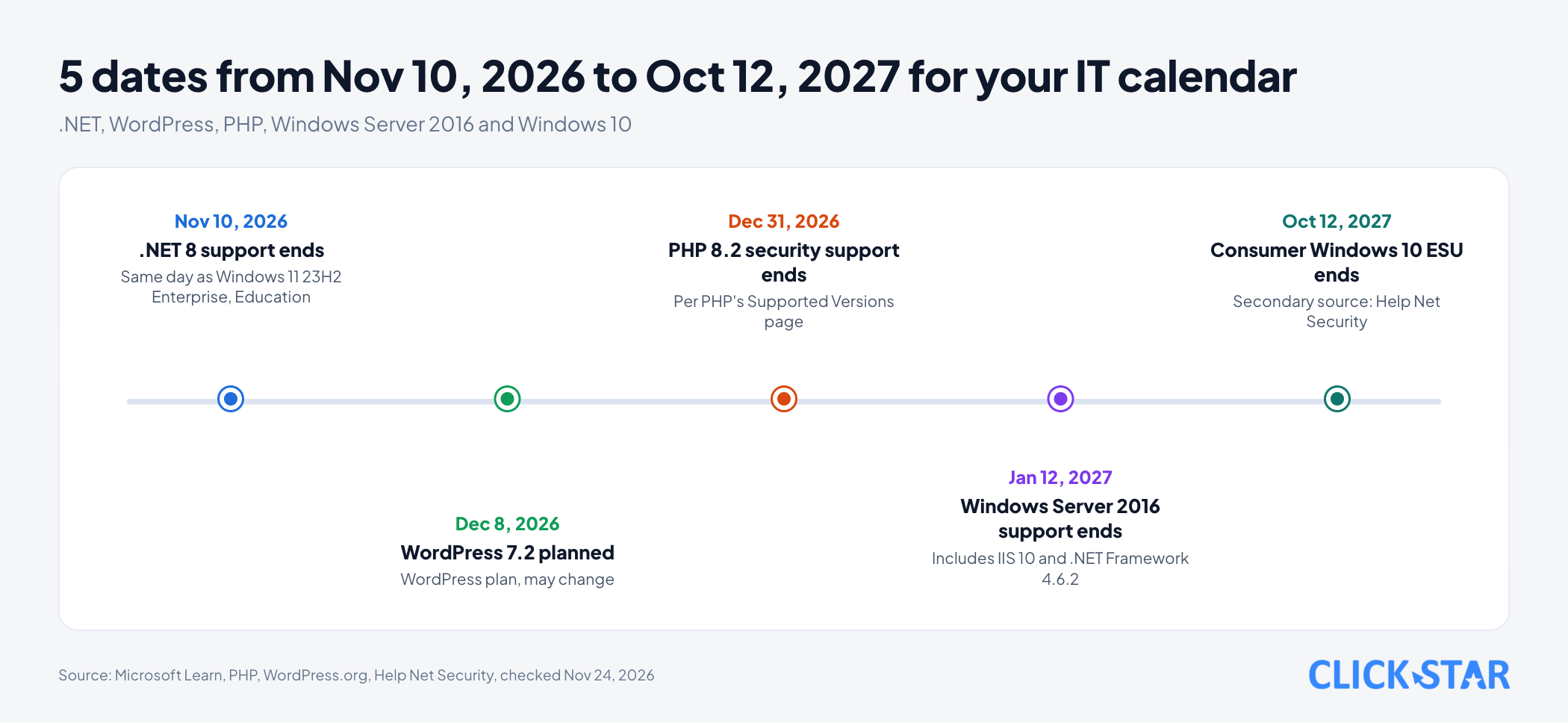
For Windows 10, Microsoft Learn's ESU page (updated November 10, 2026) says organizations buy ESU at USD 61 per device for the first year, doubling each year, for up to 3 years.
For the consumer edition, Help Net Security (June 26, 2026, secondary) reports Microsoft extended ESU to October 12, 2027. Click Star has not confirmed it on Microsoft's page.
Patch order: CVSS score or sign of exploitation
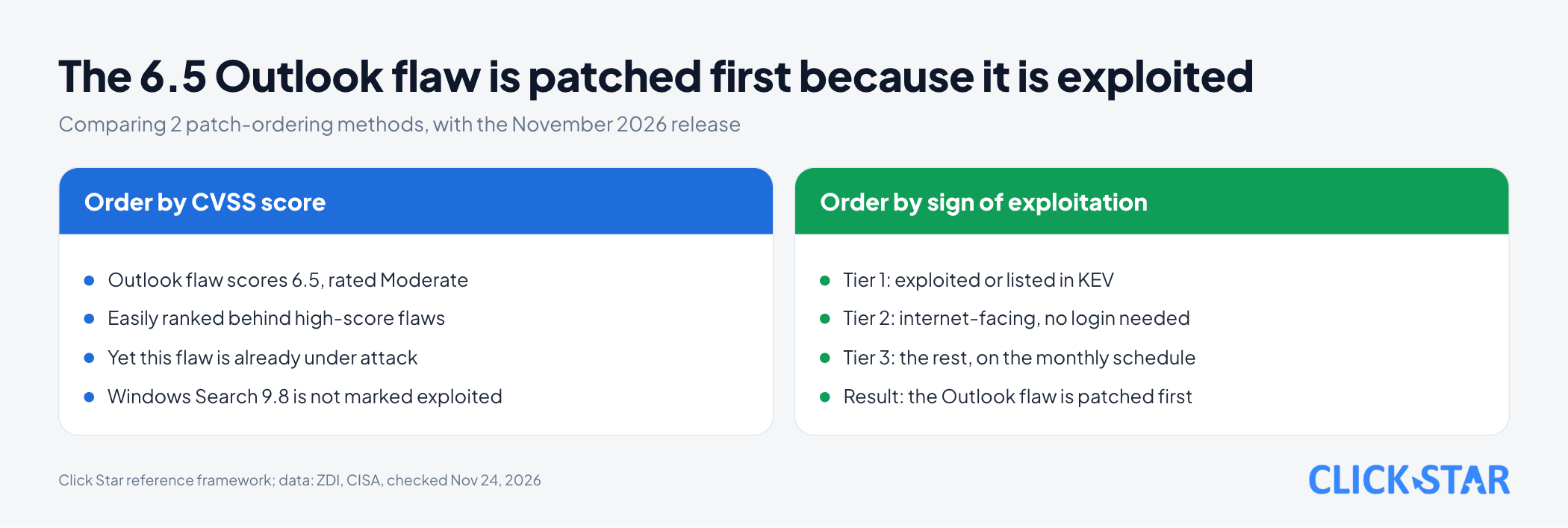
Patch exploited flaws first, then look at scores. The Outlook flaw scored 6.5 and is rated Moderate, yet it is under attack; the 9.8 Windows Search flaw in the same release is not marked exploited.
CISA keeps the KEV (Known Exploited Vulnerabilities) catalog, listing only flaws with evidence of exploitation. On November 10, 2026 it added 6, including the Outlook flaw above and Chromium flaw CVE-2026-125350.
CISA says BOD 26-04 binds only US federal agencies but urges all organizations to prioritize KEV flaws.
The tiers below are Click Star's reference framework, not taken from outside sources. Tier 1: vendor or KEV says exploited, patch within the week. Tier 2: internet-facing, no login needed, patch within 2 weeks. Tier 3: the rest, on the monthly schedule.
What this means for Vietnamese businesses
Most small companies do not patch all 5 layers themselves: an IT partner does PCs, the web designer the site, the host PHP. The big risk is each party assuming another did it.
Click Star's view. Separate 2 kinds of work: urgent patches measured in days, and support deadlines measured in quarters. Mixed together, urgent work slows down.
Each item needs 1 named person or provider responsible. Click Star sells website design, so it has an interest in advising a website review.
What to do: a 5-job plan
This is a Click Star reference plan, not an industry standard.
Job 1. Patch Office, Outlook and Chrome (this week). Run Windows Update and update Microsoft 365 Apps on every PC, then restart Chrome.
Job 2. Patch WordPress in a safe order (this week). Back up, block wp-content/upgrade/, confirm a 403, then move to 7.1.5. Then check for unknown admin accounts and plugins.
Job 3. Ask the host about PHP (this week). Get the PHP version and update date in writing. If it is 8.1 or older, act now; if 8.2, move before December 31, 2026.
Job 4. Inventory software that is expiring or expired (December 1 to 7). List Windows 10 PCs, Windows 11 24H2 Home or Pro and 23H2 Enterprise or Education, Office 2021 and LTSC 2021 (ended October 13, 2026), Windows Server 2016, and apps on .NET 8 or .NET Framework 4.6.2.
Job 5. Set a fixed patch schedule (from December 8). Pick 1 slot each month after Patch Tuesday, with a list of who owns which item.
How to measure: 4 metrics
All 4 metrics are Click Star's proposals, with no industry threshold. Set thresholds to match your risk tolerance.
- Days from patch release to installation, counted separately for exploited flaws.
- Share of PCs and websites on the new version.
- Number of assets running software past support.
- Number of websites tested with
wp-content/upgrade/returning 403.
Common mistakes
- Ordering patches by CVSS score alone and ignoring exploited flaws such as the 6.5 Outlook flaw.
- Updating WordPress from an unpatched version before blocking
wp-content/upgrade/. - Placing
.htaccessinsidewp-content/upgrade/, where the old updater deletes it. - Assuming a WordPress update is enough when the PHP flaw is on the server.
- Waiting for the host to patch without asking for the exact PHP version, or leaving PHP 8.1 or older until year end.
- Waiting until the deadline to inventory Windows Server 2016 or .NET 8 apps.
What is not known
Click Star has no Vietnam data on website PHP versions, Windows 10 share or patching speed, or on which local hosts have patched PHP.
ZDI and CISA do not say who exploits CVE-2026-124194 or at what scale. Click Star could not open the MSRC or consumer ESU pages, so it used ZDI, VnReview and Help Net Security.
It is unclear how much the WordPress flaw is exploited in Vietnam, and whether background updates from an old version face the same risk window. The Chrome flaw has no technical description beyond a single line in the release log, and Click Star has not determined which Chrome release fixed CVE-2026-125350 from the KEV list.
Related posts
Need tailored advice for your business?
Click Star helps you build a solution that fits your industry and scale. We answer every question during business hours.