Putting an AI chatbot on your website: cost, risk and how to measure results
The real cost of a website AI chatbot has 5 parts, with 6 risks backed by documented incidents, the Vietnamese legal framework and a 3-tier metric set, based on official price pages, OWASP and published cases.
Many businesses want to put an AI chatbot on their website to answer customers 24 hours a day, but are missing 3 answers before they decide: what each conversation costs, what can go wrong and who pays when it does, and how to tell whether the chatbot is actually helping.
This article answers those 3 questions with official documentation. Prices come from the pricing pages of Anthropic, Google, OpenAI and Intercom (read on October 21, 2026). Risks come from the OWASP list for LLM applications and from documented incidents. The legal part rests on summaries of the Personal Data Protection Law and the Artificial Intelligence Law, and needs checking against the original text.
One limit needs saying plainly: Click Star found no peer-reviewed study measuring how well chatbots work on small-business websites in Vietnam. So the article gives no expected rates, only a way to measure your own. Click Star already has an article on token optimization; this one focuses on the decision to put a chatbot in front of customers.
Key points
- The token cost of one conversation is usually a few cents or less in US dollars, but the total cost has 5 parts: tokens, platform, building the knowledge base, operations and the people who take over handoffs. The last is often forgotten.
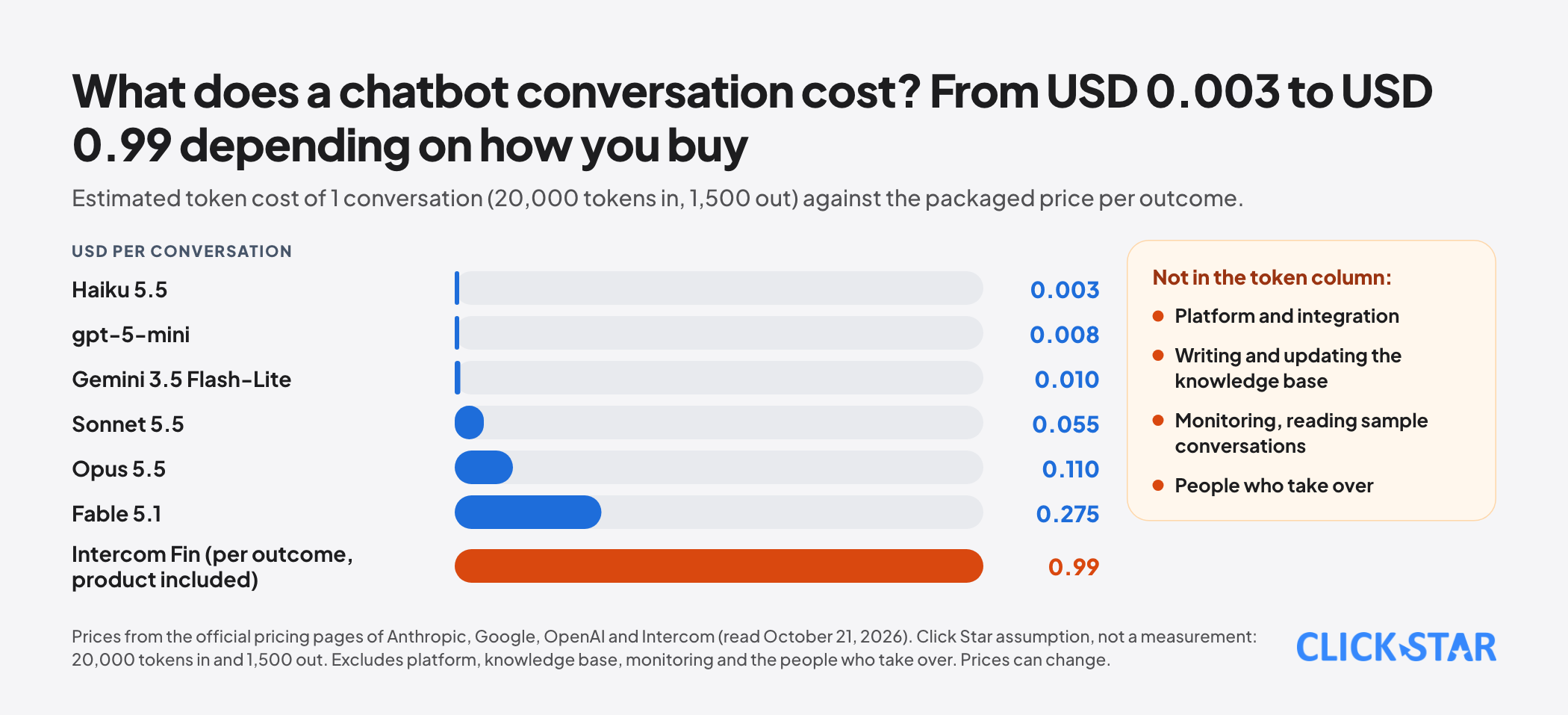
- An example using Click Star's assumption (20,000 input tokens and 1,500 output tokens per conversation): about USD 0.003 with Haiku 5.5 and USD 0.055 with Sonnet 5.5, against USD 0.99 per outcome for a packaged product such as Intercom Fin.
- The business is responsible for what its chatbot says. In Moffatt v. Air Canada (February 14, 2024), a dispute tribunal in British Columbia rejected the argument that a chatbot is a separate entity.
- The most common risks of a website chatbot are wrong answers, being steered by crafted prompts (prompt injection), saying inappropriate things, leaking data and being abused to run up costs.
- The Artificial Intelligence Law No. 134/2025/QH15 (in effect March 1, 2026) requires telling users when they interact with an automated AI system, according to summaries. Systems already running before that date have a transition period.
- Measurement should use a control group: compare visitors served by the chatbot with visitors who have none on contact capture rate, response time, satisfaction and cost per resolved conversation.
What a website AI chatbot can and should not do
A website AI chatbot is a chat window that answers customers with a language model, drawing on the business's knowledge base (price lists, policies, frequently asked questions). It differs from a scripted chatbot in that it does not need every question written in advance.
Suitable jobs: answering common questions, guiding product choice, collecting contact details, booking appointments and looking up order status once connected to a system.
Jobs not to give a chatbot alone: committing to prices or promotions outside the price list, refunds, explaining legal rights, medical or financial advice, and handling tense complaints. For these, the chatbot should hand over to a person.
Click Star suggests a simple principle: the chatbot may answer only what is in approved documents, and must say "I will pass you to a staff member" when a question falls outside them. A chatbot guessing at answers is the source of most incidents below.
The real cost of a chatbot has 5 parts
Part 1: tokens (if you build on an API). Prices are per 1 million tokens, split into input and output. According to Anthropic's pricing page (read October 21, 2026): Sonnet 5.5 is USD 2 input and USD 10 output; Haiku 5.5 is USD 0.10 and USD 0.50 (for prompts up to 100,000 tokens); Opus 5.5 is USD 4 and USD 20; Fable 5.1 is USD 10 and USD 50.
According to Google's pricing page (updated October 19, 2026): Gemini 3.5 Flash-Lite is USD 0.30 and USD 2.50. According to OpenAI's pricing page (latest entry dated July 30, 2026): gpt-5-mini is USD 0.25 and USD 2; gpt-5.4-mini is USD 0.75 and USD 4.50.
Prices can change. Google's page shows Gemini 4 Argon rising from USD 2 and USD 10 to USD 4 and USD 20 after November 30, 2026, and Gemini 3.6 Flash rising after December 31, 2026. Anthropic's page says Claude 4.7 and later models use a tokenizer that produces about 30% more tokens for the same text.
Part 2: a packaged platform (if you buy a ready-made product). Intercom Fin charges USD 0.99 per "outcome" (a resolved conversation, or the customer stops asking, or a workflow completes including handoffs), plus helpdesk seats at USD 29, 85 or 132 per seat per month, and has a minimum.
Zendesk's per-outcome price is not published, and Click Star does not use third-party blog estimates.
Part 3: building and maintaining the knowledge base. A chatbot is only right when its documents are right. Someone must rewrite price lists, policies and conditions as short, clear text, and update them every time they change.
Part 4: operations and monitoring. Reading a sample of conversations every week, fixing wrong answers, watching cost and abuse. This is ongoing work, not a one-time task.
Part 5: the people who take over. The chatbot hands over when it cannot answer, so someone must be on duty during working hours and a process must exist for after hours. This part is often left out of the budget.
An example of token cost for one conversation
Click Star's assumption (not a measurement): a conversation totals 20,000 input tokens, because each reply resends the whole context and the document passages retrieved, and 1,500 output tokens.
Under that assumption, the estimated token cost is about USD 0.003 with Haiku 5.5, USD 0.008 with gpt-5-mini, USD 0.010 with Gemini 3.5 Flash-Lite, USD 0.055 with Sonnet 5.5, USD 0.11 with Opus 5.5 and USD 0.275 with Fable 5.1.
Under the same assumption, Intercom Fin's USD 0.99 per outcome is about 18 times the token cost of Sonnet 5.5. The 2 numbers cannot be compared directly, because Fin includes the product, the knowledge base, the dashboard and the handoff process, while token cost includes none of those.
Click Star's view. For a business with a few hundred conversations a month, token cost is almost not the issue. The main costs are the effort of writing documents, monitoring and the people who take over. The question to ask is not "which model is cheapest" but "who is responsible when the chatbot says something wrong."
6 risks and the incidents that happened
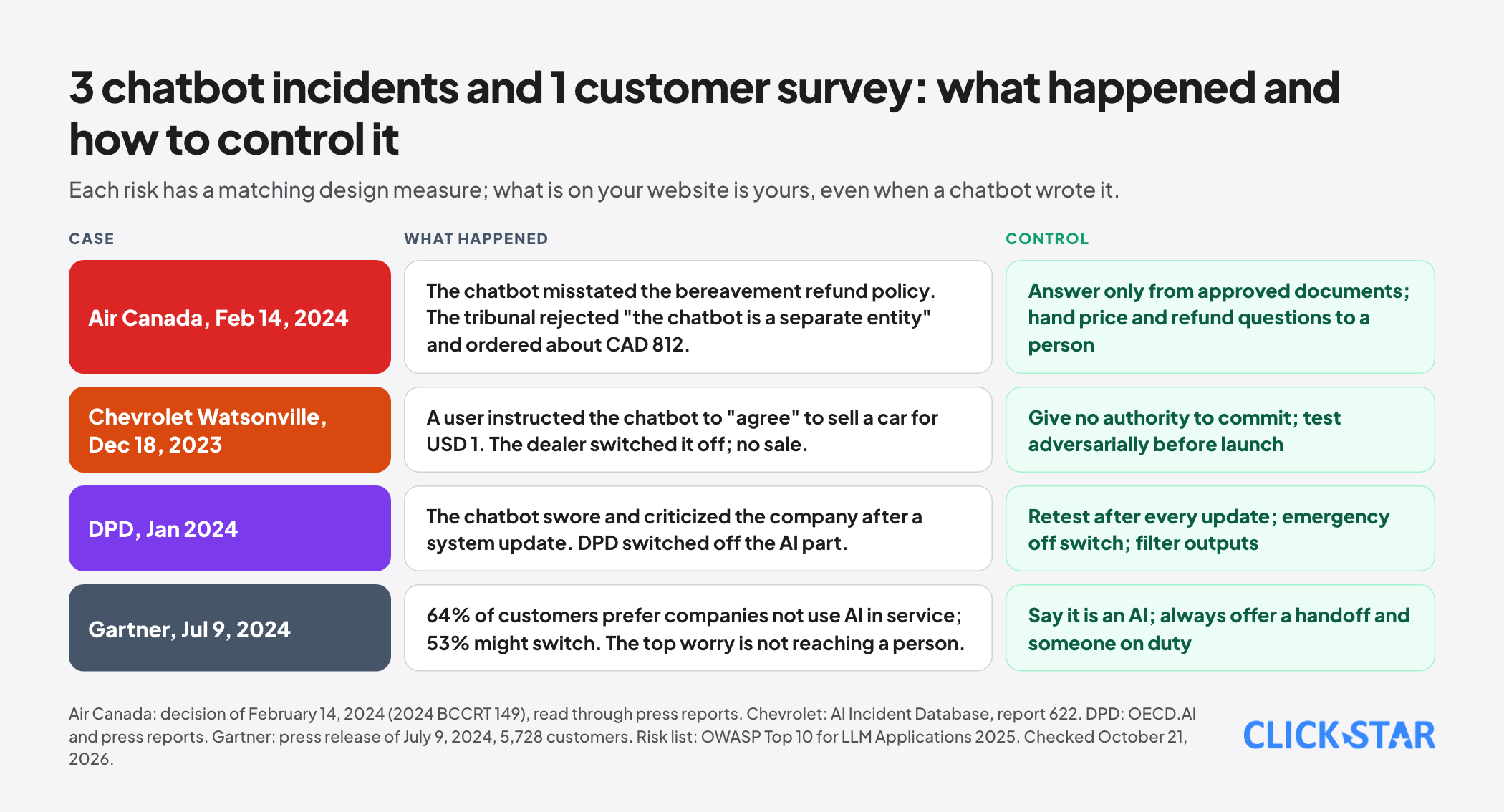
Risk 1: wrong answers and legal responsibility. According to reports on the February 14, 2024 decision (Moffatt v. Air Canada, 2024 BCCRT 149), the airline's website chatbot told a customer he could buy a full-price ticket and then claim a bereavement refund within 90 days, contrary to the airline's policy.
Tribunal member Christopher Rivers rejected the argument that the chatbot was a separate entity, found negligent misrepresentation and ordered about CAD 812 in damages, interest and fees.
The sum is small and this is a small-claims tribunal, not a binding precedent, but the principle is clear: what is on your website is yours, even when a chatbot wrote it. Click Star could not read the original decision and relies on reports.
Risk 2: being steered by prompts (prompt injection). On December 18, 2023, a Chevrolet dealer's chatbot in Watsonville, USA, built on ChatGPT, was instructed by a user to "agree" to sell a 2024 Tahoe for USD 1 and to call it a legally binding offer (per AI Incident Database report 622). The dealer switched the chatbot off; no sale was made.
Risk 3: saying inappropriate things. In January 2024, a DPD customer posted online that the company's chatbot swore and criticized the company itself. DPD said it was an error after a system update and switched off the AI part (according to OECD.AI and press reports; Click Star could not read the original articles).
Risk 4: leaking data. Customers can type phone numbers, addresses and even identity documents into a chat window. OWASP lists "Sensitive Information Disclosure" (LLM02) and "System Prompt Leakage" (LLM07) in its 2025 list of risks for LLM applications.
Risk 5: being abused to run up costs. OWASP has an entry "Unbounded Consumption" (LLM10). A chatbot with no limit on conversation length, number of turns or frequency can be used as a free gateway to call a model at your expense.
Risk 6: customers who do not want to talk to a machine. According to Gartner's press release of July 9, 2024 (a survey of 5,728 customers in December 2023, data from an advisory firm), 64% of customers said they would prefer companies not use AI in customer service and 53% said they might switch to a competitor. The biggest worry was not reaching a human.
Legal points in Vietnam: what to check
Click Star does not give legal advice. This section rests on summaries, needs checking against the original text, and should go to a lawyer for any decision with real risk.
Personal data. The Law on Personal Data Protection No. 91/2025/QH15 (passed June 26, 2025, in effect January 1, 2026) makes consent the main legal basis. According to a summary, consent must be per purpose, not bundled with other purposes, and silence is not consent. A chatbot that collects contact details needs to say what the details will be used for.
Penalties according to KPMG's summary: up to VND 3 billion for general violations and up to 5% of the previous year's revenue for unlawful transfers of data abroad.
Small enterprises and startups are exempt from some items (such as impact assessment) for 5 years, but the duties on consent are not among them. If the model is hosted abroad, the obligations on transferring data abroad need review.
Artificial intelligence. The Artificial Intelligence Law No. 134/2025/QH15 was passed on December 10, 2025 and took effect on March 1, 2026. According to Duane Morris's summary (March 3, 2026), users must be told when they interact with an automated AI system. Systems already running before March 1, 2026 have a transition period to March 1, 2027 for most sectors.
Decree 142/2026/NĐ-CP (issued April 30, 2026, in effect May 1, 2026), according to one summary, places systems that could confuse users who do not know they are talking to AI in the medium-risk tier.
Click Star could not read the original text, so it does not claim which tier a small business's website chatbot falls into, or whether the duty rests on the provider or the deployer.
Other markets. Article 50 of the European Union's AI Act requires telling users they are talking to an AI, applying from August 2, 2026. It matters when a website serves customers in Europe.
A tension to know about. A study by Luo, Tong, Fang and Qu (Marketing Science, 2019) of more than 6,200 customers found that disclosing early that the caller was a machine reduced the purchase rate in outbound sales calls. That was phone calls, not website chat, but it is a reminder that a mandatory notice can affect results, and must be measured.
8 design measures to reduce risk
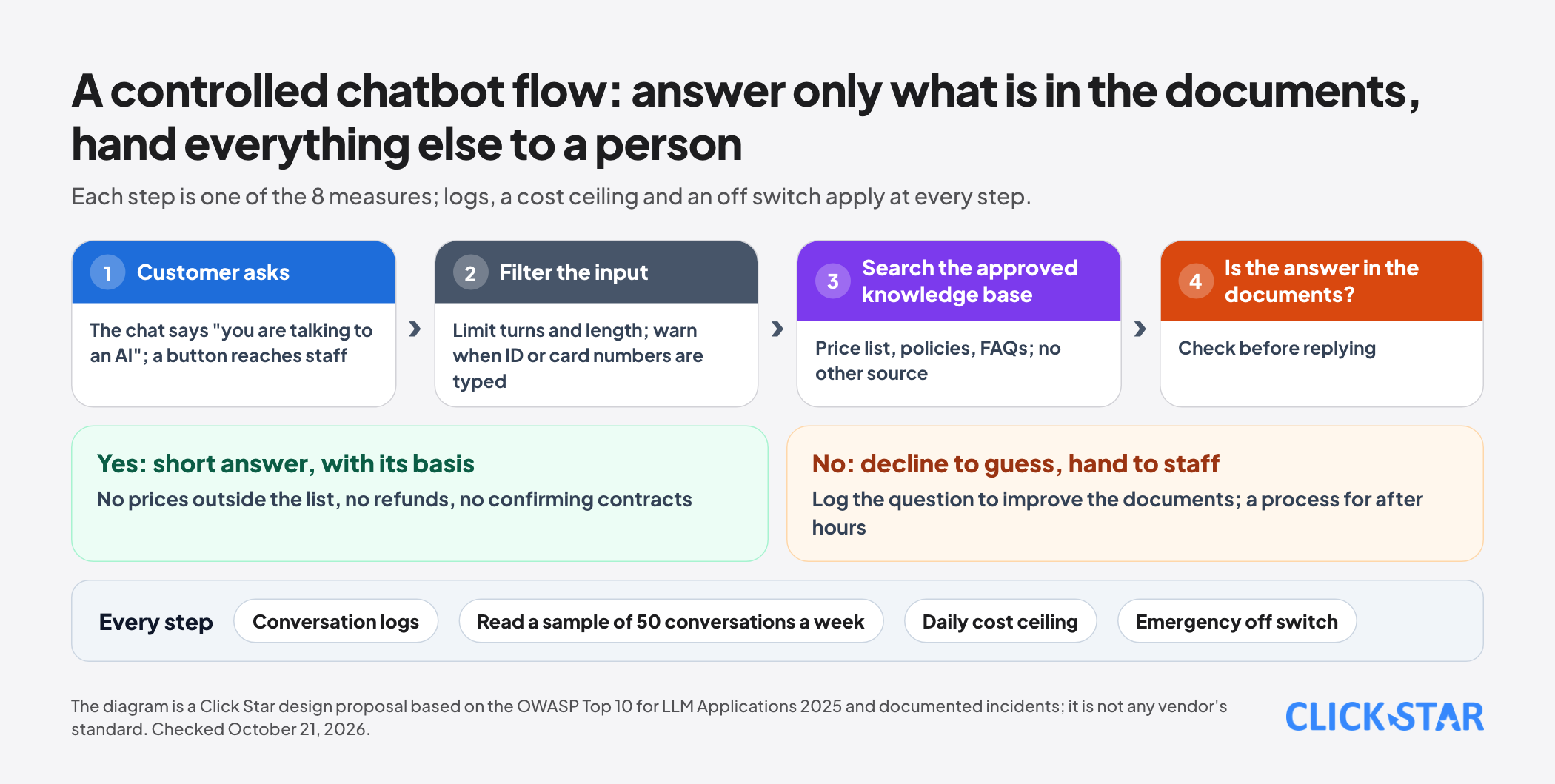
- Say from the start that the customer is talking to an AI, and how to reach a staff member.
- Allow answers only from the approved knowledge base; when something is not in the documents, decline and hand over.
- Give the chatbot no authority to commit: no prices outside the list, no refunds, no confirming contracts.
- Provide a handoff button at every step, and a process for when no staff are on duty.
- Mask or warn when customers type identity numbers, card numbers or passwords; keep conversations no longer than needed.
- Limit turns, conversation length and frequency per user, and set a daily cost ceiling.
- Test adversarially before launch: ask 3 to 5 people to try to push the chatbot into a wrong price, dropping its rules or revealing its system prompt.
- Have an emergency off switch and someone with the authority to press it; keep logs for investigating incidents.
How to measure results
Use 3 tiers of metrics and define each in writing before launch, because each platform defines them differently.
Quality tier. The rate of wrong or unsupported answers, scored by a person reading a random sample of 50 conversations each week. The handoff rate. Satisfaction (CSAT) after the conversation.
Business tier. Contact capture rate, booking or order rate, first response time.
Cost tier. Cost per resolved conversation, calculated as (token cost + platform fee + the time of the people who take over) divided by the number of resolved conversations. This is Click Star's formula, not any vendor's standard definition.
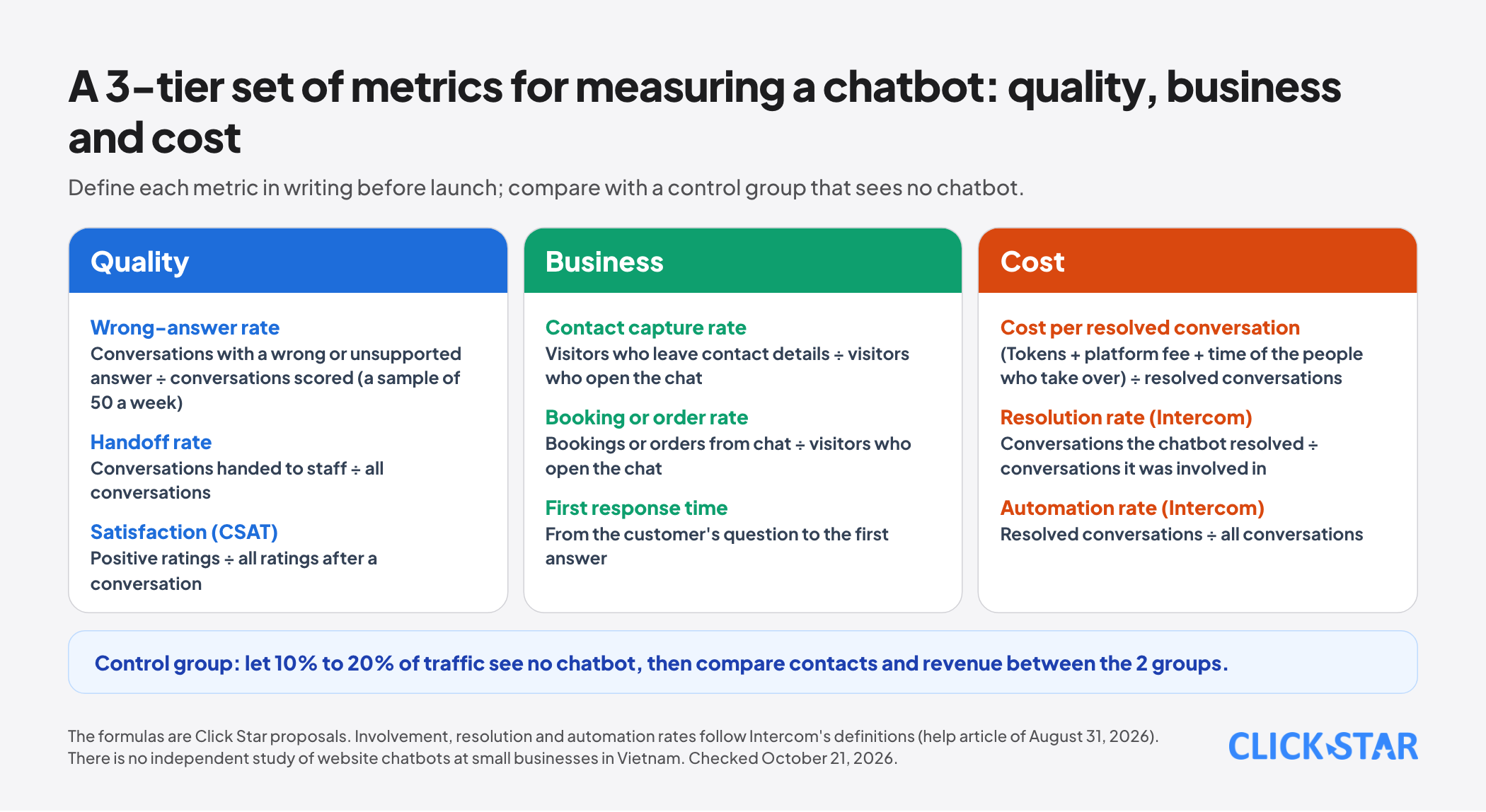
Intercom (help article dated August 31, 2026) defines involvement rate as conversations in which the chatbot had a chance to answer divided by all conversations; resolution rate as conversations the chatbot resolved divided by conversations it was involved in.
Automation rate is resolved conversations divided by all conversations. These are the vendor's definitions, and the word "resolved" needs a careful read because a silent customer is not always a satisfied one.
A control group is needed. Let a share of traffic (for example 10% to 20%) see no chatbot, then compare contact capture and revenue between the 2 groups. Without a control group, any improvement could be seasonality or an ad campaign.
Reference numbers need care. Click Star does not use the "30% to 50%" level that a vendor employee once posted on a forum, because it is a 2023 opinion and not independent.
The study "Generative AI at Work" (Brynjolfsson, Li and Raymond, QJE 2025) recorded about 14% more issues resolved per hour across 5,179 support agents. That is AI helping agents, not a chatbot answering customers.
A 30-day plan
- Week 1: choose the scope (at most 20 common questions), write the knowledge base, choose the model or platform, define the metrics, name a person responsible.
- Week 2: build the chatbot, apply the 8 measures above, test adversarially with 3 to 5 people, fix problems.
- Week 3: run with 10% to 20% of traffic, read 50 conversations each week, log the wrong answers.
- Week 4: compare with the control group, calculate cost per resolved conversation, decide whether to expand, adjust or stop.
What is not known
Click Star has no independent measurement of how well chatbots perform on small-business websites in Vietnam.
It is unclear which risk tier a small business's website chatbot falls into under the Artificial Intelligence Law, and which party carries the duty to notify. The Air Canada decision was read through reports. Model prices change quickly, so check them again before budgeting.
Common mistakes
- Putting a chatbot on the website with no approved knowledge base, leaving the model to guess.
- Giving the chatbot authority to commit to prices, refunds or terms.
- Having no route to a person, or having one that nobody staffs.
- Looking only at token cost and ignoring the effort of documents, monitoring and the people who take over.
- Setting no limit on turns and no cost ceiling, so the chatbot gets abused.
- Not testing adversarially before launch.
- Measuring by number of conversations instead of outcomes, and having no control group.
Related posts
Need tailored advice for your business?
Click Star helps you build a solution that fits your industry and scale. We answer every question during business hours.