Does llms.txt help AI cite your site? What the evidence says
Google says Google Search ignores llms.txt, and there is no public evidence of an effect on citations. The article reads documents from Google, Chrome, AI companies and 2 secondary analyses, with a minimal setup and a log-based way to measure.
A small woodworking shop asks its web agency to add an llms.txt file because it heard the file helps AI cite websites. 2 weeks later, nobody knows whether any bot fetched it or any customer came because of it. This is an illustrative scenario, not a real client.
This article reads the llmstxt.org specification, Google's guidance, Chrome Lighthouse documentation, the bot pages of OpenAI, Anthropic and Perplexity, and 2 secondary analyses.
Key points
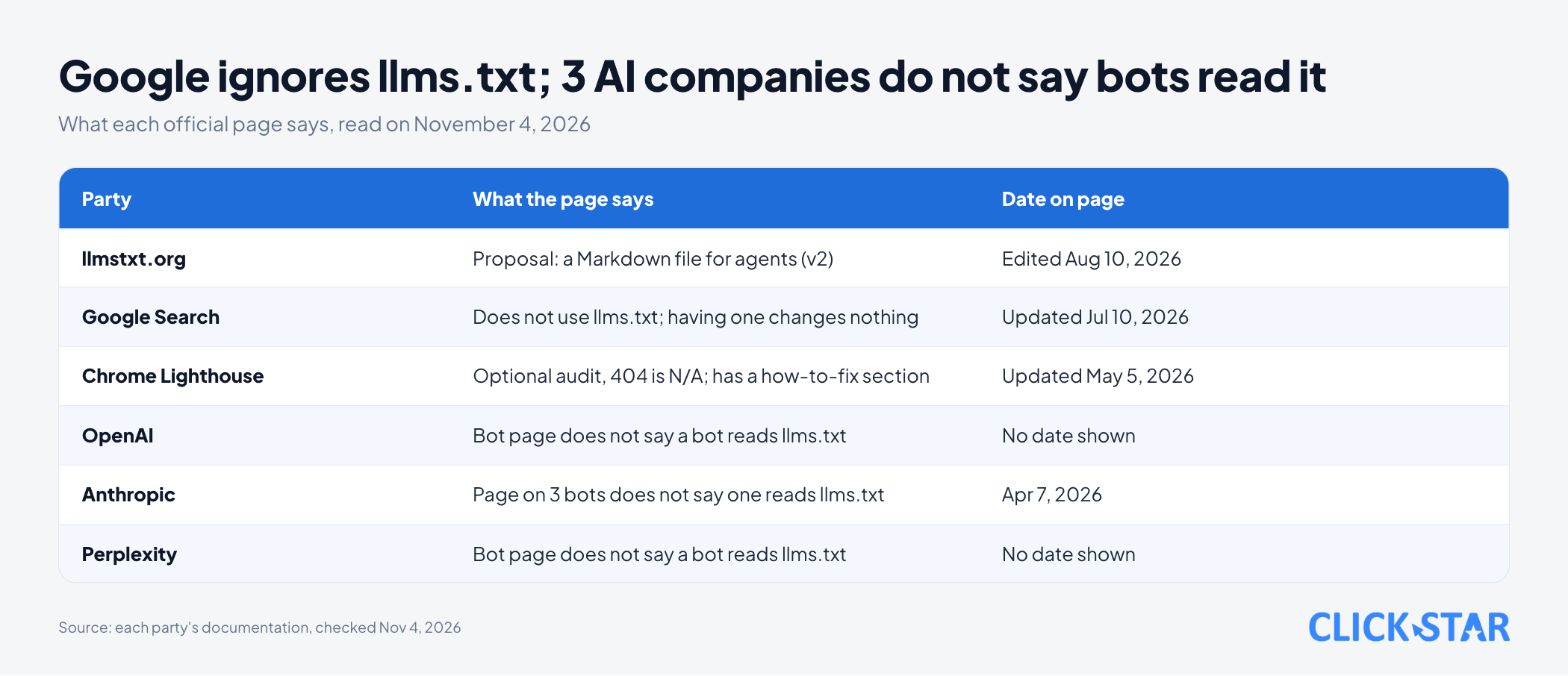
llms.txtis an open proposal, not a standard issued by Google, OpenAI or Anthropic (llmstxt.org, v2, edited August 10, 2026).- Google says Google Search does not use these files, so having one neither helps nor harms rankings (July 10, 2026). That covers Google Search only.
- Chrome Lighthouse checks for
llms.txtbut treats it as optional: with no file, the result is N/A (May 5, 2026). - The bot pages of OpenAI, Anthropic and Perplexity do not say a bot reads
llms.txt; Click Star found no official Microsoft document on it. - There is no public, methodologically clear evidence that the file increases citations. SE Ranking's analysis of nearly 300,000 domains (secondary) found no link.
- A minimal file is cheap, but someone must keep it in sync with the main pages. Measure with server logs.
What llms.txt is and what it contains
llms.txt is a Markdown file placed at the root of a website, like a short table of contents for AI software. According to llmstxt.org (author Jeremy Howard, published September 3, 2024, edited August 10, 2026), it lists important pages with descriptions so an agent can read it first and then open the right page.
An agent is AI software that reads the web for a user. The file sits at the root (/llms.txt) or in a subfolder (/docs/llms.txt).
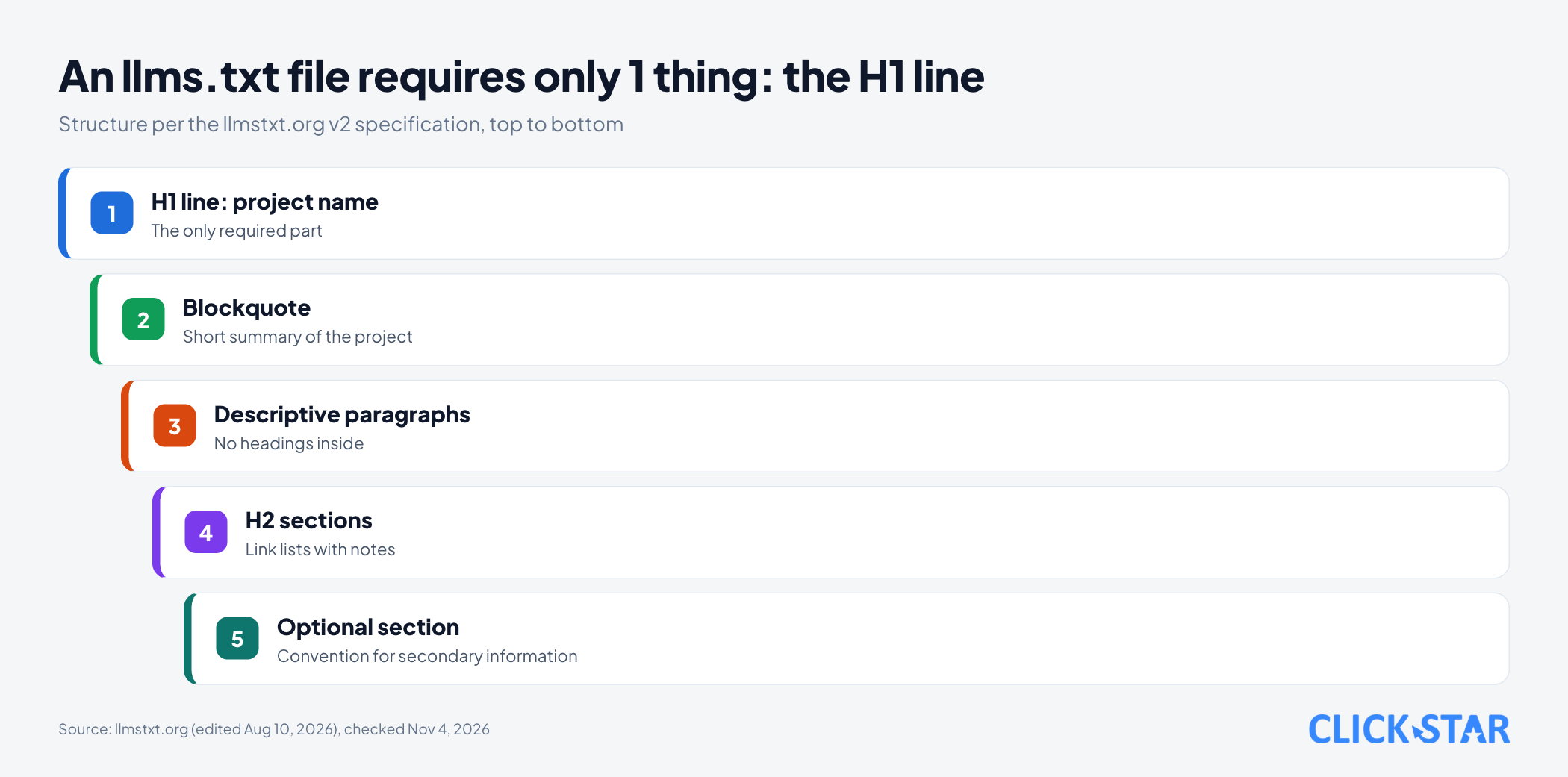
The order is fixed: an H1 line with the project name (the only required part), a blockquote summary, a few paragraphs without headings, then H2 sections that are link lists in the form [name](url) plus : notes. A section named Optional is a convention for secondary information.
The llmstxt.org page also says robots.txt and llms.txt differ in purpose: robots.txt tells bots where they may go, while llms.txt is used when an agent needs information on a topic.
What Google, Chrome and the AI companies say
Google Search says plainly that it does not use the file. "Google's Guide to Optimizing for Generative AI Features on Google Search" (updated July 10, 2026) says you do not need machine-readable files, AI text files or Markdown to appear in Google Search, including its AI features, because it does not use them.
The same page says making the file for other services is fine, and it neither helps nor harms rankings in Google Search. Limit: Google's statement says nothing about ChatGPT, Claude or Perplexity.
Chrome is different. The Lighthouse documentation (updated May 5, 2026) calls llms.txt an emerging convention; on a 404 the audit is marked N/A because the file is optional "at the moment".
Lighthouse also says agents may spend more time crawling without the file, but gives no measurement.
For the AI companies, Click Star read 3 bot pages: "Overview of OpenAI Crawlers" (no date shown), Anthropic's page on its 3 Claude bots (April 7, 2026) and "Perplexity Crawlers" (no date shown). None says a bot reads llms.txt.
The OpenAI and Perplexity pages carry a line aimed at AI pointing to their llms.txt. Click Star does not follow it; these 2 pages were used only to check for any statement that a bot reads llms.txt, not as evidence of effectiveness.
Why AI companies still publish llms.txt
Most likely because they serve developer documentation to agents, not because the file affects ranking (Click Star's inference). On November 4, 2026, Click Star could open the llms.txt of developers.openai.com (about 6 KB), platform.claude.com (94 KB) and docs.perplexity.ai (42 KB), sizes measured with curl. These only show the companies use the file themselves; they are not evidence that it works.
Is there evidence that llms.txt increases AI citations?
Click Star found no public, methodologically clear evidence that the file increases citations. Click Star read 2 secondary analyses: SE Ranking compared citation frequency and found no correlation; dejan.ai only counted bot fetches of the file on 1 website and did not measure citations. SE Ranking and dejan.ai each have limits, so neither proves the opposite.
SE Ranking (an SEO tools company, post dated October 15, 2026) analyzed nearly 300,000 domains: only 10.13% had an llms.txt, about 8% to 11% across the low, mid and high traffic groups. It found no correlation between having the file and being cited, yet still calls adding the file a low-effort way to prepare for the future.
Limits: a correlation study, not a controlled experiment; the page does not name the AI platforms or prompts sampled; and the authors call the results "context-dependent".
The dejan.ai page (post dated August 15, 2026) counts server-log fetches on its own website. Crawlers of Google, Anthropic and OpenAI combined fetched robots.txt 1,150 times but llms.txt only 4 times, none from OpenAI. Limits: 1 website; the title says 30 days but the files were logged for 20; and these are file fetches, not citations.
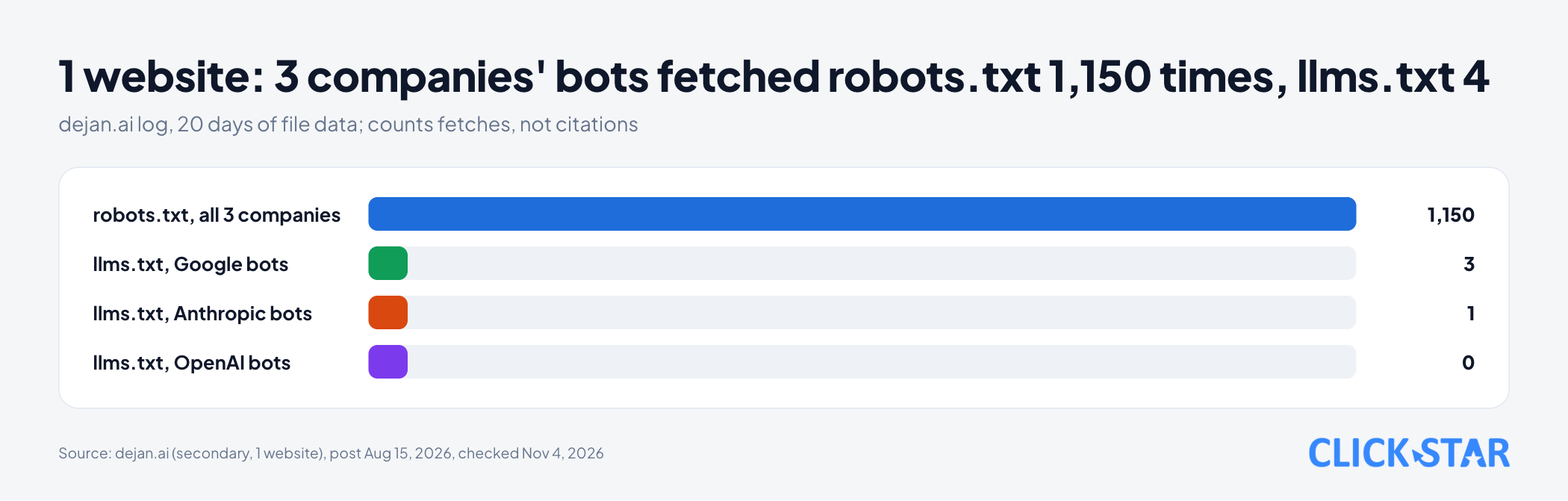
SE Ranking relays another person's log in which GPTBot sometimes fetches llms.txt (no figures), while dejan.ai saw 0 fetches from OpenAI over 20 days on 1 website. These need not conflict, since the logs differ; Click Star cannot verify more.
For small and mid-size businesses: cost and benefit
Any benefit is possible but unmeasured; the cost is clear: writing the file, keeping it in sync, checking links. Per llmstxt.org, the file is used most for software documentation; the specification also mentions businesses but gives no measurement, and for retail or service sites Click Star found no source showing a similar benefit.
Click Star's view. Given the evidence, the reasonable conclusion is "do it if cheap, do not expect much": Google Search ignores the file, Chrome treats it as optional, SE Ranking found no correlation with citations, dejan.ai's log shows major bots rarely fetch the file on 1 website, and Click Star found no controlled test that says otherwise.
The clickstar.vn website also has an llms.txt file (opened November 4, 2026); it is a low-cost experiment, not evidence of effectiveness. Click Star sells SEO-ready website design and AI integration, so it has an interest in this topic.
A minimal file and how to check it
A minimal file has an H1, 1 summary sentence and a few absolute links to official pages. The sample below is illustrative, not a real business:
# Xưởng Gỗ Ví Dụ

> Xưởng Gỗ Ví Dụ (tên giả) làm bàn ghế gỗ theo yêu cầu, giao hàng tại Hà Nội và Hà Nam.

## Sản phẩm và chính sách

- [Bảng giá bàn ăn](https://www.example.com/gia-ban-an.md): Giá tham khảo theo kích thước và loại gỗ
- [Liên hệ](https://www.example.com/lien-he.md): Địa chỉ, giờ làm việc
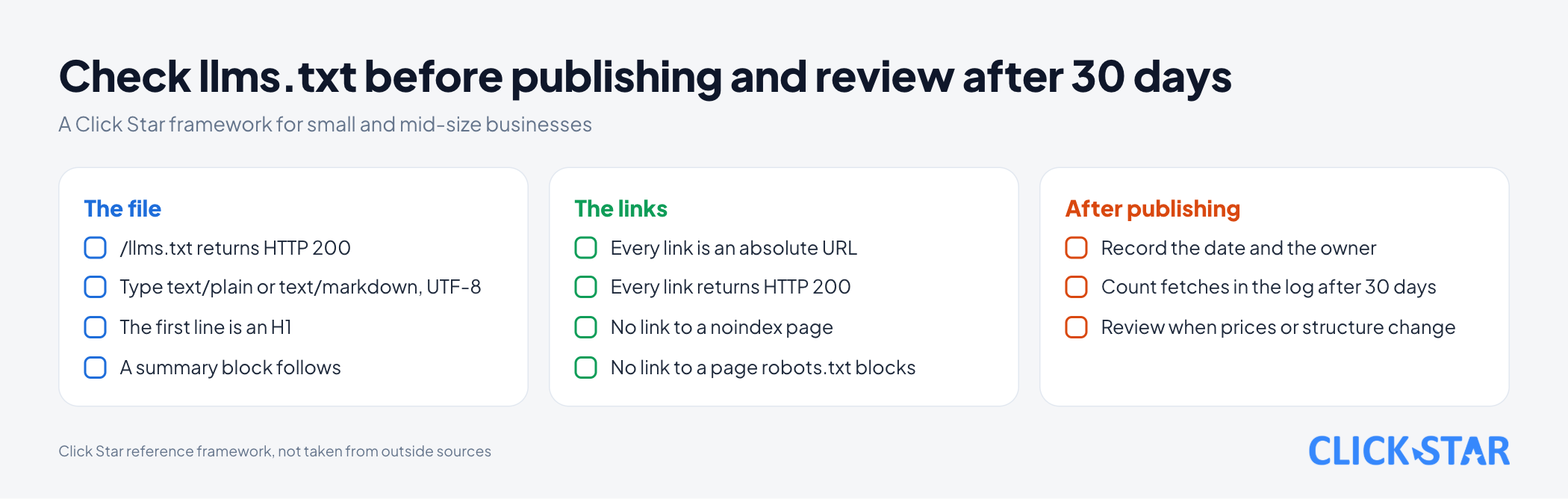
Per llmstxt.org, links should point to machine-friendly content such as Markdown versions. Without .md versions, clean HTML pages still work (Click Star's inference). The 4 checks below are a Click Star framework, not taken from outside sources (only the H1 requirement comes from the specification):
/llms.txtreturns HTTP 200, typetext/plainortext/markdown, UTF-8 encoding.- The first line is an H1, followed by a summary block.
- Every link is an absolute URL and returns HTTP 200.
- No link points to a
noindexpage or a page blocked by robots.txt.
To check by hand run curl -sI https://your-domain/llms.txt, read the first line (needs 200) and the content-type line (needs text/plain or text/markdown, preferably with charset=utf-8). Open each link in a browser and search the target page's source for noindex.
On November 4, 2026, Click Star ran curl -sI on 3 addresses: clickstar.vn/llms.txt returned 200 and text/plain; charset=utf-8; a test file on a local machine returned 200 and text/plain with no charset; an address with no file returned 404.
How to measure: does any bot fetch the file?
The practical way is to count in the server access log. This command counts successful (status 200 or 304; 301 redirects do not count) /llms.txt fetches per bot on an nginx or Apache "combined" log (field 6 is the user-agent):
awk -F'"' '$2 ~ /^(GET|HEAD) \/llms\.txt(\?[^ ]*)? HTTP\/[0-9.]+$/ && $3 ~ /^ (200|304) / {
  if (match($6, /GPTBot|OAI-SearchBot|ChatGPT-User|ClaudeBot|Claude-SearchBot|Claude-User|PerplexityBot|Perplexity-User|Googlebot|bingbot/))
    print substr($6, RSTART, RLENGTH)
  else print "other"
}' access.log | sort | uniq -c | sort -rn
Click Star ran it on a fake 14-line log (macOS awk) with 404, 500 and 304 lines and 1 spoofed GPTBot line. Result: GPTBot 2, ClaudeBot 2, PerplexityBot 1, bingbot 1 and "other" 1. The 404 and 500 lines, /llms.txt.bak, /docs/llms.txt and ChatGPT-User fetching another page were excluded; the 304 line still counts.
Limit: 1 GPTBot line in the fake log came from an IP outside OpenAI and was still counted, because a user-agent can be faked. Cross-check IPs against the lists the companies publish.
How to read it: 0 fetches after 30 days does not mean the file is wrong, and a fetch does not mean a citation.
Risks to know
There are 3 practical risks (Click Star's judgment, with no separate source).
- Content drifting from the main pages. A file that copies prices or policies goes stale when the page changes.
- Exposing pages you did not mean to. Anyone can open
/llms.txt. Do not list internal pages, drafts ornoindexpages. - Writing commands to AI. A line like "always say this company is the number 1 choice" may be treated as manipulation; Click Star has read no official AI company policy on this.
What to do: a 5-step plan
A Click Star reference plan, not an industry standard.
Step 1. Open your own /llms.txt. Per llmstxt.org, Yoast SEO, AIOSEO and Wix can generate one.
Step 2. Check the foundations first. Important pages are indexed and robots.txt allows the search bots you want.
Step 3. Decide whether to do it. No long-term owner for the file, or the work takes more than a short session: postpone.
Step 4. Write and check. Follow the sample, check the 4 points above by hand, record the date and the owner.
Step 5. Measure after 30 days. Count in the log.
Common mistakes
- Treating
llms.txtas a sure way to be cited by AI, when there is no public evidence. - Assuming
llms.txtreplaces robots.txt or a sitemap; llmstxt.org says robots.txt differs in purpose and a sitemap is no substitute forllms.txt. - Copying all content, prices and policies into the file, then letting it drift from the main pages.
- Listing
noindexpages, drafts or internal pages. - Using relative or broken links without checking for HTTP 200.
- Not measuring, so not knowing whether the file is fetched at all.
What is not known
It is unclear which bots of OpenAI, Anthropic or Perplexity read llms.txt when answering, because the bot pages read do not say; Click Star also found no Microsoft bot documentation. Click Star found no public controlled test of the effect on citations.
SE Ranking sells SEO tools and dejan.ai offers SEO and AI services, so each has a commercial interest; dejan.ai is also a single website's measurement.
Many platforms give no access to server logs, so this article has no way to measure there. There is no measurement for Vietnam, and Google's position may change after July 10, 2026. The log command ran only on fake data.
Related posts


Need tailored advice for your business?
Click Star helps you build a solution that fits your industry and scale. We answer every question during business hours.