Where do visitors from ChatGPT and AI assistants show up in GA4?
GA4 now has an AI Assistant channel, but Google's own AI visits sit in Organic Search and many visits fall into Direct. Based on documents from Google, OpenAI and Microsoft.
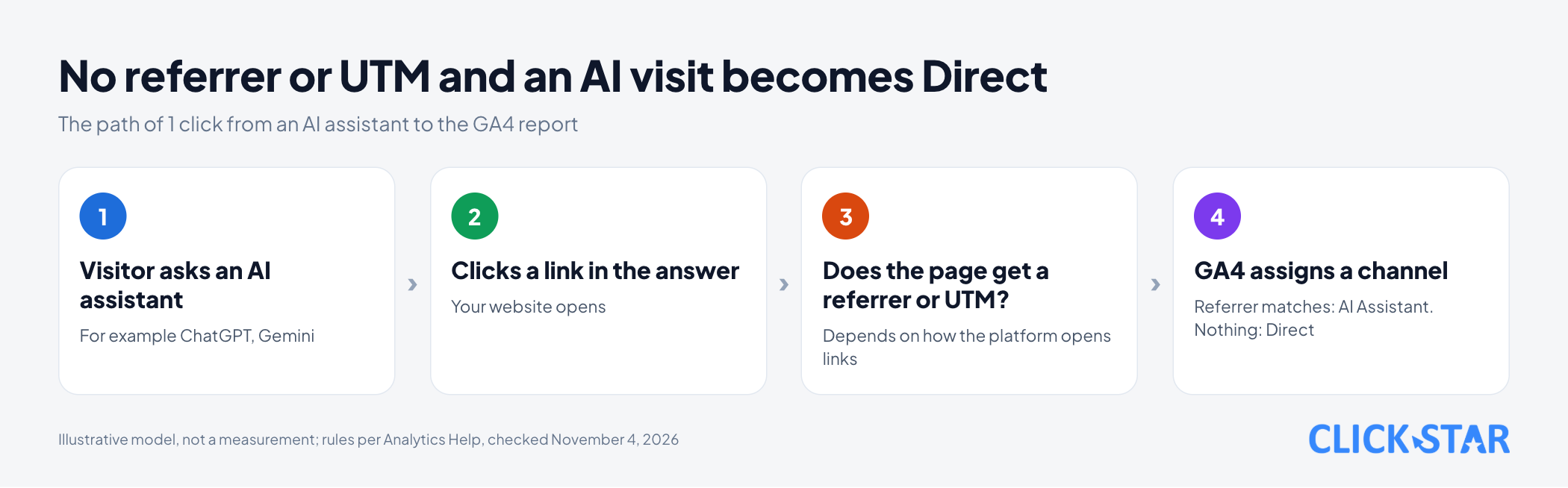
A shop owner hears customers say "I asked ChatGPT and then came to your site". In GA4 the owner only sees "Direct" rising, and ChatGPT's name is nowhere. This is an illustrative scenario, not a real measurement.
This article draws on documents from Google, OpenAI, Perplexity, Anthropic, Microsoft and 2 secondary sources (Search Engine Roundtable, Analytics Mania), checked on November 4, 2026.
The short answer: GA4 now has its own channel for AI assistants, but it excludes Google's own AI features and misses visits that carry no source information.
Key points
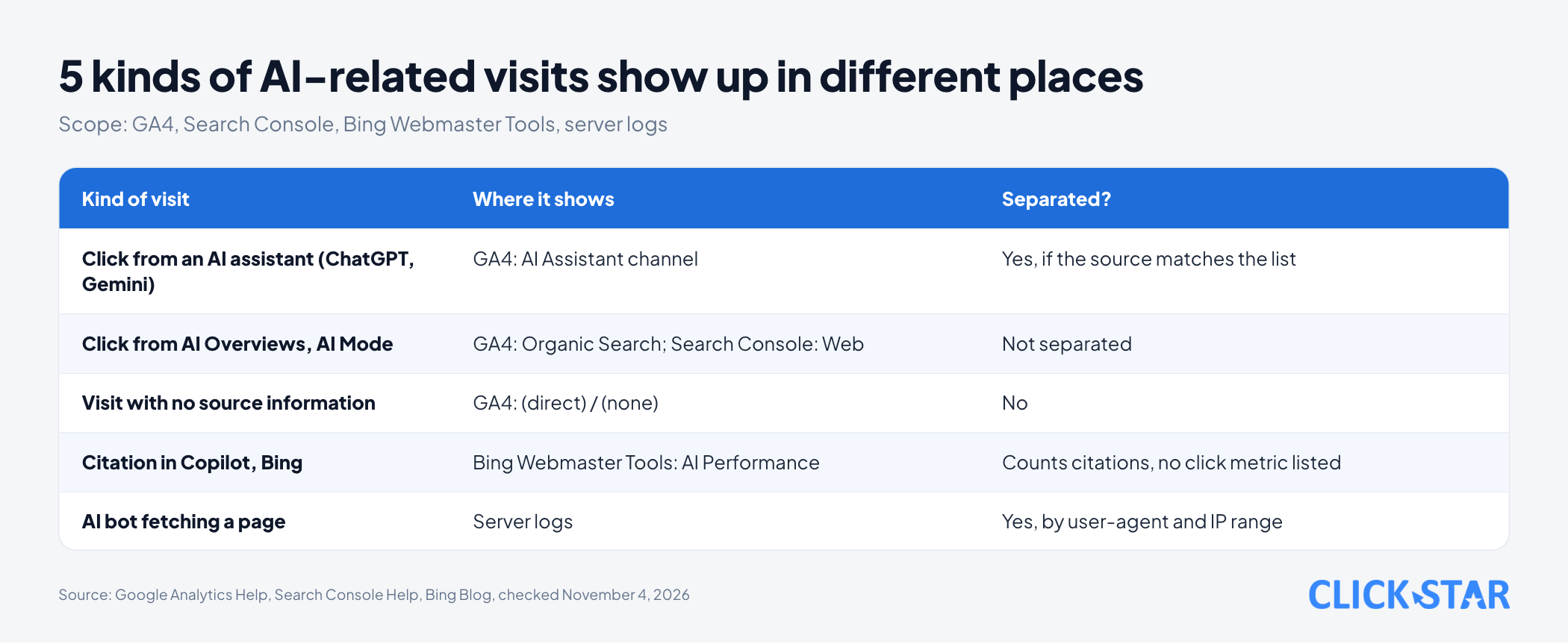
- The entry dated May 13, 2026 on the "What's new" page says GA4 has a default "AI Assistant" channel. It takes visits from assistants such as ChatGPT or Gemini when the source matches Google's list, and excludes AI Overviews and AI Mode.
- Clicks from AI Overviews and AI Mode sit in Organic Search in GA4, and in the Performance report under the Web search type in Search Console.
- OpenAI says ChatGPT adds
utm_source=chatgpt.comto links (via search results). Per a secondary source, in October 2026 it was reported missing, then restored. - The Perplexity, Anthropic and Microsoft documents read state no referrer or UTM for visitor clicks: no official source.
- Visits with no source information land in (direct) / (none), so the AI Assistant channel is a minimum (Click Star's inference).
GA4 already has an AI Assistant channel
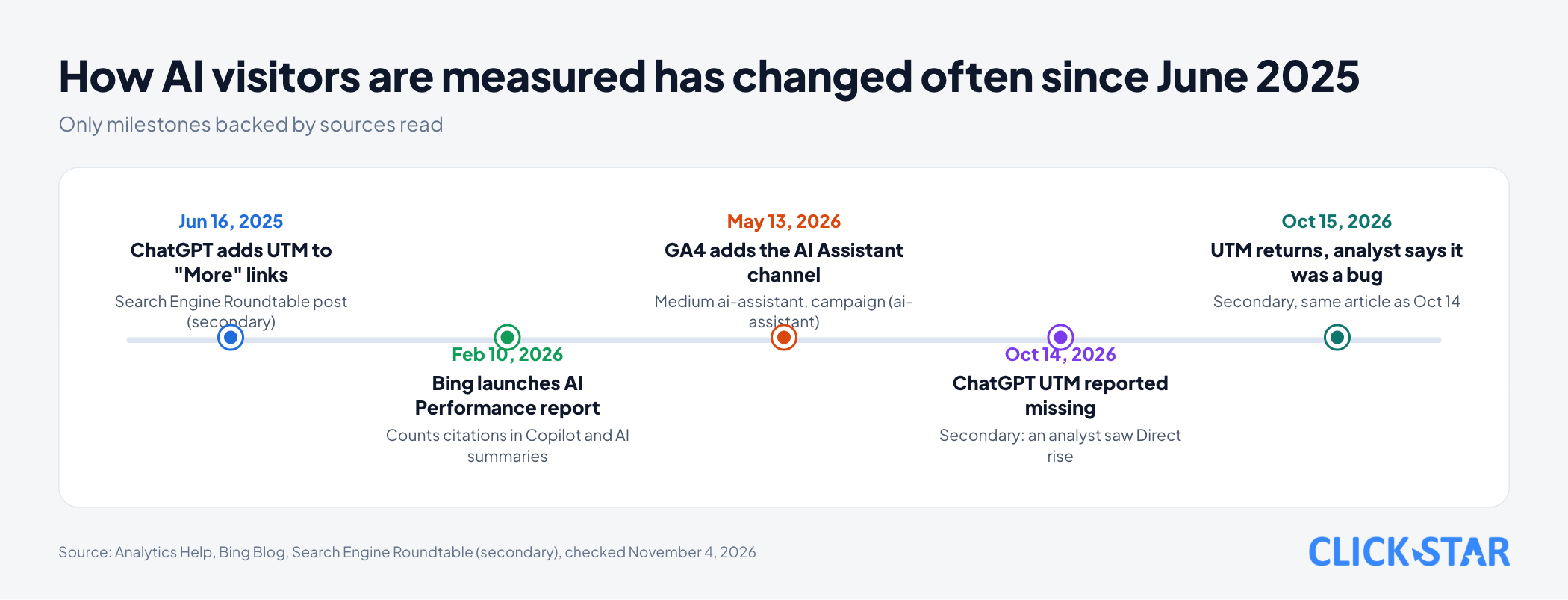
GA4 may already group AI visits for you. The entry dated May 13, 2026 on the "What's new in Google Analytics" page (read November 4, 2026) says GA has an "AI Assistant" channel in the Default Channel Group, with medium ai-assistant and campaign (ai-assistant).
The condition is that the referrer (the page the visitor clicked from) matches an assistant Google recognizes. The "Default channel group" page (no date shown, read November 4, 2026) says the channel excludes AI Overviews and AI Mode.
The "What's new" page names ChatGPT, Gemini, Claude; the "Default channel group" page names ChatGPT, Gemini, Deepseek, Copilot, Grok. The lists differ, and neither page names Perplexity in the channel description.
Where visits from AI Overviews and AI Mode appear
They sit with ordinary search. Google Search Central's "AI features and your website" page (shows updated 2025-12-10 UTC, read November 4, 2026) says sites appearing in AI features are counted in overall search traffic, reported in Search Console's Performance report under the "Web" search type.
The "What are impressions, position, and clicks?" page (no date shown, read November 4, 2026) says clicking an external link in an AI Overview or AI Mode counts as 1 click. In GA4, the "Default channel group" page puts these in Organic Search. Click Star's inference: with standard reports, you cannot separate Google's AI part from ordinary search.
What each platform sends to your site
OpenAI. Per the search-result summary of the "Publishers and Developers - FAQ" page (blocked to tools), ChatGPT adds utm_source=chatgpt.com to links, and sites that allow OAI-SearchBot can track ChatGPT referrals.
The "Overview of OpenAI Crawlers" page (no date shown, read November 4, 2026) says sites that opt out of OAI-SearchBot will not be shown in ChatGPT search answers, though they can still appear as navigational links.
Search Engine Roundtable (secondary) posted on June 16, 2025 that ChatGPT added UTM to "More" group links too. Its October 14, 2026 article says the parameter seemed dropped from the GPT-6 launch; the analyst updated it on October 15, 2026 to say it was a bug and the parameter is back.
Perplexity and Anthropic. The "Perplexity Crawlers" page (no date shown) and Anthropic's help page on its crawlers (shows April 7, 2026), read November 4, 2026, only describe bots and robots.txt, with no referrer or UTM.
Microsoft Bing. Bing's blog post of February 10, 2026 introduces the AI Performance report, which counts how often pages are cited in Copilot and Bing's AI summaries. Its metrics are total citations, cited pages per day on average and grounding queries. The post lists no click metric.
Why the numbers are usually lower than reality
Because many visits carry no source information. The "[GA4] Understand (direct) / (none) traffic" page (no date shown, read November 4, 2026) lists causes: links without UTM, redirects that strip UTM, link shorteners, offline documents such as PDFs, and ad blockers.
The October 2026 episode is a real example. Per Search Engine Roundtable, an analyst described that with no tag and no referrer, GA4 records the visit as Direct. Across about 500 pages where ChatGPT drove 5% or more of visits, comparing October 9 to 13, 2026 with the week before, this person saw ChatGPT drop by 31 thousand visits and Direct rise by 26 thousand per day.
That is 1 person's measurement on 1 set of pages, from a secondary source: do not generalize it.
Grouping them yourself with a custom channel group
Only needed when the default channel misses sources you need. To see each assistant, use Session source. The "Custom channel groups" page (no date shown, read November 4, 2026) says a standard property allows at most 2 custom groups, and a visit goes to the first matching channel in order, so "AI assistants" must sit above "Referrals".
The page supplies a regex (regular expression, a text pattern for matching source names) with the "matches regex" condition. It starts with the branch ^.*ai, then .*chatgpt.*, .*gemini.* and similar.
Click Star re-ran this pattern with Python re on November 4, 2026 on 12 sample names picked for the test (not measurements): claude.ai, perplexity.ai, grok.com, chat.deepseek.com, sgpt-training.vn, chatgpt-fan-blog.vn, email, baidu, mail.google.com, main.vn, google, bing.
Python is not GA4's regex engine, so this shows only the pattern's shape.
- Google's pattern, full match: catches
claude.ai,perplexity.ai; falsely hitssgpt-training.vn,chatgpt-fan-blog.vn; missesgrok.com,chat.deepseek.com. - Google's pattern, partial match: also falsely hits
email,baidu,mail.google.com,main.vn, because the^.*aibranch matches any name containing "ai". - Click Star's pattern: catches
claude.ai,perplexity.ai, hits no wrong name in either mode, but missesgrok.com,chat.deepseek.com, which are not in it.
Click Star's pattern (example domains; check them against your real Session source values):
^(www\.)?(chatgpt\.com|chat\.openai\.com|perplexity\.ai|gemini\.google\.com|copilot\.microsoft\.com|claude\.ai)$
Google's page does not say whether "matches regex" is a full or partial match. Per Analytics Mania (updated November 20, 2025, secondary), "matches regex" requires the whole string, while "partially matches regex" may appear in custom channel groups.
Measuring further with server logs and a question for customers
A server log records every request to the site, bots included, and a bot line is not a visitor. The "Overview of OpenAI Crawlers" page (as above) says ChatGPT-User may visit a page when a user asks ChatGPT, and robots.txt rules may not apply.
Click Star's inference: lines from user bots (ChatGPT-User, Perplexity-User, Claude-User) show a page was fetched, not that a customer visited. Bot names can be faked, so check each company's published IP ranges.
This command counts lines per bot, visits whose Referer is an AI page (lines of the AI bots above excluded), and visits carrying ChatGPT's UTM:
for b in GPTBot OAI-SearchBot ChatGPT-User PerplexityBot Perplexity-User ClaudeBot Claude-User Claude-SearchBot; do
  printf '%s %s\n' "$b" "$(grep -ci "$b" access.log)"
done
grep -viE '(GPTBot|SearchBot|ChatGPT-User|PerplexityBot|Perplexity-User|ClaudeBot|Claude-User)[^"]*"$' access.log | grep -ciE '[0-9-] "https?://(www\.)?(chatgpt\.com|perplexity\.ai|gemini\.google\.com|claude\.ai|copilot\.microsoft\.com)(/|")'
grep -ciE 'utm_source=chatgpt\.com' access.log
Test conditions: macOS, sh, combined log format.
Click Star re-ran it on November 4, 2026 on a fake log with a 304 line whose size is "-", a bot line carrying an AI Referer, a fake Referer chatgpt.com.fake-site.example and an empty file: the output matched, the fake Referer was not counted, the empty file gave zeros, and a visitor on a CUBOT phone (User-Agent containing "bot") was still counted.
The next layer is asking: add "How did you hear about the business?" to a form, with an option "AI assistant (ChatGPT, Gemini, Perplexity)". It catches customers counted as Direct, but depends on people answering.
A 4-metric sample report and how to read it
Click Star's framework, not from an outside source, not yet run on real data. Read weekly, never summed.
- Sessions and key events from the AI Assistant channel (GA4).
- Search Console clicks and Google organic sessions in GA4 (source google, medium organic). The "Using Search Console and Google Analytics Data for SEO" page (shows updated 2026-01-07 UTC) says Clicks and Sessions are the most comparable but do not match exactly.
- AI bot lines in logs, split by bot type.
- Share of customers who say they came via an AI assistant.
What this means for Vietnamese businesses
Click Star's view. For most business websites, AI-assistant visits are a secondary signal, not yet a channel for revenue targets. Some visits may go unrecognized, and platforms change how they send data without notice.
Click Star offers data dashboards and digital marketing services, so it has an interest in this topic.
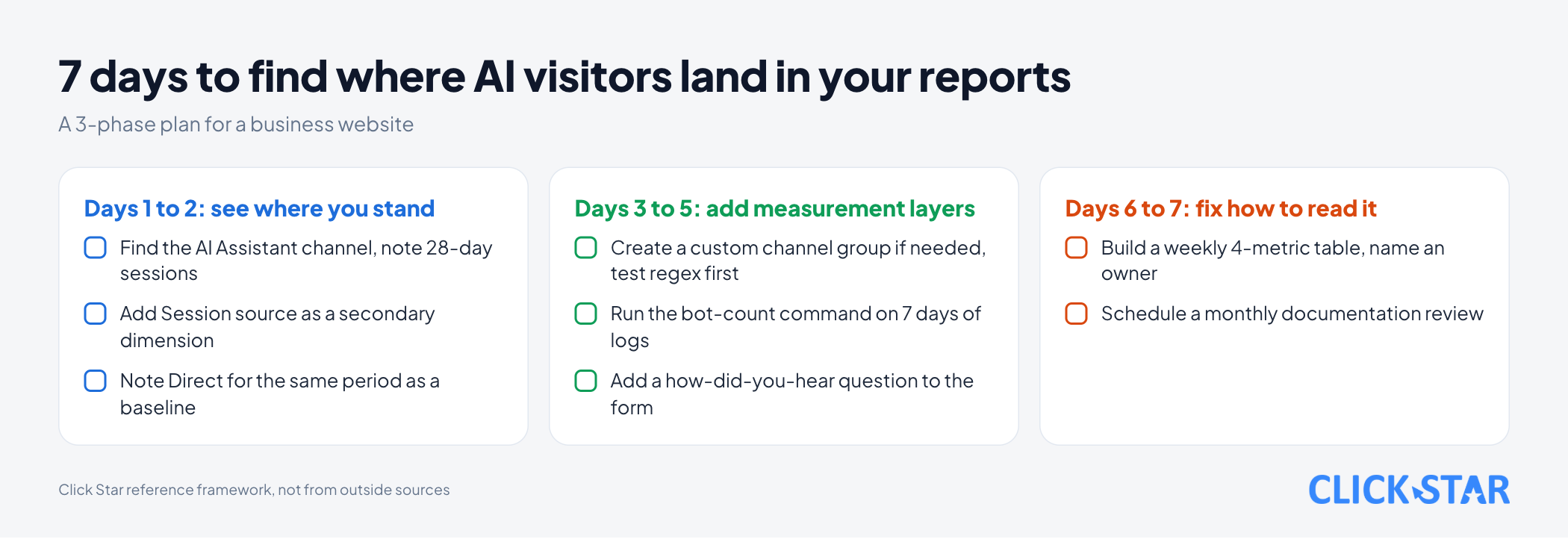
What to do: a 7-day plan
A reference plan from Click Star, not an industry standard.
Days 1 to 2: see where you stand
- Open Traffic acquisition, find the AI Assistant channel and note its sessions over 28 days.
- Add Session source as a secondary dimension to see which assistants appear.
- Note Direct for the same period as a baseline.
Days 3 to 5: add measurement layers
- Create a custom channel group only if the default channel misses sources you need, and test the regex first.
- Run the bot-count command on the last 7 days of logs.
- Add a "how did you hear about us" question to the main form.
Days 6 to 7: fix how to read it
- Build a weekly table of the 4 metrics and name an owner.
- Schedule a monthly documentation review.
Common mistakes
- Concluding "AI brings no customers" only because the AI Assistant channel is small, without checking Direct.
- Adding AI Overviews and AI Mode visits to the AI Assistant channel, although GA4 puts them in Organic Search.
- Treating ChatGPT-User or Perplexity-User lines in logs as customers who visited.
- Pasting a regex with an over-broad branch like
^.*aiwithout testing it on real sources, so under partial matchemailorbaiduslip in. - Assuming robots.txt decides how GA4 assigns channels. Per OpenAI, a page that blocks OAI-SearchBot is not shown in ChatGPT search answers; GA4 channels follow the referrer and UTM.
What is not known
It is unclear what the full list of assistants GA4 recognizes is, and whether the AI Assistant channel applies to data before May 13, 2026. The two pages describing the channel only give examples, each with its own list, and neither names Perplexity; only the "Custom channel groups" page names it, as an example for a self-built regex.
Google names Gemini, Copilot and Claude as example sources for the channel, but Click Star found no document stating the specific referrer or UTM each assistant sends. It is unclear whether Perplexity visits go to AI Assistant or Referral, how many AI visits land in Direct, and there is no measurement for Vietnam.
The regex and log command ran only on fake data; the 4-metric framework has not been run on real data.
Related posts
Need tailored advice for your business?
Click Star helps you build a solution that fits your industry and scale. We answer every question during business hours.