The best AI video models right now (October 2026): leaderboard, prices and how to choose
The Artificial Analysis blind-vote leaderboard, API prices, per-model specs and how to choose an AI video model by need, updated October 18, 2026.
"Which AI video model is best" has no fixed answer. Best by blind-vote score, cheapest, longest, or able to run on your own servers are different questions, and the rankings change every month.
This article uses the Artificial Analysis blind-vote leaderboard as the base, adds specifications and prices from each provider's official pages, and then suggests how to choose by need. The ranking data was captured on October 18, 2026.
Key points
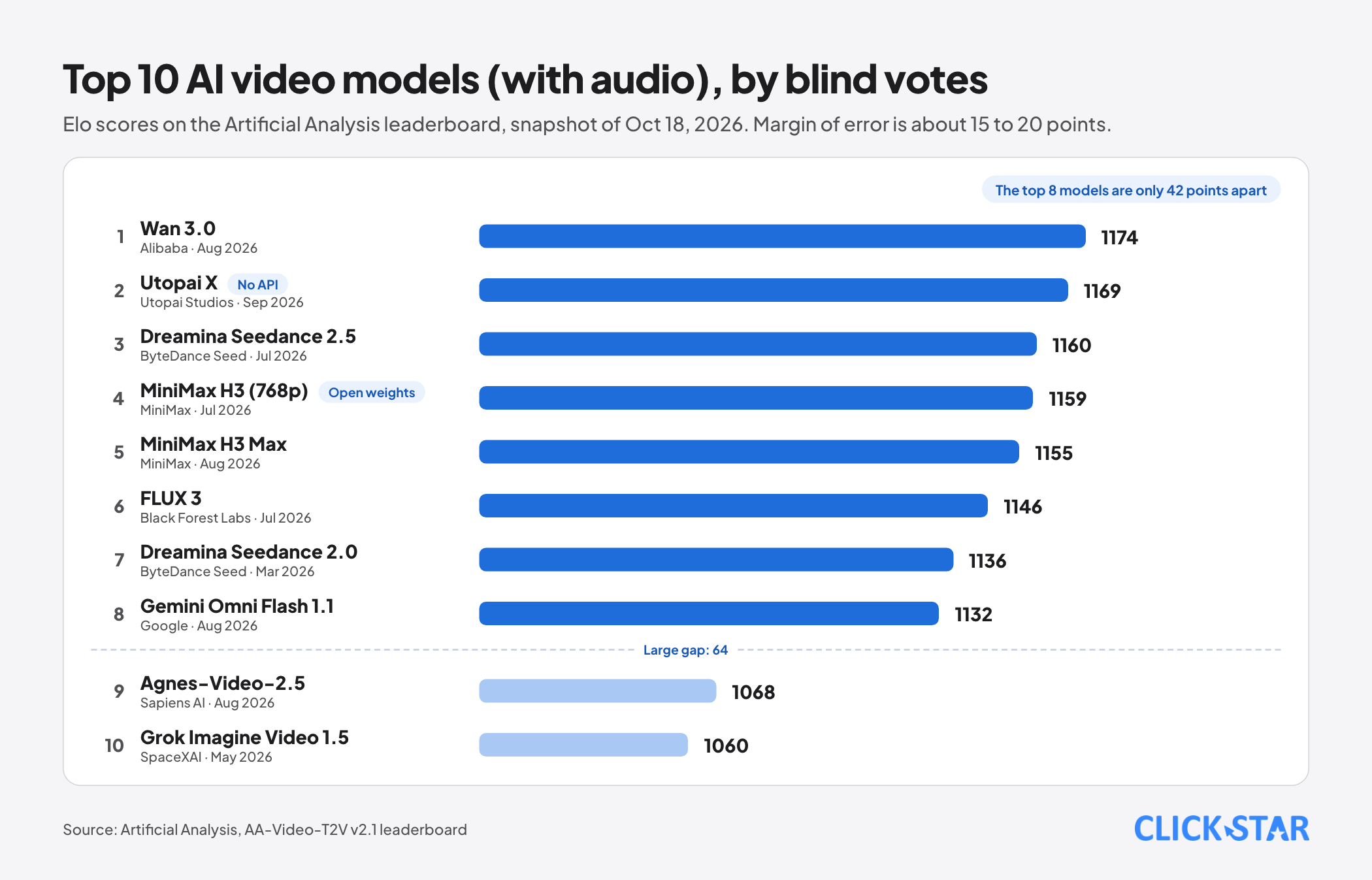
- On the Artificial Analysis text-to-video leaderboard with audio (version v2.1), Alibaba's Wan 3.0 is first with 1174 points, followed by Utopai X (1169) and ByteDance's Dreamina Seedance 2.5 (1160).
- The top 8 models are only 42 points apart, while the margin of error is about 15 to 20 points. Many adjacent ranks are not meaningfully different. After that there is a 64-point gap to rank 9.
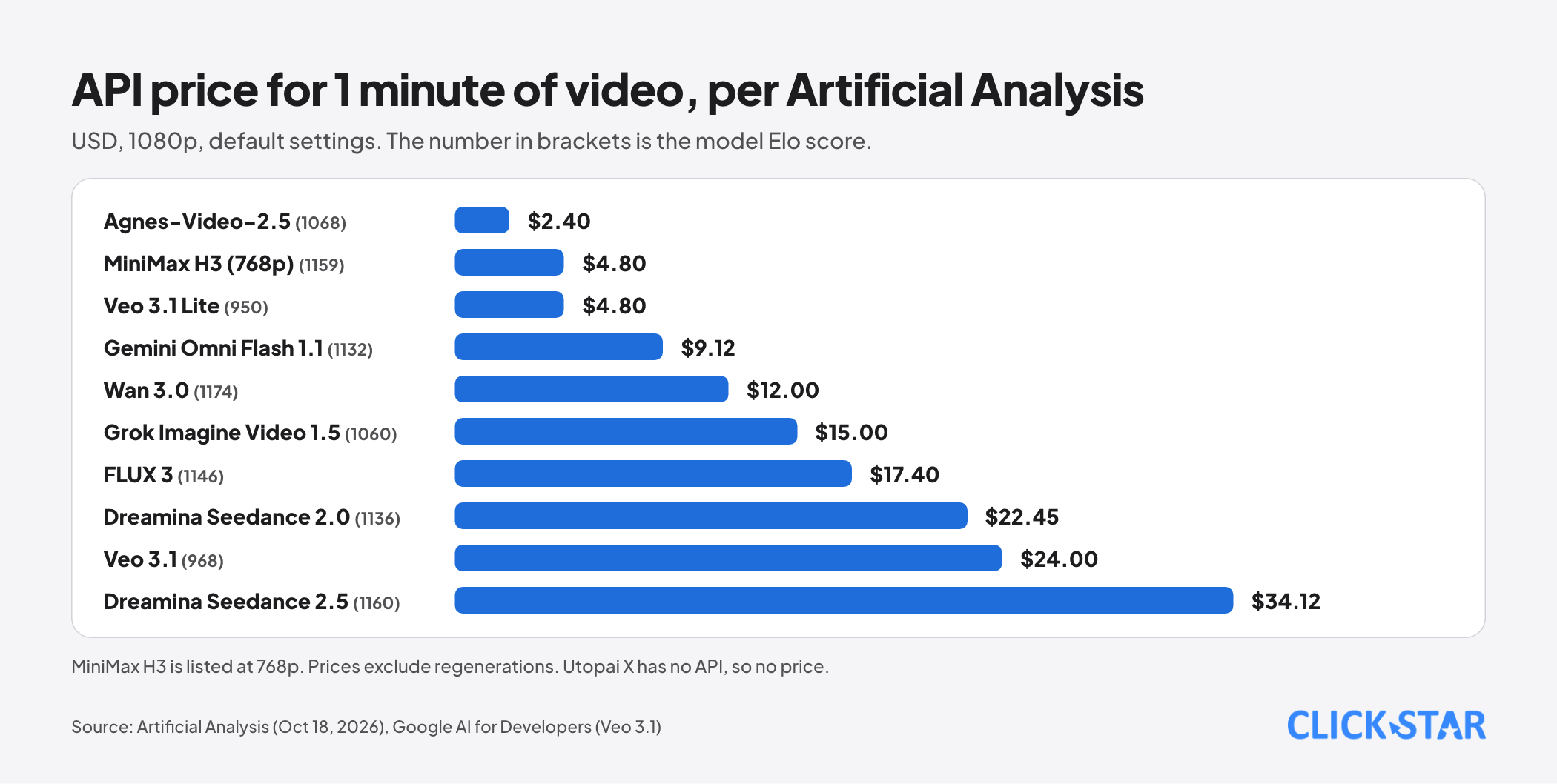
- API prices vary widely: from $2.40 to $34.12 for one minute of video in the same table.
- Only one model in the top 15 has open weights: MiniMax H3 (the 768p version).
- Wan 3.0 and Seedance 2.5 can both generate clips of up to 30 seconds with audio in one pass.
- Sora, Runway and Pika do not appear on this leaderboard.
1. How to read the leaderboard
The Elo scores on this board come from pairwise blind comparisons. Voters watch 2 videos generated from the same prompt without knowing which model made which, and are described as validated private evaluators. A higher score means the model is chosen more often.
4 things to keep in mind:
- Margin of error. Each score has a 95% confidence interval of about 15 to 20 points, and the page groups statistically equivalent ranks. So rank 1 and rank 3 are almost indistinguishable.
- The audio board. The default board ranks videos with audio. The silent board has its own ranking, for example Wan 3.0 at 1135 and MiniMax H3 (768p) at 1121.
- The scale. Kling 3.0 1080p (Pro) is fixed at exactly 1000 points as the anchor. Artificial Analysis changed the scale between versions, so do not compare this board's scores with older snapshots.
- Price. The price on the board is the cost of generating one minute of 1080p video through the creator's API at default settings.
Blind voting measures viewer preference on general prompts. It does not replace testing on the exact kind of video your business needs to make.
2. The standout models
Wan 3.0 (Alibaba, August 2026), rank 1. Score 1174 and an API price of $12.00 per minute.
According to Runway's page, the model generates clips from 2 to 30 seconds at 480p, 720p or 1080p, produces audio in the same pass as the picture, and accepts text, an image (with an optional last frame), or references of up to 10 images, 5 video clips and 5 audio tracks.
Artificial Analysis lists Wan 3.0 as a proprietary model with no open weights.
Utopai X (Utopai Studios, September 2026), rank 2. Score 1169, no API. According to Utopai's own page, it is a model post-trained from MiniMax H3 and used through the company's PAI platform. The page cites an Artificial Analysis analysis saying Utopai X leads narrowly in audio synchronization and physics.
This is content published by the provider, so read it alongside the original leaderboard.
Dreamina Seedance 2.5 (ByteDance, July 2026), rank 3. Score 1160, and the most expensive in the top 10 at $34.12 per minute.
According to The Decoder, clips run up to 30 seconds and can be extended several times, audio is generated with the picture in one pass, and it accepts up to 30 images, 10 videos and 10 audio files as references.
When The Decoder reported on August 1, the model was available on Jimeng AI and Doubao Pro, with API access through BytePlus "coming later". The resolution is not stated in that article and other sources give different figures, so check before relying on it.
MiniMax H3 (MiniMax, July 2026), rank 4 for the 768p version, and the H3 Max version at rank 5. Scores of 1159 and 1155, with an API price of $4.80 per minute for both. The 768p version is the only model in the top 15 with open weights, published on Hugging Face.
According to the model page: 33 billion parameters, clips of 4 to 15 seconds, 24 frames per second, a default shorter side of 768 pixels, 32 kHz stereo audio generated with the picture, and dialogue stably supported in 11 languages. 2K output comes from a separate stage (H3-Regenerate-2K) that is currently available only through an API and is not open source.
The page does not spell out the commercial terms and regional scope of the MiniMax H3 Community License Agreement, so you must read the full license before using it for business.
Gemini Omni Flash 1.1 (Google, August 2026), rank 8. Score 1132 and $9.12 per minute per Artificial Analysis. Google's pricing page says the model is generally available to developers on the paid tier of the Gemini API, at about $0.10 per second of video at 720p, with no free tier.
Google states that version 1.1 adds scene extension and the ability to specify the first and last frames of a shot.
Veo 3.1 (Google). The Standard version ranks 19th with 968 points at $24.00 per minute. Fast ranks 20th (965 points, $7.20) and Lite ranks 21st (950 points, $4.80). Google's pricing page matches these amounts: Standard at $0.40 per second, Fast at $0.12 and Lite at $0.08 at 1080p.
Other names in the top 15: FLUX 3 from Black Forest Labs (rank 6, 1146 points, $17.40 per minute), Dreamina Seedance 2.0 (rank 7, 1136 points, $22.45), Agnes-Video-2.5 (rank 9, 1068 points, $2.40, the cheapest on the board), Grok Imagine Video 1.5 (rank 10, 1060 points, $15.00) and Kling 3.0 Omni 1080p Pro (rank 15, 1019 points, $8.40).
Besides MiniMax H3, the open-weights LTX-2.5 models rank lower, around 22nd and 23rd with about 950 points.
3. Price: up to a 14x spread
To make it concrete, here is the list price for a 10-second clip. Each figure is the per-minute price divided by 6, before any regeneration.
- Agnes-Video-2.5: $0.40.
- MiniMax H3 (768p) and Veo 3.1 Lite: $0.80.
- Gemini Omni Flash 1.1: $1.52.
- Wan 3.0: $2.00.
- Veo 3.1: $4.00.
- Dreamina Seedance 2.5: $5.69.
The gap between the most and least expensive model in this table is 34.12 divided by 2.40, about 14x. But a low price does not mean a low cost: an ad video usually needs several regenerations before one is usable, so the real cost is the price of one run multiplied by the number of runs.
A cheap model that needs 3 times as many attempts can cost more than a pricier model that gets it right the first time.
4. Choosing by need
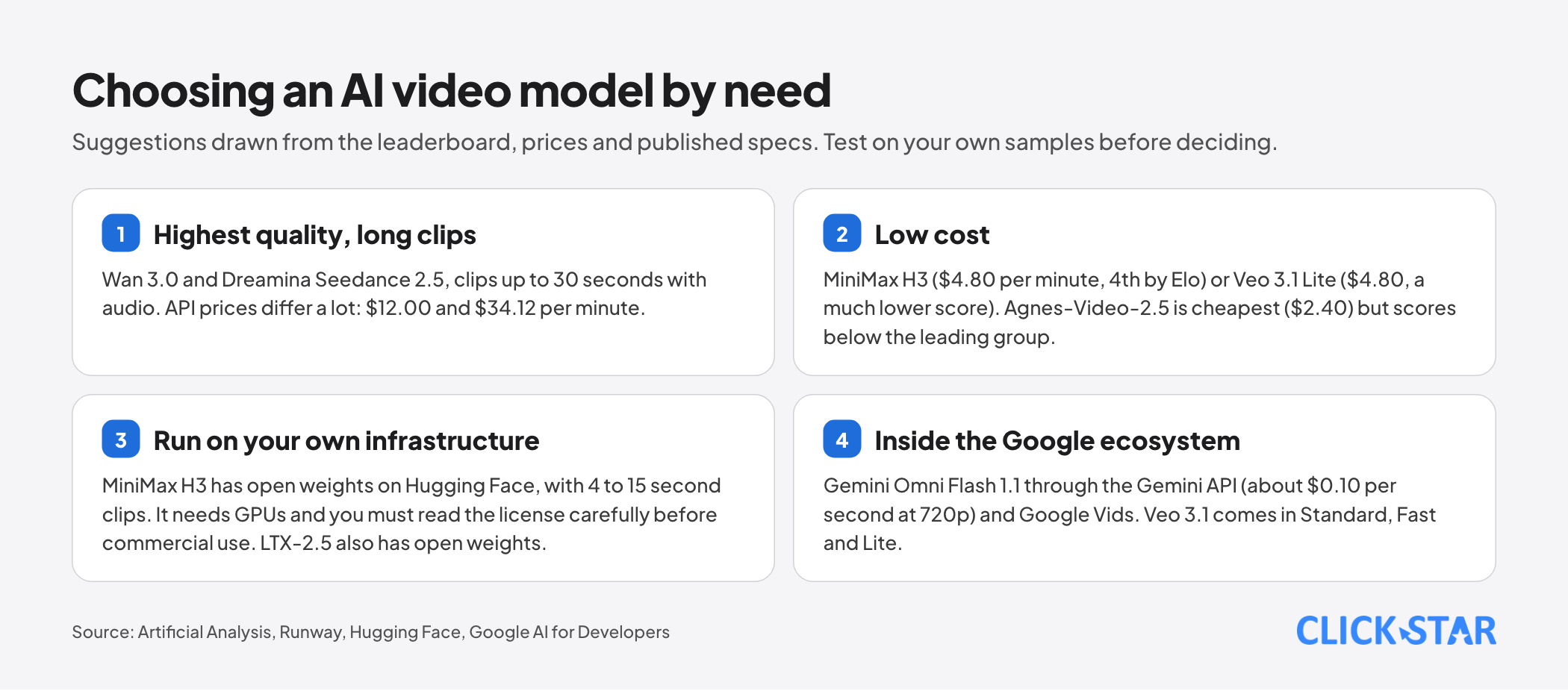
- Highest quality, long clips: Wan 3.0 and Dreamina Seedance 2.5, which both generate clips up to 30 seconds with audio. API prices differ a lot ($12.00 and $34.12 per minute) while the scores are close.
- Low cost: MiniMax H3 ($4.80 per minute, 4th by score) is the highest-scoring option in the low-price group. Veo 3.1 Lite costs the same but scores much lower. Agnes-Video-2.5 is the cheapest but sits 64 points below the leading group.
- Run on your own infrastructure: MiniMax H3 has open weights and needs GPUs (for example the model page's sample run uses 4 GPUs), and you must read the license carefully before commercial use. LTX-2.5 also has open weights but scores lower.
- Inside the Google ecosystem: Gemini Omni Flash 1.1 through the Gemini API, or the Veo 3.1 line with 3 price tiers.
5. A testing process for businesses
- Decide the kind of video you need: short ads, product videos, explainers, social content. Each has different requirements for length, voice and characters.
- Pick 2 to 3 models from the list above by budget and technical requirements, not just by rank.
- Write a set of 5 to 10 real prompts from your business and use exactly the same set on every model.
- Record the number of regenerations, wait time and cost per usable video, not just the price per minute.
- Have your content people score the results blind, the way the leaderboard does.
- Check the commercial-use license of the platform and the model before you publish videos externally.
6. Things to watch
- License and commercial rights: terms differ between models, especially open-weights ones. Read the full license rather than a summary.
- Input data: reference images, voices or videos may contain personal data or customer assets. Check the provider's data-handling terms before uploading.
- Labeling AI-generated content: check current labeling rules and each ad platform's terms before publishing.
- Specs change fast: models launch constantly, and prices and terms change too. This leaderboard is a snapshot of one day.
Related posts
Need tailored advice for your business?
Click Star helps you build a solution that fits your industry and scale. We answer every question during business hours.