Tesla's flying Roadster: what happened at the October 15, 2026 demo
A summary of Tesla's second-generation Roadster demo at a SpaceX test facility: what the car did, the technology, price, regulation and what has not been verified.
On October 15, 2026, Tesla demonstrated its second-generation Roadster at a SpaceX test facility in McGregor, Texas, on a live stream. The car drove upside down along a curved ramp, launched into the air, rotated in mid-air and landed on its wheels.
This article summarizes what the press reported, separates what Tesla claims from what has been confirmed, and sets out what businesses can learn when reading a technology demo.
A note on the name. This is a 2-seat sports car (the Roadster), not a motorcycle or a motorbike. None of the sources checked for this article reports Tesla testing a flying motorcycle.
Key points
- The second-generation Roadster was demonstrated live on October 15, 2026 in McGregor, Texas.
- The car drove upside down on a curved ramp, launched, rolled 180 degrees using bursts of compressed air and landed on its wheels. In a second run, according to Tesla, it jumped about 27 feet (over 8 meters) while performing a barrel roll.
- There was no driver. Tesla said the car ran autonomously for safety.
- 2 main technical elements: a fan-based suction system under the car and cold-gas thrusters that can refill their gas.
- There are 3 versions. Reservation deposits are $50,000 and $250,000, and final prices are not announced. The production target is 2028, 8 years later than first promised.
- Not yet verified: how long and how far the car can fly, and most performance figures. The US aviation regulator (the FAA) said the car does not meet its definition of an aircraft.
1. How the demo went
The demo was streamed live from SpaceX's rocket test facility in McGregor, near Waco, Texas. Fortune dates it to Thursday, October 15, while NBC News dates it October 16. This article uses October 15, following Fortune.
The sources describe the sequence as follows:
- The car drove upside down along a curved ramp, left the ramp, rolled 180 degrees using bursts of compressed air and landed on its wheels.
- It then used its thrusters to jump over a line of Tesla vehicles. Fortune says the line included a Cybertruck and a Tesla Semi, and NBC News counts 5 vehicles.
- In a second run, according to Tesla, the car jumped about 27 feet while performing a barrel roll, then landed softly.
- Nobody was driving. A mannequin in a SpaceX spacesuit sat inside, a nod to the "Starman" dummy of 2018. The car ran autonomously during the demo for safety.
- Musk told the audience that people were needed to watch in person to prove the stunts were real and not made with AI. Musk also said the car is not necessarily optimized for safety.
2. The technology behind the demo
Fan suction system. According to Lars Moravy, Tesla's vice president of vehicle engineering, a fan-based suction system under the car can generate up to 2 Gs of pull to hold the car to the road surface, including when driving upside down. NBC News describes it as a system that creates downforce against the road.
Cold-gas thrusters. The airborne maneuvers use self-refilling cold-gas thrusters. As a general principle, this kind of thruster releases compressed gas through nozzles without burning fuel. Tesla built on a SpaceX thruster package that Musk first floated in 2018.
According to Lars Moravy, the car carries about 600 liters of rechargeable compressed air. Musk described the car as having altitude control thrusters and rear main thrusters, so it can fly much like a rocket.
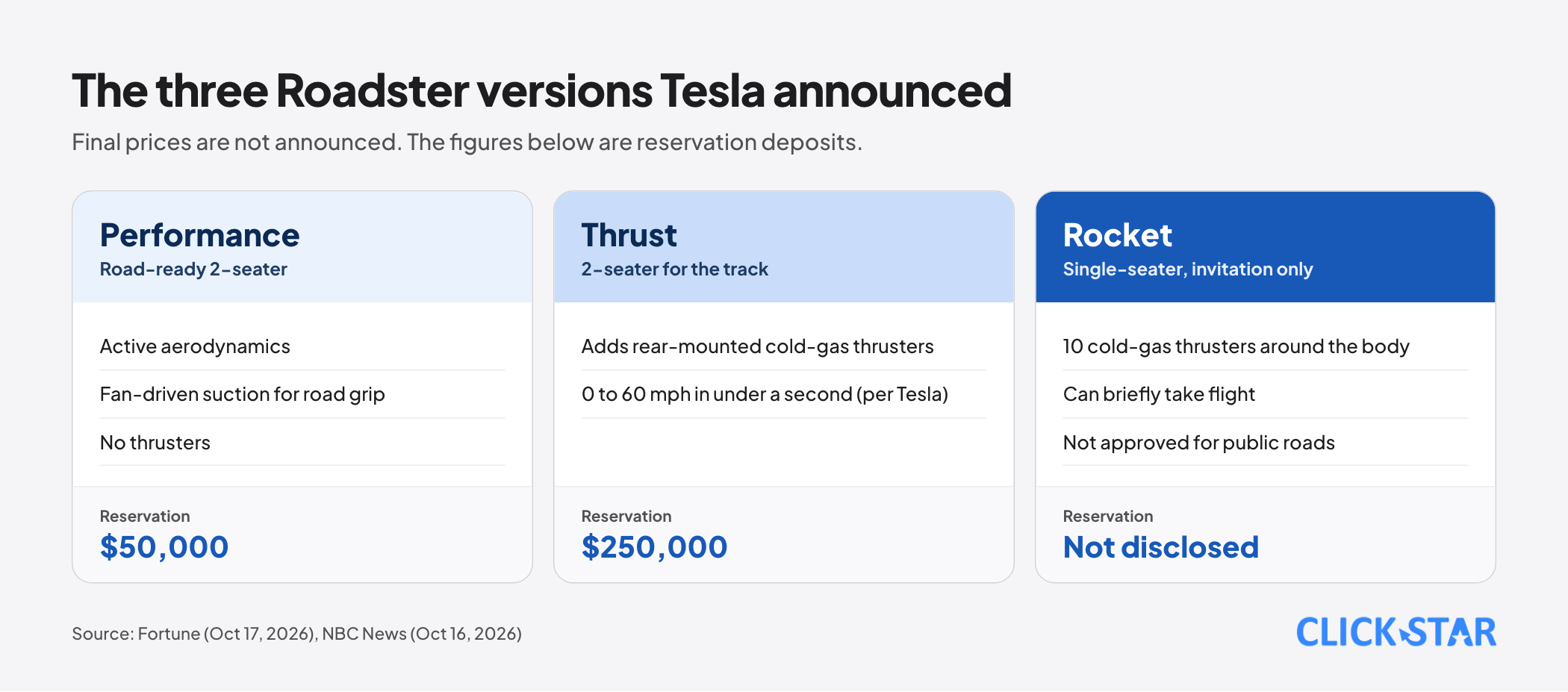
3 versions. Performance is a road-ready 2-seater with active aerodynamics and the fan suction system, with no thrusters. Thrust is also a 2-seater and adds rear-mounted cold-gas thrusters for acceleration. Rocket is a single-seater sold by invitation only, with 10 cold-gas thrusters around the body, able to briefly take flight.
3. Price, reservations and performance figures
- Reservation deposits: $50,000 for Performance and $250,000 for Thrust. Rocket is by invitation only and no deposit is disclosed. Final prices are not announced.
- Acceleration: Tesla says the Thrust version reaches 0 to 60 mph in 0.81 seconds. NBC News notes this is a figure given by Tesla.
- Top speed: Fortune reports Tesla citing a top speed above 230 mph. Musk wants the car to reach about 383 mph, which Musk called halfway to the speed of sound.
- Range per charge: more than 300 miles.
- People who reserved in 2017: Tesla has not said how they will be handled.
4. Compared with the 2017 promise
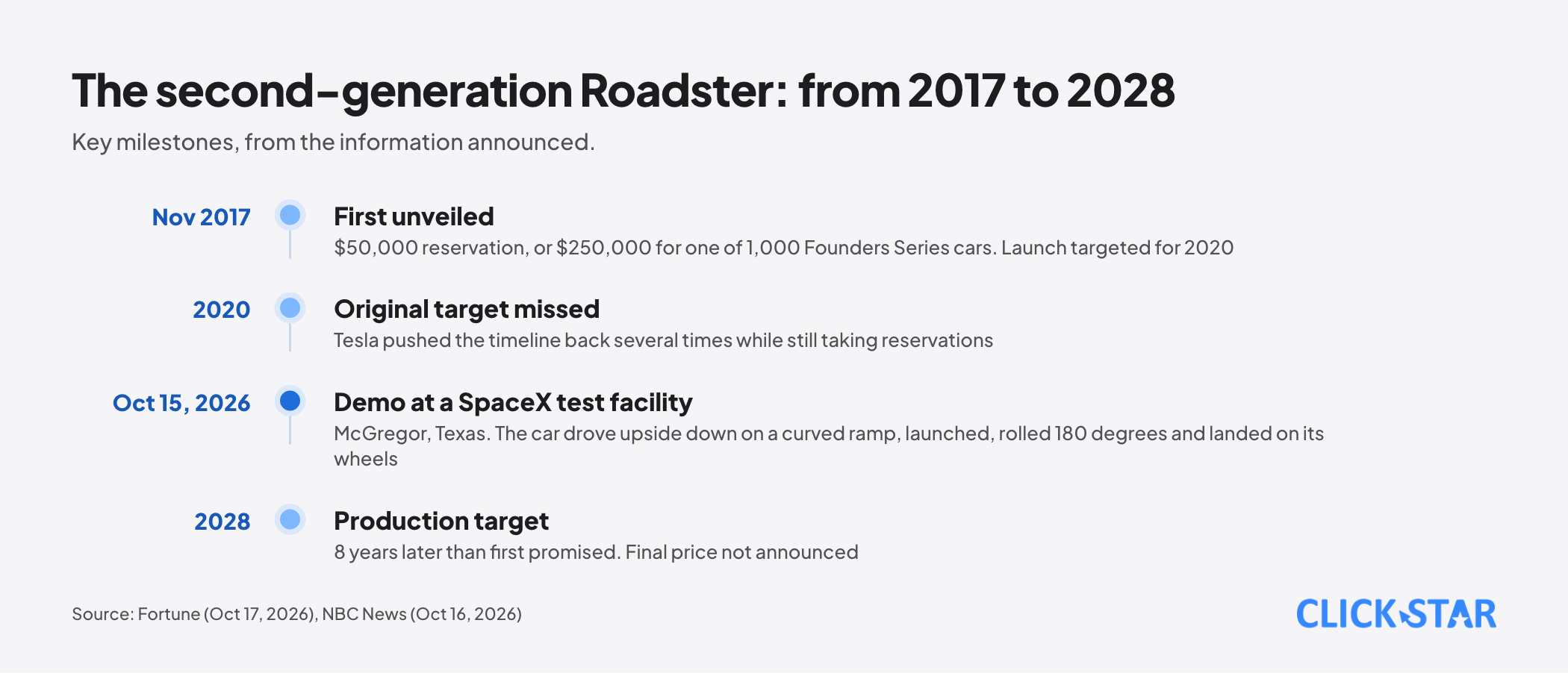
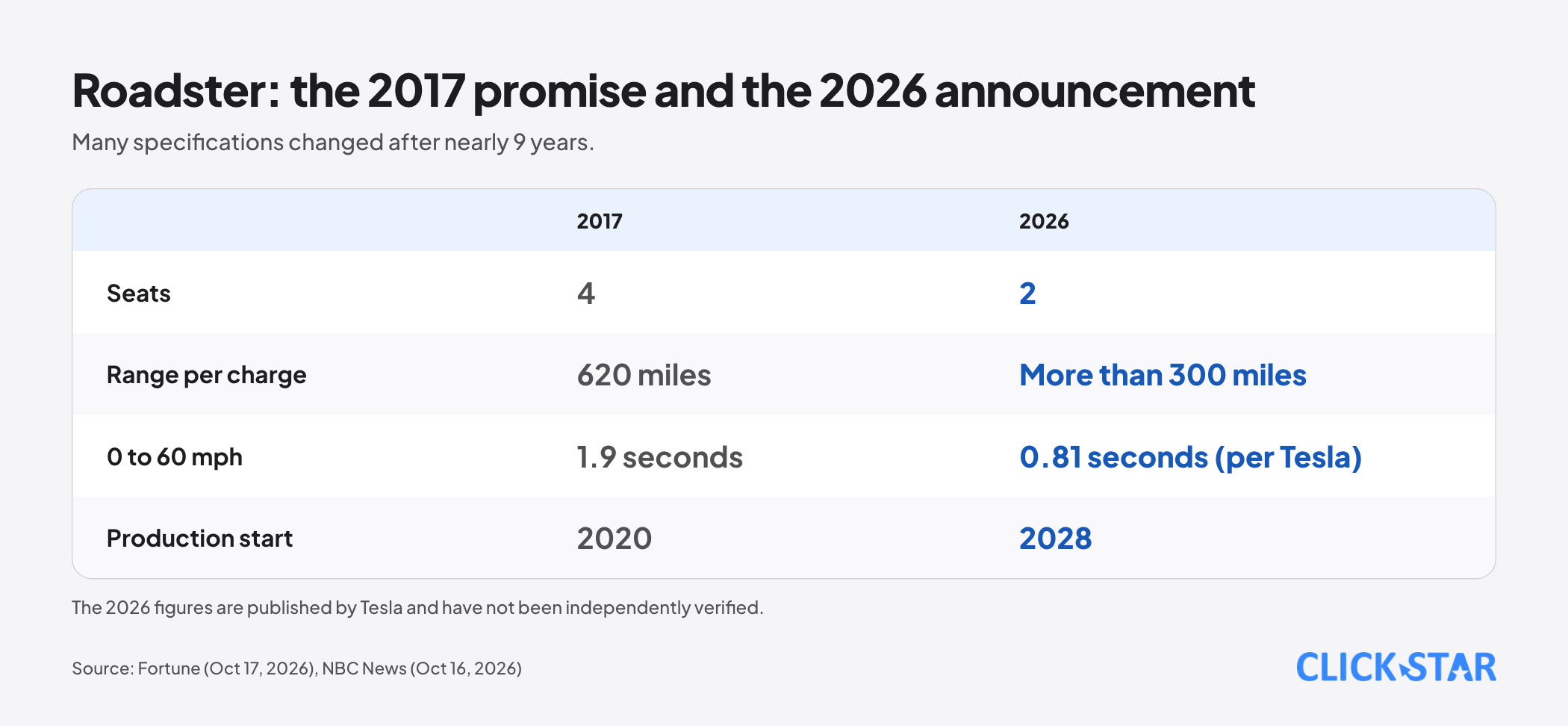
The Roadster was first unveiled in November 2017 with a launch targeted for 2020. Looking back, many specifications have changed:
- Seats dropped from 4 to 2.
- Range per charge dropped from 620 miles to more than 300 miles.
- 0 to 60 mph: 1.9 seconds promised in 2017, 0.81 seconds claimed by Tesla in 2026.
- The production milestone moved from 2020 to 2028, 8 years late. Musk attributed the delay to supply chain shortages and to the Roadster being a lower priority for Tesla.
5. Regulation and safety
- FAA: told CBS News and Politico that the car does not meet the agency's definition of an aircraft, so it would not need airworthiness certification.
- NHTSA: largely relies on automakers to certify compliance with federal vehicle standards. The US Department of Transportation said NHTSA will continue to monitor the situation.
- Public roads: Tesla's website says the Rocket version is not approved for public road use. Musk acknowledged the car may not be legal everywhere.
- Oversight of flight: it is unclear which regulator, if any, would oversee the car's flying features.
6. What has not been verified
- This was a demo of a prototype, showing brief airborne maneuvers and not sustained flight. Tesla has not said how long the car can stay in the air or how far it can fly.
- The figures for speed, acceleration and range are specifications published by Tesla and Musk, or targets, and have not been verified by a third party.
- There is no final price, no official delivery date beyond the 2028 target, and Tesla's timelines have been pushed back repeatedly.
7. Market reaction
Analyst Dan Ives said the Roadster will not move Tesla's volume or revenue. TechCrunch called it a "halo car", a model meant to showcase technology rather than sell in volume. The reveal came days before Tesla's third-quarter results, which analysts say matter more to investors.
8. What to take from a technology demo
These are questions to ask about any product demo, not only Tesla's:
- What does the demo actually prove? A capability shown for a few seconds does not prove a mass-market product that works reliably.
- Was the last promise kept? Compare today's specifications with the first announcement, as in the comparison above.
- Who verifies it? Look at what regulators and independent parties say, not only the manufacturer.
- What money has been taken, and on what terms? Large reservation deposits with no final price and an unclear policy for earlier depositors is a signal worth noting.
- For businesses doing communications: a live demo with witnesses builds trust fast, but lasting trust needs verifiable specifications and promises kept.
Related posts


Need tailored advice for your business?
Click Star helps you build a solution that fits your industry and scale. We answer every question during business hours.