The challenges of marketing work in the AI era: 7 pressures and how to respond
7 concrete challenges for marketing teams as AI changes search, content, measurement, skills and data compliance, with evidence and a 90-day program.
Marketing has never lacked change, but AI creates a different kind of pressure: it is changing how customers look for information, the cost of producing content, how performance is measured and the skills a marketing team needs, all at the same time.
This article does not forecast doom for the marketing profession, nor does it promise that AI will solve everything. It describes 7 concrete challenges that marketing teams in Vietnam are facing, the evidence for each from Google's official documentation and from published studies and surveys, and practical ways to respond.
The figures come from Google Search Central, Pew Research Center, SparkToro, Conductor, Graphite, the Law on Personal Data Protection and other sources, each named in the sentence that uses it and checked as of October 20, 2026.
Some sources are reports run by tool vendors, and most measure the US market; Click Star says so where that applies.
Key points
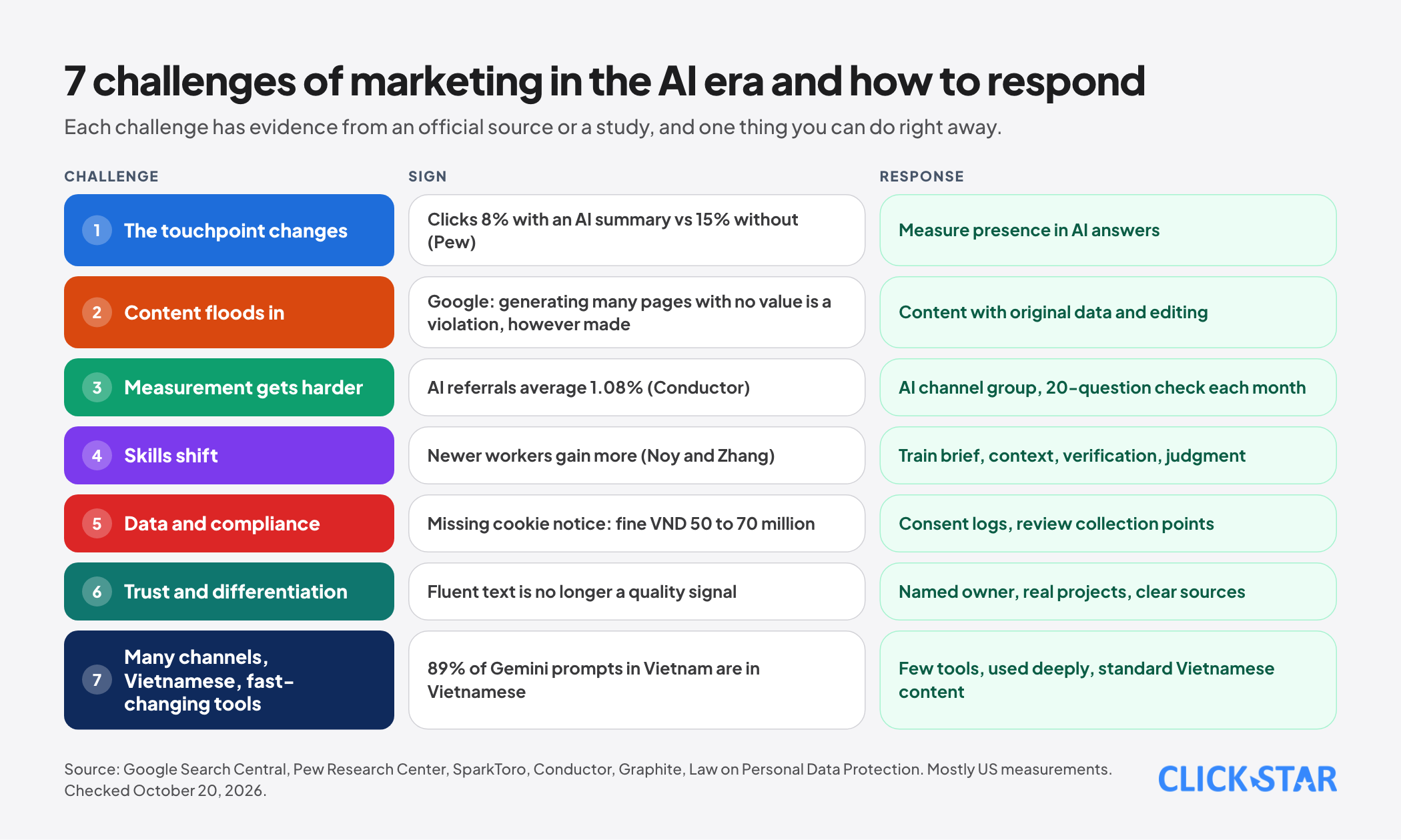
- The first challenge is that the touchpoint is changing: according to Pew Research Center, users click a traditional result in 8% of visits when an AI summary is present against 15% when it is not, and according to SparkToro, 68.01% of US Google searches in the first 4 months of 2026 ended without a click.
- Traffic from AI tools is still small but worth watching: Conductor, an SEO software vendor, records AI referral traffic at 1.08% of website traffic on average, across 3.3 billion sessions and more than 13,000 domains.
- AI-generated content is flooding in, but Google states plainly that its spam policy does not distinguish how content is produced: generating many pages that add no value for users is a violation "no matter how it's created".
- Measurement gets harder because many mentions of a brand in AI answers leave no visit behind.
- Data and compliance become an operating risk: Penalty Decree 330/2026/ND-CP, in force since August 19, 2026, sets fines for common marketing mistakes such as missing privacy notices, missing cookie consent and failing to keep consent logs.
- Skills are shifting from execution to delegating, verifying and judging. Productivity studies show AI helps newer workers more than strong ones, so training must change too.
- An effective response is a small program with measurement: measure presence in AI answers, write content with original value, standardize data and consent, and train verification skills.
Challenge 1. The touchpoint changes: customers read the answer instead of clicking through
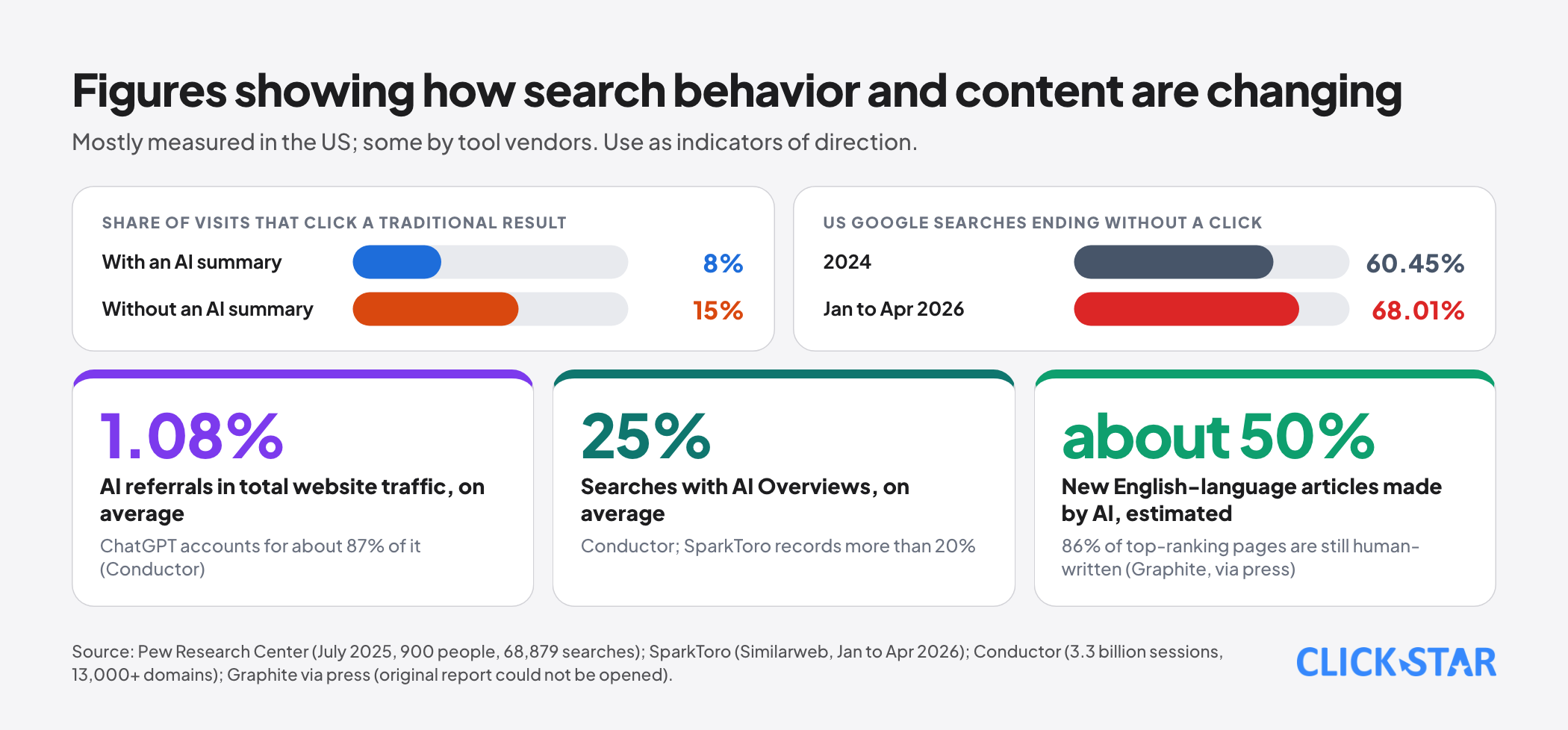
Evidence. The Pew Research Center study published in July 2025, tracking 900 US adults across 68,879 searches, found that users clicked a traditional result in 8% of visits when the page had an AI summary against 15% when it did not, and clicked a link inside the summary itself in only about 1% of visits.
SparkToro's 2026 data, based on Similarweb, recorded 68.01% of US Google searches ending without a click in the first 4 months of the year, up from 60.45% in 2024, with AI Overviews appearing on more than 20% of searches.
Both studies measure US users, and the authors state the limits: these are observational comparisons that cannot isolate the effect of AI Overviews alone. Conductor's report puts AI Overviews at an average of 25% of searches in its sample.
Response. Do not measure only visits. Add measurement of presence: is the brand mentioned in AI answers to the questions that matter. Write content that answers directly, with figures and sources, so it is easy to quote. Click Star has analyzed this in detail in its articles on the shift in SEO in the AI era and on user search trends.
Challenge 2. Content floods in and tends to look alike
Evidence. Graphite's analysis, through press reports (Click Star could not open the original report), used an AI-content detector on a random sample of English-language pages from Common Crawl and estimates that about half of new articles are now AI-generated, with the share hovering around that level since early 2025.
According to the same reports, 86% of the top-ranking pages on Google are still human-written. The detector has error rates, so this is an indicator of direction, not a precise measurement.
On Google's side, its spam policy on scaled content states that generating many pages with the main purpose of manipulating rankings is a violation, and that using generative AI to produce many pages that add nothing for users is one example, "no matter how it's created".
Response. Differentiated value is no longer in producing content fast but in having what others and machines do not generate themselves: the business's own data, real experience, named expert opinion, real examples and analysis with depth. Use AI for drafting and checking, not for bulk publishing without editing. An editing and verification process becomes an advantage.
Challenge 3. Measurement and attribution get harder
Evidence. According to Conductor, AI referral traffic averages 1.08% of traffic, and about 87% of it comes from ChatGPT. This is one vendor's figure, and it grows slowly relative to total traffic. But when an AI answer names a brand and the customer does not click, the influence does not show in ordinary traffic reports.
Google, in its documentation on AI features, says traffic from AI Overviews and AI Mode is included in total search traffic in Search Console under the "Web" search type, not separately.
Response. Create a separate channel group for AI sources in Google Analytics 4, read server logs to see which bots read which pages and each month ask the AI tools about 20 questions customers often ask and record which brands are mentioned. Track branded search and lead quality, because the volume is small but the intent may be high.
Challenge 4. Skills and roles shift
Evidence. A secondary summary of McKinsey's State of AI survey says marketing and sales is the function that uses generative AI most regularly, but Click Star could not check the specific figure on the original page, so it does not quote a number.
Controlled productivity studies show the direction: the study by Noy and Zhang in Science (2023), with 453 professionals, found that ChatGPT cut writing time by 40% and raised quality by 18%, with weaker writers gaining more; the study by Brynjolfsson and colleagues of 5,172 support agents recorded an average gain of about 15%.
When AI helps newcomers quickly reach a working level that once took years of experience, basic execution work changes in value.
Response. Shift training emphasis from operations to 4 capabilities: stating a clear goal and criteria (the brief), supplying the right context, verifying output and strategic judgment. Let newcomers use AI but with a review process. Keep strong people in the roles of direction, editing and relationships.
Click Star has articles on how to work with GPT and on AI skills for this purpose.
Challenge 5. Data and compliance become an operating risk
Evidence. Since January 1, 2026, the Law on Personal Data Protection and Decree 356/2025/ND-CP apply to all collection and use of customer data.
According to the summaries of Decree 330/2026/ND-CP by Luat Viet An and Bao Lao Cai, in force since August 19, 2026, failing to keep consent logs is fined VND 30 to 50 million, missing privacy notices or cookie consent on online platforms is fined VND 50 to 70 million and collecting beyond the agreed scope is fined VND 70 to 150 million.
These are behaviors very close to marketing reality: tracking code, lead forms, email lists, entering customer data into AI tools. According to Luat Viet An, Article 18 of Decree 356/2025/ND-CP also sets conditions for transferring data abroad. These figures should be checked against the original text before being applied.
Response. Review every data collection point, log consent, update notices and cookie banners and set a rule not to enter personal data into AI tools that have not been assessed. Click Star has a separate article updating this law for 2027 and one on databases in online operations.
Challenge 6. Trust and brand differentiation
Evidence. Google's helpful-content guidance centers on content written for readers that shows experience, expertise, authoritativeness and trustworthiness. When every business can produce fluent text in seconds, fluent text is no longer a signal of quality.
Response. This is Click Star's judgment, not a measurement: signals that are harder to copy are those that are real and verifiable, including the name of the person responsible for content, projects and results that can be named, clear data sources, real reviews and consistent brand information everywhere. Invest in those rather than in the number of articles.
Challenge 7. Many channels, Vietnamese and fast-changing tools
Evidence. The Adobe Express survey (January 2026 data, 807 US consumers, vendor-funded) found that 49% have used TikTok as a search engine, but Google is still rated most helpful at 85%.
In Vietnam, Google's Gemini Southeast Asia report (published July 14, 2026) found that 89% of prompts from Vietnamese users are written in Vietnamese, and according to DataReportal 92.3% of Vietnamese internet users use at least one social platform.
On tools, AI capability rankings contradict one another and change weekly, as Click Star analyzed in its article roundup of 10 AI tools.
Response. Be present consistently where customers search and compare, and give priority to clear Vietnamese content with the right terminology. On tools, choose few, use them in depth with an owner, instead of chasing every new product.
A 90-day program for a marketing team
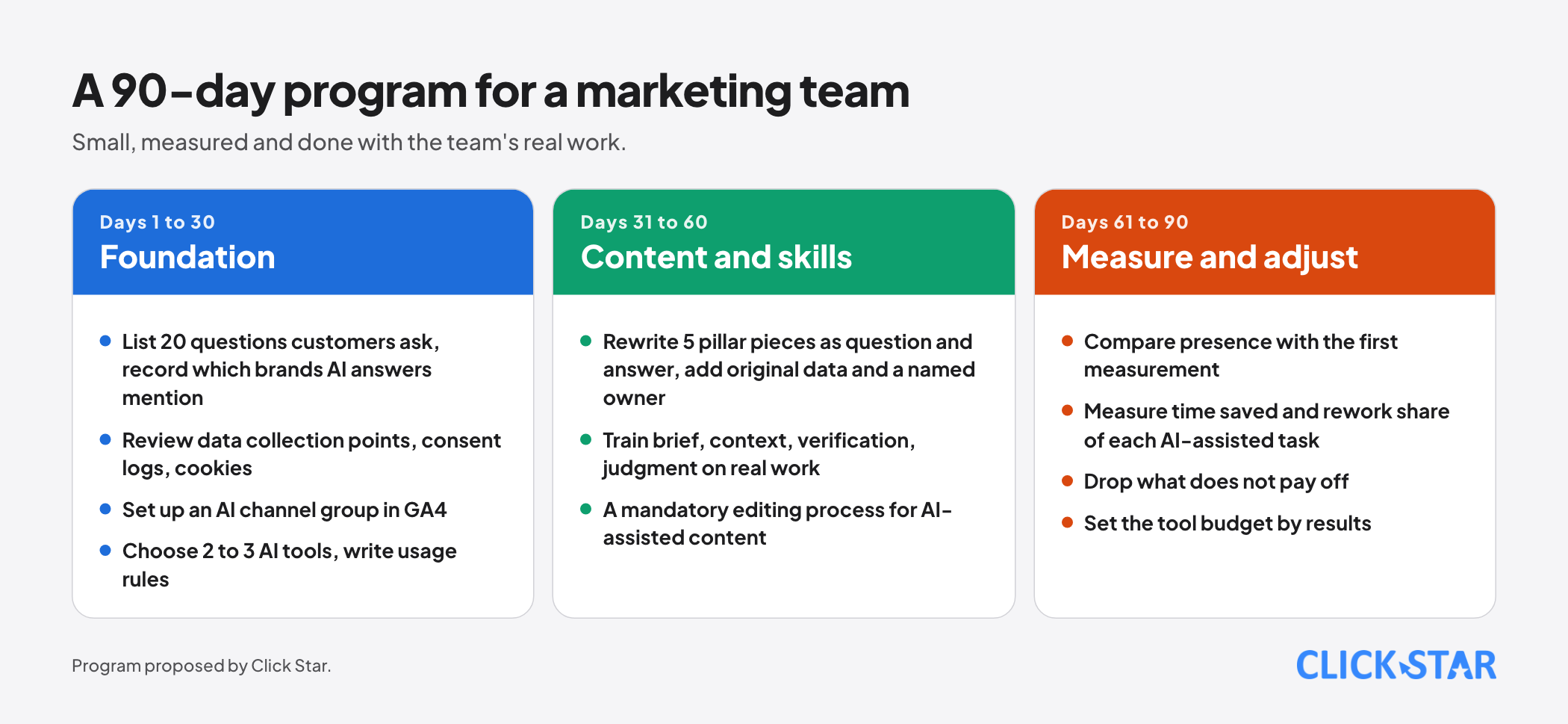
- Days 1 to 30, foundation: list 20 questions real customers ask and record which brands are mentioned in AI answers; review data collection points, consent logs and cookies; set up an AI channel group in GA4; choose 2 to 3 AI tools and write usage rules.
- Days 31 to 60, content and skills: pick 5 pillar pieces to rewrite in a question-and-answer structure, adding original data and a named owner; train the 4 capabilities (brief, context, verification, judgment) using the team's real work; set up a mandatory editing process for AI-assisted content.
- Days 61 to 90, measure and adjust: compare presence with the first measurement; measure time saved and the share needing rework for each AI-assisted task; drop what does not pay off; set the tool budget by results.
Metrics to track
- Presence in AI answers for the 20 important questions (measured monthly, compared by trend).
- Traffic from AI sources and the quality of leads from them.
- Branded search.
- The share of content that was edited and verified before publishing.
- Time saved, the share needing rework and the error rate of AI-assisted tasks.
- The number of data collection points with consent and complete logs.
Common mistakes
- Responding by producing more content with AI instead of content with more value.
- Looking only at visits and concluding AI "does not matter" because AI traffic is still small.
- Or the reverse, dropping all traditional optimization because AI is believed to replace everything. SEO foundations and page quality are still a prerequisite.
- Using AI tools with real customer data without reviewing legal duties.
- Not training verification skills, so AI errors reach customers directly.
- Chasing a new tool every week without an owner and without measuring.
- Relying on a single figure. The studies above measure users in other markets with their own methods and shift with each product update, so measure on your own data.
Related posts
Need tailored advice for your business?
Click Star helps you build a solution that fits your industry and scale. We answer every question during business hours.