Online fashion at year end: sales, marketplace fees, returns, tariffs


This article reads Metric and YouNet ECI data via news coverage, TikTok Shop's fee notice and new rules to see how fees, returns and tariffs bear on growing online fashion sales, and what to do in the next 30 days.
The owner of a small modern ao dai label opens the dashboard after 11.11 and sees more orders. But after marketplace fees, ads, shipping and returns, the money left has not grown with them. This is an illustrative scenario, not a measurement.
This article reads online fashion sales data for Shopee, TikTok Shop, Lazada and Tiki from 2 measurement firms, Metric and YouNet ECI (secondary sources, via news coverage). It also reads TikTok Shop's fee notice, livestream rules, US tariffs and EU rules on textiles, checked on November 24, 2026.
It answers 3 questions: how big online fashion is, why sales can grow while profit does not, and what a small label can do in 30 days. Click Star already has a separate article on TikTok Shop versus Shopee.
Key points
- Fashion was the largest category on the 4 marketplaces in 2025: about 28% of total GMV (gross merchandise value) and up 34%, per YouNet ECI via news coverage.
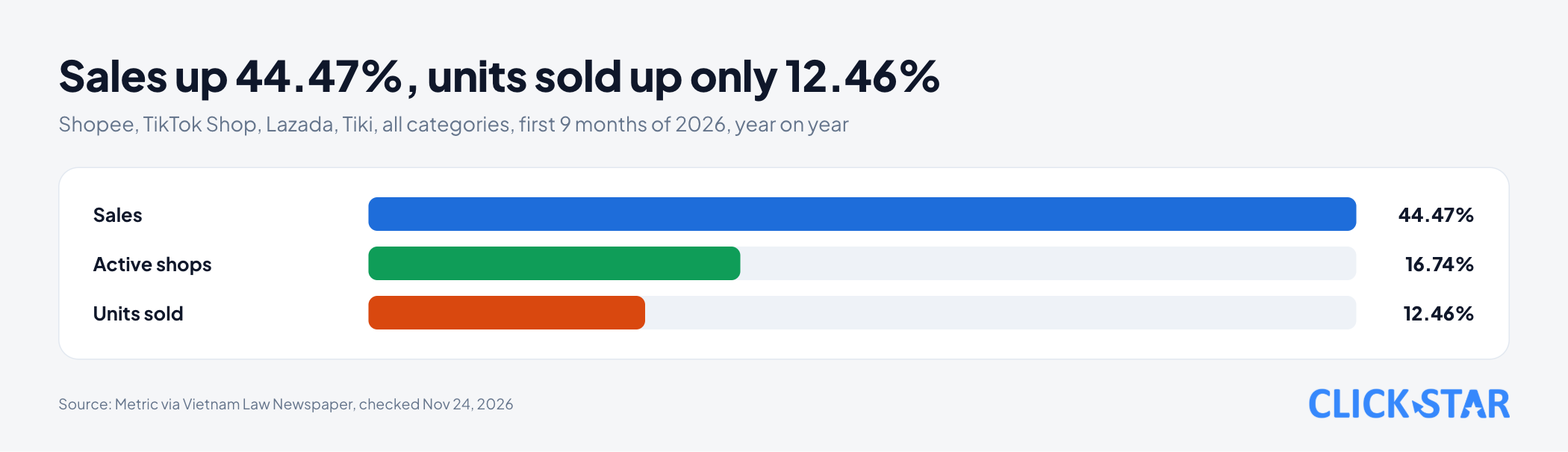
- In the first 9 months of 2026, sales on the 4 marketplaces (all categories) rose 44.47% but units sold rose only 12.46%, per Metric. The value of each unit sold is rising.
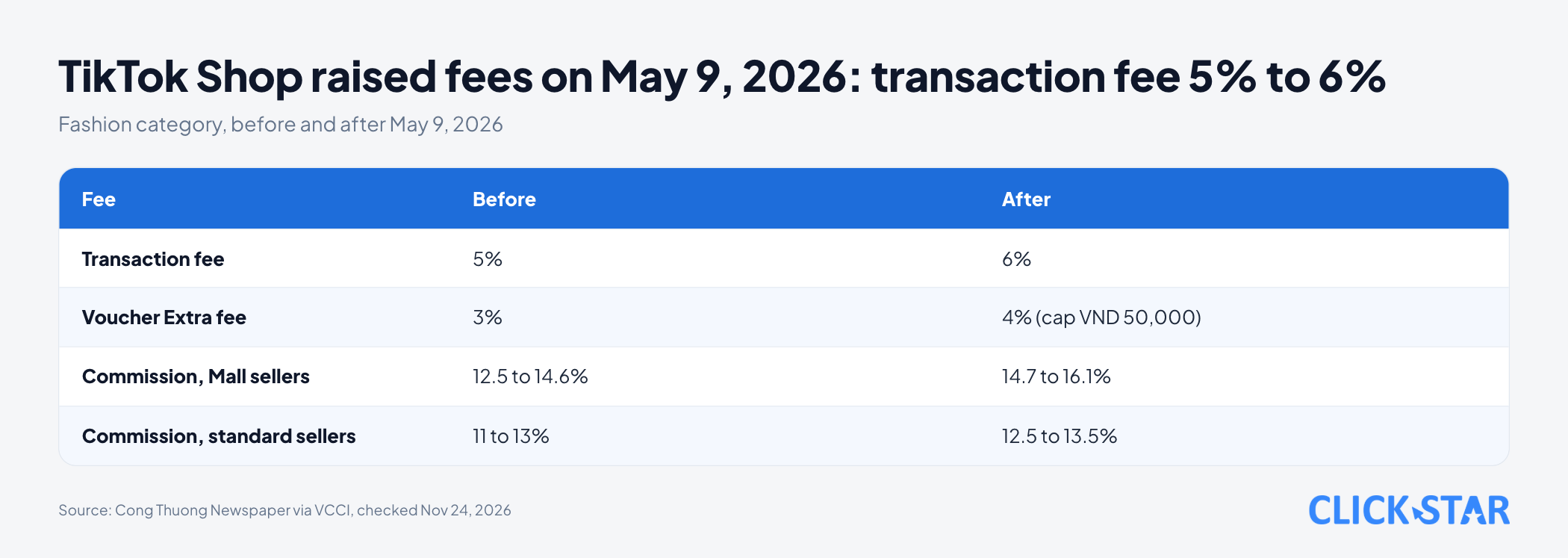
- TikTok Shop raised fees from May 9, 2026: the transaction fee went from 5% to 6%, and the fashion commission for standard sellers from 11-13% to 12.5-13.5%.
- Vietnam's E-commerce Law 2025 (effective July 1, 2026) requires livestream sellers to verify identity and keep broadcast data for at least 1 year. Click Star read only a summary.
- Fit-preview tools have evidence of lowering return costs in 1 controlled experiment, but there is no Vietnamese measurement.
- For export orders, the 12.5% US surcharge (from July 24, 2026) stacks on each product's base tariff, so it must be calculated per product.
How big is online fashion in Vietnam
Fashion is the largest category, but there is no measurement of seller profit. YouNet ECI's report on 2025 put GMV on the 4 marketplaces at VND 458.16 trillion, up 26%. Fashion and accessories grew 34% and ranked first by size (Vietnam Business Magazine, February 17, 2026, republished by VCCI).
The same firm put fashion at about 28% of GMV, with TikTok Shop leading the category for the first time at 53.1% against Shopee's 46.1% (Nha dau tu, March 17, 2026).
For 2026, Metric recorded first-half sales on the 4 marketplaces of about USD 11.08 billion, up 44.11%. Women's fashion reached USD 1.53 billion, behind beauty (USD 1.88 billion) and ahead of home and living products (USD 1.43 billion), per VietnamNet on July 27, 2026. In Q3/2026 TikTok Shop led both men's and women's fashion (Vietnam Law Newspaper, October 28, 2026).
Sales are growing faster than units: what is left as profit
Per Metric (Vietnam Law Newspaper, October 28, 2026), sales on the 4 marketplaces reached about VND 442,000 billion in the first 9 months of 2026, up 44.47%. Units sold rose 12.46%, and active shops rose 16.74% to 661,200. These figures cover all categories on the 4 marketplaces, not fashion alone.
The gap between 44.47% and 12.46% means each unit sold carries more value. Per YouNet ECI (VCCI, February 17, 2026), the average selling price on the 4 marketplaces rose about 33% in Q4/2025 against Q4/2024, while volume fell 8%.
That article links the cause to platform fees passed into prices. It also says sellers with revenue fell 5.6% to about 672,000 while average revenue per seller rose 33%. In Click Star's reading, revenue is concentrating in larger sellers.
Metric recorded Q3/2026 sales up 45.16% while active shops fell 2.47% (Vietnam Law Newspaper, October 28, 2026).
This is an illustrative example, not a measurement. A shirt sells for VND 400,000 and costs VND 160,000. If commission is 12% and transaction fee 5%, marketplace fees are VND 68,000. At 13% and 6%, they are VND 76,000.
The difference is VND 8,000 per order, or 2% of the price, before ads, the Voucher Extra fee, shipping and returns.
Fees and new rules sellers must price in
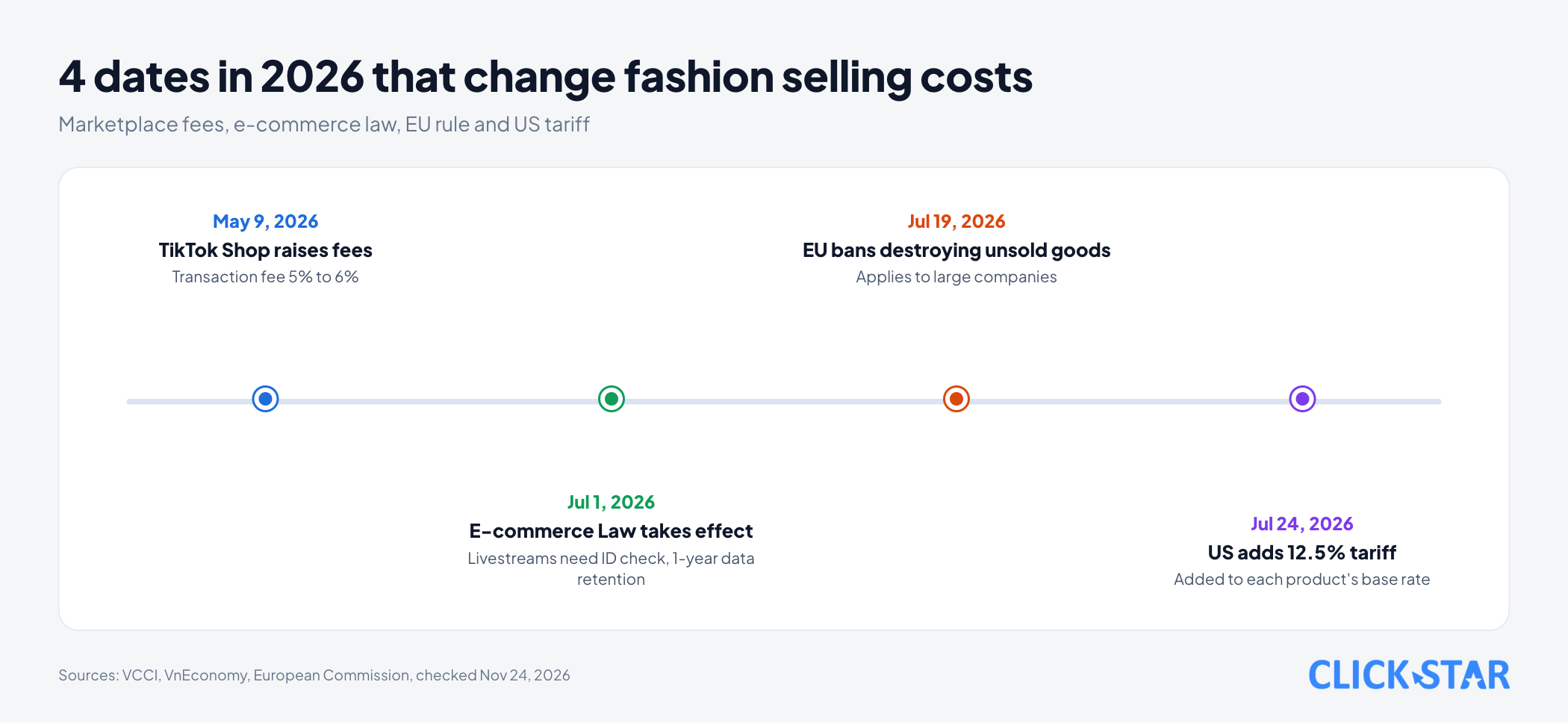
Fee increases are the most visible cost. Per Cong Thuong Newspaper (May 4, 2026, republished by VCCI), from 0:00 on May 9, 2026 TikTok Shop raised its transaction fee from 5% to 6% and its Voucher Extra fee from 3% to 4% (capped at VND 50,000 per product).
The fashion commission for Mall sellers rose from 12.5-14.6% to 14.7-16.1%. For standard sellers it rose from 11-13% to 12.5-13.5%.
On livestreaming, Cong Ly Newspaper (May 5, 2026, republished by VCCI, a summary) says the E-commerce Law 2025 takes effect on July 1, 2026. Sellers must complete electronic identity verification before broadcasting, and broadcast data must be kept for at least 1 year.
Sellers also need product quality documents and documents supporting advertising claims. Click Star gives no legal advice: check the original text and implementing guidance.
On returns, VnExpress (March 13, 2024) reported that Shopee extended the return-request window to 15 days after successful delivery, including change-of-mind returns if the item is intact. Shopee covers 100% of return shipping and does not count these against the seller's failed-order rate.
This is a 2024 policy. Check Shopee's Help Center for the current version.
How shoppers are buying
Click Star has no measurement of Vietnamese shopper behavior, so the article gives no figure on genuine-goods or price-sensitive buyers.
Click Star found no fashion measurement after 11.11/2026, so the article gives none.
Returns and size: how far can AI help
Click Star found no measurement of the fashion return rate in Vietnam, so the article states none.
The strongest evidence found is a controlled experiment by Gallino and Moreno (Manufacturing & Service Operations Management, September 2018, abstract via Crossref). Customers were randomly assigned to a group with a fit-information tool or a group without.
The tool raised conversion and order value and reduced costs from returns and from customers ordering several sizes at once. The full page blocks automated tools, so Click Star read only the abstract, and the result does not transfer automatically to other shops.
On Google's virtual try-on, Click Star could not confirm whether the tool is available in Vietnam, so the article draws no conclusion.
Export orders and the tariff and rule dates to know
This section is for labels with contract manufacturing or overseas sales. Per Corporate Finance Magazine (October 16, 2026, republished by VCCI), textile and garment exports reached about USD 35.721 billion in the first 9 months of 2026, up 3.3%. Garments alone were about USD 28.237 billion, up 2.2%.
On US tariffs, VnEconomy (August 16, 2026) says that from July 24, 2026 the common additional tariff is 12.5% under Section 301, added to each product's base (MFN) rate. Its example: a product with a 27.5% base rate totals 40%.
That article gives no base rate for specific garments, so Click Star gives no figure for clothing. Vinatex advises assessing by product group and market, not by average tariff (Tuoi Tre, August 2, 2026).
On Europe, the European Commission page (July 17, 2026) says that from July 19, 2026 large companies are banned from destroying unsold clothes and shoes. Medium-sized companies follow from 2030, and small and micro businesses are exempt.
The Commission page does not say how this applies to sellers outside the EU, so labels selling to Europe should ask their importer.
What this means for a small fashion label
3 pressures arrive together: higher fees, higher prices that slow unit sales, and compliance costs. In Click Star's reasoning, sales are the wrong yardstick. Look at gross margin after fees and returns, by product and by channel.
Marketplaces bring ready-made shoppers, but they set fees and rules. A website and owned channels (Zalo, email) give customer data and price control, but take effort to fill. Click Star has no Vietnamese measurement comparing profit across them, so the article does not rank them.
Click Star's view. For a small label, the biggest risk is selling a lot without knowing profit per order. Measure correctly first, then raise ad spend or add channels.
Customer data (purchases, size, returns) should sit where the label controls it, not only in marketplace reports. Click Star offers SEO-ready fast websites, CRM and CDP, so it has an interest in this direction.
What to do: a 30-day plan
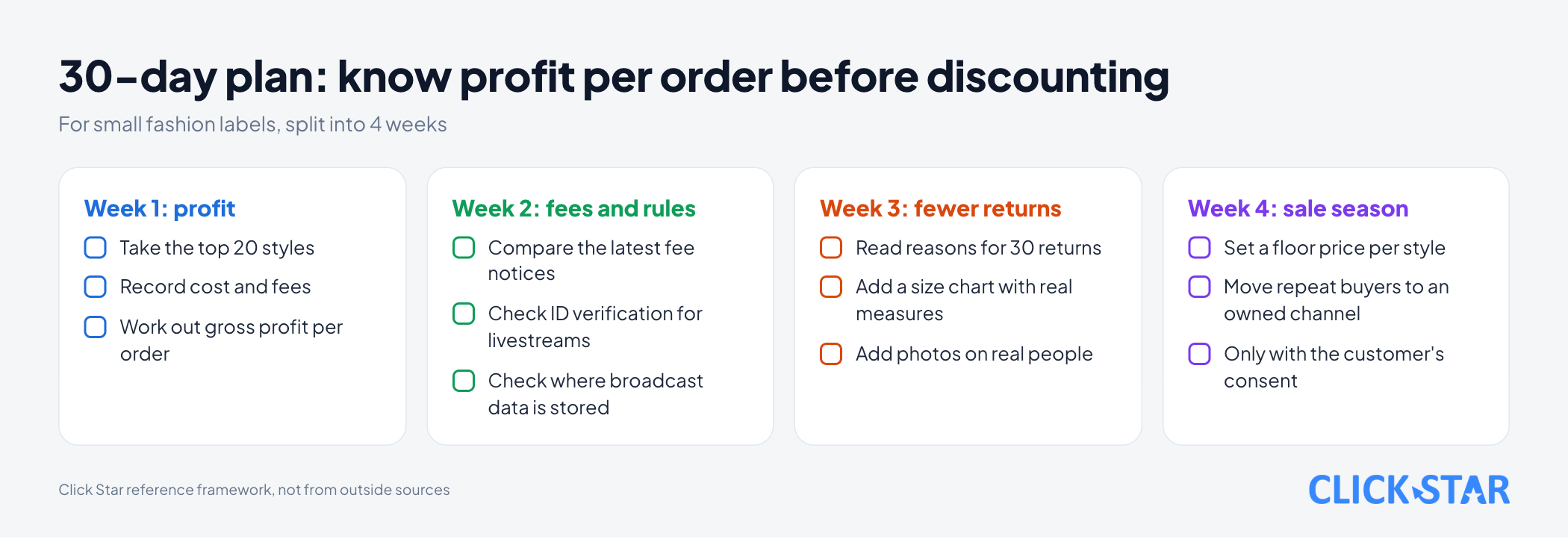
This is a Click Star reference framework, not drawn from outside sources.
Week 1. Calculate profit per order. Take the 20 top-selling styles. For each, record price, cost, commission, transaction fee, voucher fee, shipping and return rate.
Week 2. Review fees and rules. Compare each marketplace's latest fee notice with the spreadsheet. If you livestream, check identity verification and where broadcast data is stored.
Week 3. Reduce returns. Read the return reasons of the last 30 orders. Add a size chart with real measurements, photos on real people and fabric descriptions.
Week 4. Prepare for sale season. Set a floor price for each style so nothing sells below the target gross margin. Move repeat buyers to an owned channel, with their consent.
How to measure: 5 metrics
All 5 metrics are proposed by Click Star, with no industry benchmark.
- Gross profit per order after marketplace fees, vouchers and shipping.
- Return rate, split by reason (size, defect, change of mind).
- Ad cost per profitable order, not just per order.
- Repeat purchase rate within 90 days.
- Share of revenue from channels the label controls.
Common mistakes
- Reading market-wide sales growth (44.47%) as growth in your own profit.
- Counting commission but forgetting the transaction fee, voucher fee and return shipping.
- Discounting heavily on 11.11 and 12.12 without knowing each style's gross margin.
- Using foreign return-rate figures as Vietnam's.
- Buying a virtual try-on tool before fixing the size chart and product photos.
- Livestreaming without checking identity verification and data retention rules.
What is not known
Click Star could not read the original Metric and YouNet ECI reports, so all market figures come via news coverage. It is unclear why the 2 firms give different growth rates, and there is no real profit figure for fashion sellers.
Click Star could not confirm whether Google's virtual try-on works in Vietnam, and found no Vietnamese fashion return rate, no fashion results for 11.11/2026, and no measure of the E-commerce Law 2025's effect on small sellers.
Reports of 10-month 2026 exports give different numbers (USD 33.74 to 39.8 billion), so the article uses the 9-month figure only. Shopee's current return policy and base tariffs on garments in the US were not confirmed.
Related posts


Need tailored advice for your business?
Click Star helps you build a solution that fits your industry and scale. We answer every question during business hours.