How many visitors does AI send? New data and a 30-day plan
Reads new data from Pew, Ahrefs, SE Ranking, Similarweb, Cloudflare and Google's October 15, 2026 post on visits from AI and clicks. Includes a 30-day framework to track citations.
The owner of a cosmetics shop hears that the website is "mentioned by AI more and more". In GA4, the visits from AI barely move. This is an illustrative scenario, not real measurements.
This article reads studies from Pew Research Center, Ahrefs, SE Ranking, Similarweb, Cloudflare and Statcounter, plus a post on Google's blog dated October 15, 2026. All figures were checked on November 24, 2026.
It answers 3 questions: how many visitors AI sends to websites, how AI answers change click-through rates, and what to track over 30 days.
Key points
- SE Ranking (June 18, 2026, 101,574 websites with GA) found AI at 0.32% of all visits in 2026 (January to April data), against 0.24% in 2025 and 0.02% in 2024. Organic search was 42.75%.
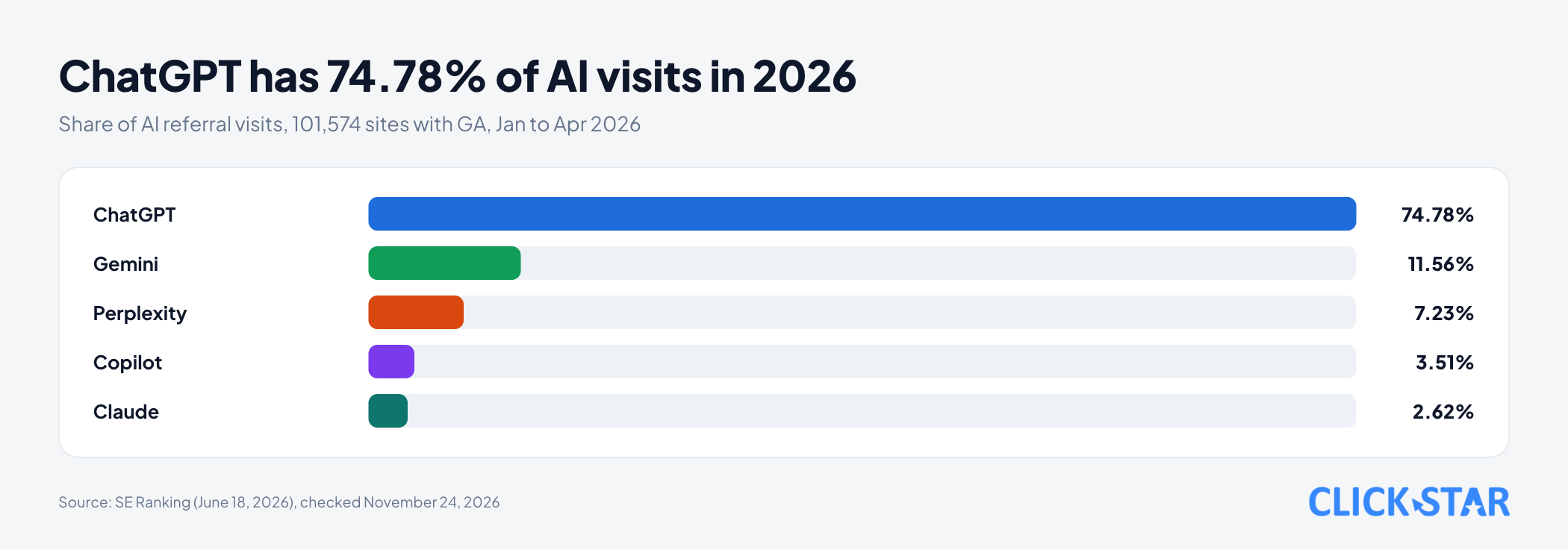
- In the same dataset, ChatGPT had 74.78% of AI visits in 2026, down from 79.74% in 2025. Gemini 11.56%, Perplexity 7.23%, Copilot 3.51%, Claude 2.62%.
- Market share depends on what is measured: Statcounter lists Gemini 61.02% and ChatGPT 28.74% in Vietnam (October 2026), but the page does not state its method. Do not mix it with SE Ranking's figures.
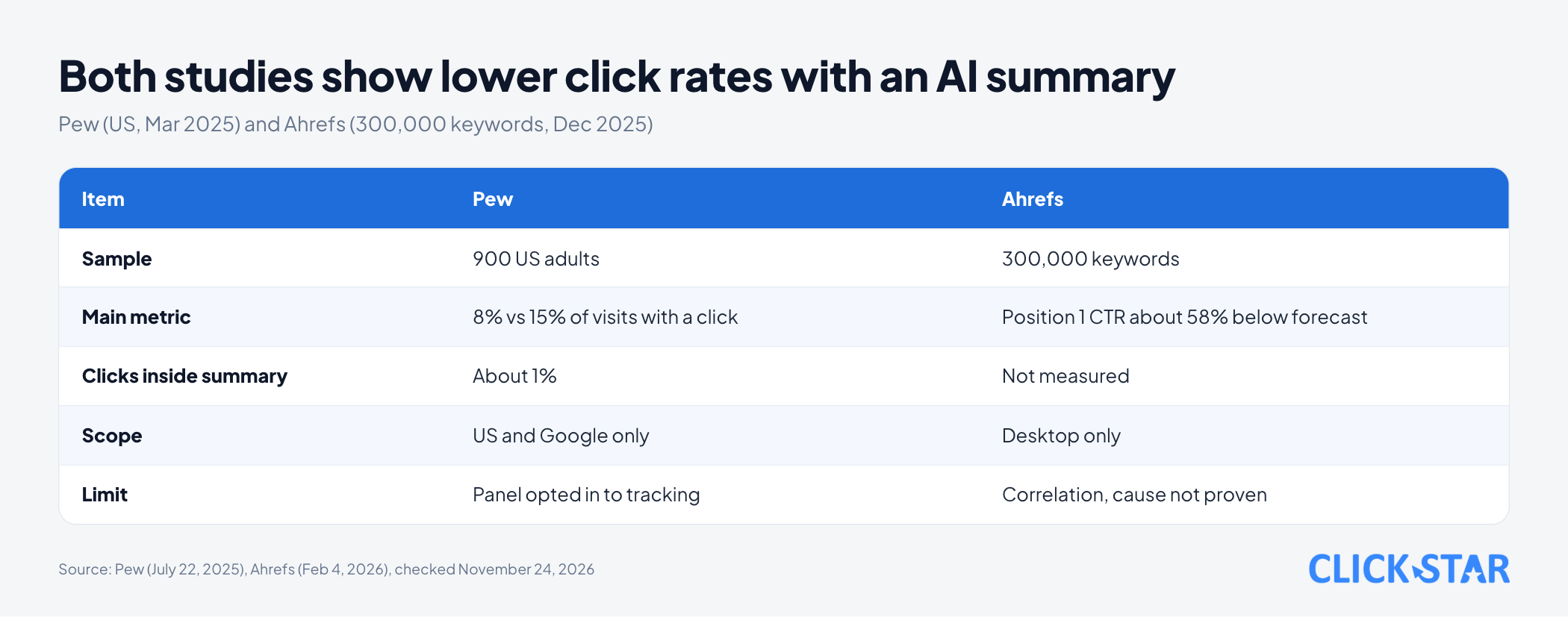
- Pew (900 US adults, March 2025): when results show an AI summary, 8% of visits include a click on a regular result, against 15% without one. Ahrefs (February 4, 2026) estimates position 1 click-through rate is about 58% below forecast when an AI Overview appears.
- On October 15, 2026 Google announced links placed higher in AI Mode and AI Overviews, but the post gives no click or traffic figures.
- Click Star's 5-step, 30-day framework: record a baseline, run 10 priority queries, compare CTR by query length, check where AI visits land, then decide.
How many visitors AI sends to websites
Still small next to regular search, but growing. SE Ranking (posted June 18, 2026, read November 24, 2026) tracked 101,574 websites with Google Analytics across 250 countries and territories, from January 2025 to April 2026.
AI platforms were 0.02% of all visits in 2024, 0.24% in 2025 and 0.32% in 2026 (about 1 in 312 visits). Organic search was 42.75%, roughly 134 times larger.
Similarweb (posted September 3, 2026, read November 24, 2026) counts differently: an average of 770.7 million referral visits per month from AI platforms worldwide, June 2025 to May 2026, up 117.4% year over year.
Similarweb says its figure is a floor: visits without source information are counted as direct.
SE Ranking also tracked ChatGPT alone (July 9, 2026): its global share rose from 0.23% in April to 0.32% in May 2026, above the previous peak of 0.29% in October 2025. The two 0.32% figures differ: one is all AI, one is ChatGPT alone.
The authors call the cause a working hypothesis, not proven, and do not know whether it is a one-month spike or a trend.
Which assistant sends the most visitors: each source measures differently
"ChatGPT or Gemini?" has different answers because each source measures something else. Ask first what is being measured.
SE Ranking measures website visits from AI assistants: ChatGPT 74.78%, Gemini 11.56%, Perplexity 7.23%, Copilot 3.51%, Claude 2.62% (2026). Growth differs too: Gemini grew 231% and Claude 320% year over year, ChatGPT 27%, while Perplexity slipped slightly.
Statcounter (page "AI Chatbot Market Share Viet Nam", October 2026, read November 24, 2026) lists Google Gemini 61.02%, ChatGPT 28.74%, Perplexity 6.7%, Claude 2.39%, Microsoft Copilot 1.14%.
The page gives no method, and the FAQ Click Star read does not define this metric, so what it counts is unknown. It is the only Vietnam figure Click Star could read, and it differs sharply from SE Ranking's global numbers.
How much AI answers cut click-through rates
Independent studies point the same way: with an AI summary, fewer people click through to websites. The size of the drop depends on the method, so do not treat one number as a standard.
Pew Research Center (July 22, 2025) tracked the browsing of 900 US adults in March 2025, covering 68,879 Google searches, of which 12,593 produced an AI summary. With a summary, 8% of visits included a click on a regular result; without one, 15%.
Clicks on links inside the summary itself were about 1%. And 26% of pages with a summary ended the browsing session, against 16% without.
Pew also found 18% of searches produced a summary: 8% for 1 to 2 word queries and 53% for queries of 10 or more words.
Limits: US only, Google only, and participants agreed to install a tracking app. Results were re-collected in April 2025, after the March browsing.
Ahrefs (February 4, 2026) used 300,000 keywords, December 2023 against December 2025, with desktop Search Console data. Position 1 CTR for AI Overview keywords was 0.016, against a forecast of 0.037 without AI Overviews, about 58% lower.
Ahrefs describes this as a correlation ("correlates"). The forecast uses the CTR drop of informational keywords without AI Overviews (0.076 to 0.039) as the baseline; Ahrefs says other SERP features contributed too. In Click Star's reading, 58% is an estimate, not proof of cause.
In Ahrefs' table the drop shrinks at lower positions: about 50.8% at position 2 and 19.4% at position 10.
Neither study measured Vietnamese websites or Vietnamese-language searches.
How Google changed link display in AI answers
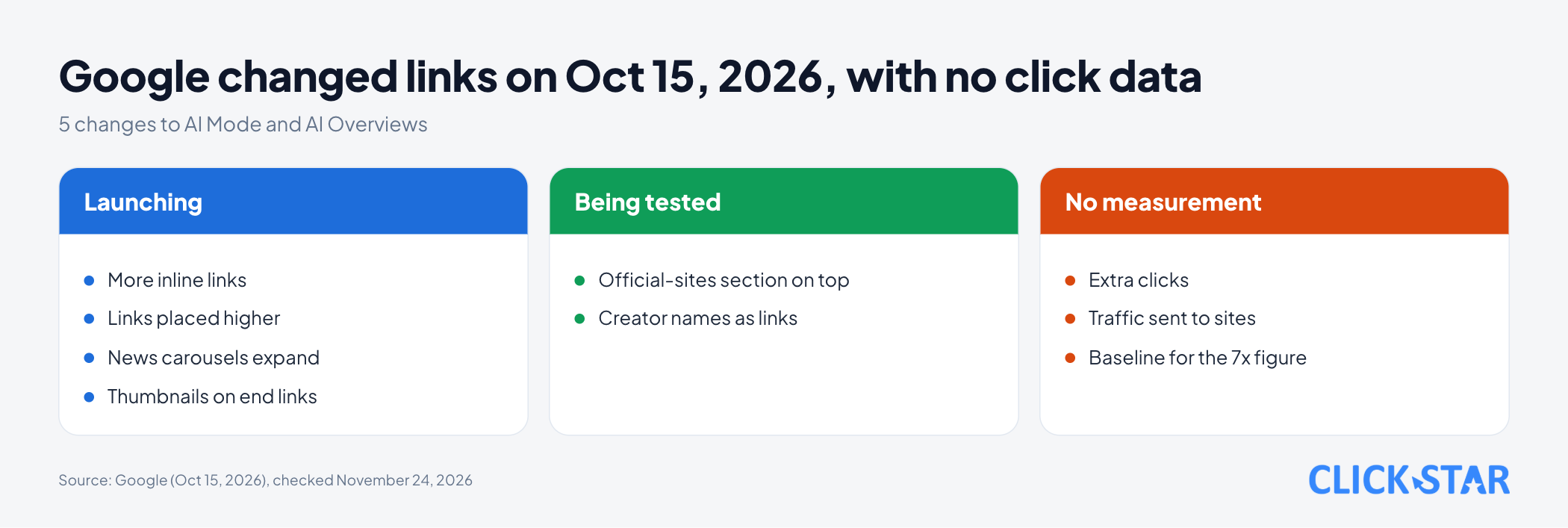
On October 15, 2026 Google posted "More ways to connect with the web from Search" (Hema Budaraju, read November 24, 2026), listing 5 changes to AI Mode and AI Overviews:
- Substantially more links embedded in the text, shown higher and more often (launching, no dates).
- A test section at the top of answers for official pages, with the reason each link is useful (testing).
- News carousels expanding to more places and languages, highlighting Preferred Sources (sources users choose themselves).
- Links at the end of some answers get image thumbnails and a more clickable design (an update, no date given).
- A test making creator names on AI Mode video results link to Search profiles.
Google also said the number of people using Preferred Sources grew more than 7 times since the start of the year; the post gives no starting number or definition of "using".
The key point: Google's post has no click or traffic figures for these changes.
AI reads many pages and sends few visitors
Cloudflare (post August 29, 2025, page last modified July 15, 2026, read November 24, 2026) measures bot crawls per referred visit. Cloudflare Radar data for July 2025, rounded: Anthropic about 38,066, OpenAI 1,091, Perplexity 195, Microsoft 41 and Google 5.
This is a read-to-send ratio, not a quality score.
In the same post, about 80% of AI bot crawling over the previous 12 months was for training, 18% for search and 2% for user actions (classified from what operators disclose).
Cloudflare notes Google referrals to news sites fell from February 2025, and says the drop seems to coincide with some of Google's changes, without claiming a cause.
On citations, Similarweb reports ChatGPT answers carried web citations in 22.6% of travel cases and 6.8% on average across all conversations (US, desktop, May 2026). So most answers carry no web citation.
What this means for Vietnamese businesses
The data suggests AI is a minor but growing channel, and its effect on clicks from Google is more notable than the visits AI sends. AI summaries appear most for long, question-style queries (53% for queries of 10 or more words, Pew's US figure).
In its July 9, 2026 post, SE Ranking also wrote that 60% of AI visits land on the homepage, against 17% for organic search, with no sample or period stated. If your homepage does not guide visitors onward, AI visits may land where they do not know where to go.
Click Star's view. There is not enough Vietnam data to set a separate revenue target for "AI visitors". It is reasonable to treat it as a secondary signal, measure it on your own site, and not pay for reports built only on US or global numbers.
Click Star offers SEO-standard website design, data dashboards and digital marketing, so it has an interest when you decide to invest in measurement.
What to do: a 30-day plan to track citations
This is a Click Star reference framework, not taken from outside sources and not tested on real data.
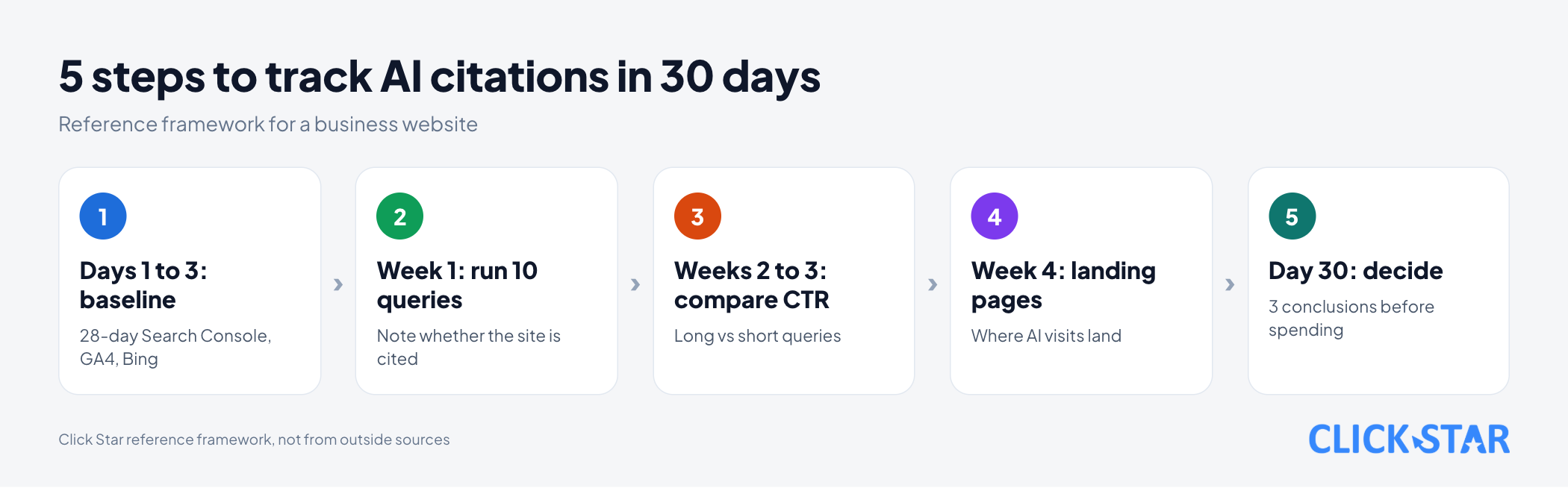
Step 1. Days 1 to 3: record a baseline. Export the last 28 days of clicks and impressions from Search Console, sessions from the AI Assistant channel in GA4, and Bing's AI Performance if available. Note major Google changes too.
Step 2. Week 1: run 10 priority queries. Pick 10 questions real customers ask. Each week, on the same day, run them on 3 AI tools and note whether your site is cited. Run each twice, since results can differ.
Step 3. Weeks 2 and 3: compare CTR by query length. Per Google's page "Performance report (Search results): Advanced filtering and comparison" (read November 24, 2026), you can filter queries with "Custom (regex)" in RE2 syntax.
Compare covers devices, countries, search types, search appearances and date ranges, so apply each pattern once and record CTR each time.
Filter queries of 10 or more words with ^([^ ]+ ){9,}[^ ]+$ and 1 to 2 words with ^[^ ]+( [^ ]+)?$, then compare CTR between the groups.
Pew counts English words, while Search Console splits on spaces (Vietnamese syllables), so this threshold does not match Pew's figures. Both patterns were tested with Python re on 6 sample strings on November 24, 2026 (illustration, not measurement); Search Console uses RE2, so test them in the interface.
Step 4. Week 4: check where AI visits land. Filter AI Assistant sessions in GA4 by landing page. Record the homepage share as your own site's baseline; SE Ranking's 60% and 17% are for reference only.
Step 5. Day 30: decide. Write down 3 conclusions: is the site cited in the 10 queries, is long-query CTR lower than short-query CTR, and where do AI visits land. Only when all 3 are clear should you weigh further optimization cost.
How to measure: 5 metrics
All 5 are Click Star's proposals, with no industry threshold. Read them weekly, and do not add them into one number.
- Number of the 10 queries where the site is cited.
- CTR of queries with 10 or more words against queries with 1 to 2 words.
- Sessions from the AI Assistant channel (GA4), recorded as a floor.
- Share of AI visits landing on the homepage versus content pages.
- Number of AI bot requests in server logs, split by bot.
Common mistakes
- Taking one number (8% against 15%, or the 58% drop) as the standard for your own site, when the samples are US and Google.
- Mixing share as listed by Statcounter with referral share (SE Ranking) when each measures something different.
- Reading Google's "links placed higher" as proof of more clicks, when the post has no figures.
- Dismissing 0.32% as small without looking at growth and at the part counted as direct.
- Running test queries once and concluding, when AI results can change between runs.
What is not known
Click Star found no measurement of AI traffic or CTR for Vietnamese websites or Vietnamese-language queries. Statcounter's Vietnam figure has no method and differs sharply from SE Ranking's global figure.
It is unclear how many extra clicks Google's October 15, 2026 link changes create. It is unknown whether ChatGPT's May 2026 figure is a spike or a trend; SE Ranking's data covers only websites with Google Analytics.
Pew and Ahrefs measure different things, so they cannot be added together. Cloudflare uses 2025 data, and no newer version could be read.
Related posts

Need tailored advice for your business?
Click Star helps you build a solution that fits your industry and scale. We answer every question during business hours.