10 of the most powerful AI tools right now (October 2026): how to choose by the job
10 AI tools worth considering for businesses in Vietnam, each tied to the job it does best, with details verified from vendors, how to read conflicting rankings and a 14-day trial process.
"Which AI tool is the most powerful" has no fixed answer, because what matters is powerful at what. One tool may lead on number of users, another may lead a blind-vote ranking, and a third may simply do the job you need next Monday. So this article does not offer a single ranking.
Click Star has picked 10 tools worth considering for businesses in Vietnam as of October 20, 2026, each tied to the job it does best, what has been verified from the vendor's official pages and what to be careful about.
The selection draws on 3 sources: real-world usage according to Similarweb's September 2026 traffic ranking, information from vendors' official documentation and announcements, and capability rankings that every source warns are changing constantly.
Prices and plan names change fast, so the article avoids quoting prices except API prices from official documentation.
Key points
- No tool is "the most powerful" for every job. The capability rankings Click Star reviewed contradict one another: many sources put Gemini 4 Argon at the top of LMArena's text vote in mid-October 2026, while most sources put Claude Opus 5.5 at the top of the Artificial Analysis intelligence index, and one source gives a different order. The gap between leading models is often smaller than the gap between how well people use them.
- On usage, Similarweb ranks chatgpt.com, gemini.google.com and claude.ai first, second and third in September 2026, followed by DeepSeek, Grok, Character.ai, Perplexity and Microsoft Copilot.
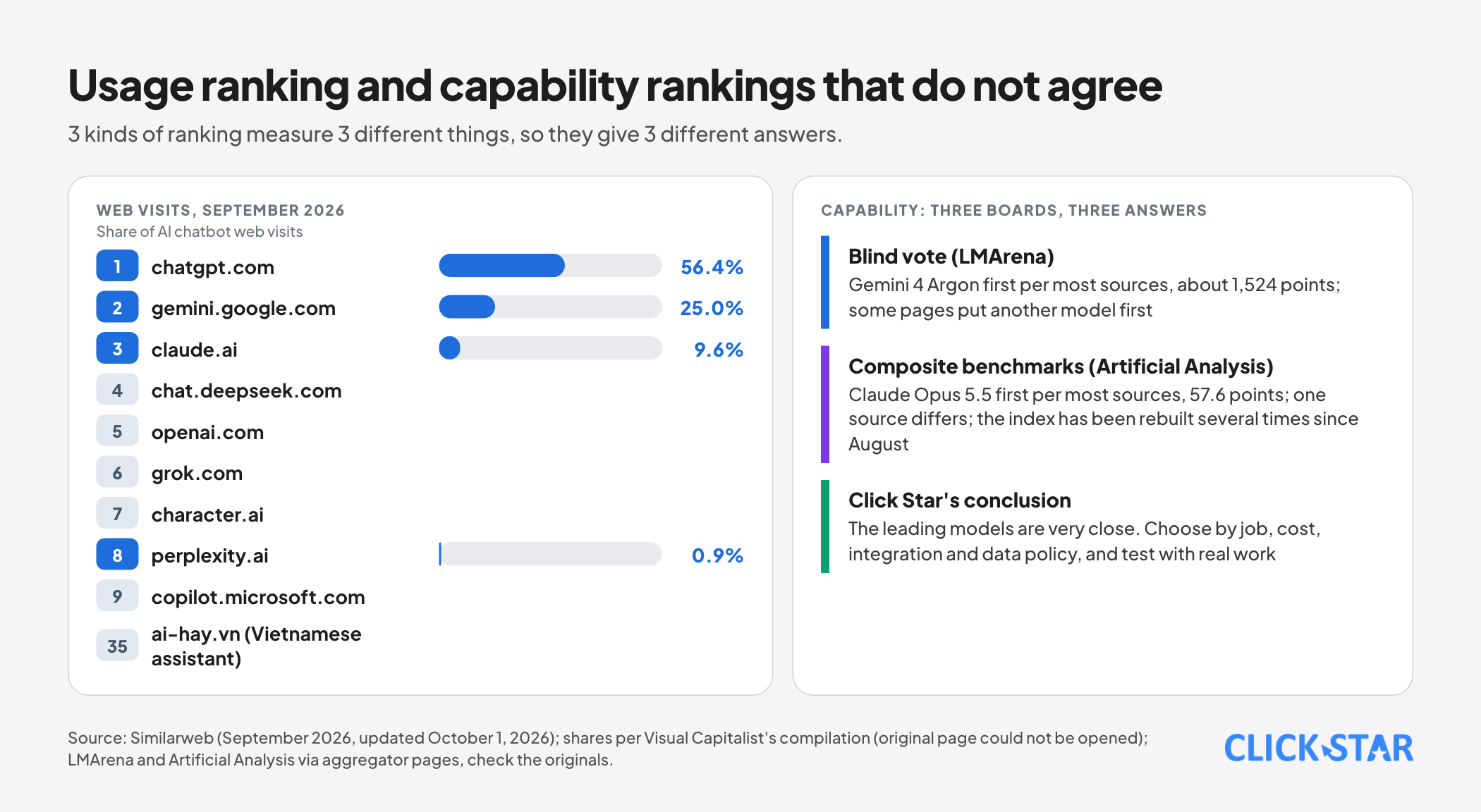
- The 10 tools in this article fall into 7 job groups: general assistants (ChatGPT, Claude, Gemini), search with cited sources (Perplexity), an assistant inside office software (Microsoft Copilot), analysis of your own documents (NotebookLM), software building (Cursor), design and presentations (Canva, Gamma) and a low-cost model (DeepSeek).
- Most businesses need 2 to 3 tools used in depth, with a verification process, rather than 10 subscriptions.
- The biggest risk lies in data, not in the tools: entering customer information into a service hosted abroad may trigger cross-border transfer duties under the Law on Personal Data Protection.
How to read AI rankings
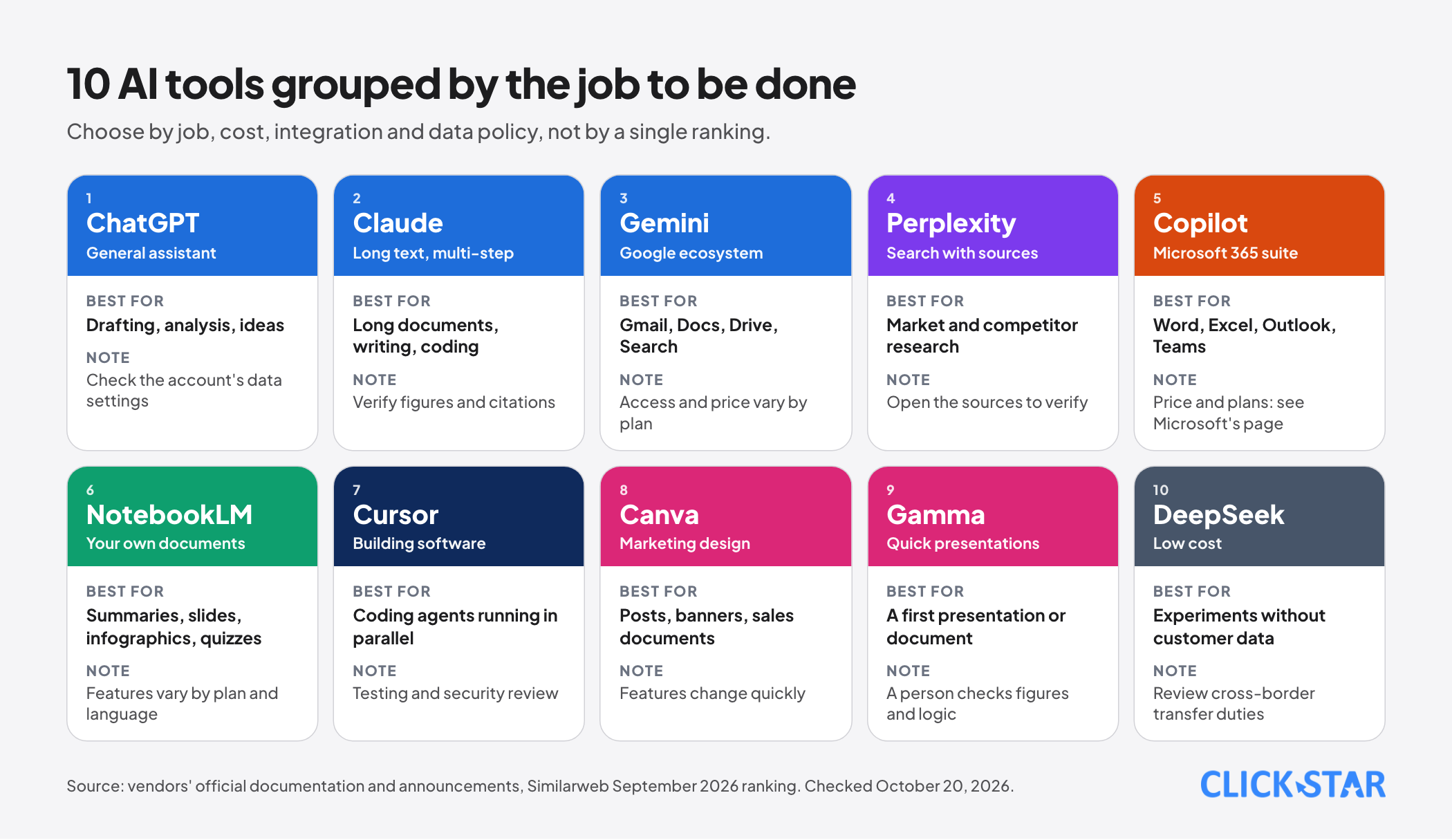
3 kinds of ranking are often quoted, and each measures something different.
Ranking by usage. Similarweb ranks AI sites by global traffic.
Its "Top AI Chatbots and Tools Websites Ranking" page, updated October 1, 2026 and covering September 2026, puts chatgpt.com first, gemini.google.com second, claude.ai third, chat.deepseek.com fourth, openai.com fifth, grok.com sixth, character.ai seventh, perplexity.ai eighth and copilot.microsoft.com ninth.
Notably, ai-hay.vn, a Vietnamese assistant, ranks 35th. According to a Visual Capitalist compilation based on the same source (Click Star could not open the original page), ChatGPT takes 56.4% of AI chatbot website visits, Gemini 25.0%, Claude 9.6% and Perplexity 0.9%.
A separate Semrush dataset for June 2026, via Exploding Topics, records 5.32 billion visits for ChatGPT and growth of 236.2% for Claude between February and June 2026, the fastest among tools with 10 million or more monthly visits. These figures count web visits only, not mobile apps or API use.
Ranking of capability by blind vote. LMArena lets users compare 2 anonymous answers and pick one. In mid-October 2026 most aggregator sources put Gemini 4 Argon at the top of the text board with about 1,524 points, but the aggregators' figures differ from one another and some put a different model first. Open LMArena's own page for the current version.
Ranking by composite benchmarks. The Artificial Analysis intelligence index combines several tests. Most aggregator sources put Claude Opus 5.5 first with 57.6 points and Claude Sonnet 5.5 second with 56.0, and one source reports a different order.
According to those same sources, the index has been rebuilt several times since August 2026, so a score quoted without its version is nearly meaningless.
Click Star's view. 3 rankings give 3 different answers to the same question, and that is useful information. It shows that the leading models are very close, and that tool choice should rest on the job to be done, cost, integration and data policy, not on one ranking. The surest way is to test with your own real work.
10 tools and what each does best
**1.
ChatGPT (OpenAI): the most widely used general assistant.** According to OpenAI's developer documentation, the GPT-6 family now has 3 models: Astra ("our most capable model for the most demanding work"), 6.1 Sol (near-Astra performance at lower cost) and Luna (the most efficient for focused, high-volume tasks), each with a context window of about 1.05 million tokens.
Published API prices are USD 10 and 50, USD 2 and 10, and USD 0.10 and 0.50 per million input and output tokens for the 3 models in that order. Best for: drafting, data analysis, ideas, general Q and A and a broad ecosystem of integrations.
Note: OpenAI's business data page says it does not use data from its business plans and API to train models by default, but that is a commitment for the plans it names, so for a personal account check the data controls in the account's own settings. Click Star has a separate article on how to use GPT.
2. Claude (Anthropic): long documents, writing and multi-step work. According to the official documentation, the Claude line now includes Fable 5.1, Opus 5.5, Sonnet 5.5 and Haiku 5.5, all with a 1-million-token context window.
The documentation recommends starting with Opus 5.5 for most workloads, using Fable 5.1 for demanding reasoning and long agentic work, Sonnet 5.5 for the best balance of speed and intelligence and Haiku 5.5 for high-volume, latency-sensitive tasks.
API prices run from USD 0.10 to USD 10 per million input tokens and from USD 0.50 to USD 50 per million output tokens depending on the model. Best for: reading and summarizing long documents, writing, analysis and multi-step coding. Note: check figures and citations as you would with any model.
**3.
Gemini (Google): people in the Google ecosystem.** According to the official announcement of October 13, 2026, Gemini 4 Argon is in the Gemini app for Google AI Pro and Ultra subscribers, described as answering more directly, reporting progress better on long tasks, helping with coding and having a task mode that lets Gemini keep working while the user is away.
Gemini connects to more than 40 apps such as Instacart, OpenTable, Adobe and Shopify. Best for: people who already use Gmail, Google Docs, Drive and Search and want AI built in. Note: access options by plan and API pricing change, so check Google's pages before buying.
4. Perplexity: search with cited sources. Perplexity's help center describes it as an AI-powered search engine that answers conversationally and includes links to original sources so users can check them, with Search, Pro Search and Deep Research modes. Best for: researching markets, competitors and news where source links matter.
Note: citing a source does not mean citing it correctly, so open the source to verify.
5. Microsoft Copilot: organizations on Microsoft 365. Copilot appears at 9th (copilot.microsoft.com) and 21st (copilot.cloud.microsoft) in Similarweb's ranking. Best for: organizations already using Word, Excel, Outlook and Teams, where data and access are already governed in the same system.
Note: the secondary sources Click Star reviewed disagree on price and plans, so the article does not quote a price; see Microsoft's official price list.
**6.
NotebookLM (Google): analysis of your own documents.** The official announcement of March 20, 2026 says NotebookLM can revise individual slides, create infographics in 10 new styles, flashcards and quizzes, accept EPUB e-books as sources and export slide decks to PPTX, plus Cinematic Video Overviews that are English-only and limited to some plans.
Best for: turning a set of internal documents (reports, procedures, template contracts) into summaries, reading material and question sets. Note: some features are limited by plan, age and language.
7. Cursor: building software with AI agents. The official page describes Cursor as a coding agent: hand tasks to agents that run in parallel to build, test and demo features, with a command-line tool, Slack integration, pull-request review on GitHub and a choice of models from OpenAI, Anthropic or Gemini.
Cursor ranks 18th in Similarweb's list. Best for: engineering teams and product builders. Note: AI-generated code still needs testing and security review. Click Star has a separate article on vibe coding.
8. Canva (AI): design for marketing. According to Semrush data via Exploding Topics, Canva had about 759.8 million visits in June 2026, fourth among the 74 AI tools tracked. According to secondary roundups of the Canva Create event in April 2026, Canva is moving toward conversational design.
Best for: posts, banners, sales documents and presentations for marketing teams without a professional designer. Note: feature details change quickly, and the official source could not be opened when Click Star checked.
9. Gamma: quick presentations and documents. Gamma ranks 20th in Similarweb's list. Click Star could not open Gamma's official page when checking, so it gives only the general description of a tool that builds presentations and documents from a description.
Best for: a first version of a proposal presentation or report, to be edited further. Note: the content still needs a person to check figures and reasoning.
10. DeepSeek: a low-cost model with open versions. DeepSeek ranks 4th in Similarweb's September 2026 list. Best for: engineering teams that want to try a low-cost model or run one themselves.
An important note: before entering customer data into the web service of any provider abroad, DeepSeek included, read its data policy and review the cross-border transfer duties. The safest course is not to enter personal data into any service the business has not assessed.
Choosing tools by job
Click Star's view. Suggested starting points for a business that operates online:
- One general assistant (ChatGPT, Claude or Gemini) for drafting, analysis and ideas. Choose by the ecosystem you already use and the quality in Vietnamese on your own real work.
- Perplexity or the research mode of a general assistant for sourced market research.
- NotebookLM if you have an internal document store to mine.
- Copilot if the organization already governs everything on Microsoft 365.
- Canva or Gamma for the marketing team's visual output.
- Cursor if you have engineers or product builders.
- A low-cost tool such as DeepSeek for experiments that do not use customer data.
A 14-day trial to choose tools
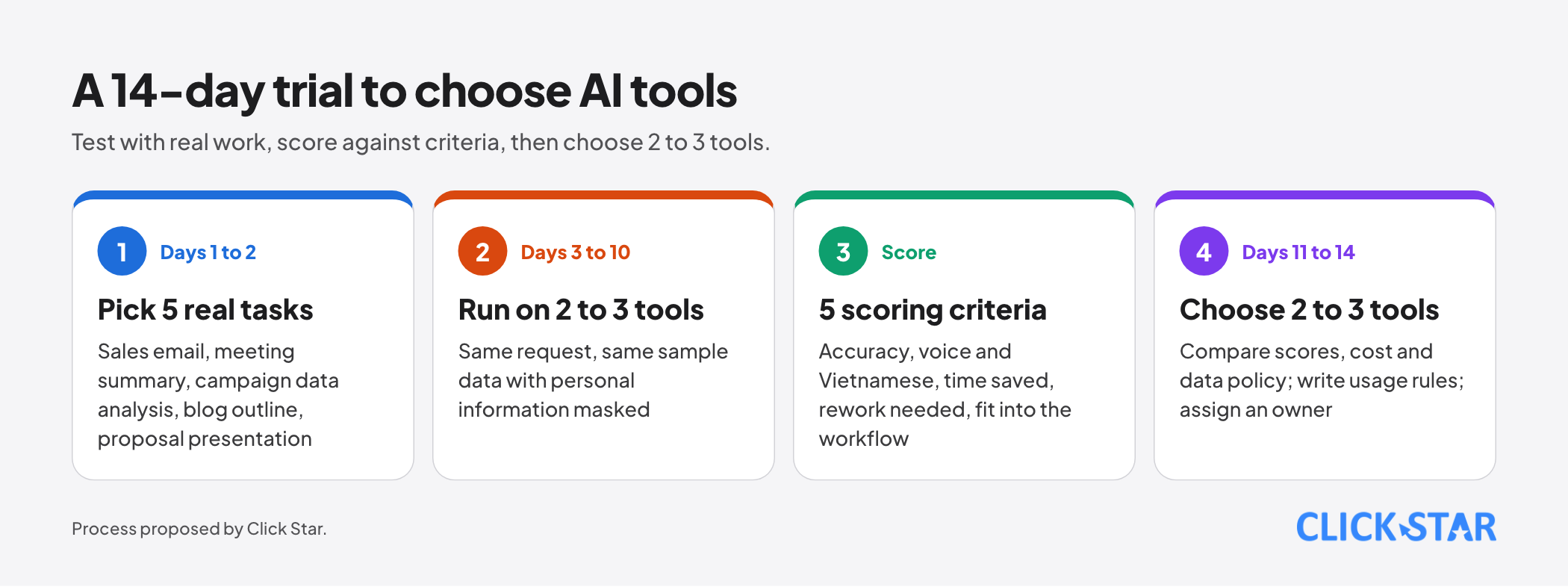
- Days 1 to 2, pick 5 real tasks that eat the team's time (for example a first draft of a sales email, a meeting summary, analysis of a campaign's figures, an outline for a blog post, a proposal presentation).
- Days 3 to 10, run each task on 2 to 3 tools with the same request and the same sample data, with personal information masked.
- Score on 5 criteria, each from 1 to 5: factual accuracy, right tone and right Vietnamese, time saved, how much rework is needed and how easily it fits into the workflow.
- Days 11 to 14, compare scores, cost and data policy, then choose 2 to 3 tools, write usage rules and assign an owner.
Personal data when using AI tools
Since January 1, 2026, the Law on Personal Data Protection and Decree 356/2025/ND-CP have set duties on consent, on data subjects' rights and on cross-border transfers.
According to Luat Viet An's summary, Article 18 of the Decree requires a transfer impact assessment, notice to the Ministry of Public Security and a binding agreement with the overseas recipient. Entering a customer list into an AI tool hosted abroad may fall under these duties.
Click Star has a separate article updating this law for 2027. A practical rule for teams: do not paste customers' phone numbers, emails, addresses or purchase history into a tool the business has not assessed, mask or replace sample data, and use a business plan with data commitments when real information must be processed.
Common mistakes
- Choosing a tool by a single ranking, when the rankings contradict one another and change weekly.
- Subscribing to too many tools, none used deeply enough to become a habit.
- Using a free personal version for sensitive work data.
- Trusting an answer that has citations without opening the sources.
- Having no owner and no usage rules, so each employee works differently and data leaks without anyone knowing.
- Not measuring: not knowing how many hours a tool saves or whether output quality improves or worsens.
- Treating tools as a replacement for people. Productivity research suggests the biggest gains come when people remain the ones who assign the work and check the results.
Related posts
Need tailored advice for your business?
Click Star helps you build a solution that fits your industry and scale. We answer every question during business hours.