Vercel in October 2026: what is new in Next.js 16.4, Daemons, Services and Token Pass
Next.js 16.4 recommends Cache Components for every app, Daemons runs background processes, and Services puts several apps in one project. A summary checked against official sources, with a view on when to try each.
Vercel has shipped a lot in the last 2 quarters, from the framework (Next.js 16.4) to background infrastructure (Daemons), from running several services in one project (Vercel Services) to the gateway for AI models (AI Gateway).
This article gathers the changes that have an official announcement as of October 19, 2026, separates what is stable from what is still beta, and says when it makes sense to try each one. Technical details come from the official Vercel and Next.js changelog and blog; the assessments are Click Star's opinion.
Key points
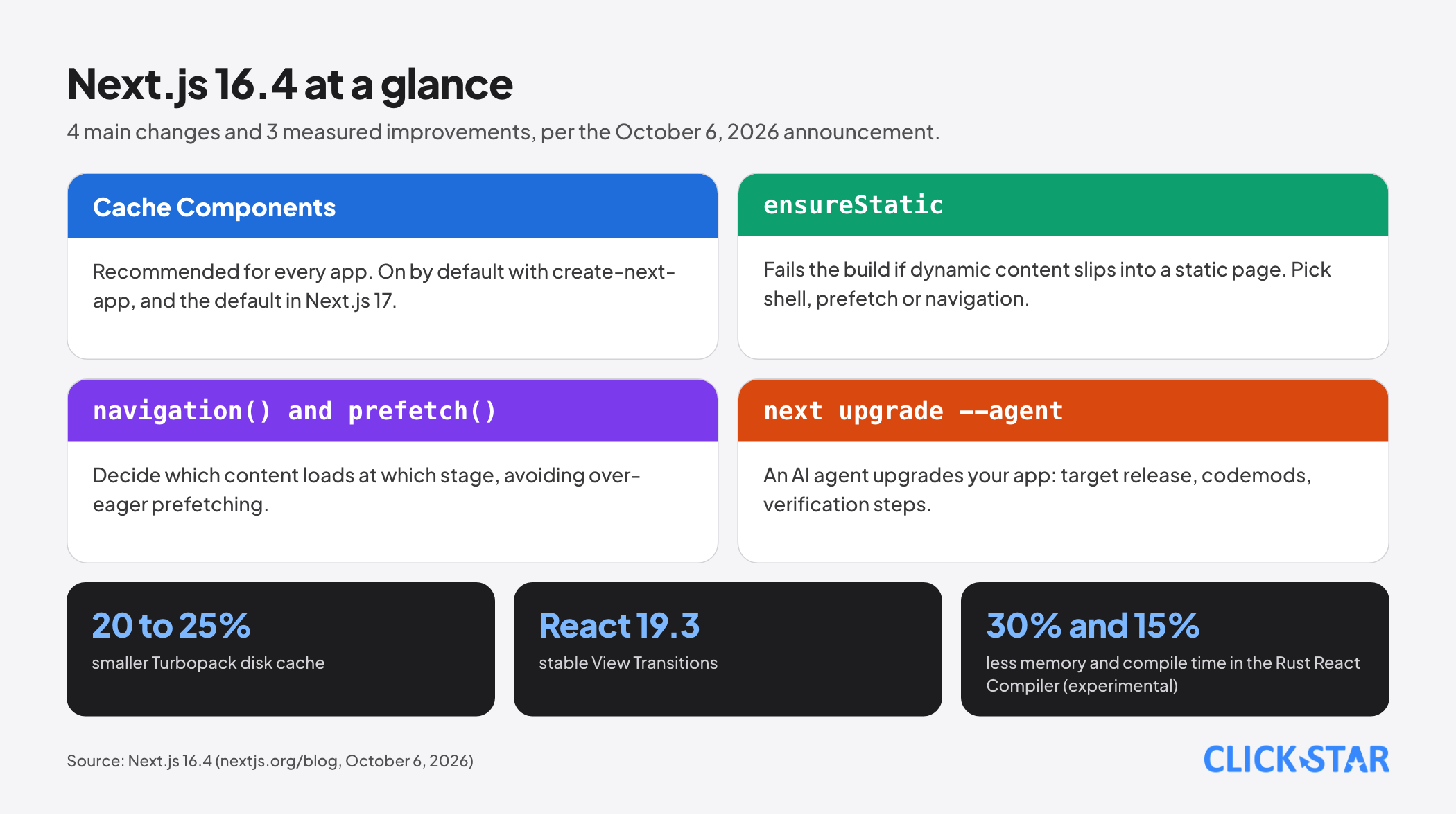
- Next.js 16.4 (October 6, 2026) recommends Cache Components for every app. New apps created with create-next-app have it on by default, and it becomes the default in Next.js 17.
- Vercel Daemons (public beta since October 15, 2026) runs background processes that pull work to process, without an HTTP server: queue workers, Kafka consumers, self-hosted CI runners.
- Vercel Services (beta, June 30, 2026) lets you put several frontends and backends in one project. Functions now accept packages up to 5 GB (beta, June 29, 2026), 20 times the old 250 MB.
- AI Gateway gained session logs and session affinity to make better use of prompt caching. The Token Pass plan (early access) sells open-weight model credit for $30 a month.
- Most of the new infrastructure features are beta or early access. Try them in a side project before moving your main system.
Next.js 16.4: Cache Components becomes the main path
Across the 16.x releases, Next.js has been building a new programming model called Cache Components. The core idea: you mark parts of the component tree as eligible for caching with the 'use cache' directive, like a component-level version of the Cache-Control header.
Static, cached and request-time parts can sit on the same page and be returned in one response. This replaces the implicit caching behavior of earlier App Router versions with explicit declarations.
The big change in 16.4 is the stance. Vercel says it did not recommend the model for everyone before, because a few cases could not match the cost and performance of the old approach, and this release closes those gaps. From 16.4 it recommends Cache Components for every Next.js app.
Apps created with create-next-app have it enabled, and it becomes the default in Next.js 17. For an existing app, you turn it on with 2 flags:
// next.config.ts
const nextConfig = {
  cacheComponents: true,
  partialPrefetching: true,
}
export default nextConfig
ensureStatic: keep dynamic content out of static pages
On marketing pages, blogs or shops, one dynamic component that slips in can quietly cost a page its static advantage and raise server cost. Next.js 16.4 adds ensureStatic to fail the build if that happens.
The value 'navigation' is the strictest (navigating to the page never renders at request time), while 'prefetch' and 'shell' guard earlier stages more lightly. You can set it on a page or on a layout to cover a whole group of pages.
// app/layout.tsx
export const ensureStatic = 'navigation'
navigation() and prefetch(): decide what loads at which stage
Prefetching removes loading states, but if every link prefetches heavy data, the server pays for it. Version 16.4 adds 2 APIs to defer work: await navigation() excludes part of the content from a prefetch until the user actually navigates, and prefetch() defers content inside the page shell until an explicit prefetch.
Vercel's example is an inbox: prefetch only the first message, and wait for navigation to load the rest of the thread.
Tools for coding agents
Next.js 16.4 invests in letting AI agents upgrade your app for you. The command npx next@canary upgrade --agent=latest checks your installed version, picks a target release, and prepares migration guides, codemods and verification steps for the agent.
The experimental.agentUpgrade setting reminds you when a relevant upgrade exists, with the policies 'security' (the default, only reminds about vulnerability fixes), 'latest' or false. The experimental agentFeedback lets an agent draft bug reports for you to review and decide whether to send to the Next.js team.
According to Vercel, the agent is told to leave source code, logs and secrets out of reports, and nothing is sent until you select Send feedback. It requires telemetry and does not run in CI.
Improvements for every app
- Turbopack's disk cache is 20 to 25% smaller thanks to Zstandard compression of the bulk of the data.
- Server HMR is lazy: it recompiles only when a request needs that page, reducing background work during development.
- Turbopack's runtime ships as one chunk shared across routes, so downloads are smaller and cache hits more likely.
- Production CSS Module class names are shorter, plus export mangling, so bundles shrink.
- It ships with React 19.3: stable View Transitions, Fragment Refs and the
browser()API.
There is also a group of experimental features: a Rust version of the React Compiler (the Turbopack team reports 30% less memory and 15% less compile time than before), garbage collection for the disk cache, lazy dynamic imports in development, running tools such as Babel and PostCSS in worker threads, and additional roots for pnpm's or Bun's shared package store.
The Bundle Analyzer was also upgraded, with an agent skill that finds and reduces the JavaScript your app ships. On October 16 Vercel released 16.4.2, an update for the long-term support line.
Click Star's view. New projects should accept the Cache Components default.
For a running project, do not flip the 2 flags on the main branch: work on a separate branch, use Vercel's preview deployments to check page by page, and run the agent-assisted upgrade and read the changes carefully. clickstar.vn currently runs Next.js 16.2, so the sensible path for us is also a trial branch first. ensureStatic fits about pages and blogs especially well, where you want to guarantee nothing dynamic sneaks in.
Vercel Daemons: background processes that pull work
Familiar serverless infrastructure revolves around answering an HTTP request. Many real systems also have processes that run continuously and pull work from a queue.
According to the October 15, 2026 announcement, Vercel Daemons (public beta) targets exactly that group: Vercel Queues workers in poll mode, Celery, BullMQ, RabbitMQ, Kafka consumers, Temporal or Cadence workers, and self-hosted CI runners for GitHub Actions, GitLab and CircleCI.
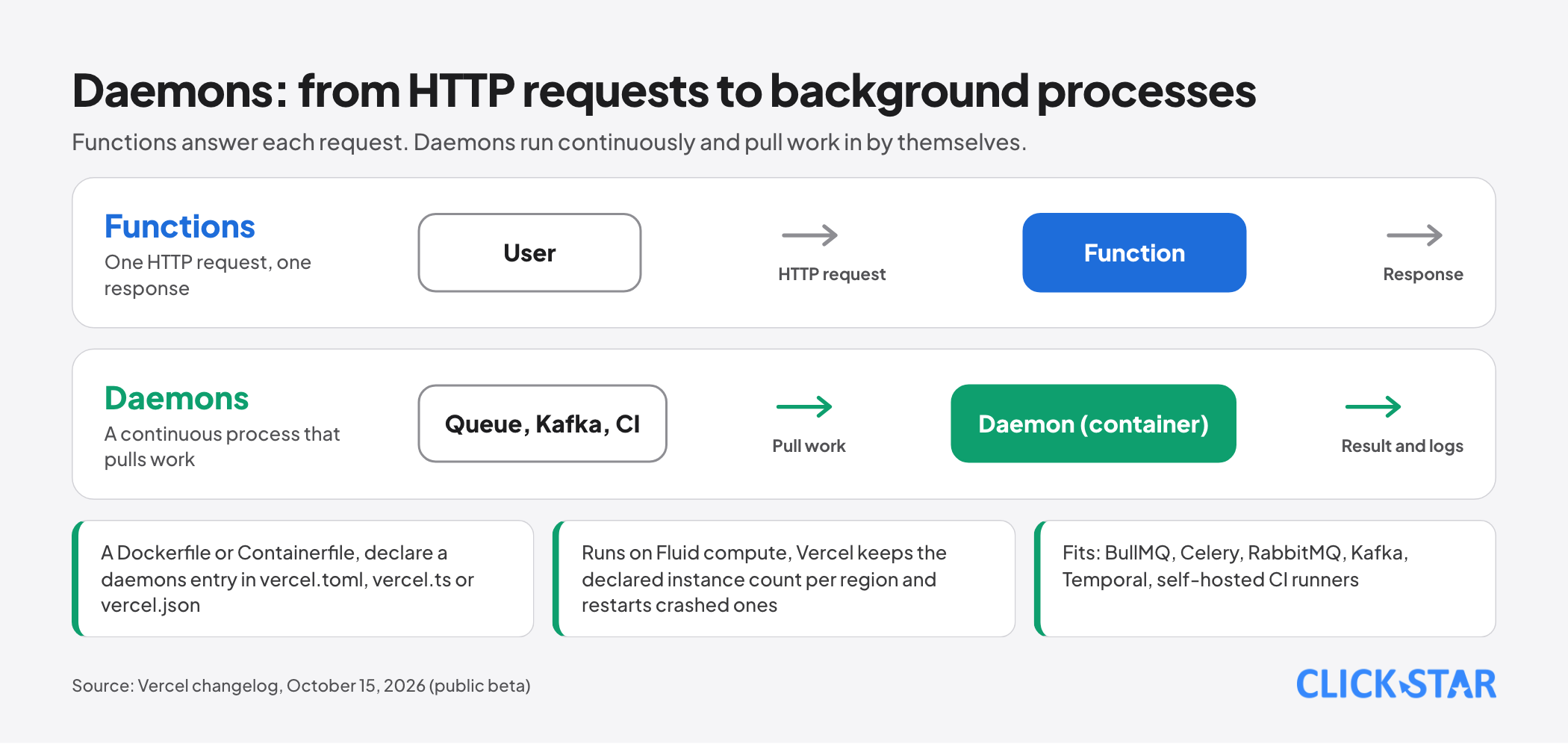
How it works: package your app with a Dockerfile or Containerfile, then add a daemons entry to the project's root config file (vercel.toml, vercel.ts or vercel.json). The entry declares the root directory, entrypoint, start command and the number of instances per region.
A daemon runs as a container on Fluid compute, deploys with your app in the same project, and is built by Vercel. Vercel keeps the instance count you declared and restarts any instance that exits or crashes. Connection details go in production environment variables, and output appears in the project's Logs.
CPU and memory metrics require Observability Plus, and the announcement states neither limits nor separate pricing for Daemons.
Click Star's view. If you rent a dedicated server just to run queue workers, Daemons is worth trying in a side project to compare cost and stability. Because it is beta and has no published limits, do not move payment flows or critical data processing there until you have tested it long enough yourself.
Vercel Services and Functions up to 5 GB
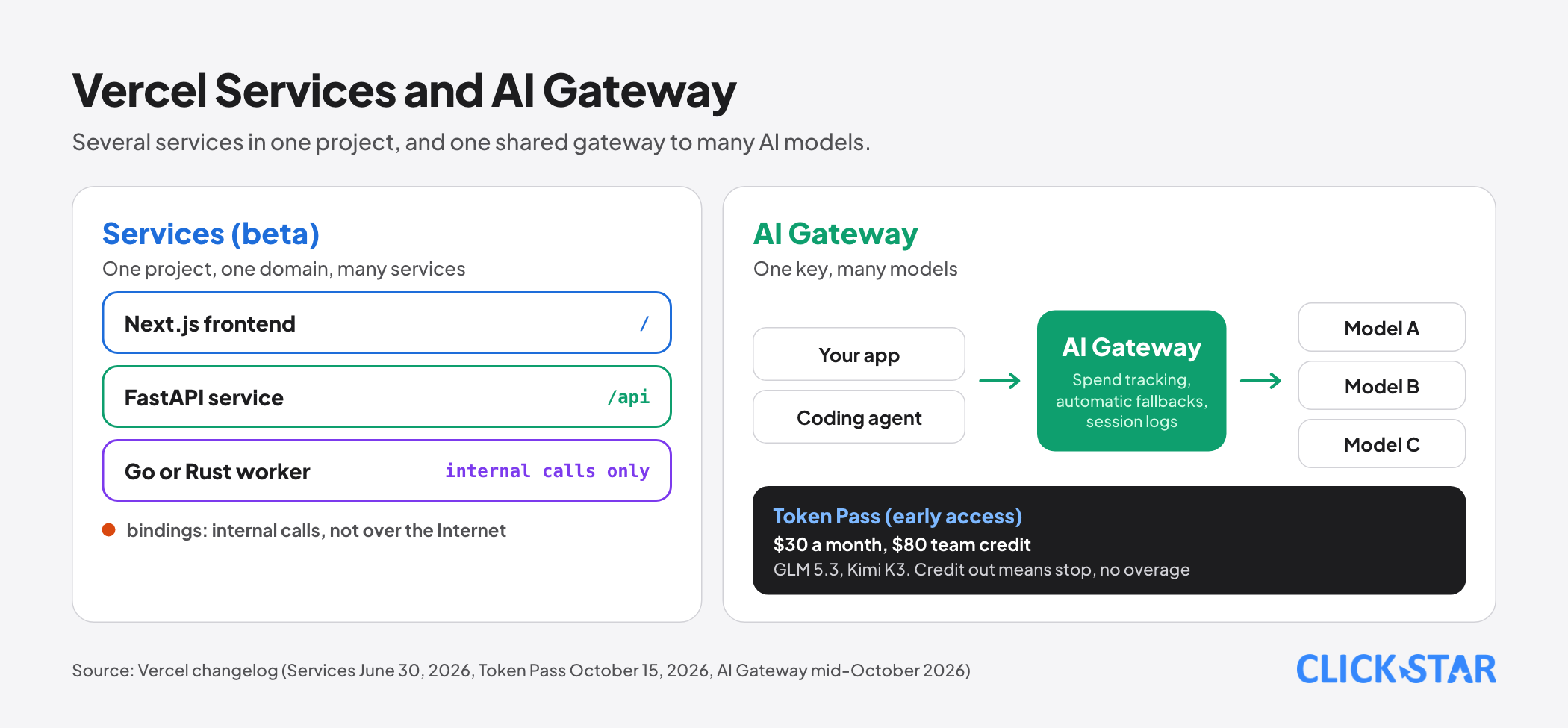
According to the June 30, 2026 changelog, Vercel Services lets you deploy multiple frontends and backends in one project on one shared domain. Each service is built separately and routed by path prefix.
The declaration lives under the services key in vercel.json: each service has a root directory and either a framework (for example nextjs) or an entrypoint (for example main:app).
The bindings key lets one service call another over an internal address, not through the public Internet, with that address exposed as an environment variable. Public routes use the familiar rewrites. A service with no rewrite has no public route, so only other services can call it.
The announcement names FastAPI, Flask, Express and Hono, and says Go and Rust have first-class support. The dashboard shows a graph of services, Logs filters by service, and vercel dev runs all services locally. Services run on Fluid compute, billed by the time your code is actively running. Vercel's documentation labels the feature as beta.
At the same time, the June 29, 2026 changelog says Vercel Functions support packages up to 5 GB for Node.js and Python on Fluid compute, 20 times the previous 250 MB limit. It is a public beta: new projects join automatically, and existing projects add the environment variable VERCEL_SUPPORT_LARGE_FUNCTIONS=1 and redeploy.
It does not currently work with Secure Compute or Static IPs, and Vercel says 10 GB and larger is coming. A Vercel community recap also mentions Dockerfile deployments up to 5 GB, but that detail is not in the changelog post itself, so check the documentation before relying on it.
Click Star's view. This pair suits AI products with a Next.js interface paired with a Python service (FastAPI) that handles models, where heavy libraries often exceed 250 MB. Instead of splitting 2 systems across 2 places, you get one project, one preview, one rollback.
The thing to weigh is that both are beta, so do not put services with tight uptime commitments on them yet.
AI Gateway and the Token Pass plan
AI Gateway is a gateway for calling many models with one key, with spend tracking, request traces and automatic fallbacks.
The model catalog is extended almost daily: in the week of October 16 to 19 alone it added DeepSeek V4.1 Flash 1017 (with image input), Perplexity Decider V1.2, Elorian's Glimpse, Reflection AI's Beam and MiniMax M3.1 Flash, some of them offered free (Beam for a limited time only).
The most notable operational change is session logs. According to the mid-October changelog, Gateway logs now have a Sessions view that groups requests into conversation sessions and shows who ran the session (a coding agent or an app), the cost, models, providers and the share of input served from cache across turns.
Session affinity sends each turn to the provider that served the previous turn, because that provider already has most of the prompt cached, so the whole session reads more input from cache. It runs by default for text and chat requests.
For accurate grouping, send the same sessionId value or x-session-id header on every request in a conversation.
On October 15, 2026 Vercel introduced Token Pass in early access for Pro teams.
The plan costs $30 a month, includes $80 of credit each month shared across the team, currently for GLM 5.3 and Kimi K3, used through AI Gateway with coding agents or apps built with the AI SDK. Zero Data Retention is on by default, inference runs in the US and EU, and prompts and responses are deleted after each request and not used for training.
Credit does not roll over, and when credit runs out requests stop until the next period, with no automatic overage charges.
Click Star's view. For a team that uses coding agents every day, a fixed spending cap is the most attractive part: you know the maximum bill. The limits are the narrow model range and early-access status. Businesses that process customers' personal data should review the rules on processing data abroad before sending real data to any service that runs in the US or EU.
Small changes worth knowing
- Turborepo 2.11.9 (October 16) expands Turborepo-managed tool setup, improves cache and lockfile performance, and adds the
turbo execcommand. - Vercel CLI 64.0.1 (October 13) fixes a bug so the
VERCEL_OIDC_TOKENvariable keeps refreshing after the dev server starts. - The deployments list in the dashboard was redesigned on May 27: a denser layout, grouped environment statuses, easier scanning of branches and commits.
What to adopt, in what order
- This week: create a trial branch, upgrade Next.js to 16.4.x, run
npx next@canary upgrade --agent=latest, read the diff and check the preview. - New projects: keep the Cache Components default. Add
ensureStaticto about pages, blogs and static sales pages. - If you run workers or queues outside Vercel: try Daemons in a side project and compare cost and stability.
- If you pair an interface with a Python or Go service: try Services on a trial project, plus large Functions if dependencies exceed 250 MB.
- If you call several AI models: turn on AI Gateway and set a
sessionIdper conversation to track cost and cache hit rate. - For every beta or early-access feature: read the limits and terms, and do not put your business's most critical flow on it before testing it yourself.
Related posts
Need tailored advice for your business?
Click Star helps you build a solution that fits your industry and scale. We answer every question during business hours.