AI trends to 2030: what has been measured, what is still assumption, and what to do from now
3 layers of information kept apart: measured figures (METR, Stanford AI Index, IEA, Epoch AI, WEF), scenarios from researchers (AI 2027) and Click Star's assessments with a confidence level, plus 3 scenarios and 8 actions a business should take whichever one happens.
Forecasts about AI in 2030 can be read in 2 ways: as prophecy, or as an exercise in sorting evidence. This article takes the second approach.
It separates 3 layers of information so you know what you are reading: what organizations have measured (METR, the Stanford AI Index, the IEA, Epoch AI, the World Economic Forum), scenarios written by research groups (AI 2027), and Click Star's own assessments with a confidence level.
Every figure is attributed in the sentence and may be out of date by the time you read it. Technology forecasts are easy to get wrong, so the most useful thing to keep is not a specific year but the list of signals to watch and the actions worth taking whichever scenario happens.
Key points
- The most clearly measured thing: the length of work that AI models complete autonomously is growing exponentially. METR estimates a doubling time of about 7 months for 2019 to 2024, and about 4.3 months (130.8 days) for the period since 2023 in its January 2026 update, with large error bars and mostly on software work.
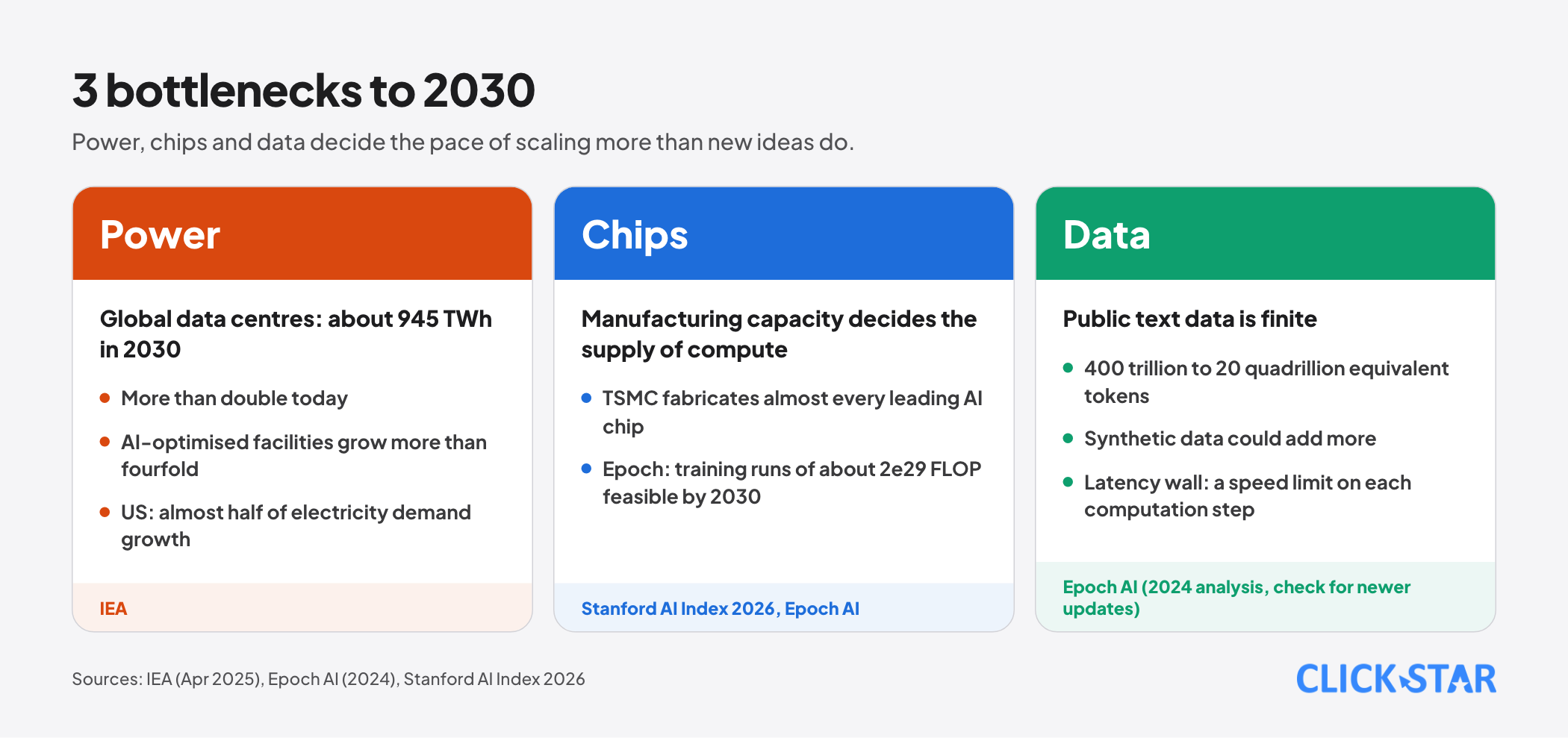
- The biggest limits to 2030 are likely power, chips and data rather than ideas. The IEA projects global data centre electricity demand to nearly double to about 945 TWh by 2030; Epoch AI argues that training runs of about 2e29 FLOP are technically feasible by that year.
- On jobs, the World Economic Forum estimates that by 2030, 170 million roles are created and 92 million displaced, a net gain of 78 million, and about 40% of the skills needed will change.
- Even the authors of the AI 2027 scenario moved their forecast after updating. Treat scenarios as thinking tools, not calendars.
- A business does not need to guess the right year. It needs clean data foundations, gradual automation of repetitive work, a verification culture, a training plan, no dependence on a single provider and data governance.
What has been measured
Longer work every year
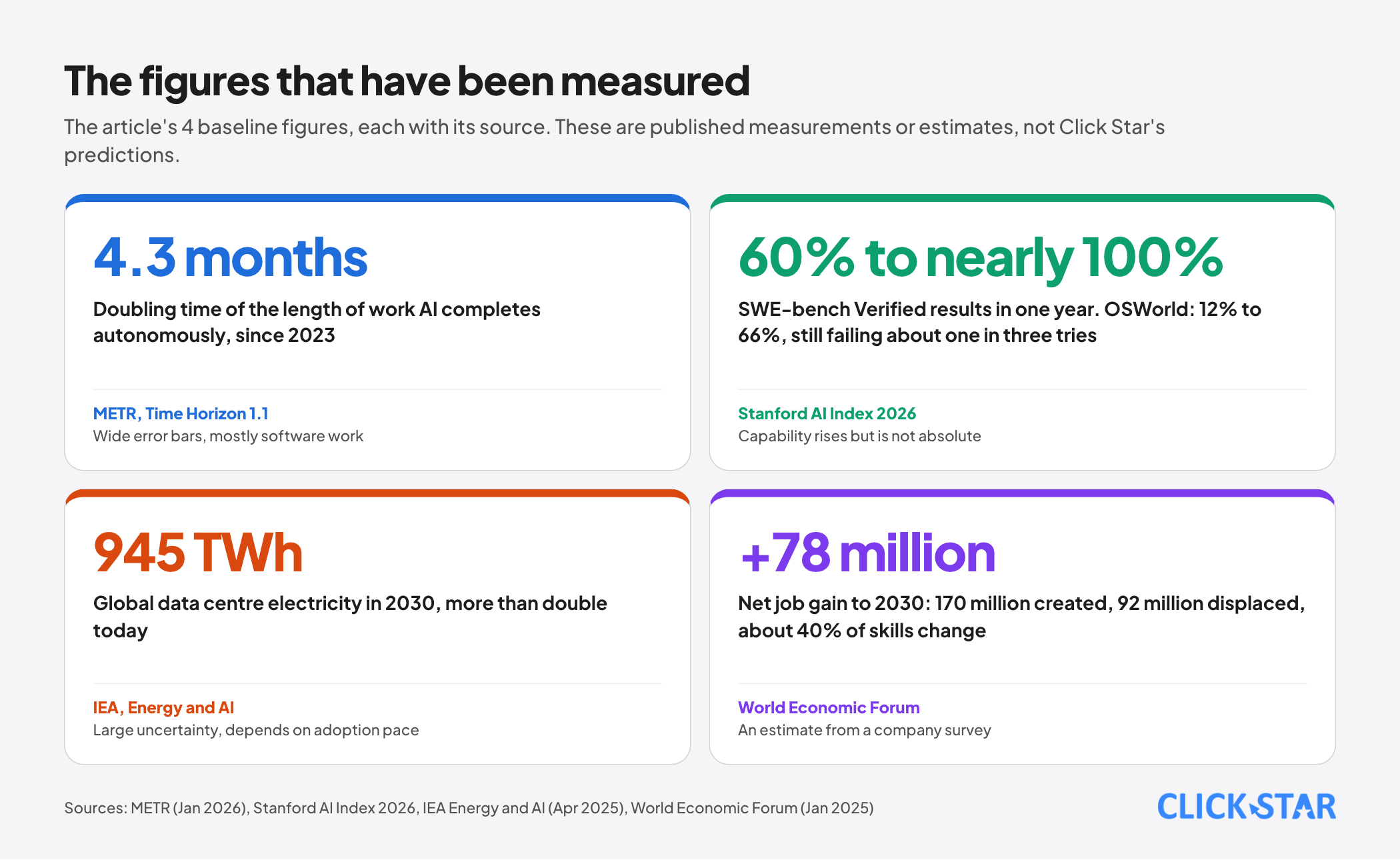
METR measures a "time horizon": the length of work, in the time a human expert would need, that a model completes successfully at 50% reliability. Its March 2025 paper estimated that this measure doubled about every 7 months between 2019 and 2024.
The Time Horizon 1.1 update (January 2026) shows faster progress: the doubling time since 2023 is about 130.8 days, roughly 4.3 months.
Read the limits correctly: the error bars are wide, especially for the newest models, the benchmark is mostly software work, and a "4-hour horizon" means failing about half of 4-hour tasks, not that "AI can do 4 hours of work". Some also argue the pace will slow; no one knows for sure.
Capability jumps, but not yet fully dependable
The Stanford AI Index 2026 reports that results on the SWE-bench Verified benchmark rose from about 60% to nearly 100% in a single year, and top models meet or exceed human baselines on many science and math tests.
But on structured computer-use tasks (OSWorld), the success rate rose from about 12% to about 66% and agents still fail nearly one in 3 attempts. Documented AI incidents rose from 233 (2024) to 362 (2025).
Adoption faster than any earlier technology
Also according to the AI Index 2026, generative AI reached 53% of the population within 3 years, faster than the personal computer and the Internet; 88% of organizations have adopted AI. US private investment in AI reached $285.9 billion in 2025, against $12.4 billion for China and $20.92 billion for Europe.
One detail stands out: 73% of experts expect a positive effect on how people do their jobs, against 23% of the public.
Power, chips and data are the bottlenecks
The IEA, in its Energy and AI report (April 2025), projects global data centre electricity demand to more than double to about 945 TWh by 2030, slightly more than all of Japan's electricity consumption today. AI-optimised facilities grow more than fourfold.
In the United States, data centres account for almost half of the growth in electricity demand through 2030. The IEA stresses that significant uncertainty remains, depending on the pace of AI adoption, energy efficiency and whether energy-sector bottlenecks are resolved.
Epoch AI, in a 2024 analysis, examines 4 constraints: power supply, chip manufacturing capacity, data and the "latency wall" (a speed limit from the minimum time each computation step needs).
Its conclusion is that training runs of about 2e29 FLOP are likely feasible by 2030; the equivalent text data is between 400 trillion and 20 quadrillion tokens, and synthetic data generated by AI could add substantially. This analysis is 2 years old, so check Epoch's newer updates before relying on it.
Jobs: created, displaced and re-skilled
The World Economic Forum's Future of Jobs Report 2025 (published January 8, 2025, based on a survey of over 1,000 companies) estimates that by 2030, 170 million roles are created and 92 million displaced, a net gain of 78 million, with about 22% of jobs disrupted.
About 40% of the skills employers need will change, and 63% of employers see the skills gap as the main barrier to transformation. Skills in AI, big data and cybersecurity are expected to see fast-growing demand. These are estimates from a survey of employers' views, not measurements.
What is a scenario: AI 2027
AI 2027, published on April 3, 2025 by a team including Daniel Kokotajlo (formerly at OpenAI), Scott Alexander, Thomas Larsen, Eli Lifland and Romeo Dean, is a concrete scenario of how superhuman AI might develop, written to be easy to check and rebut.
The authors say plainly that it is not a recommendation and that it has 2 endings (a slowdown and a race).
Notably, they adjusted it themselves: 2027 was the most likely (modal) year at publication, not the median; their July 2025 update moved the median back about 1.5 years; a December 2025 note says that after accounting for factors outside the model, Eli Lifland's median is 2030.
They also say their forecasts for 2025 and 2026 are on firmer ground than later years, where AI accelerating its own research makes outcomes much harder to predict. The most useful lesson: even a serious research group sees its forecast curve move when new data arrives.
6 trends to 2030, with a confidence level
This section is Click Star's assessment, based on the evidence above and what we see working with clients. The confidence level is a subjective judgment, not a measured probability.
- Agents can do longer work (high confidence in direction, low in speed). METR's measure and the AI Index point the same way. It is unclear whether the pace will hold, but "hand over a multi-hour task and get a result back" will become more common.
- Power and chips set the pace (medium to high confidence). The IEA and Epoch both point to physical and infrastructure limits. Businesses using AI should expect price and availability to depend on this supply chain.
- Competition among providers makes "one provider" less safe (medium confidence). Model gateways add new models almost every day. Designing systems so you can swap models easily will be an advantage.
- Work reorganizes around verification (medium confidence). When producing output costs almost nothing, the bottleneck moves to testing, review and design, as Simon Willison observes about programming. The skills worth investing in are asking questions, verifying and being accountable.
- Search becomes an answer engine (medium confidence). Clicks fall when an AI summary appears, and brands need to be cited as sources, not only ranked. See our article on SEO thinking in the AI era.
- Regulation, safety and trust are the big unknowns (low confidence). Incidents are rising, and trust in regulators differs widely between countries (per the AI Index 2026: lowest at 31% in the US, highest at 91% in Singapore). Personal data rules, such as Vietnam's Law on Personal Data Protection (Law No. 91/2025/QH15, effective January 1, 2026), will shape how AI is used in practice.
This article has no separately verified data for the Vietnamese market. The studies above are mostly based on global or US data, so use them as indications of direction.
3 scenarios to think with, not to guess
Instead of choosing one future, plan for a range. The 3 scenarios below are Click Star's thinking frame, not probability forecasts.
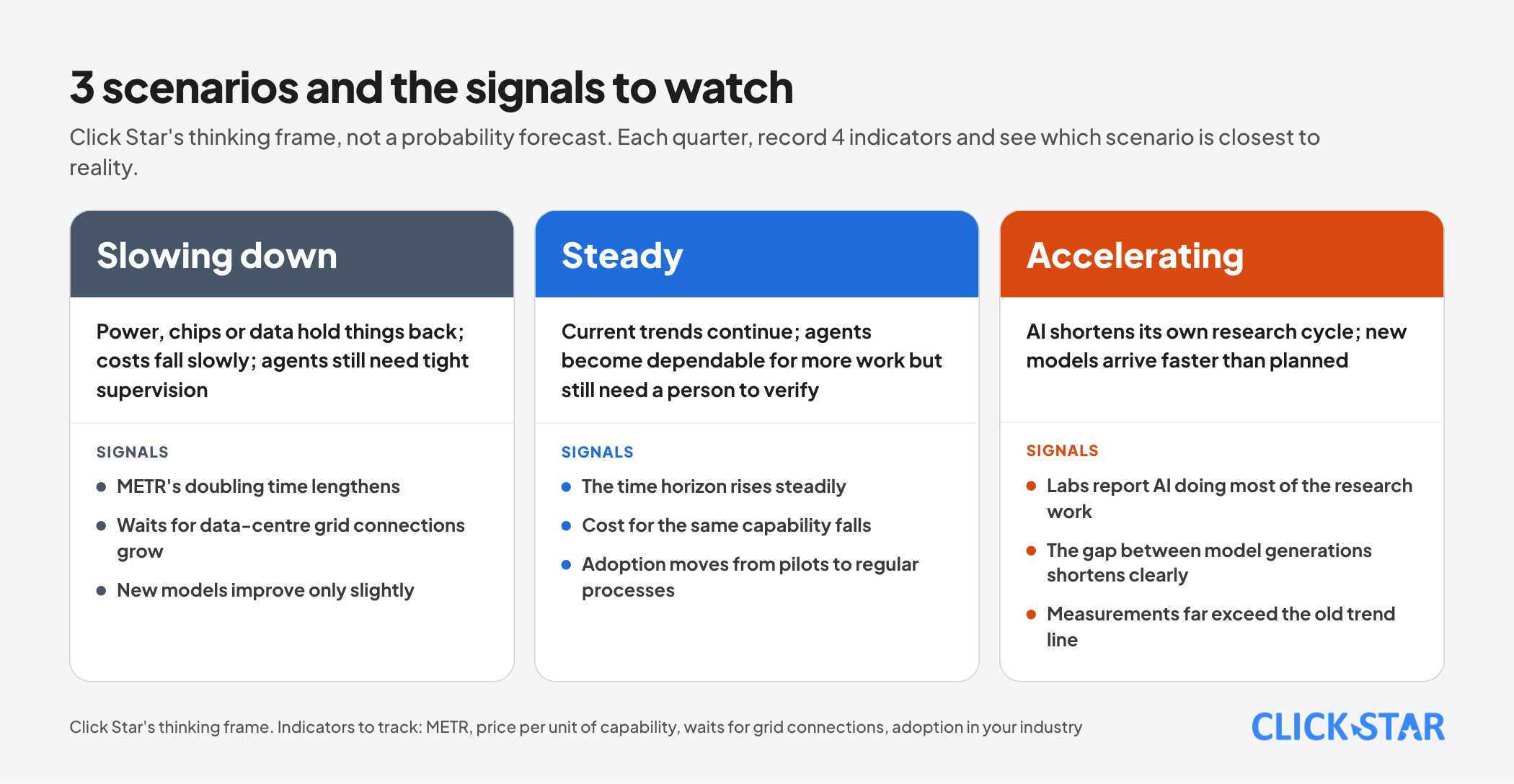
- Slowing down: power, chips or data hold things back, costs fall slowly, and agents still need tight supervision. Signals: METR's doubling time lengthens, waits for data-centre grid connections grow, new models improve only slightly on their predecessors.
- Steady: current trends continue, agents become dependable for more kinds of work but still need a person to verify. Signals: the time horizon rises steadily, cost for the same capability falls, adoption in companies moves from pilots to regular processes.
- Accelerating: AI shortens its own research cycle and new models arrive faster than planned. Signals: labs report that AI contributes most of the research work, and the time between model generations shortens clearly.
Tracking is simple: each quarter, record 4 indicators (METR's time horizon, price per unit of capability, waits for power infrastructure, and adoption in your own industry) and see which scenario is closest to reality.
What a business should do from now
The following help in all 3 scenarios:
- Clean and consolidate data. Every good AI application needs structured data with an owner and clear access. This is the lowest-risk investment.
- Automate repetitive work gradually, measuring before and after. Start with low-risk work, keep a person approving, and record the time actually saved.
- Build a verification culture. Define which work needs a person's approval, check sources and figures, and say who is finally accountable.
- Train against a skills framework. With about 40% of skills forecast to change, plan learning for each role instead of waiting until the role changes.
- Do not depend on one provider. Separate the model-calling layer from the rest, test with 2 or 3 models and keep your own test set to compare.
- Govern data and security from the start. Classify data, review the terms of AI services, and check personal data protection rules.
- Set aside budget for small experiments each quarter. Technology changes faster than the annual planning cycle, so you need a fixed amount to try and learn.
- Revisit assumptions every year. Write down what you believe about AI in 2030, then check it each year and correct it.
Related posts
Need tailored advice for your business?
Click Star helps you build a solution that fits your industry and scale. We answer every question during business hours.