AI development trends over the next 5 to 10 years: what has evidence, what is guesswork and what to do
Separates what has evidence, what is only extrapolation and what nobody knows about AI to 2036, with the arithmetic of why trends must bend, 6 long-term structures, 8 indicators and no-regret decisions.
Forecasts of AI to 2030 can still lean on trend lines that are being measured, but looking further to 2036, most numbers turn into guesses. This article does not promise a picture of 2036.
It does something different: it separates what has evidence, what is only extrapolation and what nobody knows, then identifies 6 long-term structures that businesses in Vietnam can prepare for without knowing the pace in advance.
The figures come from Anthropic's pricing documentation, Epoch AI's analysis, the International Energy Agency (IEA), METR's measurements, Microsoft's AI Diffusion report, the World Economic Forum (WEF), the International Monetary Fund (IMF) and other sources, checked as of October 20, 2026.
Click Star already has a separate article on AI to 2030 with scenarios and confidence levels; this one complements it and does not repeat it.
Key points
- Confidence drops fast with time: 2026 to 2028 can still rely on data that is running, 2029 to 2031 is the zone of scenarios, and 2032 to 2036 is almost only structural reasoning.
- Straight-line extrapolation gives absurd results, so any trend that holds must bend: at 4x per year growth in training compute (Epoch AI), 10 years gives a factor of about 1 million; at the 4.3-month doubling time of the "time horizon" (METR), 10 years gives about 28 doublings, roughly 250 million times.
- Electricity is the most visible constraint: Epoch estimates a training run of about 2e29 FLOP needs about 6 GW by 2030, and according to press coverage of the IEA's April 2026 report, data centre electricity demand grew 17% in 2025, far faster than the 3% growth of total electricity demand worldwide.
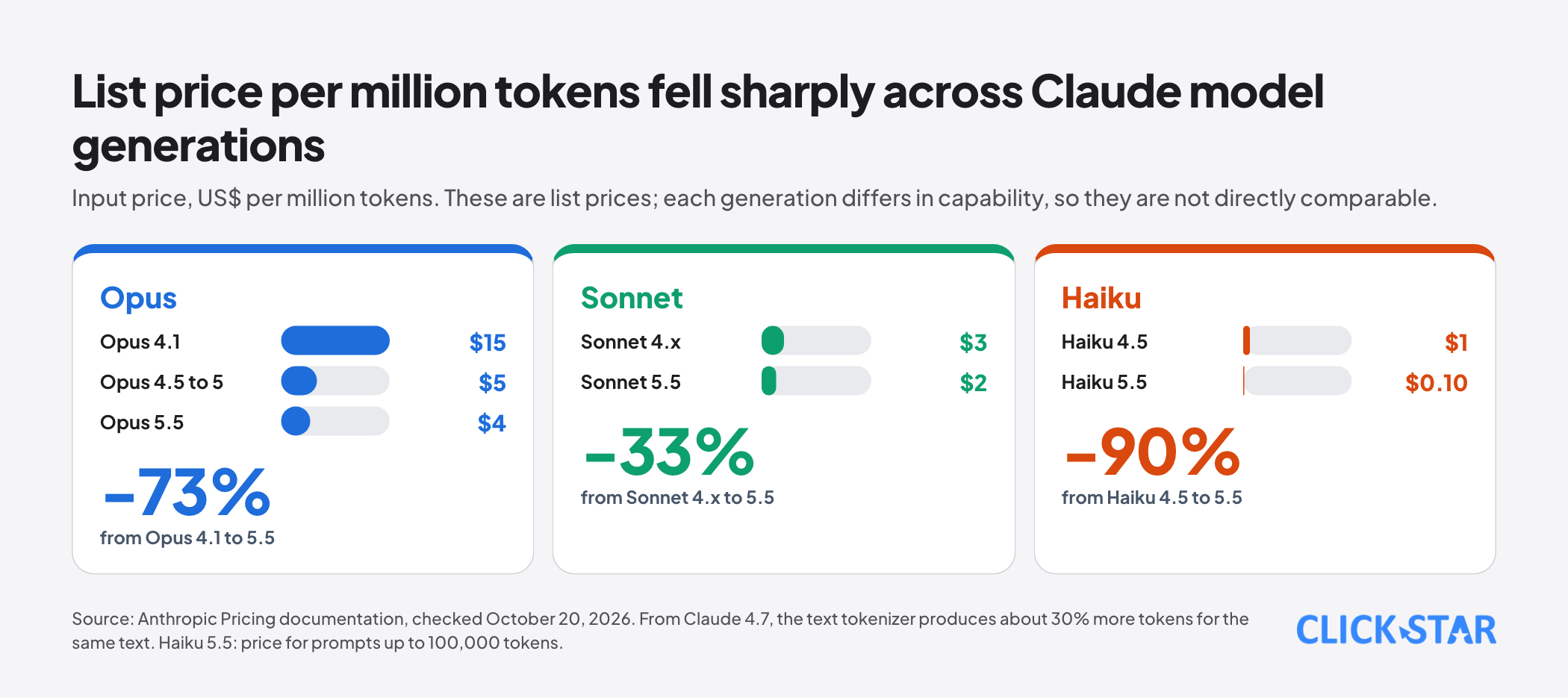
- The strongest evidence for the long term is price: according to Anthropic's price list, input pricing in the Opus tier fell from US$15 (Opus 4.1) to US$4 (Opus 5.5) per million tokens, and in the Haiku tier from US$1 (Haiku 4.5) to US$0.10 (Haiku 5.5), although each generation is not directly comparable in capability.
- Adoption is still low relative to capability: Microsoft estimates 18.8% of the world's population aged 15 to 64 used generative AI in June 2026, and 27.9% in Vietnam, so most of the economic impact has not happened yet.
- What to do now is "no-regret" decisions (clean data, consent, verification skills, measurement) instead of betting on one speed scenario.
Why 5 to 10 years is harder than 2030
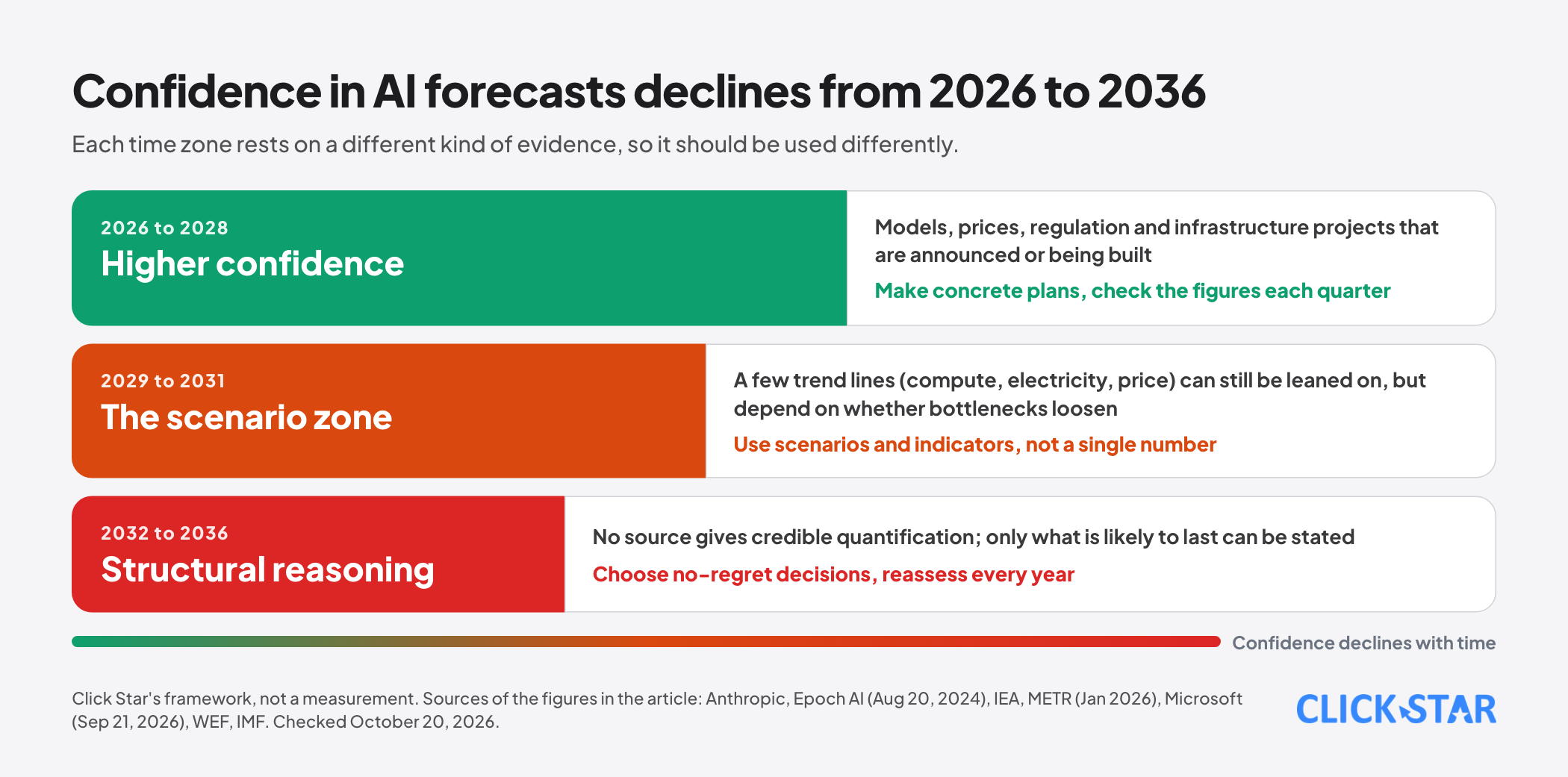
There are 3 zones with different confidence. Click Star uses this split so each judgment in the article is tied to a clear confidence level; it is Click Star's framework, not any source's.
- 2026 to 2028 (higher confidence): models, prices, regulation and infrastructure projects that are announced or being built. Measured data can be checked every quarter.
- 2029 to 2031 (the scenario zone): a few trend lines (compute, electricity, price) can still be leaned on, but they depend on whether the constraints loosen. Click Star's article on AI to 2030 covers this zone in detail.
- 2032 to 2036 (structural reasoning): Click Star found no source giving credible quantification for this period. What can be said is structural: what is likely to last (falling prices, electricity as a limit, maturing regulation), not specific numbers.
One caution from the sources themselves: Epoch AI's analysis of scaling to 2030 was published on August 20, 2024, so it is 2 years old; newer updates should be checked before relying on its specific numbers.
The arithmetic shows why straight lines must bend
This is Click Star's illustrative arithmetic based on the sources' numbers; it is not a forecast.
Training compute. Epoch AI records training compute growing about 4x per year and concludes that training runs of about 2e29 FLOP are likely feasible by 2030, with electricity the first constraint to bite (about 6 GW for a run of that size).
If the pace of 4x per year continued for another 6 years from 2030 to 2036, the factor is 4 to the power of 6, about 4,096. If the electricity for a single run kept doubling every year, 6 GW in 2030 becomes about 384 GW in 2036.
Against the electricity of the whole sector. The IEA (Energy and AI report, April 2025) estimates the electricity of all the world's data centres at about 945 TWh in 2030. Divided by the 8,760 hours in a year, that is about 108 GW of average power.
A single training run of 384 GW would be about 3.5 times all the world's data centres in 2030, which is hard to imagine. Conclusion: a doubling every year for electricity cannot continue to 2036; either compute efficiency must rise sharply, or the pace must slow.
The length of work AI can do. METR estimates (Time Horizon 1.1, January 2026) that the time horizon doubles about every 130.8 days, or 4.3 months, since 2023 (wide error bars, mostly software work, 50% reliability).
Taking a "4-hour horizon" as an example, 10 years holds about 28 doublings (about 250 million times), multiplied by 4 hours gives about 1 billion hours, equal to about 110,000 years of work. Nobody treats that as a forecast; it shows that this rate of growth will certainly slow or stop being measurable by today's yardstick.
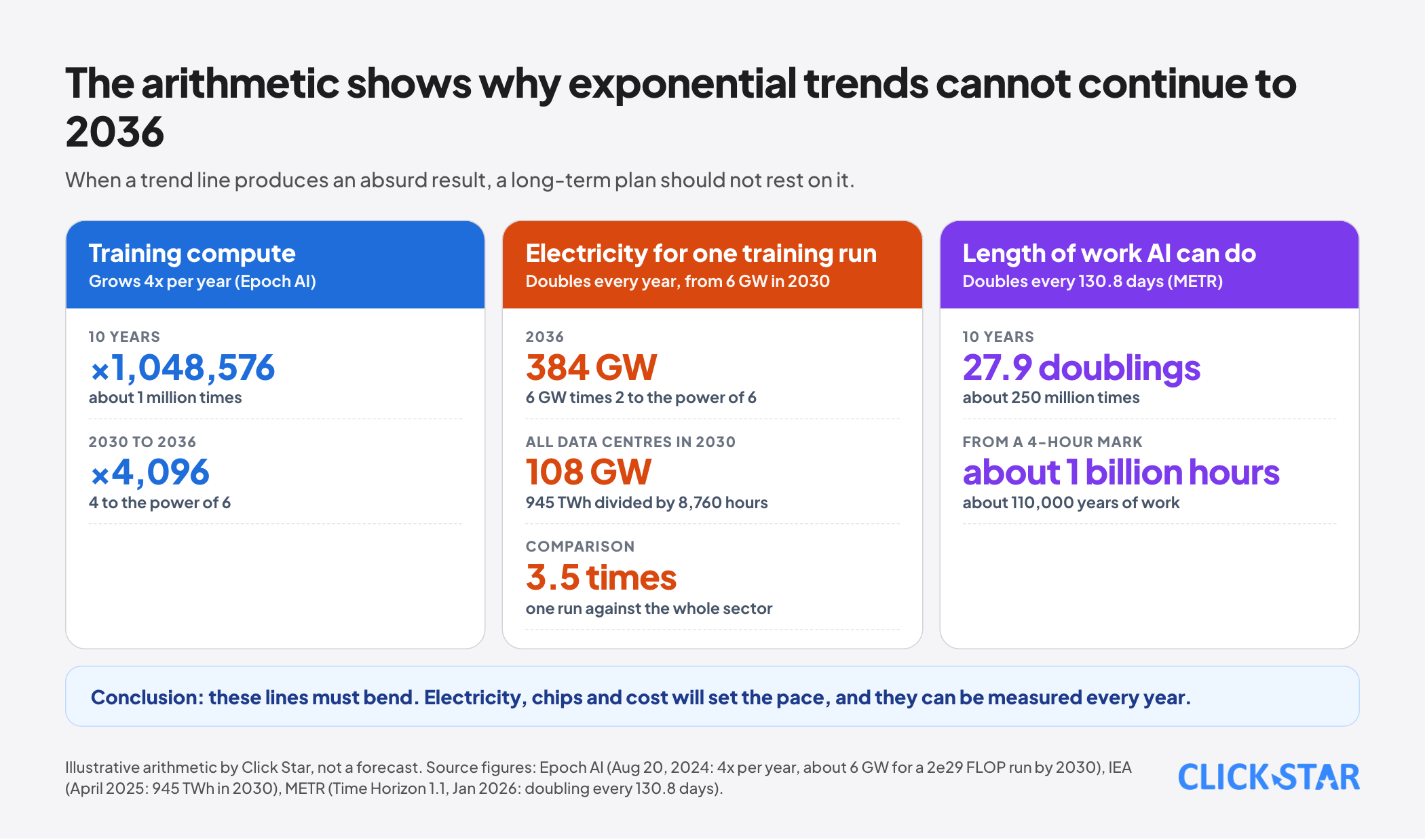
Click Star's view. The lesson is not "AI will stop" but this: when a trend line produces an absurd result, a long-term plan should not rest on it. What is more reliable is that physical and economic limits (electricity, chips, cost) will set the pace, and those limits can be measured every year.
The strongest evidence for the long term: falling prices
The current list prices in Anthropic's documentation show a clear trend. Opus tier: Opus 4.1 is US$15 input and US$75 output per million tokens; Opus 4.5 through 4.8 and Opus 5 are US$5 and US$25; Opus 5.5 is US$4 and US$20. Sonnet tier: Sonnet 4.x is US$3 and US$15; Sonnet 5.5 is US$2 and US$10.
Haiku tier: Haiku 4.5 is US$1 and US$5; Haiku 5.5 is US$0.10 and US$0.50 for prompts up to 100,000 tokens (above that the price is higher). On that basis, Opus-tier input pricing fell about 73% from Opus 4.1 to Opus 5.5, and the Haiku tier fell 90% from 4.5 to 5.5.
The limits need to be read correctly.
These are list prices, not the real cost of a task; each generation differs in capability so they are not directly comparable; Anthropic states that the newer text tokenizer from Claude 4.7 produces about 30% more tokens for the same text, so the token count for a task can rise even when the price per token falls; and this is one provider's data.
Even so, the direction (the same capability tier getting much cheaper across generations) is consistent with the most credible structural assumption for the long term: AI gradually becoming a utility service with cheaper unit prices.
Adoption: most of the impact has not happened yet
Microsoft (AI Diffusion report for Q2 2026, published September 21, 2026) estimates 18.8% of the world's population aged 15 to 64 used generative AI in June 2026, up about 1 percentage point from Q1; Vietnam is at 27.9% (per Vietnamese press coverage of the report).
The Stanford AI Index 2026, as cited in Click Star's article on AI to 2030, records 88% of organizations having adopted AI, but the effect on economy-wide productivity is still being measured.
That means that in the next 5 to 10 years, most of the "spreading" has not happened yet; users' skills, processes and data will decide who benefits.
On jobs, the World Economic Forum (Future of Jobs 2025, January 2025, a survey of more than 1,000 large employers) estimates that by 2030 there will be 170 million new roles and 92 million displaced roles, a net gain of 78 million, with about 22% of jobs disrupted.
The IMF (January 2024) estimates about 40% of jobs worldwide and 60% in advanced economies are exposed to AI, where "exposed" means changed, not eliminated. These are estimates for 2030 or measures of exposure, not forecasts for 2036.
6 long-term structures worth preparing for (2031 to 2036)
Each structure below carries Click Star's confidence level based on the evidence available.
- AI becomes infrastructure that gets cheaper (high confidence in direction). The price per unit of capability falls across generations as above. Consequence for businesses: avoid long-term commitments to one provider or one model; prefer an architecture where the model can be swapped.
- Longer tasks handed to agents, responsibility still with people (medium). The time horizon is growing, but the yardstick is narrow and the error bars wide. Consequence: invest in delegation, verification and logging processes instead of waiting for "AI to do it all".
- Electricity, chips and networks shape who can run what (medium to high). Epoch and the IEA both show this is the bottleneck. Consequence for Vietnam: most businesses will use cloud services; cost and data location become criteria for choosing a provider.
- Small, open and local-language models move closer to users (medium). Microsoft records open-weight models taking a growing share of API token volume, and says they may lower costs and support local languages, but infrastructure, connectivity and skills remain barriers. Consequence: running part of the sensitive work where the data sits is a practical option.
- Regulation and trust become conditions of operation (high in direction, low in detail). Vietnam has the Law on Artificial Intelligence No. 134/2025/QH15 (passed December 10, 2025, in force March 1, 2026, a framework with 3 risk tiers) alongside the Law on Personal Data Protection; according to law firm summaries, many details await implementing documents. Consequence: prepare data records, consent and AI-use logs in advance; check the original text when guidance is issued.
- Skills shift from doing to delegating, verifying and judging (medium to high). The WEF records about 40% of needed skills changing by 2030. Click Star has an article on 7 skills for using AI for this group. Consequence: training is the longest-lived investment.
What nobody knows
- The pace after 2030: Click Star found no credible research quantifying 2032 to 2036, and current trend lines must bend as shown above.
- The definition and timing of "general AI" (AGI): organizations use different definitions so year-markers are not comparable; Click Star gives no year.
- The conversion of capability into economy-wide productivity: model capability is rising faster than businesses are reorganizing their processes.
- The impact on each industry and role in Vietnam: the large studies measure other markets; Click Star could not verify an equivalent measurement for Vietnam.
What businesses should do: no-regret, options, bets
Click Star splits decisions into 3 kinds (Click Star's framework).
- No-regret (do now, useful in every scenario): clean customer and operating data with consent; training in delegation and verification skills; measuring results on real work; choosing an architecture that allows swapping models.
- Options (small investments to keep the ability): trial agents on one low-risk process; trial a small or open model for sensitive work; track the 8 indicators each year.
- Bets (only with a clear reason, accepting the loss): putting the whole core process on one provider or one speed scenario; buying multi-year capacity commitments.
A suggested path: 2026 to 2028 build the foundation (data, consent, skills, measurement, small trials); 2029 to 2031 scale the processes that proved themselves and review the architecture against price and infrastructure; 2032 to 2036 reassess from scratch by the indicators, not keeping the old plan just because it was made.
8 indicators to track every year
- The list price per million tokens in the model tier you use (and the real tokens per task).
- The doubling time of the time horizon (METR) and the published error bars that go with it.
- Growth in data centre electricity demand against total electricity demand (IEA).
- The share of generative AI users in Vietnam and worldwide (Microsoft AI Diffusion).
- The share of businesses adopting AI in your size group (statistical surveys).
- The number of implementing documents for the Law on Artificial Intelligence and the transition deadlines that apply to you.
- The share of your own tasks that AI does at an acceptable level, measured with your own test set.
- AI cost against revenue or against each unit of work in your business.
Common mistakes
- Taking a short-term trend line and stretching it straight out to 10 years.
- Treating one analyst's year-marker as fact, especially markers about AGI.
- Making long-term commitments to one provider while prices and capability change every quarter.
- Waiting for "AI to be good enough" before starting, instead of building skills and data now.
- Ignoring electricity, cost and data location when choosing a solution.
- Generalizing job figures from other markets into a forecast for Vietnam.
- Not reviewing the plan each year against the indicators.
Related posts
Need tailored advice for your business?
Click Star helps you build a solution that fits your industry and scale. We answer every question during business hours.