6 sales and customer care processes to automate first
6 processes to automate first, chosen by 5 criteria, with published evidence and its limits, the Zalo ZBS, SMS and email channels under Vietnamese rules, the guardrails and a 30-day plan.
Automating sales and customer care easily starts wrong in one place: choosing a process because the tool can do it, not because the process is costing the business money. The result is often many processes running in the background, duplicate messages, annoyed customers and nobody knowing whether any of it works.
This article proposes 6 processes to automate first, chosen by 5 criteria: frequent, rule-based, time-sensitive, low-risk and measurable. Each has published evidence (with its limits), the sending channel in Vietnam and how to measure it.
Sources include Harvard Business Review, a Cochrane review, the Baymard Institute, documentation from Zalo, HubSpot, Zapier and Make, and Decree 91/2020/NĐ-CP, read on October 21, 2026.
Most of the evidence is from abroad and many figures are vendors', so the article gives no expected rates. Measure with your own control group. The legal part rests on summaries and needs checking against the original text.
Key points
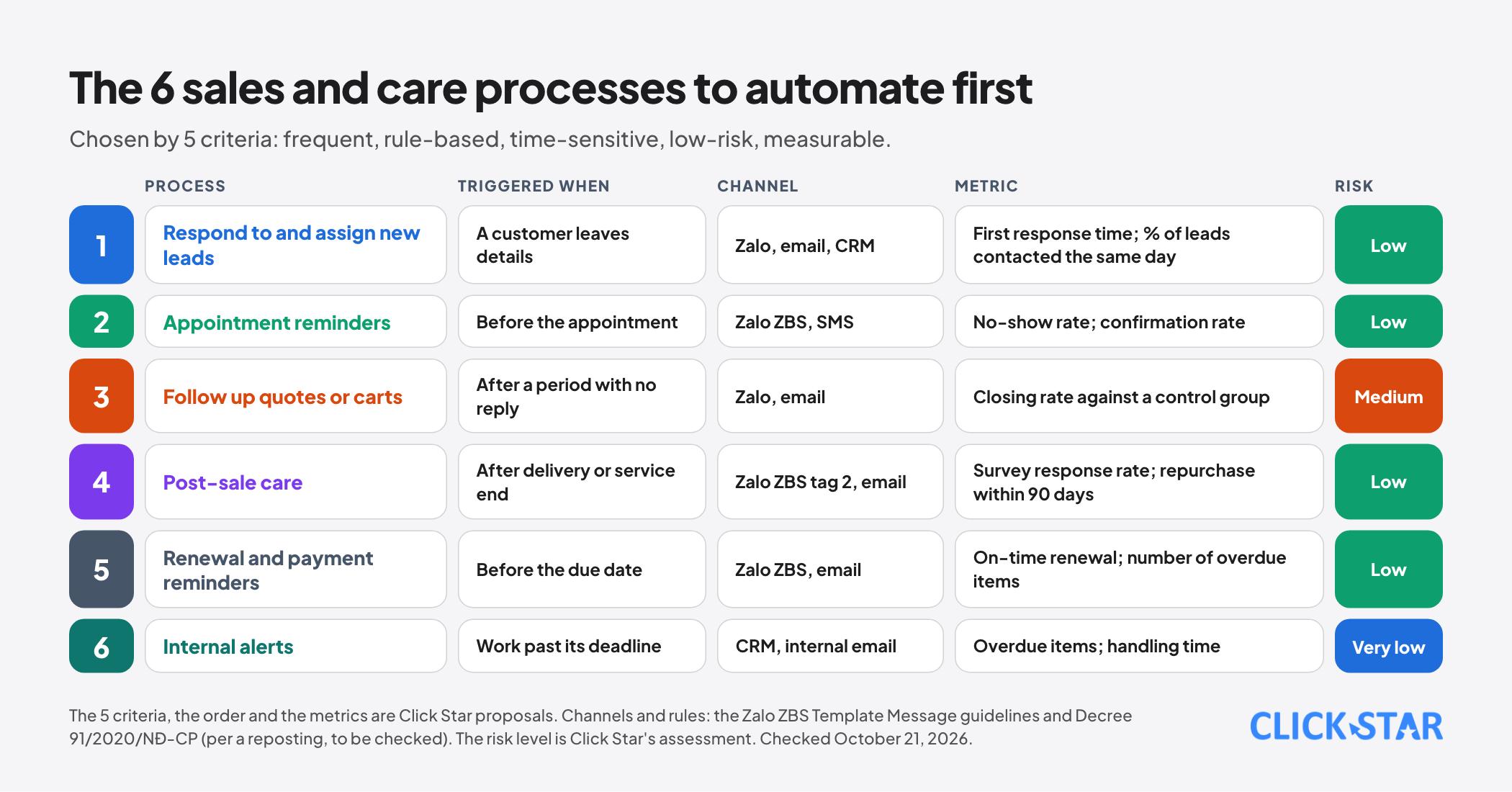
- The 6 processes to do first: responding to and assigning new leads, appointment reminders, following up unanswered quotes or carts, post-sale care, renewal and payment reminders, and internal alerts when work is overdue.
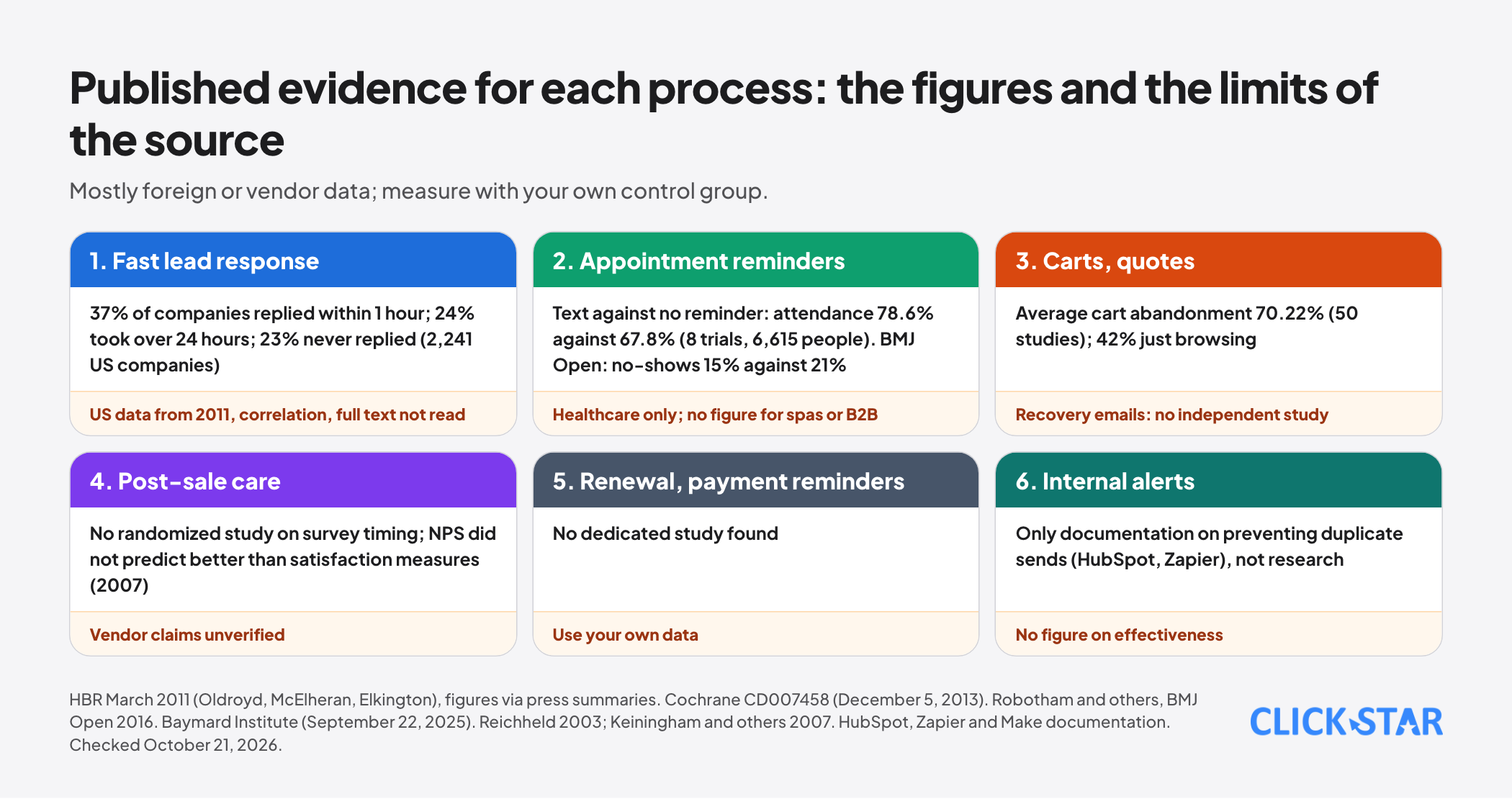
- An HBR study (March 2011) of 2,241 US companies found only 37% replied to a lead within 1 hour and 23% never replied. This is US data from 2011 and shows only correlation.
- A Cochrane review (2013) of text-message appointment reminders: attendance rose from 67.8% to 78.6%. The evidence is in healthcare only, and there is no equivalent figure for spas, B2B or sales appointments.
- The Baymard Institute records an average cart abandonment rate of 70.22% (50 studies, 2006 to 2025), but many people are just browsing. There is no independent study of the incremental effect of recovery emails.
- Zalo ZBS messages and advertising SMS and email in Vietnam have their own rules: templates must be approved by Zalo, care messages may not upsell, and advertising messages need prior consent.
- The most important guardrails: prevent duplicate sends, stop the process once the customer has replied, have people to take over, and measure with a control group.
Choose processes by 5 criteria
A process is worth automating first when it meets most of the 5 criteria below. This is Click Star's filter.
- Frequent, at least several dozen times a month.
- Rule-based, needing no human judgment.
- Time-sensitive: a day's delay loses the opportunity or annoys the customer.
- Low risk if sent wrongly, with a route to a person.
- Measurable with a specific metric.
Processes that need judgment (negotiating prices, handling tense complaints) should be left to people, with automation used only to prepare information for them.
6 processes to automate first
1. Respond to and assign a new lead right away
When a customer leaves details, the system sends a confirmation immediately (by Zalo, email or message), creates a CRM record and assigns it to an owner by rule (round-robin, by area, by product).
Evidence: the article by Oldroyd, McElheran and Elkington (HBR, March 2011) tested 2,241 US companies and recorded 37% replying within 1 hour, 24% taking more than 24 hours and 23% never replying. According to press summaries, across 1.25 million leads, contact within 1 hour was about 7 times more likely to qualify the lead than waiting 1 more hour.
Click Star could not read the full article and this is US data from before 2011.
A study by InsideSales (presented October 17, 2007) said contact within 5 minutes against 30 minutes gave about 100 times the odds of reaching the lead. That is vendor data, often wrongly credited to MIT, and 19 years old. Click Star does not use those multipliers as promises.
How to measure: time from the customer leaving details to the first human reply, and the share of leads contacted the same day.
2. Remind customers of appointments and consultations
Send a reminder before the appointment with a one-step way to confirm or reschedule.
Evidence: the Cochrane review (Gurol-Urganci and others, December 5, 2013) pooled 8 randomized trials with 6,615 participants. Text reminders against none gave a risk ratio of 1.14 (95% confidence interval 1.03 to 1.26), with attendance of 67.8% against 78.6%. Text and phone-call reminders did not differ (80.3% with calls), but texts cost 55% to 65% less per attended appointment.
Another review (Robotham and others, BMJ Open 2016) of about 8,300 patients with reminders and 7,700 without recorded that reminded patients were about 23% more likely to attend (67% against 54%) and missed less (15% against 21%); multiple reminders did better than one.
Limits: the evidence is only in healthcare, the Cochrane authors say it is not yet enough to decide policy, and there is no data for spas, B2B or sales appointments. How to measure: the no-show rate, the confirmation or reschedule rate.
3. Follow up unanswered quotes or carts
After a period the business sets (for example 2 days for a quote, a few hours for a cart), send one reminder, then stop if the customer has replied.
Evidence: the Baymard Institute (updated September 22, 2025) calculates an average cart abandonment rate of 70.22% from 50 studies published between 2006 and 2025, ranging from about 55% to 84.27%. Baymard notes that many people are just browsing: in a US survey, 42% said they were only looking. Other reasons include extra costs (40%), forced account creation (18%) and a checkout that is too long (17%).
On recovery emails, Click Star found no independent or peer-reviewed study measuring the incremental effect. Vendor figures conflict (from about 3% to 31.6%). Measure with a control group: a share of customers receive no reminder, then compare closing rates.
4. Post-sale care: thanks, guidance, survey
After delivery or when a service ends, send a thank-you, usage guidance and one short survey question.
Evidence on the best survey timing: Click Star found no rigorous randomized study, and vendor claims (such as "1 to 3 days after delivery" or "a 40% lift") are unverified. On NPS, Reichheld (HBR, 2003) argued that a 12-point rise roughly doubled growth, but Keiningham and others (Journal of Marketing, 2007) did not find NPS to predict better than satisfaction measures.
How to measure: survey response rate, the share of customers returning or repurchasing within 90 days, the number of complaints caught early.
5. Renewal and payment reminders
Send reminders before a contract renewal date, a warranty expiry or a payment deadline, with a one-step way to pay. This is a transactional kind of message, rarely annoying when on time.
How to measure: on-time renewal rate, average days from due date to payment, the number of overdue items.
6. Internal alerts when work is overdue
Send alerts to the owner and the manager when a lead has had no contact after a set time, a deal has no next step, a ticket is overdue, or a record is duplicated. This process sends nothing to customers so the risk is low, and it keeps the other 5 processes running on clean data.
How to measure: the number of overdue items each week, and the average time to handle an alert.
Sending channels and rules in Vietnam
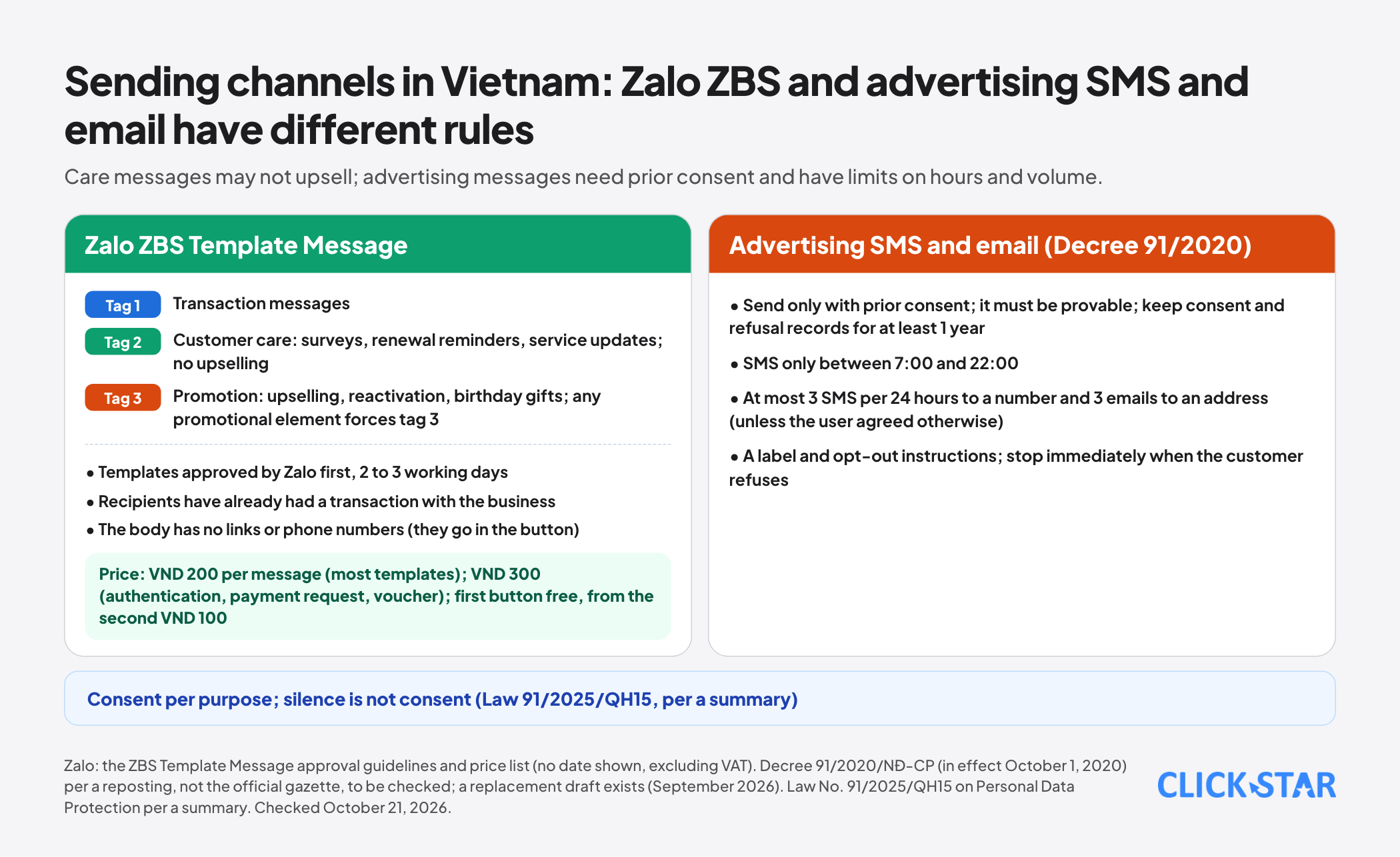
Zalo ZBS Template Message. According to Zalo's guidelines, every template is approved by Zalo before sending (2 to 3 working days). Tag 1 is transaction messages. Tag 2 is customer care (surveys, renewal reminders, service updates) and may not upsell. Tag 3 is promotion (upselling, reactivation, birthday gifts); any promotional element forces tag 3.
Recipients must be people who have already had a transaction with the business. The message body may not contain links or phone numbers (these go in the button), and vouchers must use the voucher template.
The official price page (no effective date shown, excluding VAT) lists VND 200 per message for most templates and VND 300 for authentication, payment-request and voucher templates; the first button is free and each button from the second is VND 100. A worked example: 1,000 appointment reminders a month at VND 200 is VND 200,000, excluding VAT.
Advertising SMS and email. According to a reposting of Decree 91/2020/NĐ-CP (in effect October 1, 2020; not the official gazette, so check it), advertising messages, emails or calls may be sent only with prior consent, and the advertiser must be able to prove it and keep consent or refusal records for at least 1 year.
SMS may be sent only between 7:00 and 22:00, and each advertiser sends at most 3 SMS per 24 hours to a number and 3 emails to an address (unless the user agreed otherwise).
Advertising messages must carry a label and opt-out instructions, and the advertiser must stop immediately when the customer refuses. The Ministry of Public Security has posted a comparison draft from September 2026 of a replacement decree; Click Star saw no sign it has been issued, so it needs watching.
Consent per purpose. According to a summary of the Law on Personal Data Protection No. 91/2025/QH15 (in effect January 1, 2026), consent must be per purpose and silence is not consent. Small businesses are exempt from some duties for 5 years but not from the duties on consent. Check the original text.
Guardrails for automation
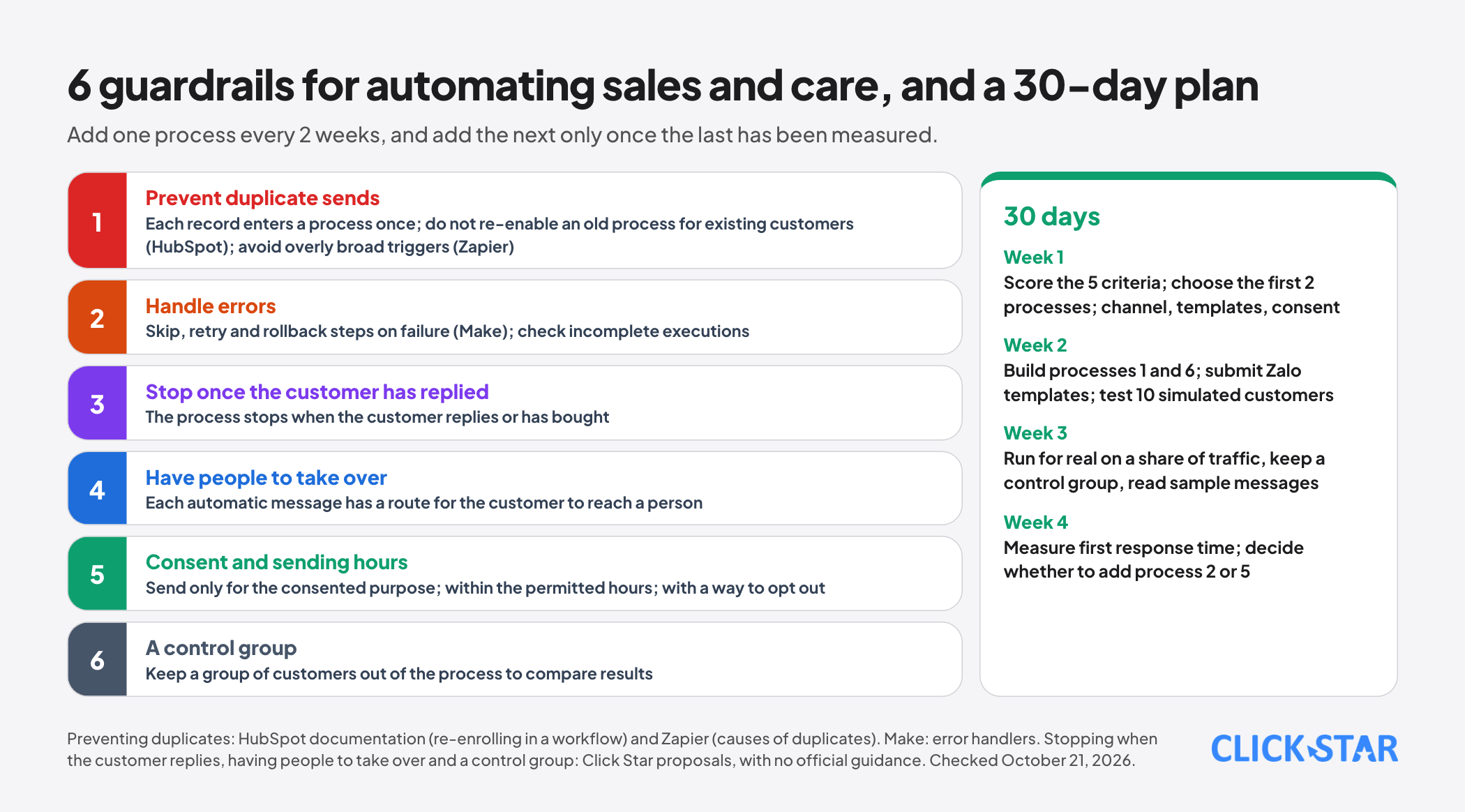
Prevent duplicate sends. According to HubSpot's documentation, by default a record enrolls in a workflow only once, but switching on re-enrollment for an old workflow can cause repeat sends, so HubSpot suggests choosing "don't enroll existing records," especially for workflows that send SMS.
Zapier lists the causes of duplicates: static values, triggers that are too broad, several automations on the same trigger, an automation that triggers itself, and replaying after a timeout.
Error handling. Make has error handlers (skip, resume, commit, rollback, retry) and retry stores incomplete executions. Click Star found no official Make guidance on preventing duplicate sends.
Stop when the customer has replied, and have people to take over. These 2 are Click Star's advice; there is no official guidance from HubSpot, Zapier or Make. A process should stop when the customer replies, and each automatic message needs a route for the customer to reach a person.
Measure with a control group. Keep a group of customers out of the process to compare results. Without a control group, any improvement could be seasonality.
Click Star's view. Start with processes 1 and 6: they carry the least risk and show the bottlenecks immediately. Add one process every 2 weeks, and only add the next once the last has been measured.
A 30-day plan
- Week 1: list the processes done by hand, score them on the 5 criteria, choose the first 2; settle the channel, message templates and consent.
- Week 2: build process 1 (lead response) and 6 (internal alerts); submit the Zalo templates for approval; test with 10 simulated customers.
- Week 3: run for real with a share of traffic, keep a control group, read a sample of sent messages, fix duplicate sends.
- Week 4: measure first response time and the share of leads contacted the same day; decide whether to add process 2 or 5.
What is not known
Click Star has no data on how effective these automated processes are at Vietnamese businesses. The reminder evidence is only in healthcare, the response-speed evidence is American, and there is no independent study of cart-recovery emails.
Zalo's sending hours and content policy have not been verified from a primary source. The rules on brand-name SMS were not read. Decree 91/2020 has a replacement draft.
Common mistakes
- Automating a process that needs judgment, such as handling a tense complaint.
- Not stopping the process when the customer has replied, so customers get reminders after they have already bought.
- Re-enabling an old workflow and re-sending to customers who already received it.
- Using a care message to upsell, so it is refused approval or breaks template rules.
- Sending advertising without consent, or outside the permitted hours.
- Having nobody to take over when a customer replies to an automatic message.
- Having no control group, so not knowing whether the process really works.
Related posts
Need tailored advice for your business?
Click Star helps you build a solution that fits your industry and scale. We answer every question during business hours.