Are your ads profitable? 3 numbers to check before raising your budget
What CAC, ROAS and LTV say about ad profit, where they mislead and how to set your own break-even line. Based on Google Ads and Google Analytics 4 documentation.
Picture an online shop that spends 10 million VND on ads, sees a ROAS of 300% in its report and doubles the budget. At month end, the bank balance is thinner. This is a hypothetical case, but many businesses will recognize it.
This article explains CAC, ROAS and LTV: how to calculate them, where they mislead and how to set your own break-even threshold. Main sources: Google Ads Help, Google Analytics 4 documentation and Google developer documentation, checked on October 24, 2026.
Click Star already has articles on Meta ad reports, GA4, UTM and weekly marketing reports.
Key points
- ROAS is conversion value divided by ad cost. Google Ads calls it an estimate of return on investment, not profit: if the value is revenue, cost of goods, fees and refunds are not deducted.
- Break-even ROAS equals 1 divided by gross margin (what is left of each unit of revenue after cost of goods, fees and refunds). A 30% margin breaks even at a ROAS of 3.33 (333%), an illustrative example.
- CAC must be divided by NEW customers and should include costs beyond ad spend. The cost-per-conversion column may already count repeat buyers.
- LTV has at least 2 meanings: forecast profit (per Wikipedia) and revenue minus refunds (GA4's way). State which you use.
- The latest days are often incomplete, because customers buy some time after clicking. The default conversion window is 30 days.
- There is no common standard for a "good" CAC or ROAS. Calculate your own break-even threshold and raise the budget in steps, measuring after each conversion cycle.
What CAC, ROAS and LTV are
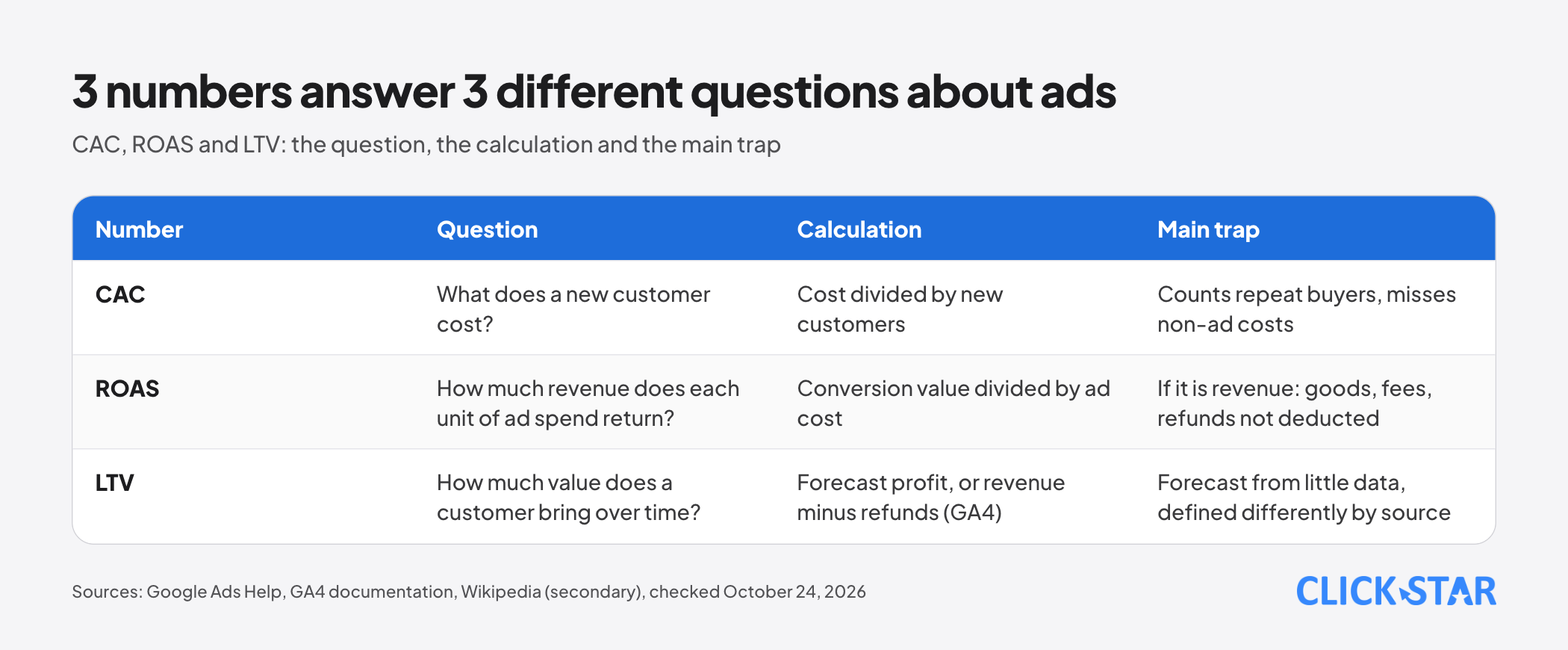
CAC (Customer Acquisition Cost) is what it costs to win a new customer. ROAS (Return On Ad Spend) is the revenue each unit of ad spend brings back. LTV (Lifetime Value) is the value a customer brings over their whole buying relationship.
For ROAS, Google Ads Help says the "Conv. value / cost" column estimates return on investment: total conversion value divided by the total cost of all ad interactions. The Target ROAS page gives an example: selling 5 USD for every 1 USD of ads is a ROAS of 500%.
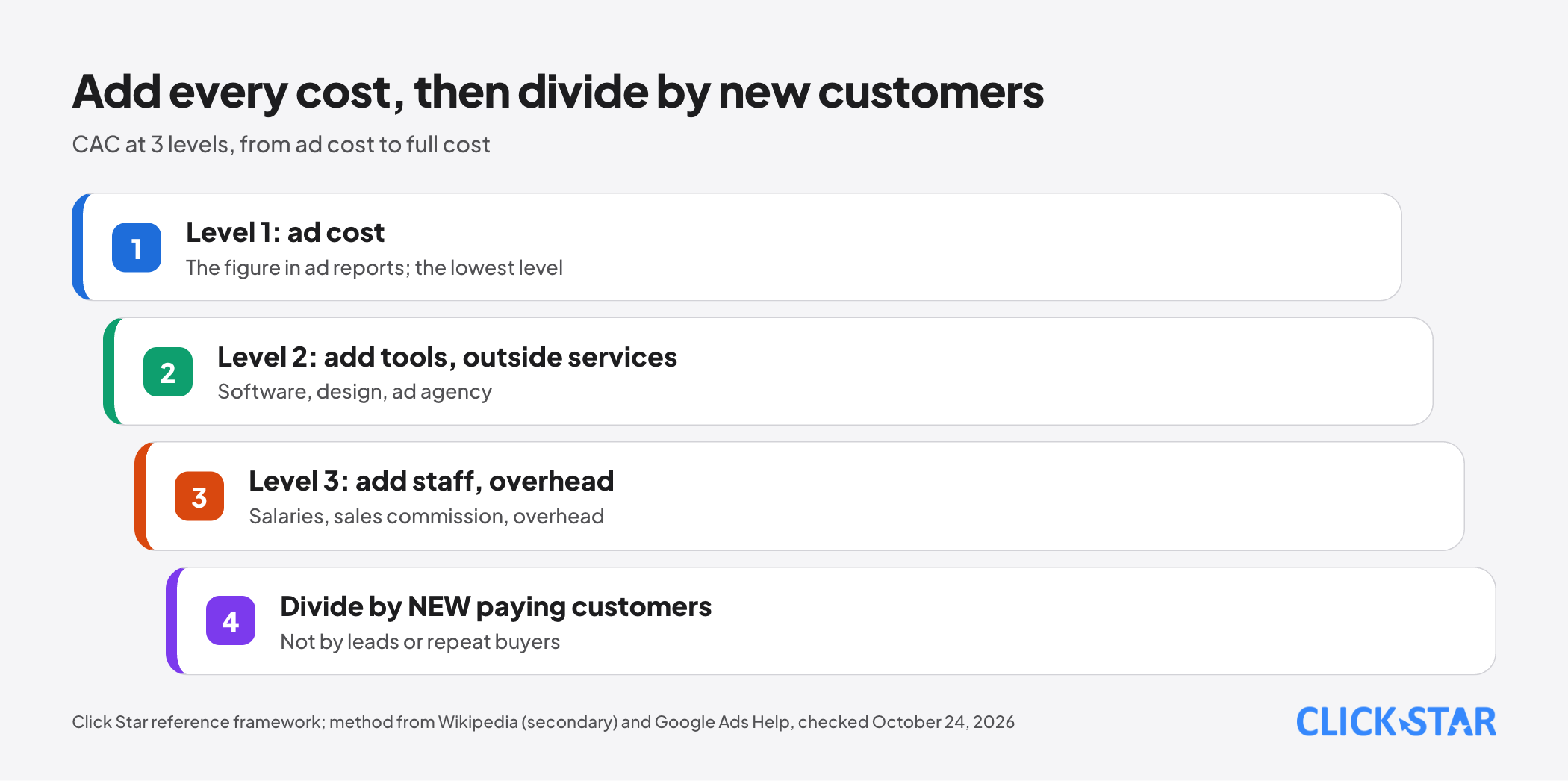
Click Star found no CAC definition in Google's official documentation. According to Wikipedia (a secondary source), the simple method divides marketing cost for winning new customers by the customers won in the same period. The full method adds salaries, software, outside services and overhead.
Wikipedia (a secondary source) describes LTV as an estimate of the net profit a customer contributes over the whole relationship, and an upper limit on what to spend to win that customer. GA4 documentation instead defines LTV as purchase revenue minus refunds, which is not profit.
Does a high ROAS mean a profit
Not necessarily. When the value is revenue, ROAS only compares revenue with ad spend. It knows nothing about cost of goods, shipping, payment fees or refunded orders.
Google Ads' "Do the math" page counts cost as ad spend plus the business's overhead, and minimum profit as revenue minus cost.
Conversion value is also only as accurate as the number you report. According to the "About conversion values" page, the value can be revenue or profit margin. Without code that sets a value per transaction, a single default value is applied to every conversion.
For GA4 websites, the developer documentation (updated September 16, 2026) says the value of a purchase event is price times quantity, excluding shipping and tax. The "Analytics dimensions and metrics" page (no date shown) separates Purchase revenue, which subtracts refunds, from Gross purchase revenue, which does not.
For GA4 to record refunds, the website must send a refund event with the transaction ID (GA4 developer documentation, updated September 16, 2026). Click Star's inference: if the value is sent at checkout, later cancellations need to be adjusted, or ROAS will look higher than reality.
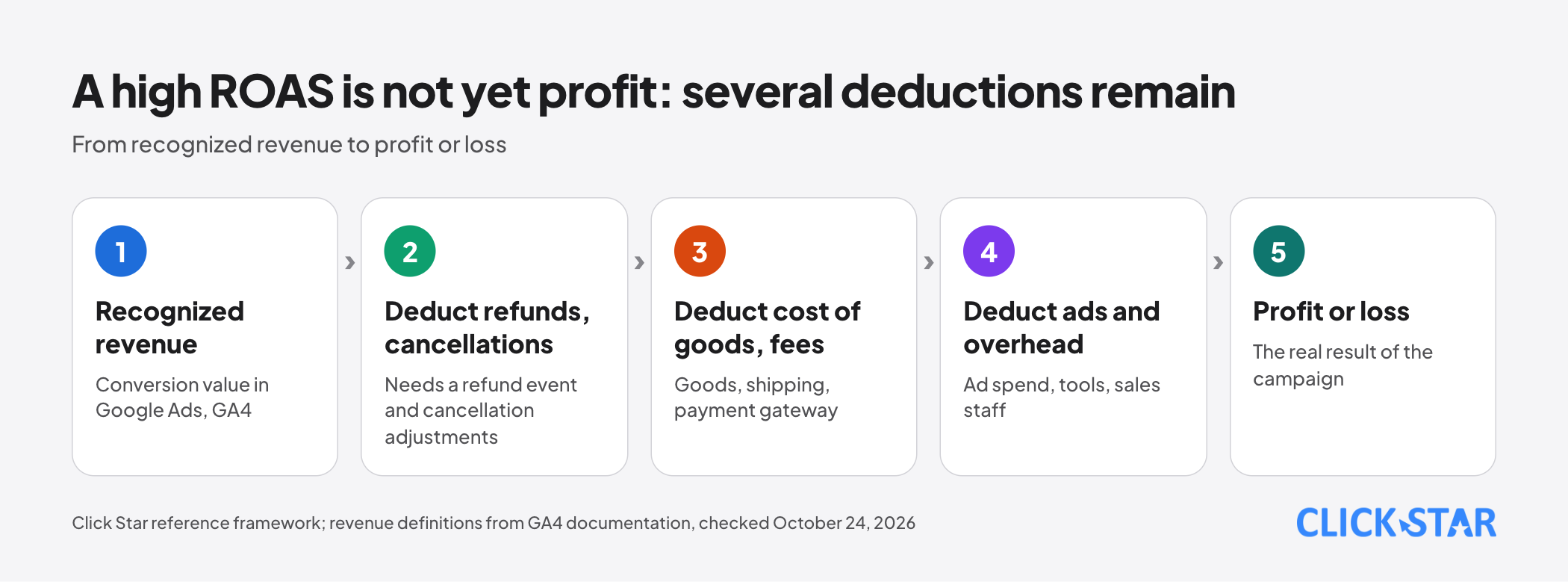
This gives an arithmetic threshold: break-even ROAS on a first order equals 1 divided by gross margin, what is left of each unit of revenue after cost of goods, fees and refunds. This margin also deducts fees and refunds, so it is lower than a book margin that deducts only cost of goods.
Illustrative example, not a measurement: a 30% margin gives 1 divided by 0.3, a ROAS of 3.33 (333%). At that margin, the ROAS of 300% in the opening case still loses money on the first order.
CAC: divide by new customers and count every cost
Cost per conversion is not CAC. According to the "Understand your conversion tracking data" page, that column is total cost divided by conversions, and conversions can include conversions estimated by models.
The "Every" counting setting counts each purchase. Click Star's inference: a returning customer's second order is another conversion, so the ratio comes out below the real CAC.
To separate new customers, GA4 documentation offers a customer_type parameter on the purchase event with the values new or returning, with a recommended window of 540 days.
If you sell through consultation, the count is usually leads (people who left their details), not paying customers. Google Ads has "qualified lead" and "converted lead" goals for leads confirmed outside Google Ads, for example in a CRM. Divide CAC by closed customers, not leads.
LTV: the easiest number to get wrong, because it is a forecast
According to Wikipedia (secondary), the compact LTV formula needs 3 assumptions: constant margin, constant retention and a discount rate. Retention has a strong effect. Click Star's inference: a business measured for only a few months can hardly test these assumptions.
GA4's "User lifetime" exploration technique has limits: lifetime data exists only for users active after August 15, 2020, and the end date is fixed at yesterday.
Click Star's reference framework, not from outside sources: instead of forecasting, track the value actually collected. Take a month's new customers and add up the gross profit they generate after 30, 90 and 180 days.
The latest days are often incomplete
According to the "About conversion windows" page, a conversion window is the period after an interaction in which a conversion is still recorded. Defaults are 30 days for clicks, 3 days for engaged video views and 1 day for views only.
Google Ads reports conversions by the date of the ad click. The page on conversion lag reporting says this can make CPA (cost per conversion) look high and ROAS look low.
So do not conclude from the last 3 days. Compare periods past a full conversion cycle (the time from click to purchase for most customers).
Tools also disagree: according to the "Understand your conversion tracking data" page, Google Ads and Google Analytics differ in attribution and dating, so gaps of up to about 20% can be expected; that is a high level Google cites, not typical.
Set a break-even threshold for your own business
There is no common standard for a "good" CAC or ROAS. Wikipedia (secondary) cites an LTV to CAC ratio of 3:1 as good, but Click Star found no primary source confirming it and does not use it as a standard.
Click Star's reference framework, not from outside sources, has 3 thresholds. Break-even ROAS on a first order is as above. Maximum CAC equals the average gross profit a new customer generates within a payback period you choose, for example 90 days. Raise the budget only while full CAC stays under that line.
A fully hypothetical example, not a measurement: price 1 million VND, gross profit 300,000 VND per order, 10 million VND of ad spend and 30 new customers. The same campaign through 4 lenses:
- ROAS: 30 million VND of revenue divided by 10 million VND is 3.0 (300%), below the 3.33 threshold.
- First order: gross profit on 30 orders is 9 million VND, so the loss is 1 million VND.
- After 90 days, suppose 9 customers buy once more: 2.7 million VND extra, 11.7 million VND in total, a 1.7 million VND gain over ad spend.
- Full CAC: add 2 million VND for tools and sales staff, for a total cost of 12 million VND and a CAC of 400,000 VND, while gross profit per customer after 90 days is 390,000 VND. That is a small loss of 300,000 VND.
How to raise ad budget safely
Click Star's inference: easy-to-win customers are usually reached first, so each extra unit of spend may cost more than average. Track the CAC of the added budget.
Target ROAS is a strategy that lets Google set bids to reach a target ROAS; for Search and Shopping it needs at least 15 conversions in the last 30 days.
The "Tips on measuring Smart Bidding performance" page advises waiting 1 to 2 conversion cycles after a major change. The "Understand your conversion tracking data" page says frequent manual changes reset the 7 to 14 day learning period (when the system adapts automatic bids to new data).
The Target ROAS page notes that from August 17, 2026 Google is updating its bidding systems for campaigns limited by budget, which may cause temporary swings in performance and traffic for Target CPA and Target ROAS.
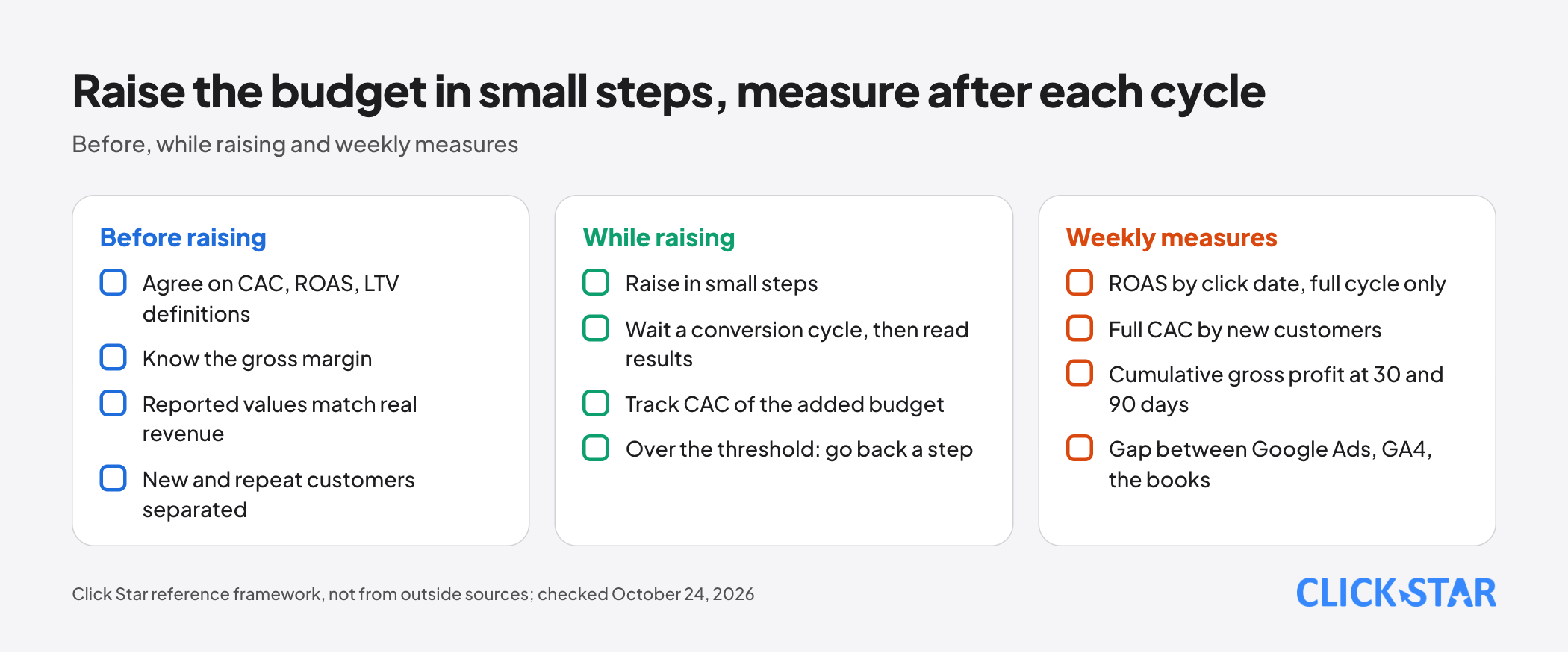
Click Star's reference framework: raise in small steps, for example 20% at a time (an illustrative figure, not from outside sources), wait out a conversion cycle, then read the result. If the threshold is crossed, go back to the previous step.
What this means for businesses in Vietnam
Many businesses close orders by phone or Zalo, so ads see leads, not money. ROAS then depends on the value you assign to a lead. The "Value-based Bidding Best Practices" page allows lead scores or proxy values when exact values are unknown.
For cash on delivery (COD), a failed delivery works like a refund and should be deducted. Click Star has no measurement of this rate for Vietnam and found no public survey of average CAC or ROAS with a clear method, so there is no "industry" benchmark here.
Disclosure: Click Star provides digital marketing, CRM and data dashboard services; the article relies only on public documents.
Click Star's view. The most common failure is not in the tools but in each department using its own definition: marketing says ROAS, accounting says profit, sales says order count. Agree on a single set. Ad platform reports show trends; decisions about real money should rest on the books or the CRM.
30-day roadmap before raising the budget
Click Star's reference framework, not from outside sources:
- Days 1 to 3: agree on shared definitions for CAC, ROAS and LTV and calculate gross margin for each product or service group.
- Days 4 to 10: check that the values sent to Google Ads and GA4 match real revenue, exclude shipping, tax and refunds, and separate new customers.
- Days 11 to 20: build a table by monthly new-customer group with cumulative gross profit at 30 and 90 days; calculate the 3 levels of CAC as in the image.
- Days 21 to 30: set the break-even threshold, the first step up and the stop condition, then raise the budget.
Weekly measurement after that: ROAS by click date (only days that have passed a full cycle), full CAC by new customers, cumulative gross profit of new customer groups at 30 and 90 days, the refund and cancellation rate, and the gap between Google Ads, GA4 and the books.
Common mistakes
- Treating ROAS as profit when cost of goods, fees and refunds are not yet deducted.
- Calling cost per conversion "CAC" even though it includes repeat buyers.
- Counting only ad spend in CAC and ignoring tools and sales staff.
- Using an LTV forecast from a few months of data without stating the assumptions.
- Judging from the latest few days, before conversions have arrived.
- Copying someone else's "3:1" or "good" ROAS instead of calculating from your own margin.
- Raising the budget by too much at once, then adjusting constantly.
What is not known
Click Star could not open the body of Meta's help page on ROAS, so no Meta definition or default is stated. The CAC and LTV definitions above come from Wikipedia, a secondary source, as no official Google definition was found.
There is no public measurement of CAC, ROAS or repurchase rate for Vietnamese businesses with a clear method. Most Google help pages show no date, and Google is relabeling some bidding strategies from June 2026.
Related posts
Need tailored advice for your business?
Click Star helps you build a solution that fits your industry and scale. We answer every question during business hours.