How to read SEO and advertising quotes to choose the right provider: fee models, 10 must-have items and 12 questions
What an SEO and advertising quote must contain, the risks of each fee model and what to ask before signing. Based on Google and Meta documentation and Vietnam's Advertising Law, checked to October 21, 2026, with a disclosure of Click Star's conflict of interest.
Two quotes that both say "full-service SEO" can differ sharply in work done and control over accounts. The bottom-line number is the easiest to compare and tells you the least.
Checked on October 21, 2026 against Google documentation on hiring an SEO, spam policies, Google Partner and access, Meta's partner page and Vietnam's Advertising Law. Click Star gives no market prices because no open source exists.
It covers how fee models differ, what a quote must contain, what to ask, and how to compare, trial and measure. To be direct: Click Star sells digital marketing and SEO, so it has a conflict of interest. The checklists apply to every provider, Click Star included.
Key points
- A quote buys 2 things: the provider's work and the money paid to the ad platform. Insist on 2 lines.
- There are 4 fee models: flat monthly, percentage of ad budget, performance-based, hourly or per project. Each gives the provider a different incentive.
- Google says no one can guarantee a top ranking. Ranking promises, a "special relationship", hidden plans or bulk link buying are signs to stop.
- Ownership matters more than price: ad accounts, Search Console and GA4 should be in your name.
- Partner badges from Google or Meta do not guarantee results for your business.
- Ask the same 12 questions, fill in 1 table with 7 rows for 3 quotes, trial with a small project, then measure at 30, 60 and 90 days.
What a quote for SEO and advertising actually buys
According to Google Search Essentials (updated December 10, 2025), appearing on Google costs nothing. According to "Do you need an SEO?" (updated June 5, 2026), Google Ads spending does not affect organic presence and Google does not accept payment for ranking. SEO fees are therefore payment for work.
For paid advertising, the budget goes to a platform such as Google or Meta and the service fee to the provider; keep them on separate lines. The same document adds that a redesign or launch is a good time to hire.
4 fee models: pros and cons
This section is Click Star's description, not statistics: no public measurement shows which model is most common in Vietnam.
1. Flat monthly fee. A fixed amount per month for a list of tasks. Easy to budget, but with vague tasks you pay the same even when little is done. Ask for monthly deliverables in writing.
2. Percentage of ad budget. The fee is a share of ad spend. Familiar, but the provider gains when the budget rises even if results do not. Ask for a cap and approval of every increase.
3. Performance-based. The fee is tied to leads, orders or revenue. It shares risk, but results also depend on your product and sales speed, and an easy metric may be picked, such as cheap, low-quality leads. Ask for a definition of "valid result" and who confirms it. For SEO, avoid tying fees to rankings.
4. Hourly or per project. Charged by hours or a package with an end point. Clear scope, suits audits and trials, but weak incentive for long-term results. Ask for an hour estimate, a cap and acceptance criteria.
10 items a good quote must include
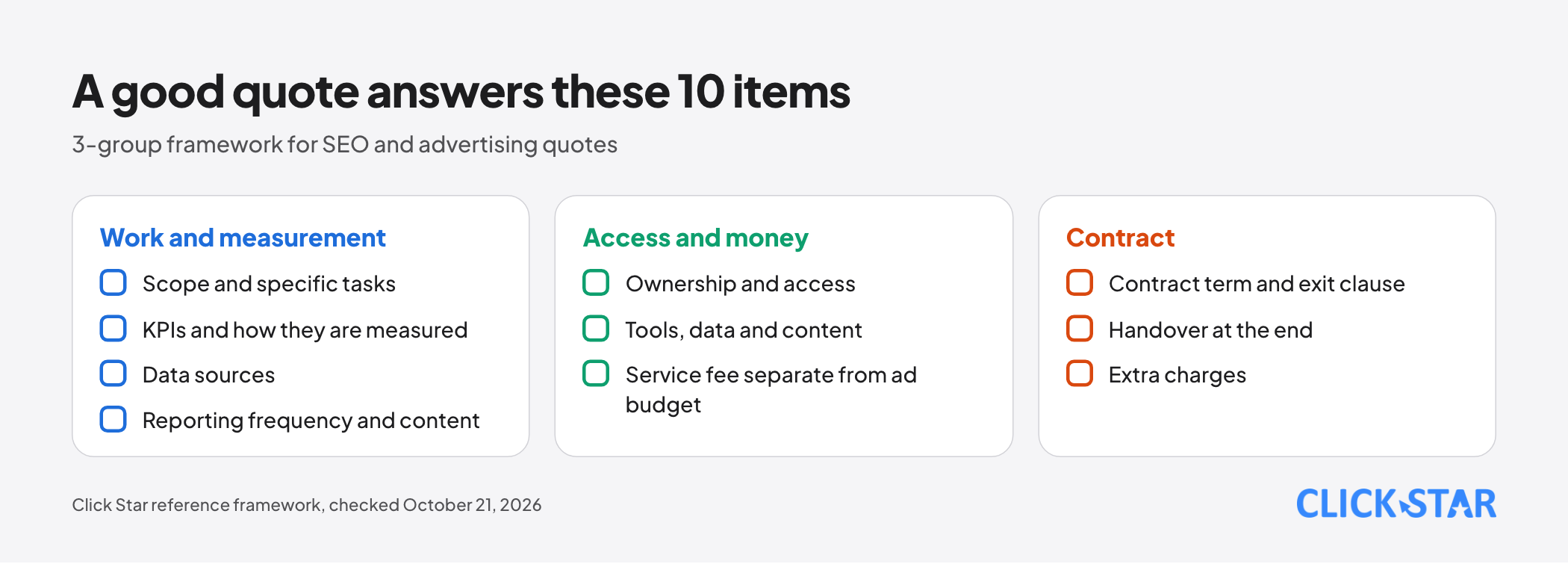
A readable quote answers these 10 items in writing. The 3 groups are Click Star's reference framework, not from an outside source.
Group 1, work and measurement:
- Scope and specific tasks. What work, how much, what is delivered monthly.
- KPIs and how they are measured. Which metrics, how defined, the starting baseline.
- Data sources. Where numbers come from, and whether you can see raw data.
- Reporting frequency and content. What is reported and how often.
Group 2, access and money:
- Ownership and access. Whose name the ad accounts, Search Console and GA4 are in.
- Tools, data and content. Who owns the data and content when the contract ends.
- Service fee separate from ad budget. 2 lines, and who pays the platform.
Group 3, contract:
- Contract term and exit clause. Minimum term, notice period, exit fee.
- Handover at the end. Accounts, documents, data, and how soon.
- Extra charges. Which work is billed extra, and whether there is a cap.
Google Ads Help (read October 21, 2026) says the client account still owns its data and can remove a manager by unlinking. A manager account that creates a sub-account becomes its owner by default. Ask who creates the account and state in the contract that it belongs to you.
Search Console Help (read October 21, 2026) defines Owner, Full user, Restricted user and Associate; only an Owner can add or remove users. For GA4, Analytics Help says an Administrator can manage users and an Editor cannot, so keep at least 1 Administrator under your control.
Under consolidated Advertising Law No. 47/VBHN-VPQH of December 10, 2018 (read via a copy on caselaw.vn), Article 6 requires advertising cooperation to go through a service contract, and Article 12 makes the advertiser jointly responsible when hiring others. Check the original text before signing.
Risk signs in quotes and sales pitches
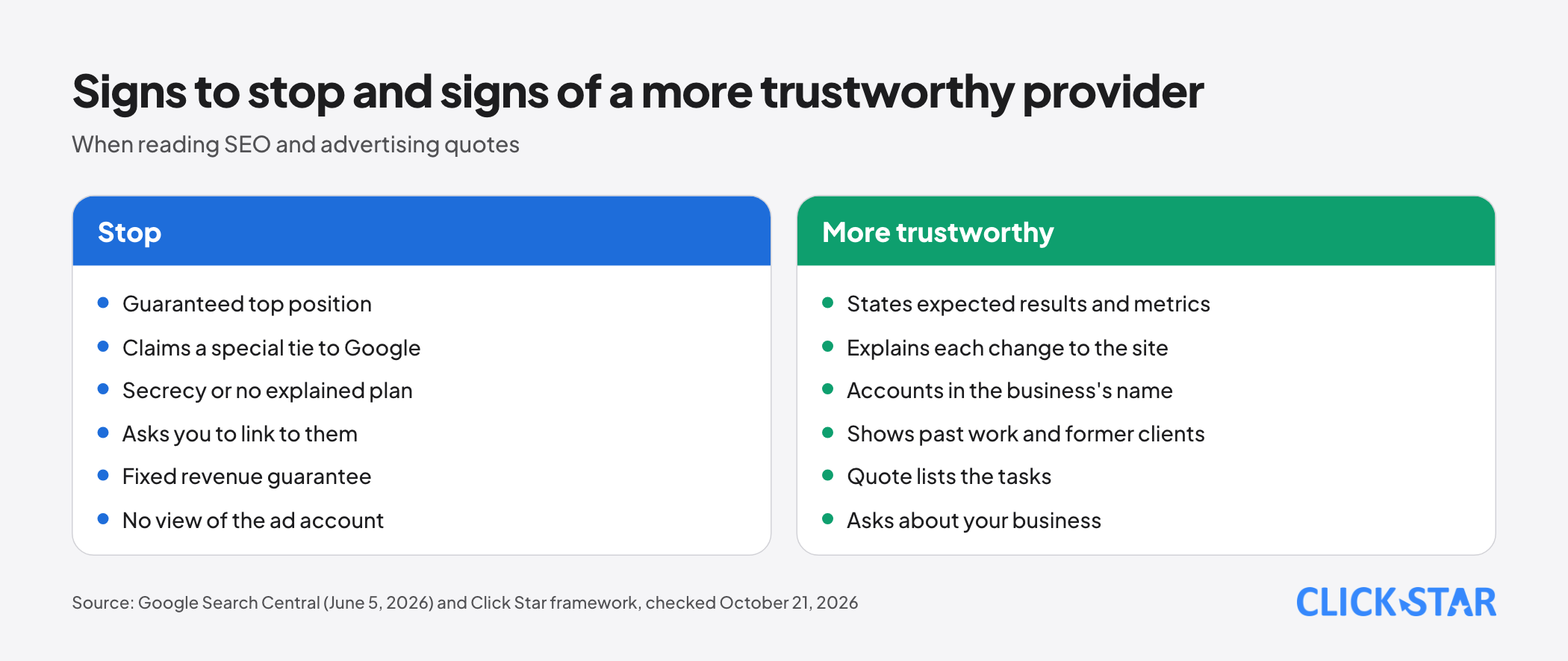
"Do you need an SEO?" (Google Search Central, updated June 5, 2026) lists warning signs for an SEO provider and reminds you that you stay responsible for the companies you hire. They fit advertising quotes too.
- Promising a guaranteed top position, which Google says no one can do.
- Claiming a "special relationship" with Google or a "priority submit" to Google.
- Secrecy, or refusing to explain the plan.
- Asking you to link to their website.
- Selling "link attraction" packages or submitting your site to thousands of search engines.
- Creating deceptive content, which can get a site removed from Google's index.
Google's spam policies (updated August 28, 2026) treat paying for links and using automated tools to generate links as spam. Advertising links stay acceptable when marked rel="sponsored" or "nofollow". For a line like "build X backlinks per month", ask which sources, whether they are marked sponsored, and who bears the consequences.
Click Star adds 3 signs from management experience, not from a source: a fixed revenue guarantee, an unexplained "secret method", and no direct view of the ad account.
Partner badges. Per Google Ads Help (read October 21, 2026), Google Partner requires an optimization score of at least 70%, USD 10,000 of ad spend over 90 days and at least 50% of account strategists certified. These conditions concern Google Ads, not SEO, and say nothing about results in your industry.
The Meta Business Partners page (read October 21, 2026) says requirements differ by solution type and does not explain how to look up a partner, so ask for an official profile, not just a logo.
For ad content written on your behalf, Article 8 of the Advertising Law (same copy) bans false or misleading advertising (clause 9), direct comparison (clause 10) and words such as "the most" without supporting documents (clause 11).
12 questions to ask the provider
Ask every provider the same 12 questions and write down the answers. Questions 1, 2, 3, 8, 12 are based on "Do you need an SEO?"; the rest are Click Star's additions.
- Can you show past work and let me talk to former clients?
- Do you follow Google Search Essentials, and which document backs each recommendation?
- What results should I expect, in what time, measured by which metrics?
- Who creates and owns the ad accounts, Search Console, GA4 and domain?
- Can I see raw numbers in my own account, or only reports you send?
- What work is done monthly, by whom, and is AI bulk writing or outsourcing used?
- Do you buy or trade links, and are paid links marked sponsored?
- Do you explain each change to the website and the reason for it?
- How are service fees and ad budget separated, and who pays the platform?
- Which work counts as extra, and is there a cap?
- If I end the contract, what do I get back, how soon, and at what fee?
- Do you ask about my business model, customers and competitors?
How to compare 3 quotes side by side
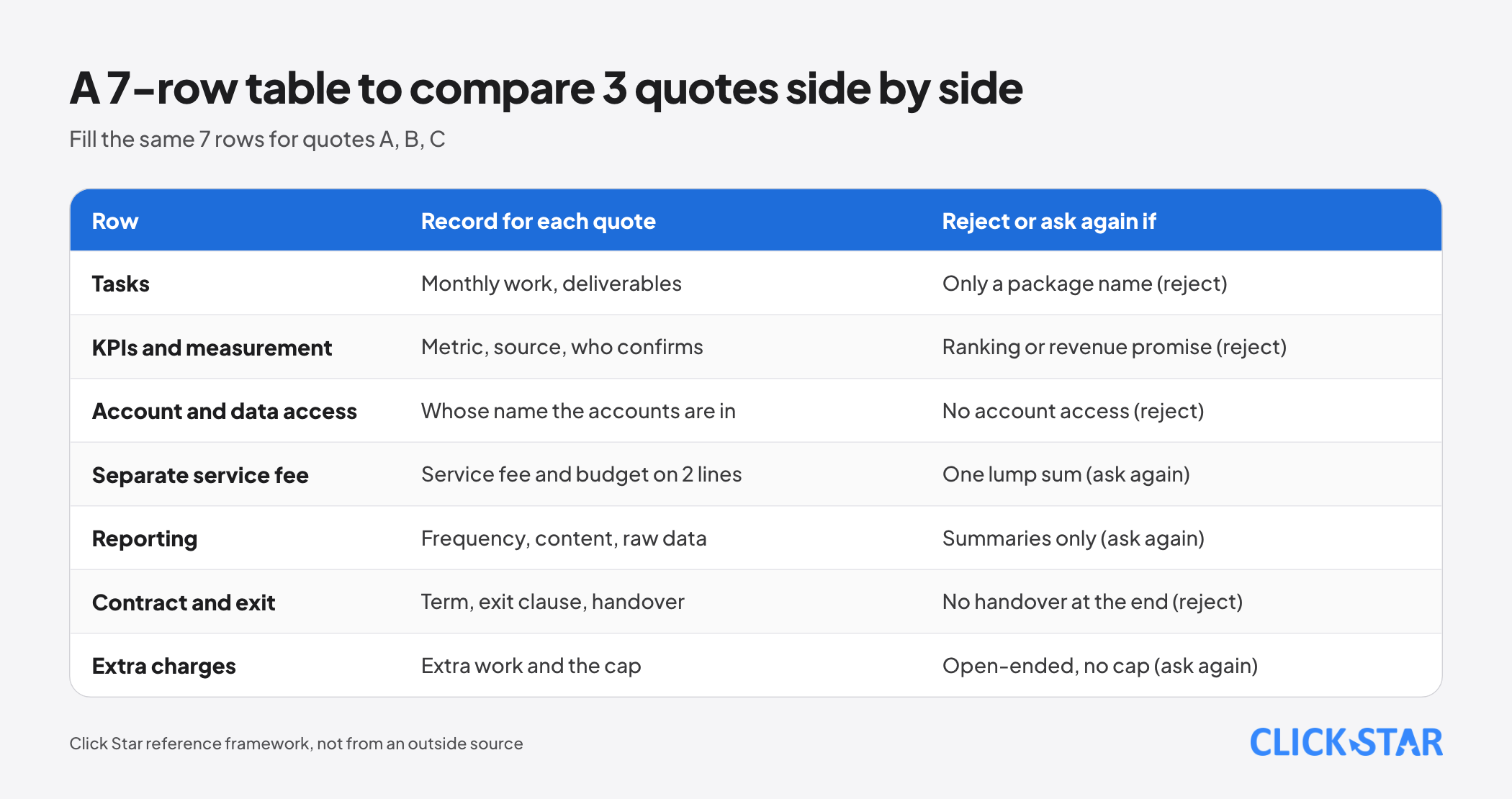
Draw 1 table with columns A, B, C and 7 rows as pictured, and fill the same 7 rows for every quote. An unfilled cell is a question to send back, not a place to guess.
The scoring is Click Star's reference framework: each row gets 2 points if in writing in the quote or contract, 1 if only spoken, 0 if absent.
The 7 rows are: tasks, KPIs and measurement, account and data access, separate service fees, reporting, contract and exit, extra charges. Reject if there is only a package name, a ranking or revenue promise, no account access or no handover. Ask again if fees are one lump sum, reports are summaries or extra charges are open.
A quote with 0 on the account-access row is rejected even with a high total. The score only shows which quote is vague; it does not replace judgment.
Trial with a small project that has criteria
According to Google, a serious audit gives realistic estimates of improvement and workload, and read-only Search Console access is enough. A trial needs a clear end point, such as an SEO audit or a small campaign on an account in your name. Click Star suggests writing 5 criteria first:
- Scope and time.
- Deliverables.
- Pass or fail metrics, with how they are measured.
- A trial budget you accept losing.
- Minimum access and the date it is revoked.
Measuring results after 30, 60 and 90 days
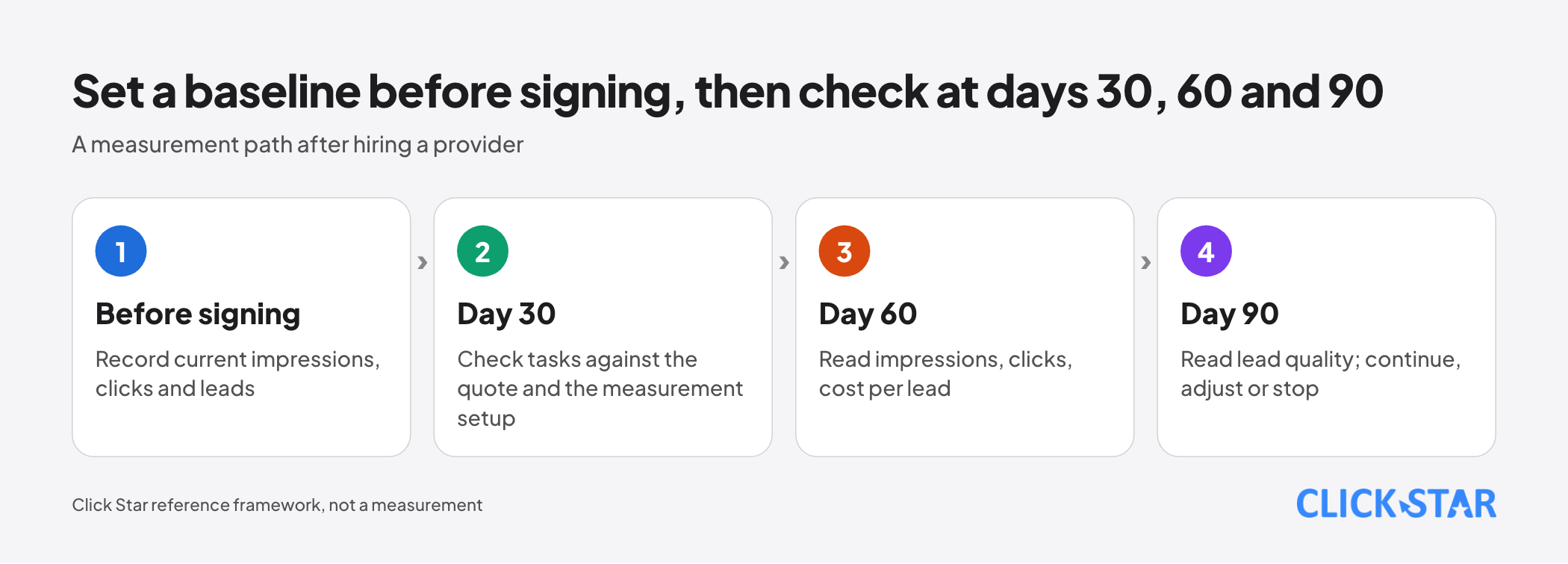
This is Click Star's framework, not a measurement or standard. Google's SEO Starter Guide (updated December 10, 2025) says some changes take effect in hours, others take months, and you should wait a few weeks before judging a change. For SEO, 90 days only suffices for leading indicators.
- Before signing: record current impressions, clicks and leads.
- Day 30: check delivered tasks against the quote and the measurement setup.
- Day 60: read leading indicators such as impressions, clicks and cost per lead.
- Day 90: read lead quality and decide to continue, adjust the scope or stop.
Click Star's view. The most valuable test of a quote is not cheap or expensive, but whether the business can verify and leave easily. A provider holding a client's accounts or raw data creates a very high switching cost.
On the interest: Click Star sells digital marketing and SEO, so apply the 7-row table, the 12 questions and the 10 items to Click Star too.
No fee model fits every case: a fixed fee suits a clear scope, and a performance fee needs the result definition and data source agreed in writing.
7-day plan before signing
- Day 1: write a 1-page goal and list existing accounts and owners.
- Day 2: send the same brief to 3 providers.
- Day 3: ask each provider the 12 questions.
- Day 4: call 2 former clients.
- Day 5: fill in the 7-row table and send back the empty cells.
- Day 6: read the contract for ownership, exit and extra charges.
- Day 7: pick a provider for the trial, write 5 criteria and record the baseline.
Common mistakes
- Comparing quotes by the bottom-line number alone.
- Treating a partner badge as proof of results.
- Letting the provider open ad accounts with their own email.
- Granting full admin rights at the first conversation.
- Accepting a vague KPI such as "more traffic".
- Judging SEO after only a few weeks.
- Not reading ad content the provider writes for you.
What is not known
Click Star found no public data on fee models or fee levels for SEO and advertising in Vietnam, so no prices are given.
For Meta, Click Star could not read detailed badge requirements or the bodies of help articles on partner access, so no detail on Meta permissions is given.
The Advertising Law was read via a copy on caselaw.vn; consolidated text No. 88/VBHN-VPQH appeared in search results but could not be opened, so check the current version. Not legal advice.
The FTC (US) page on results claims returned an error, so it is not used. The scoring table, 12 questions and 30, 60, 90 day framework are Click Star proposals, not widely validated.
Related posts
Need tailored advice for your business?
Click Star helps you build a solution that fits your industry and scale. We answer every question during business hours.