How to do SEO in the AI era: a 9-step process based on Google's official guidance (updated July 10, 2026)
Turns Google's official guidance on AI features into a 9-step process, a test for non-commodity content, a list of what is not needed, how to measure with Search Console and a 90-day plan.
After a year awash in new terms such as AEO, GEO and "optimizing for AI," Google has published its own guidance on the subject: "Optimizing your website for generative AI features on Google Search," posted on May 15, 2026 and last updated on July 10, 2026.
The central message is clear: Google's AI features (AI Overviews and AI Mode) rely on its existing ranking and quality systems, so the foundation is still good SEO, in which "non-commodity" content is the factor stressed most.
This article turns that guidance into a 9-step process for Vietnamese businesses, with a list of what is not needed, how to measure with the new report in Search Console, and corrections to 2 points in earlier Click Star articles so they match the new document.
The document was read in full on October 20, 2026; the Search Console measurement section also relies on one press report and is labeled as such. Click Star already has articles on SEO thinking in the AI era and on the shift in SEO; this one is the practical process.
Key points
- Google treats "AEO" and "GEO" as SEO for the search experience, and advises evaluating all third-party advice against Google's own guidance. There is no separate discipline with its own rules.
- The first factor is valuable, non-commodity content: a unique point of view and first-hand experience, instead of restating what everyone already knows.
- Technical conditions are still necessary: a page must be indexed and eligible for a snippet to appear in AI features, and Google does not guarantee indexing or serving.
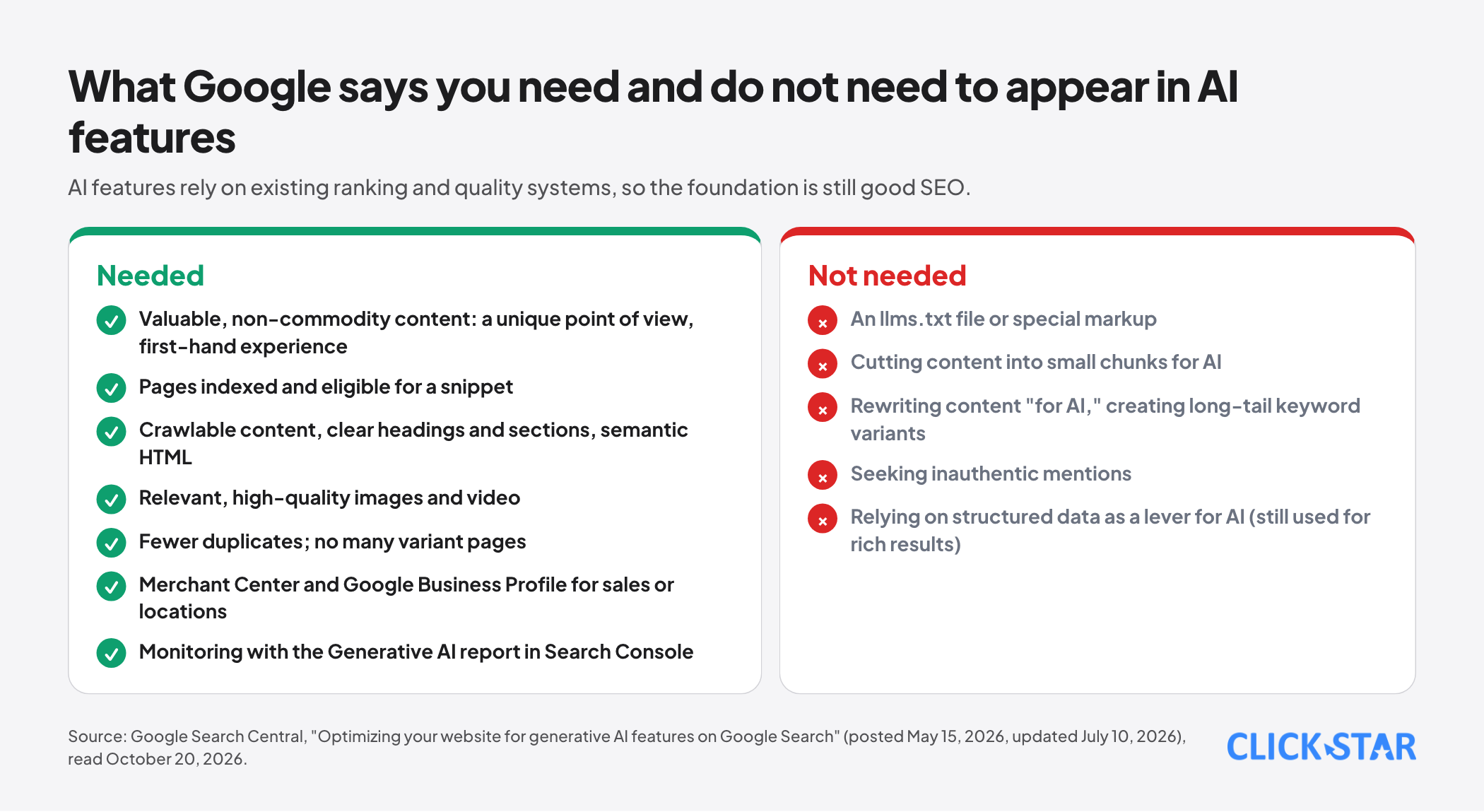
- Google says plainly that you do not need: an llms.txt file or special markup, cutting content into small chunks for AI, rewriting content "for AI," seeking inauthentic mentions, or relying on structured data as a lever for AI.
- The official measurement tool is the Generative AI report in Search Console (Search and Discover), currently released to a subset of websites; according to a press report, the report does not yet include clicks.
- The new guidance mentions AI agents (such as browser agents) reading a page's screenshots, DOM and accessibility tree, so clear, accessible HTML is an investment that benefits users as well.
What Google says about SEO for AI features
The guidance describes 2 techniques behind the AI features: retrieval-augmented generation (also called grounding, where the model answers from sources found through Google Search) and "query fan-out," where from one question the system sends many related searches and then combines them.
From this Google concludes that SEO is still relevant: the AI features rely on the core ranking and quality systems. Google regards AEO and GEO as SEO for the search experience and advises readers to evaluate third-party advice against its own guidance.
2 limits are worth noting when you read it. First, according to Practical Ecommerce's report, the guidance applies to AI Overviews and AI Mode, not necessarily to Gemini (Google's standalone AI platform) and certainly not to ChatGPT or Claude.
Second, the guidance is about appearing in Google's own products; other tools have their own bots and rules, as Click Star summarized in the article on the shift in SEO.
The 9-step process
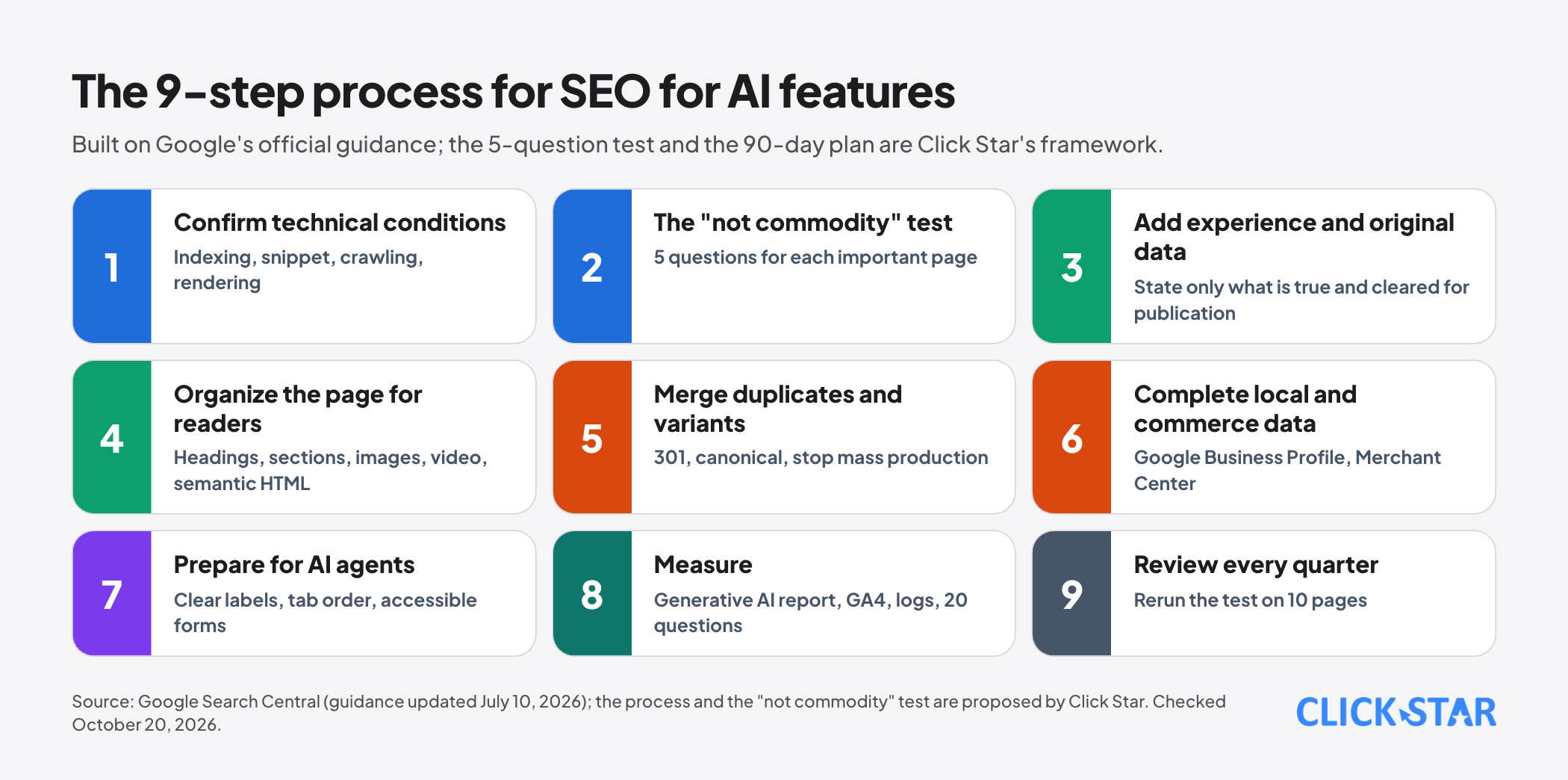
Step 1: Confirm the technical conditions
Google states that a page must be indexed and eligible for a snippet in Search, noting that indexing and serving are not guaranteed.
What to do: verify the website in Search Console, test important pages with the URL inspection tool, make sure robots.txt, the CDN and the server do not block Googlebot, key content is in HTML the bot can render (follow the JavaScript SEO guidance if the site renders in the browser), and no noindex or snippet restriction has been set by mistake.
Large, frequently updated sites should also read the crawl budget guidance.
Step 2: Test each page with the "not commodity" test
Google advises offering a unique point of view, such as first-hand experience, instead of repeating existing content, and avoiding commodity content built on common knowledge. To turn the principle into a test, Click Star proposes 5 questions for each important page (this is Click Star's reference framework, not Google's):
- Does the page contain information readers cannot find nearly verbatim on the first 5 results elsewhere (your own data, a real process, a real example)?
- Is there a specific person or team behind it who is responsible for the content?
- Does the page state real conditions of application, limits, costs or time, or only a general definition?
- If AI summarizes this page, what part of yours is still worth a reader's click?
- When was it last updated, and are the figures still correct?
A page that answers "no" to at least 3 questions is a candidate to rewrite, merge or remove.
Step 3: Add first-hand experience and original data
This is the step that creates a difference. For a service business, the sources usually exist already: the questions customers ask by phone and Zalo, working processes, real time and cost for each type of project, common mistakes, comparisons of options. An important note: state only what is true and cleared for publication. Do not invent customers, projects or figures to look experienced.
Step 4: Organize the page for readers
Google advises organizing content clearly with headings and sections, supporting text with relevant, high-quality images and video (following its image and video SEO guidance), and using semantic HTML for readability and accessibility, though the code does not need to be perfect. Write clearly and spell correctly.
There is no ideal length: do not stretch an article to reach a word count.
Step 5: Merge duplicates and variants
Google warns against creating many variant pages to manipulate rankings or AI answers (the scaled content abuse policy), and AI-assisted content must still meet Search Essentials and the spam policies. What to do: list near-identical pages, merge them into one strong page with 301 redirects, use rel="canonical" where needed, and stop producing pages in bulk from templates.
Step 6: Complete local and commerce data
For businesses with a physical location or online sales, Google advises using Merchant Center feeds and Google Business Profiles to make products and services visible, and mentions Business Agent as an option for conversational brand experiences. Keep opening hours, prices and stock status consistent with the website.
Step 7: Prepare for AI agents
The guidance says AI agents such as browser agents may access websites to complete tasks, by reading screenshots, the DOM and the accessibility tree; Google points to web.dev's "agent-friendly websites" guidance and notes that new protocols such as the Universal Commerce Protocol will let Search agents do more.
In practice: clearly labeled buttons and forms, a sensible tab order, correct names and roles for elements (which is simply the accessibility standard), and clear form error messages. Google calls this a fast-evolving area; treat it as preparation, not a current requirement.
Step 8: Measure with Search Console and your own data
See the measurement section below.
Step 9: Review every quarter
Google's AI features and user behavior change quickly. Each quarter, rerun the step 2 test on 10 important pages, check the Generative AI report again and look for new content gaps.
What Google says you do not need to do
The guidance has a whole part debunking misconceptions, worth reading closely because many services still sell these things:
- llms.txt and "special" markup: Google Search does not use these files; creating them neither helps nor harms visibility in Google Search. Note: other AI tools may handle them differently, but Click Star has not seen any major tool commit to using llms.txt.
- Cutting content into small chunks: not needed. Google understands multiple topics on one page and there is no ideal page length.
- Rewriting content for AI: not needed. AI systems understand synonyms and meaning, so there is no need to create long-tail keyword variants.
- Seeking inauthentic mentions: not helpful, because Google's ranking and spam systems focus on quality.
- Over-focusing on structured data: not required for generative AI search and there is no special schema.org markup for it. Keep using it to be eligible for rich results.
According to ppc.land's report on the May 15, 2026 post, Google also holds that restructuring content into a question-and-answer format or changing headings into questions is not required.
Click Star's view. This list saves businesses money: if a vendor quotes separately for "AI optimization" consisting of llms.txt, special schema or splitting articles, ask for their basis in Google's documentation. Conversely, the list does not mean structured data or clear content is useless: both still have value for readers and for rich results.
Corrections to earlier Click Star articles
Google's new guidance means 2 points in the article on the shift in SEO (checked earlier) need adjusting:
- On measurement: the earlier article said traffic from AI Overviews and AI Mode sits within the Performance report without separation (per the documentation updated December 10, 2025). From June 3, 2026, Google introduced a separate Search Generative AI report, currently released to a subset of websites.
- On content structure: the earlier article suggested making section headings real user questions with the answer right below. Writing clearly and answering directly is still good for readers, but under the new guidance there is no need to restructure content just to please AI. Write as you would for people, and do not cut up articles or change headings in bulk just because "AI likes it."
The earlier article also said llms.txt could be created because the cost is low; it is true that it does no harm, but do not expect anything from Google.
Measurement: the Generative AI report in Search Console
The guidance advises using the Generative AI report to see how content appears in AI features in Search and Discover, with a warning that no third-party tool has access to Google's internal ranking or AI systems, so such tools should be evaluated carefully. According to ppc.land's report on the June 3, 2026 post:
- Scope: Search (AI Overviews and AI Mode) and Discover (generative AI features).
- Measures: impressions, pages, countries, devices (Search only) and dates (by hour, day, week or month).
- Limits: clicks are not among the 5 data categories, so a click-through rate for AI features cannot be calculated; Google has not described how position is reported.
- Availability: released to a subset of websites for testing, with no broad schedule; many websites do not see the report yet.
- AI data also stays in the overall Performance report.
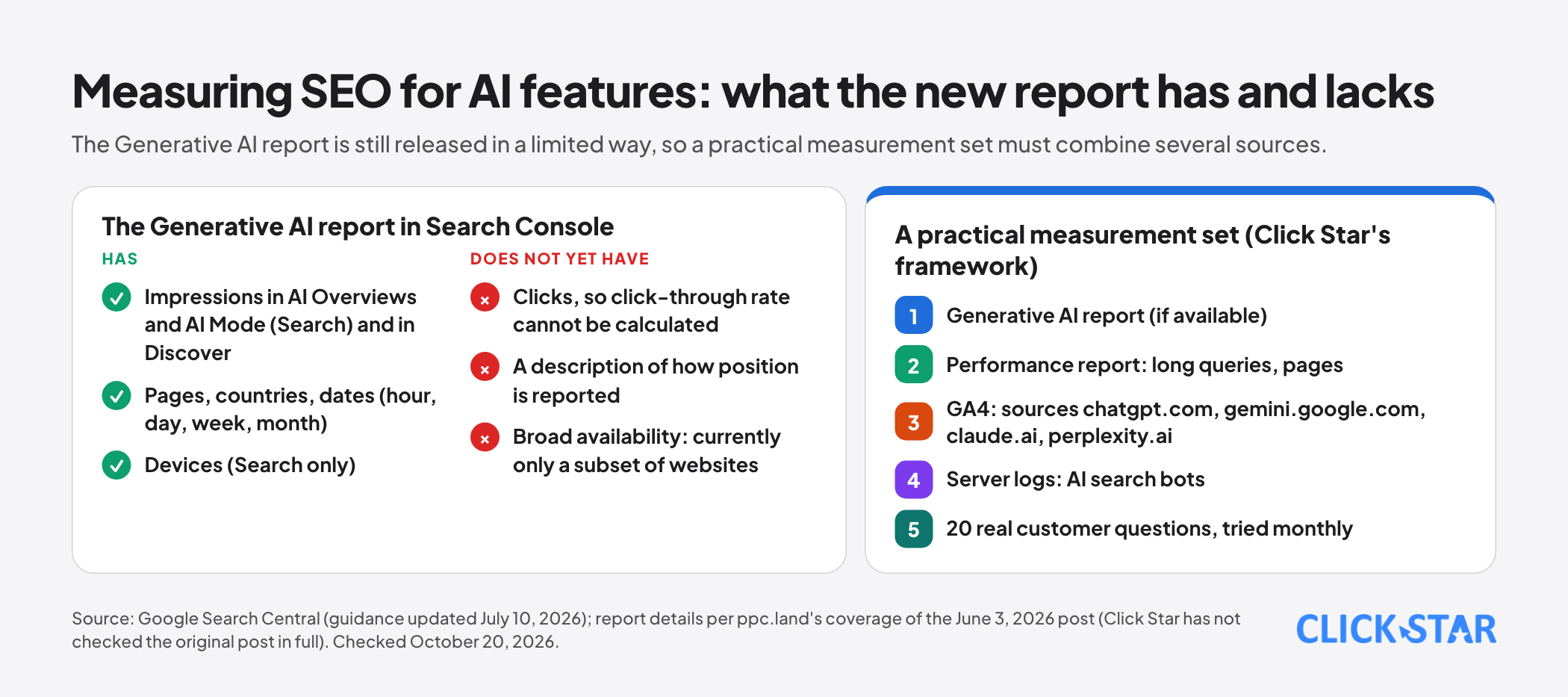
Because the new report is still limited, a practical measurement set should combine: the Generative AI report (if available), the Performance report (long queries, pages), Google Analytics 4 (referral sources chatgpt.com, gemini.google.com, claude.ai, perplexity.ai), server logs (AI search bots), and a set of 20 real customer questions tried monthly on AI tools to see whether the brand is mentioned. AI answers can differ each time, so compare trends by month.
A 90-day plan
- Days 1 to 30, foundation and inventory: verify Search Console, run a technical check of 20 important pages, list duplicate and variant pages, run the 5-question test on 20 pages, assemble the set of 20 real customer questions.
- Days 31 to 60, content: rewrite or newly write 10 pages with first-hand experience and original data, merge duplicate pages, complete the Google Business Profile and the product feed if applicable.
- Days 61 to 90, measure and prepare: set up an AI channel group in GA4, run the first 20-question check as a baseline, review the accessibility of forms and main buttons, schedule the quarterly review.
What is not known
There is no measurement for the Vietnamese market of how often AI Overviews or AI Mode appear for Vietnamese queries. Google does not publish how it picks cited sources, so there is no "formula"; third-party studies of citations differ by method.
The Generative AI report is still released in a limited way, so it is unclear when your business will see it. Finally, Google describes the AI agent part as a fast-evolving area, so it is a direction to follow rather than a requirement.
Common mistakes
- Buying an "AI optimization" service built on llms.txt, special schema or splitting articles without checking Google's documentation.
- Rewriting articles in bulk just to "suit AI" instead of adding value readers do not already have.
- Producing many variant pages to cover keywords, against the scaled content abuse policy.
- Treating structured data as a lever for AI, then neglecting content.
- Blocking bots by mistake or leaving key pages noindexed, then looking for the cause in the algorithm.
- Looking only at clicks and ignoring whether the brand appears in answers and the quality of customers.
- Using third-party tools as if they had Google's internal data.
Related posts
Need tailored advice for your business?
Click Star helps you build a solution that fits your industry and scale. We answer every question during business hours.