A checklist of 12 questions to ask before choosing CRM software
12 questions to put to a CRM vendor in writing, in 4 groups: the problem, cost, data and integrations, and compliance, based on the official price pages and technical documentation of HubSpot, Salesforce, Zoho, Microsoft, Bitrix24, MISA and Getfly.
Most CRM demos look alike: a tidy interface, a few good-looking charts, and "yes" to every question. The trouble only shows 6 to 12 months later, when you want to get your data out, add users, connect Zalo, or delete one customer's data on request.
This article gives 12 questions to ask a vendor before signing, in 4 groups. Each has the reason to ask, what a good answer looks like and how to verify it. Figures come from the official pricing pages and technical documentation of HubSpot, Salesforce, Zoho, Microsoft, Bitrix24, MISA and Getfly, read on October 21, 2026.
Click Star already has articles on whether a CRM really matters to a business and on 8 criteria for choosing one. This one goes deeper: it turns the criteria into concrete questions to ask in writing. The legal part rests on summaries and needs checking against the original text.
Key points
- Ask in writing and test with your own real data. A verbal answer in a demo is worth nothing in a dispute.
- CRM list prices come in 3 kinds: per seat (user), per bundle of users with record limits, and a flat price per organization. For the same 10 users, total cost can differ several times depending on the kind and the add-ons.
- Data export and API limits differ enormously between platforms. For example, HubSpot allows at most 300 exports per 24 hours and its download links expire after 30 days; Zoho's Free plan API has only 5,000 credits per 24 hours.
- A Zalo connection is usually a third-party app or an extended plan, not a default feature. Ask who is responsible when it fails.
- Meta leads can be downloaded only within 90 days of submission, so a CRM needs continuous sync, not manual exports.
- The figure "70% of CRM projects fail" has no primary source. Gartner has said it traces back to a survey in late 2001 about large organizations' unmet expectations.
Why ask carefully: where "70% fail" comes from
Many CRM articles open with the figure that 70% of projects fail. Click Star found no primary source for it.
According to the October 18, 2004 interview with Ed Thompson of Gartner (published on CustomerThink), the often-quoted figure traces back to a Gartner survey in late 2001 of about 500 organizations, mostly large ones in the US and Europe. About 55% said CRM had not met expectations.
The press shortened this to "failure." Mr. Thompson estimated absolute failure at about 5%, and about 15% if "somewhat unsuccessful" is included. Gartner did not measure again afterwards.
The lesson is not that CRM rarely fails. The lesson is that unmet expectations are common, and they usually come from questions not asked before buying. Click Star has no Vietnamese data on this rate.
Group A: the problem and the process (questions 1 to 3)
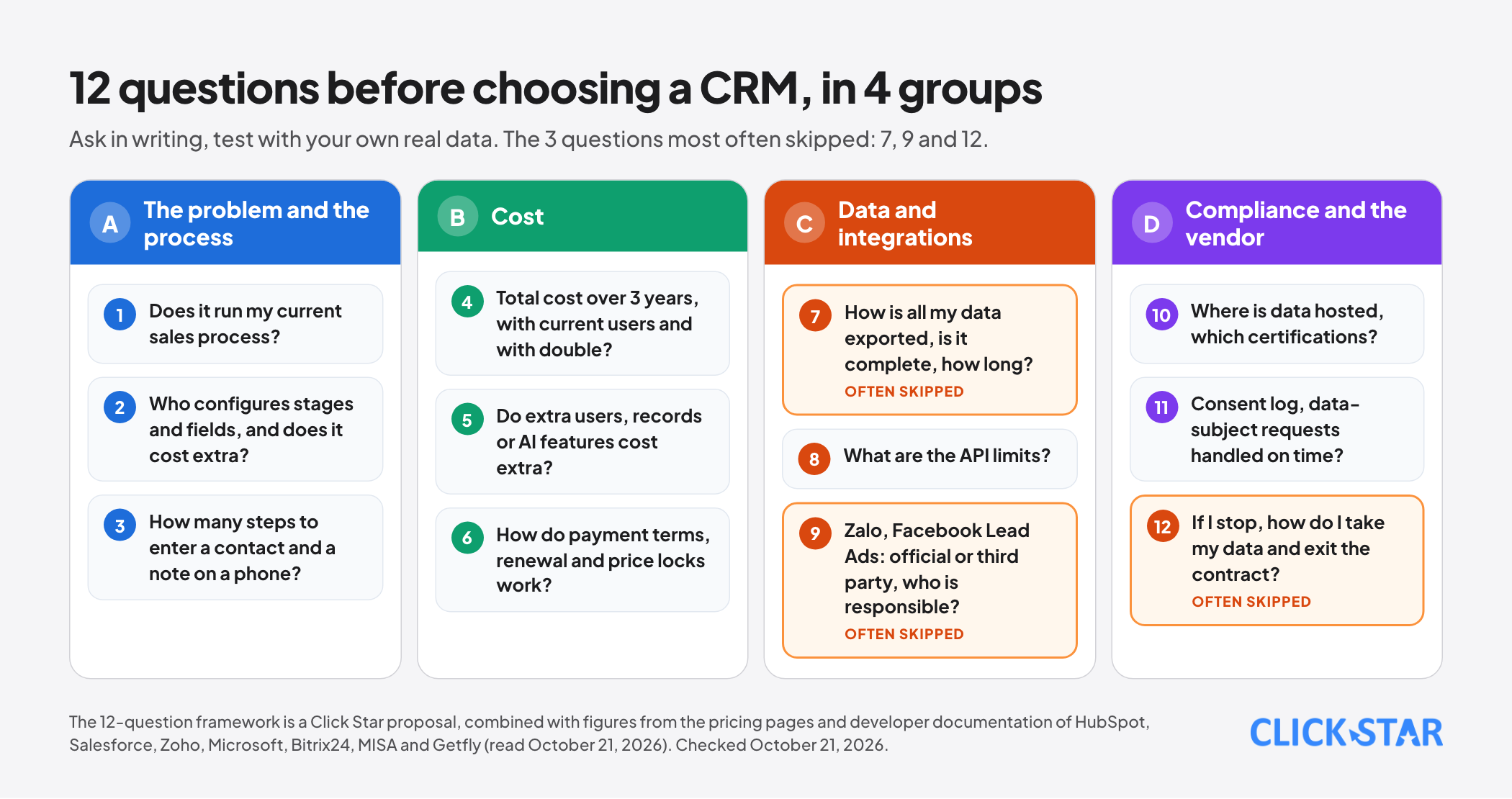
Question 1: does this CRM run my business's current sales process? Ask the vendor to build the demo with your real stages, not their sample data. A good answer is stages named after observable milestones, with entry and exit criteria.
Pipedrive's guide (updated September 23, 2026) advises naming stages after observable milestones, not vague labels such as "Interested." HubSpot's guide (September 29, 2026) advises using one pipeline unless processes truly differ, and including both Won and Lost stages so reports do not break.
Question 2: who configures stages and fields, and does it cost extra? Being able to configure them yourself is a plus, because the process will change. Ask which features sit on a higher plan: for example Pipedrive's required fields need the Professional plan or above (support page updated September 3, 2026).
Question 3: how many steps does it take staff to enter a contact and a note on a phone? Do not listen to an answer; ask them to do it in front of you. If nobody wants to enter data into the software, the data will be empty.
Group B: cost (questions 4 to 6)
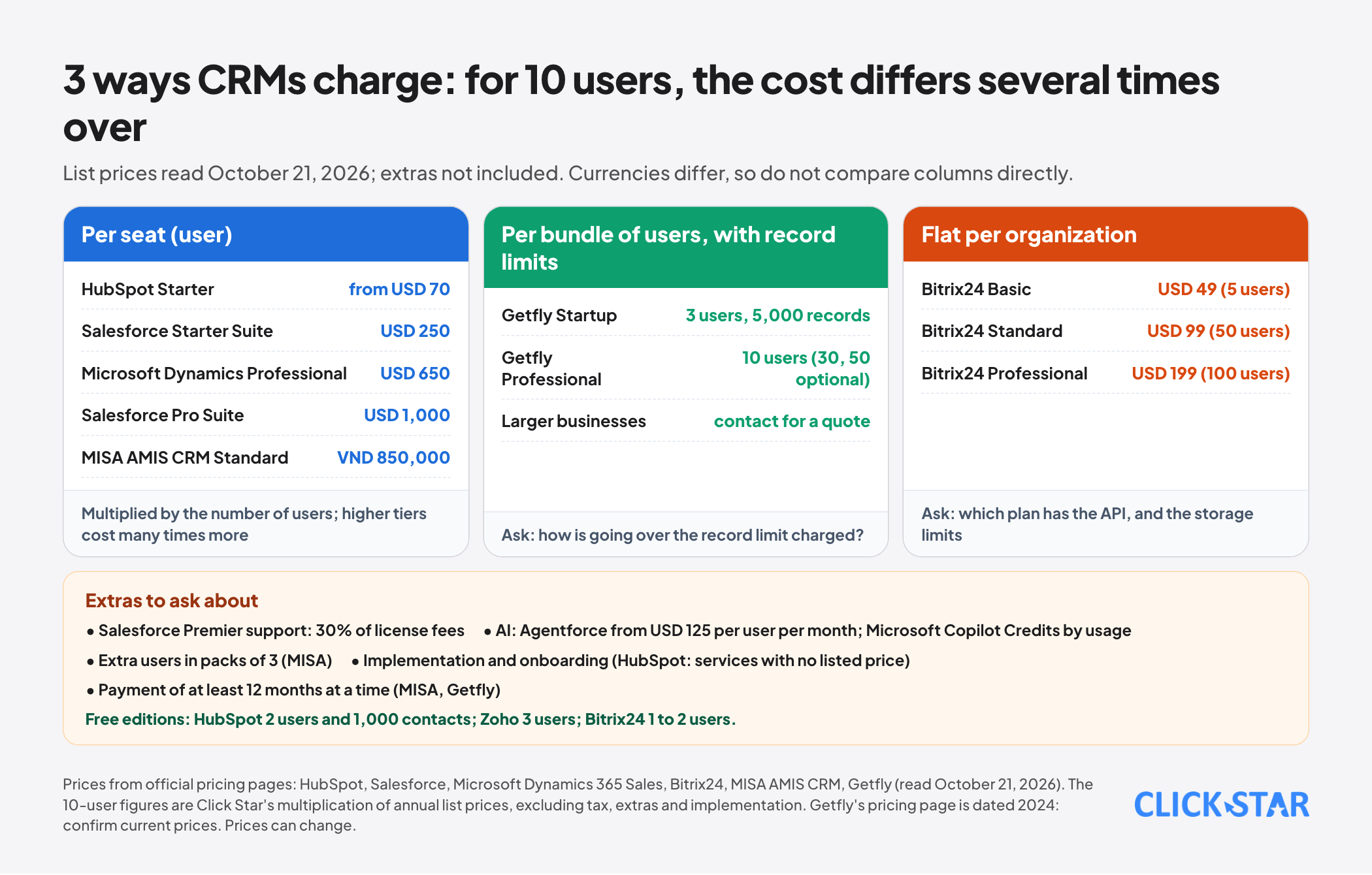
Question 4: what is the total cost over 3 years, with the current number of users and with double? List price is only part of it. Salesforce lists Sales Cloud tiers from USD 25 to USD 550 per user per month, and its Premier support plan equals 30% of net license fees.
Microsoft Dynamics 365 Sales lists USD 65, 105 and 150 per user per month (billed yearly), with Copilot Credits charged extra by usage. HubSpot lists Starter from USD 7 per seat per month and a free CRM for up to 2 users and 1,000 contacts.
Bitrix24 uses a different model: a flat price for the whole organization, for example USD 49 per month (billed annually) for 5 users on the Basic plan. MISA AMIS CRM lists VND 55,000 to VND 120,000 per user per month across 4 tiers, with payment of at least 12 months at a time.
Question 5: do adding users, adding records or switching on AI features cost extra? These charges often sit outside the list price. Salesforce lists Agentforce for Sales from USD 125 per user per month.
MISA sells extra users in packs of 3. Getfly lists a Startup plan of 3 users and 5,000 data records (the footer of its pricing page says 2024, so confirm current prices).
Question 6: how do payment terms, renewal and price locks work? Many price lists require payment of at least 12 months. Salesforce's pricing page says prices are "subject to change." Ask whether the price is locked for 12 or 24 months and the maximum increase at renewal, and put it in the contract.
Group C: data and integrations (questions 7 to 9)
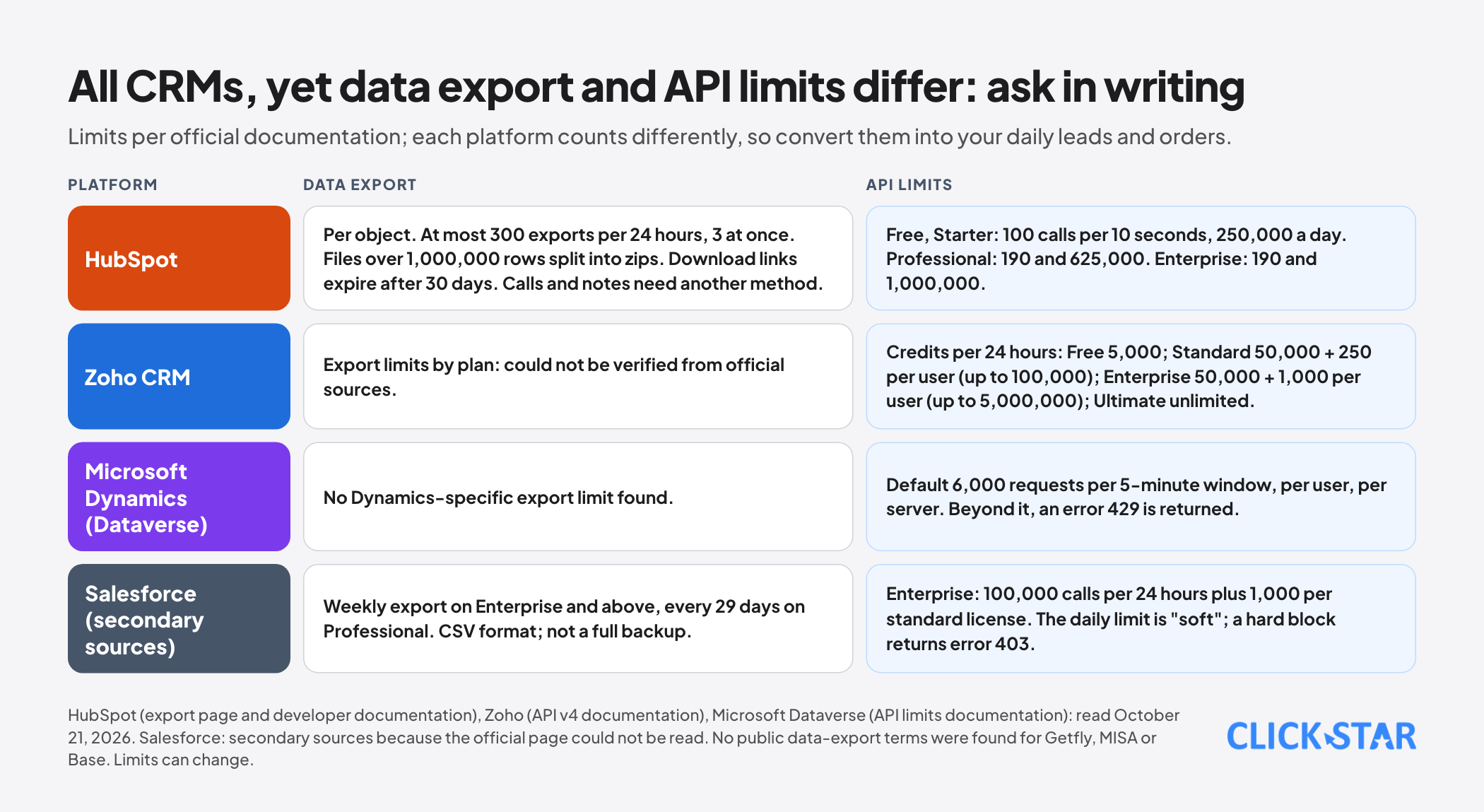
Question 7: how is my data exported, is it complete and how long does it take? According to HubSpot's support page, export is done per object (contacts, companies, deals, tickets), with no button to export a whole account.
At most 300 exports per rolling 24 hours, at most 3 at once, files over 1,000,000 rows are split into zip files, download links expire after 30 days, and activities such as calls and notes need another method.
For Salesforce, according to secondary sources (the official page could not be read), data export runs weekly on Enterprise plans and above, every 29 days on Professional, in CSV format. Ask the vendor to describe in writing how to export all data, including activity history and attachments.
Question 8: what are the API limits? Websites, Zalo and accounting all connect through APIs. HubSpot's developer documentation gives private apps 100 calls per 10 seconds and 250,000 per day on Free and Starter, 190 and 625,000 on Professional, and 190 and 1,000,000 on Enterprise.
Zoho counts API credits: Free has 5,000 credits per 24 hours, Standard 50,000 plus 250 per user (up to 100,000), and Ultimate is unlimited. Microsoft Dataverse applies a default of 6,000 requests per 5-minute window per user per server. Work out your daily leads and orders and compare them with these limits.
Question 9: is the Zalo and Facebook Lead Ads connection an official feature or a third-party app, and who is responsible when it fails? Click Star found no official Zalo connector for Salesforce or Microsoft.
For HubSpot, the Zalo ZNS connection on the marketplace is a third-party app (GapOne by GAPIT, listed at VND 24,000,000 a year plus VND 300 per ZNS message), not a HubSpot product.
Zoho receives Facebook Lead Ads through Zoho Social on the Premium or Agency plan. MISA AMIS CRM and Getfly list Facebook and Zalo connections in their price lists, but it is not clear which plan includes what. Meta leads can be downloaded only within 90 days of submission, so sync must run continuously, not by manual export.
Group D: compliance and the vendor (questions 10 to 12)
Question 10: where is the data hosted and what security certifications does the vendor hold? Zoho publishes ISO/IEC 27001 (valid to August 21, 2028) and SOC 2 Type 2, with data centers named in Europe and India.
HubSpot publishes SOC 2 Type II and has had a European data center since 2021; Click Star found no information on hosting in Vietnam. MISA holds ISO/IEC 27001:2022 according to the certification body BSI's directory (secondary source).
Decree 53/2022/NĐ-CP sets rules on storing data in Vietnam, but according to Allens's summary its main targets are businesses providing services to users, and how it applies to a business using a CRM for its own customers is unclear. Ask a lawyer. If data is hosted abroad, the obligations on transferring data abroad under the Law on Personal Data Protection need review.
Question 11: does the vendor support recording consent and handling data-subject requests on time? According to EY Vietnam's summary (March 3, 2026) of Decree 356/2025/NĐ-CP, a business must respond to a data-subject request within 2 working days, carry out viewing or editing within 10 days and deletion within 20 days (more time if a processor is involved).
Transferring data to a processor needs an agreement stating the purpose, data types, period, deletion and responsibilities.
Ask whether the CRM stores the time and content of consent, whether one customer can be deleted from all records, files and backups, and whether the vendor signs a data processing agreement. Click Star does not give legal advice; check the original text.
Question 12: if I stop using it, how do I take my data and leave, is there a fee, and when is the data deleted? HubSpot's export page says nothing about what happens to data when an account closes. Click Star found no public contract-exit terms for Getfly, MISA or Base. This is a question that must be asked in writing and put in the contract.
Click Star's view. Questions 7, 9 and 12 are the 3 that small businesses most often skip and most often pay for. If a vendor dodges these 3, treat that as a warning sign.
A 4-week selection process and 5 red flags
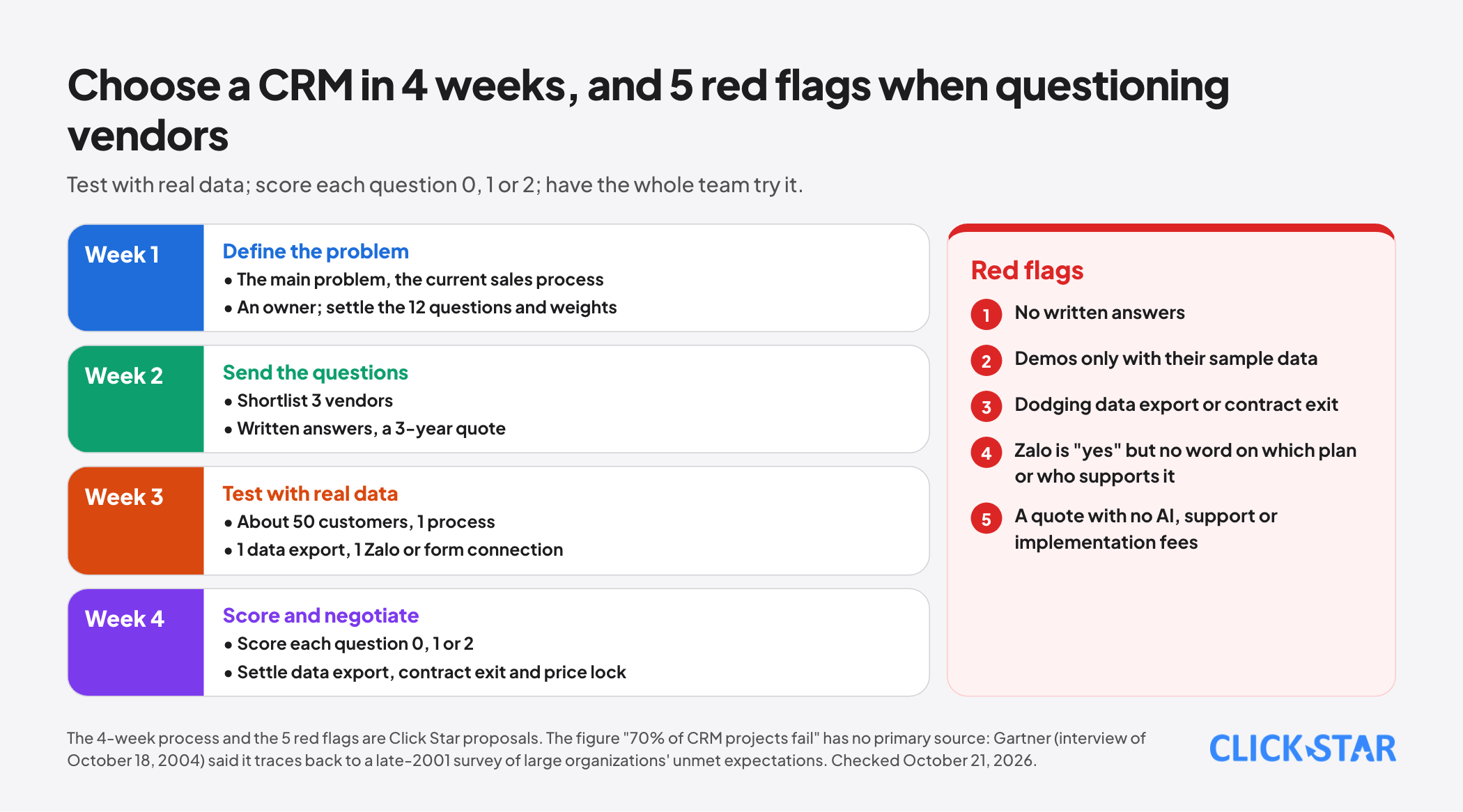
- Week 1: define the main problem, map the current sales process, choose an owner, settle the 12 questions and the weight of each.
- Week 2: shortlist 3 vendors, send the 12 questions and ask for written answers with a 3-year quote.
- Week 3: test with your real data: about 50 customers, one process, one data export, one Zalo or form connection. Everyone on the team enters data and scores it.
- Week 4: score each question 0, 1 or 2, negotiate terms on data export, contract exit and price lock, then decide.
5 red flags: no written answers; demos only with their sample data; dodging questions about data export or contract exit; a Zalo connection that is "yes" but with no word on which plan or who supports it; a quote that omits AI, support and implementation fees.
What is not known
Click Star has no independent data on how satisfied Vietnamese businesses are with each CRM, and it does not rank vendors. Salesforce's page and some documentation pages could not be read, so its limits above are secondary sources.
List prices change often, and some price pages carry no date. Public contract-exit terms of Vietnamese CRMs were not found. Whether the duty to store data in Vietnam applies to a given business needs legal advice.
Common mistakes
- Choosing by demo interface and feature list, without testing on real data.
- Comparing list prices while ignoring AI, support, implementation and extra-user charges.
- Not asking how to export all data and what the contract-exit terms are.
- Believing that "has Zalo integration" means an official feature included in the plan.
- Not working out API limits against daily leads and orders.
- Ignoring requests to delete or correct personal data within the legal deadlines.
- Letting one person alone score the options, instead of having the whole team try them.
Related posts
Need tailored advice for your business?
Click Star helps you build a solution that fits your industry and scale. We answer every question during business hours.