What website design costs in 2026: the line items and how to build a budget
The article splits website cost into 9 one-time and 8 recurring items, gives a 3-year TCO formula and shows how to write a brief for comparable quotes. Based on public pricing pages and official documents.
A website quote usually shows one number, while the real cost spreads across many years and line items. Two quotes that both say "website design" can cover very different scopes.
This article is not a price list. It splits cost into 9 one-time and 8 recurring items, gives a 3-year total cost of ownership formula, and shows how to write a brief that yields comparable quotes.
Sources are the public pricing pages of Vercel, WordPress.com, Shopify and Wix, Circular 10/2025/TT-BTC and documents from Google, WordPress.org and ICANN, checked on October 21, 2026.
Click Star already has articles on Next.js versus WordPress, converting websites and Core Web Vitals. A disclosure: Click Star sells SEO-ready, fast website design, so it has a related interest, and this article states no Click Star prices.
Key points
- Website cost has 9 one-time items (from discovery and design to training) and 8 recurring items (from domain and hosting to tool licenses).
- 3-year total cost of ownership (TCO) is the one-time cost plus 3 years of recurring cost plus a change reserve. A quote low at signing but high every year can cost more.
- Public prices are only examples for the platform item: per the pricing page read on October 21, 2026, Vercel Pro is 20 USD per month per developer seat.
- A .com.vn domain carries state fees of 100,000 VND registration (once) and 250,000 VND maintenance per year, under Circular 10/2025/TT-BTC (registrar service fees not included).
- Quotes are comparable only with the same scope, acceptance criteria, domain and code ownership, post-handover costs and support.
- Click Star found no public survey of Vietnamese website design prices with a clear method, so it states no market price.
Why a single quoted number is not enough to decide
A quote usually reflects only the initial investment, yet a website must run, be updated and be protected for years. Real cost of ownership is the sum of both.
English-language price surveys were mostly sellers' posts with US figures and no clear method, so none is used.
9 one-time items in the cost of website design
One-time items are paid while the project is built. Ask for a quote that splits these items.
- Discovery and specification: goals, page list, features.
- Interface design: layout, brand, phone and desktop versions.
- Development: coding or configuring the platform, with page templates.
- Content and images: who writes, who supplies photos, who translates.
- Migration from the old site: content, images, orders, URL redirect map.
- Integrations: forms, CRM, payments, email.
- Technical SEO: URLs, titles, sitemap, structured data, measurement setup.
- Testing: devices, browsers, forms, speed.
- Training and handover: admin training, documents, transfer of access.
On migration, Google Search Central's "Site moves and migrations" (updated August 20, 2026) advises mapping old URLs to new ones and using server-side 301 or 308 redirects. It also advises against sending all old URLs to the home page.
The same document says to keep redirects at least about 1 year and that rankings can fluctuate for weeks. If the old site brings visitors, the quote needs its own line for this.
8 recurring items after the website goes live
A recurring item is paid monthly or yearly to keep the website running. Over 3 years, this part is often larger than people expect.
- Domain: yearly renewal plus the registrar's service fee.
- Hosting or platform: a server or a platform subscription.
- Maintenance and updates: per WordPress.org (updated September 15, 2024), always update WordPress to the latest version, backing up first.
- Backups: schedule, storage and restore tests.
- Security: firewall, monitoring, incident handling.
- Content: new posts, page updates, new images.
- Measurement: conversion tracking, reports, periodic review.
- Tool licenses: paid plugins, themes, email or SEO tools, usually yearly.
An SSL certificate is not necessarily a cost. Per Let's Encrypt (read October 21, 2026), the nonprofit Internet Security Research Group runs this certificate authority and anyone who owns a domain can get a trusted certificate at no cost. It is only one layer; patching, backups and monitoring still need people.
Public prices as examples for the platform item
The prices below were read from official pricing pages on October 21, 2026 and only illustrate the shape of cost. They are in USD; tax differs by site (Wix says prices include GST); prices change quickly and vary by region.
- Vercel: Hobby is 0 USD for personal, non-commercial use only; Pro is 20 USD per month per developer seat with a 20 USD monthly usage credit, then usage billing.
- WordPress.com (billed yearly): Personal 4 USD, Premium 8 USD, Business 25 USD, Commerce 45 USD per month; free domain for the first year.
- Shopify: Basic is 19 USD per month billed yearly (25 USD billed monthly), with a 2% fee when using a third-party payment gateway; a 3-day trial, then 1 USD per month for 3 months.
- Wix: Light is 17.77 USD per month billed yearly with a free first-year domain; the page says USD prices are for reference only and the domain voucher does not apply on renewal.
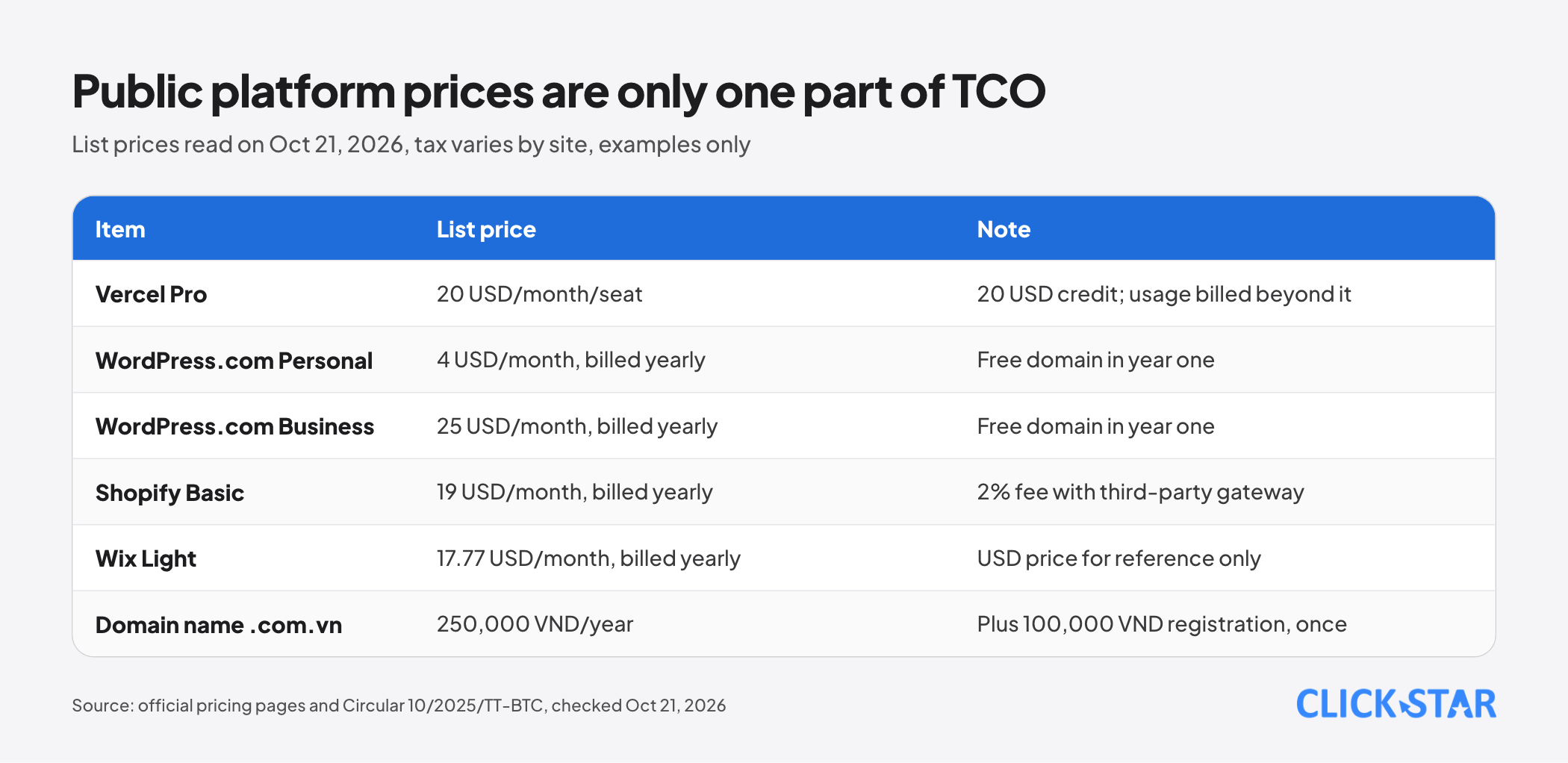
Many items are billed per year and per user, and first-year offers do not repeat in year two.
3-year total cost of ownership (TCO): formula and example
3-year TCO is everything you pay to own and run the website for 3 years. The formula is a reference framework from Click Star, not from an outside source.
- 3-year TCO = total of the 9 one-time items + 3 × total of the 8 recurring items per year + change reserve.
- Change reserve is the budget for extra features, major edits or upgrades within 3 years, set by you.
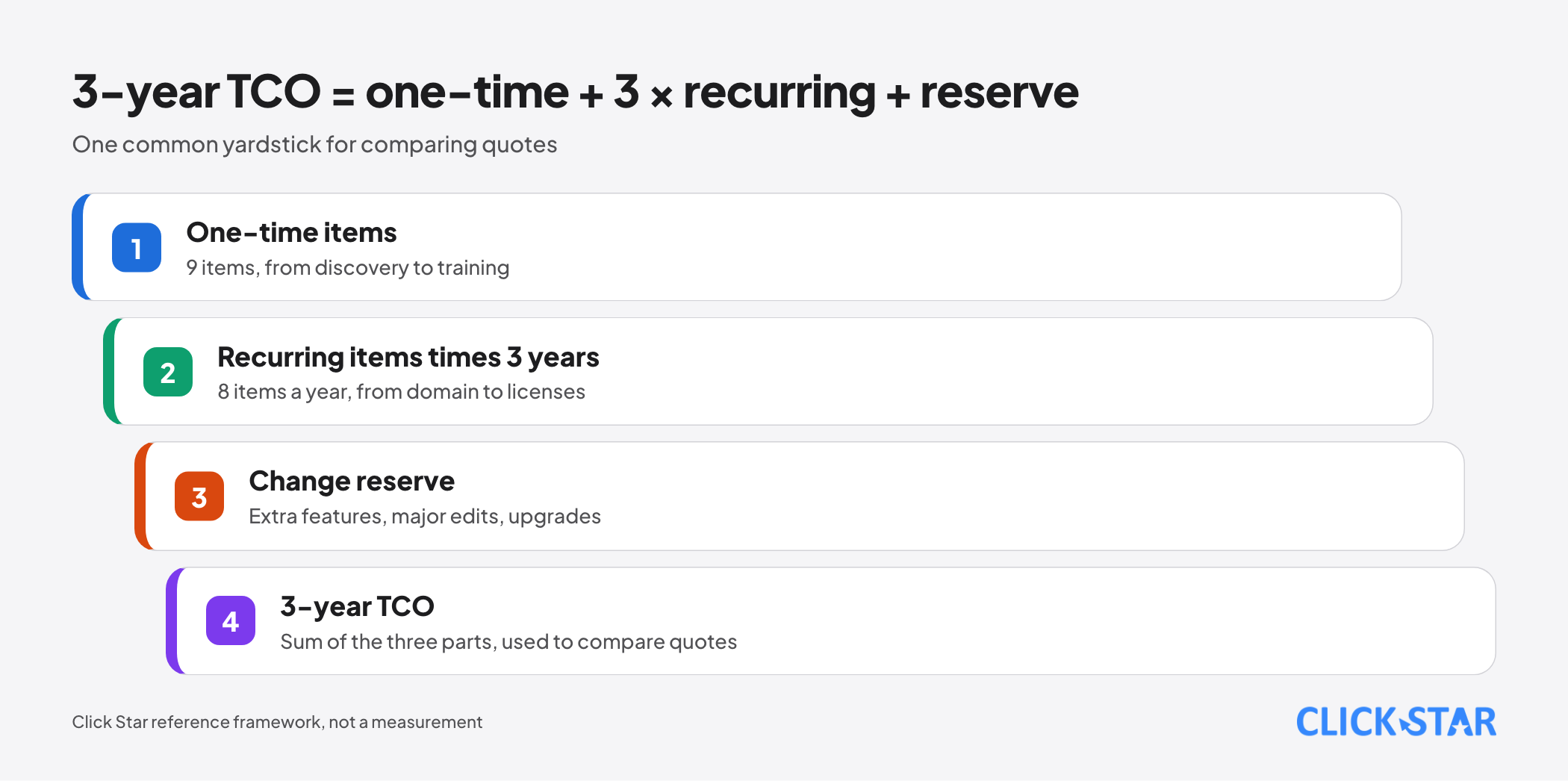
The example is an illustrative model, not a measurement, in hypothetical units. Quote A has 100 units one-time and 20 units per year recurring, so its 3-year TCO is 160 units before any reserve.
Quote B has only 60 units one-time but 45 units per year recurring, so its 3-year TCO is 195 units. B is cheaper at signing but costlier after 3 years, so work out the 3-year figure yourself.
For domains, real numbers exist for the state fee. Under Circular 10/2025/TT-BTC (Ministry of Finance, issued March 19, 2025, in force May 3, 2025), com.vn carries a 100,000 VND registration fee paid once and a 250,000 VND maintenance fee per year, paid the first time at registration.
Click Star's arithmetic: 100,000 + 3 × 250,000 = 850,000 VND over 3 years, state fee only. Retail registrars usually add a service fee, which Click Star did not verify.
Factors that change the cost
There are 8 main factors. Answer each before requesting quotes, not leave it to the vendor's guess.
- Number of page templates: count layout templates, not only pages.
- Features: booking, search, customer accounts.
- Multiple languages: translation, URLs and maintaining translated content.
- Integrations: each outside system adds configuration and testing work.
- Performance: Core Web Vitals thresholds need image, code and font optimization.
- Content: newly written, edited, or migrated from the old site.
- Images: custom photography, licensed or existing images.
- Deadline: a rush is usually pricier.
On performance, per web.dev (updated October 31, 2024), the good thresholds are LCP at most 2.5 seconds, INP at most 200 milliseconds and CLS at most 0.1, assessed at the 75th percentile, separately for mobile and desktop. Write these into acceptance criteria instead of just "fast loading".
How to write a brief that produces comparable quotes
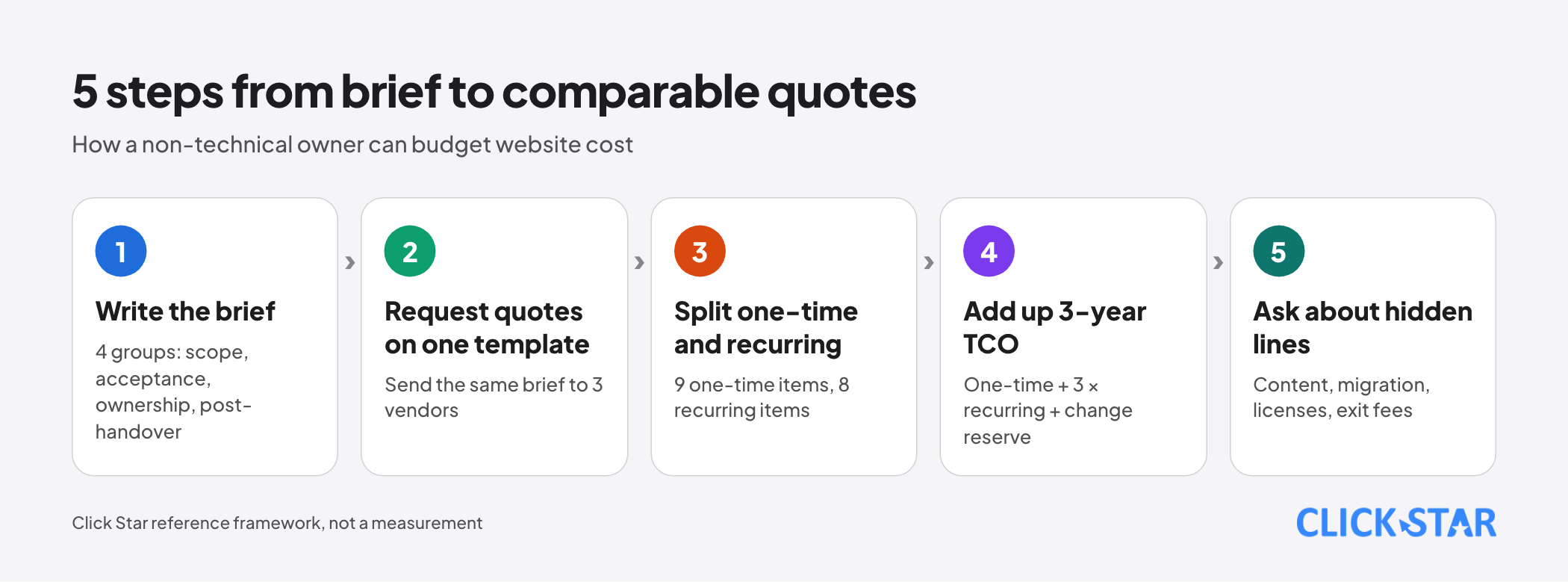
Quotes are comparable when every vendor answers the same brief. It needs only 4 groups.
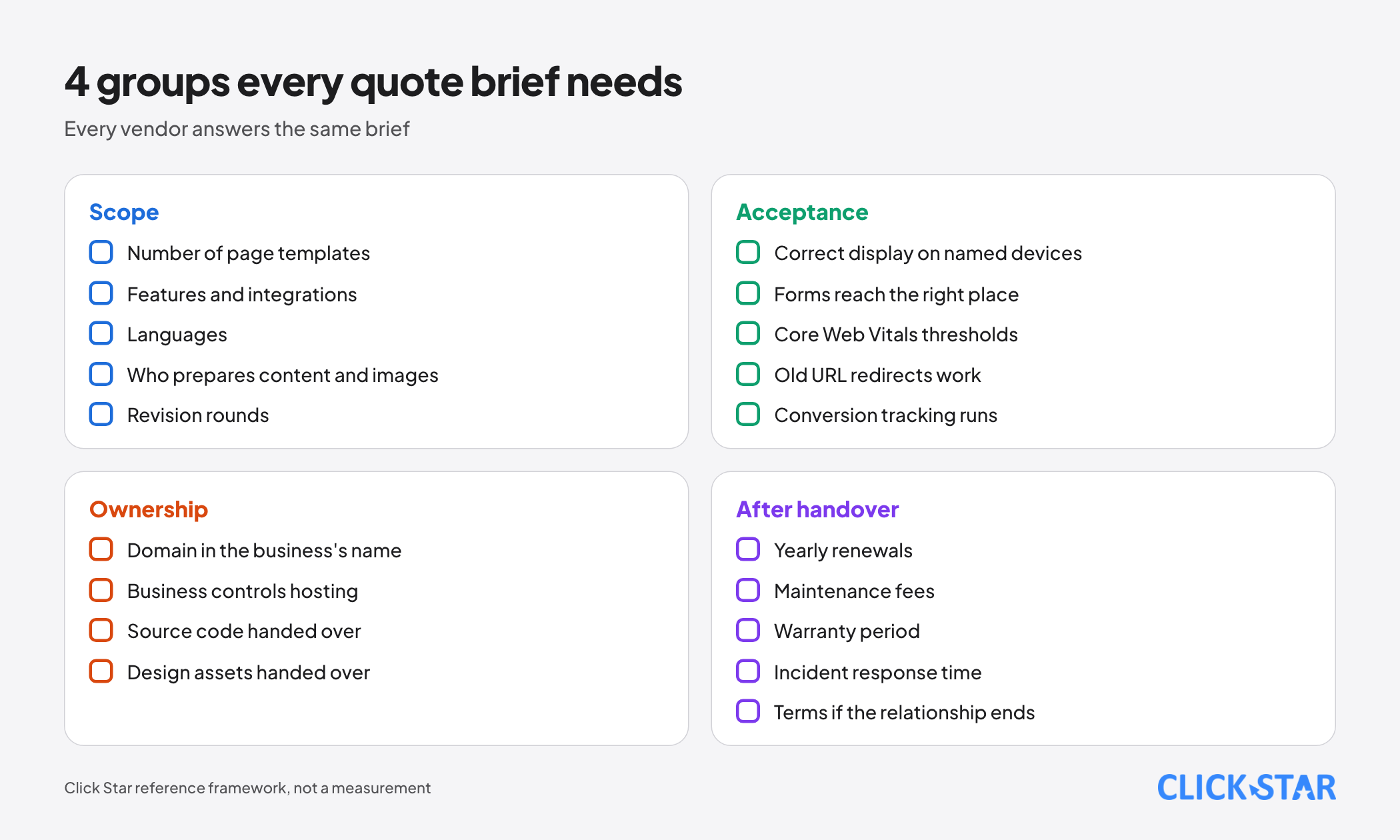
Group 1, scope. List page templates, features, integrations, languages, who prepares content and images, and revision rounds. State what is out of scope too.
Group 2, acceptance criteria. Write what can be checked: correct display on named devices, forms reaching the right place, Core Web Vitals thresholds, old URL redirects working, measurement running.
Group 3, ownership. The domain is registered to the business, which controls hosting, and code and design assets are handed over. Per ICANN (read October 21, 2026), a registrant must provide accurate information and keep it updated; Click Star recommends the business be the registrant.
Group 4, post-handover costs. Yearly renewals, maintenance fees, warranty, incident response time, and what happens if the relationship ends.
Ask every vendor to answer in the same table, so price differences reflect real scope differences.
How to read a quote and the cost lines that tend to be hidden
Look for what the quote omits. These lines are often missing or vague.
- "All-inclusive" with no scope: ask how many templates, which features, how many revision rounds.
- Content and images: many quotes assume the client supplies them.
- Migration and redirects: often no separate line despite real effort.
- First-year offers: free in year one, charged from year two, like the Wix domain voucher that excludes renewal.
- Yearly licenses: ask for the list of paid plugins and renewal prices.
- Optional maintenance: a low quote may exclude updates, backups, incident handling.
- Exit fees: ask if exporting data, moving hosting and handing over code cost extra.
If one quote is clearly lower, check which of the 9 one-time or 8 recurring items it leaves out first.
Vietnam context
For .vn domains, the state fee is small and public but you need to read the right table. Under Circular 10/2025/TT-BTC (Official Gazette issue 609 + 610, March 31, 2025), other second-level domains such as tenmien.vn have a maintenance fee of 350,000 VND per year.
Click Star read the Circular through an Official Gazette copy reposted on the legal-education portal of Quang Ninh province, so check the original text. If anyone says "the market price is X", ask for the source and scope.
Click Star's view. In Click Star's view, the costliest mistake is not choosing an expensive vendor but comparing two quotes of different scope as if they were equal. This is a technical and management judgment, not a measurement.
3 things to settle before discussing price are the page and feature list, measurable acceptance criteria, and ownership of the domain, accounts and source code. Read this view with the interest stated above.
A 14-day plan to get comparable quotes
The plan is a reference framework from Click Star, not a measurement or an outside source.
- Days 1 to 3: write the goals, the page list by template, and the must-have and later features.
- Days 4 to 6: write the brief in 4 groups and a sample quote table that splits one-time from recurring items.
- Days 7 to 10: send the same brief to 3 vendors and note their questions.
- Days 11 to 14: compute 3-year TCO per quote, list missing lines and ask again.
Common mistakes
- Comparing design prices without comparing scope and page templates.
- Looking only at year one and forgetting the recurring items of years two and three.
- Leaving the domain or accounts in the vendor's name instead of the business's.
- Leaving content, images and migration from the old site out of the budget.
- Using introductory prices or first-year offers to plan multiple years.
- Writing "fast loading" with no measurable threshold in the acceptance criteria.
- Not asking about terms when switching vendors or exporting data.
What is not known
Click Star has no public, clearly documented measurement of website design prices in Vietnam, so no market price is given. Registrar and domestic hosting prices were not read from any provider's price page.
International platform prices were read through a summarizing tool from official pages and vary by location. Click Star has not checked whether an amendment to Circular 10/2025/TT-BTC affects .com.vn fees.
The TCO model and 14-day plan are Click Star's own frameworks; no independent study measures TCO differences between quote styles.
Related posts


Need tailored advice for your business?
Click Star helps you build a solution that fits your industry and scale. We answer every question during business hours.