Is CRM really important for a business? When you need it and when you do not yet
The 6 problems CRM solves, evidence from Harvard Business Review, McKinsey and Salesforce, signs a business needs CRM, why projects fail and a 90-day plan.
CRM is one of the most discussed and most misunderstood pieces of software. To some business owners it is a mandatory investment for every company that has customers. To others it is expensive software that staff will not fill in.
Both views are partly right, and the honest answer to "is CRM really important" is: it is important when the business has a problem that CRM can solve, and not yet necessary when it does not.
This article explains which problems CRM solves, the evidence from published studies and surveys, the signs that a business has reached the point of needing one, why CRM projects fail, how to choose and a 90-day plan.
The figures come from Harvard Business Review, McKinsey, Salesforce's State of Sales report and Statista, each named in the sentence that uses it and checked as of October 20, 2026. Some sources are surveys run by software vendors, and the article says so where that applies.
Key points
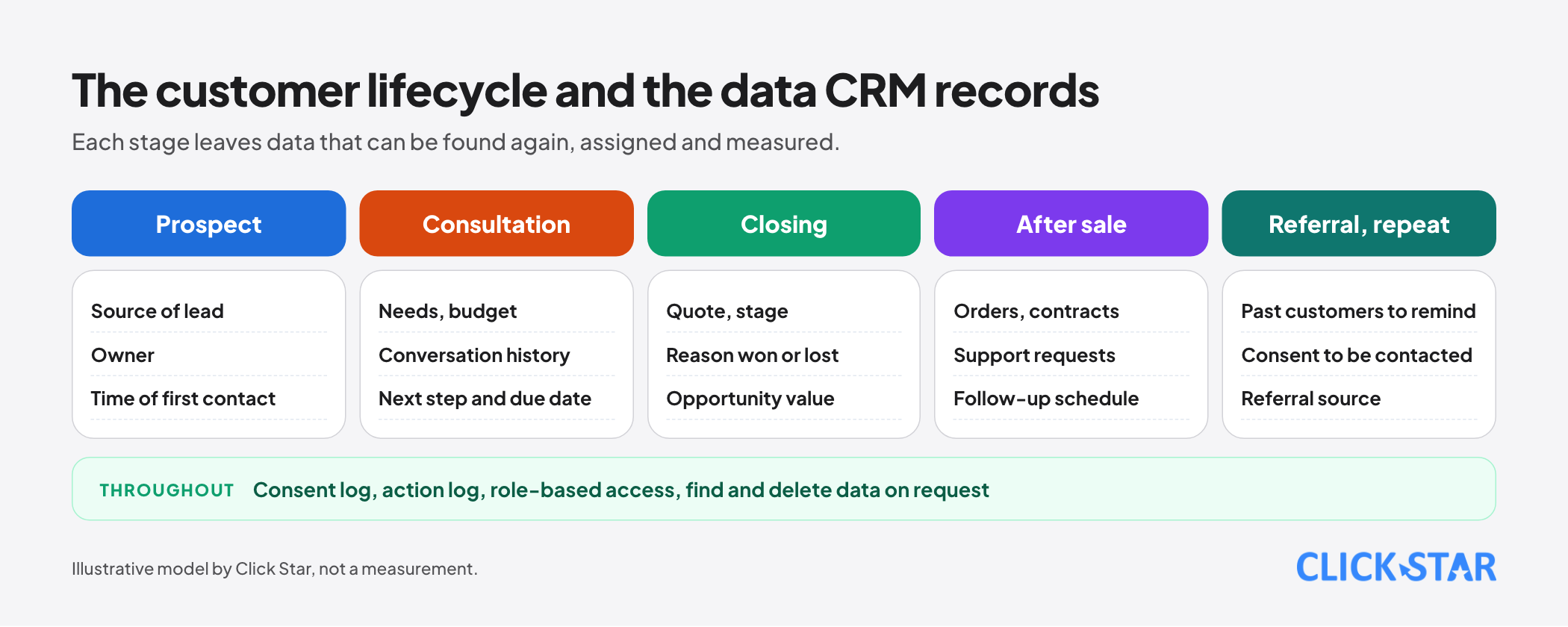
- CRM is not software for storing a contact list. Its value is in turning every interaction with a customer into data that can be found again, assigned to someone responsible and measured, from the first prospect contact to after-sales.
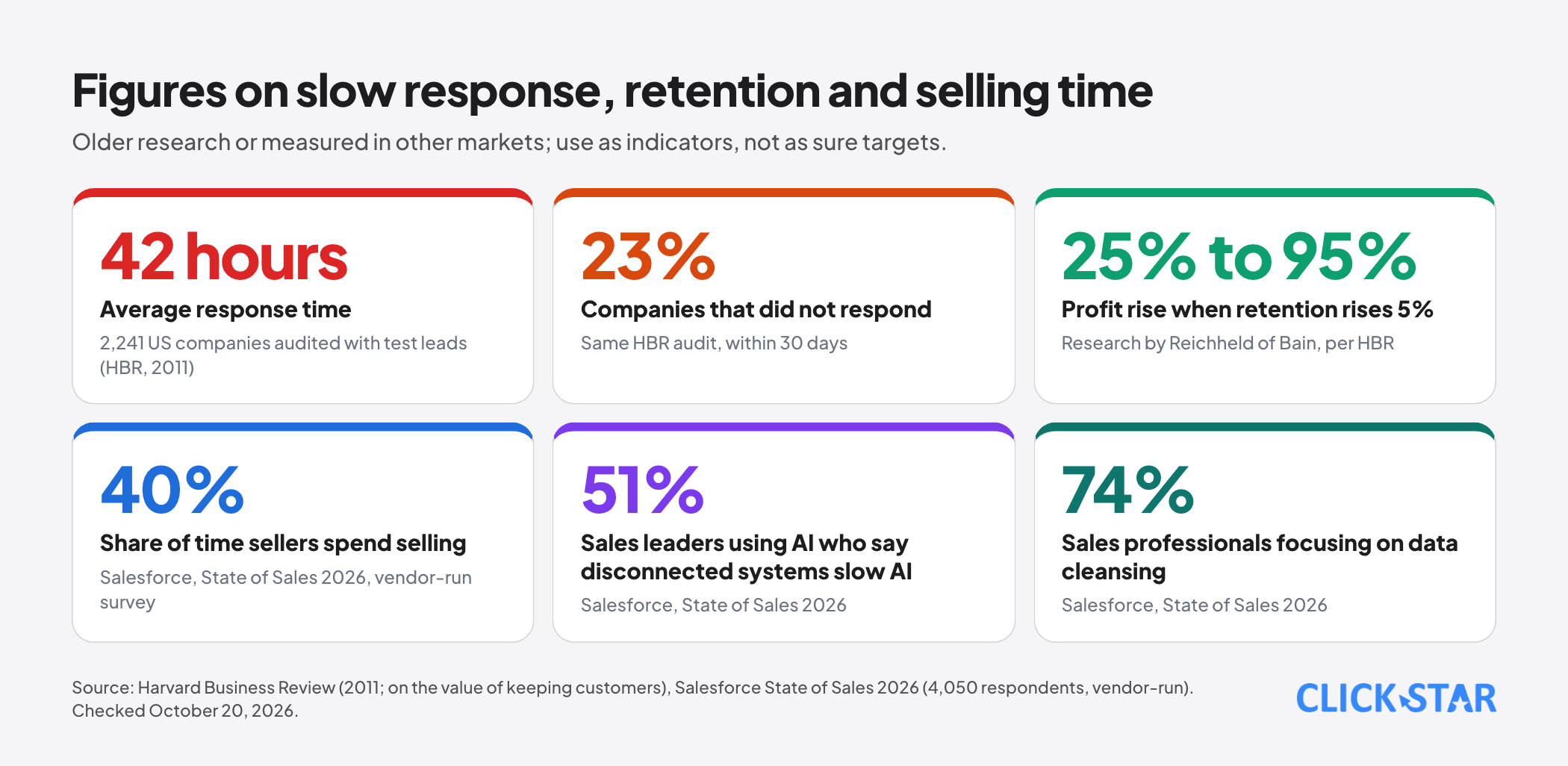
- Slow response is a common weak point. According to the 2011 Harvard Business Review article "The Short Life of Online Sales Leads", an audit of 2,241 US companies found an average response time of 42 hours and 23% that did not respond.
- Keeping customers is often worth more than finding new ones. Harvard Business Review cites research by Frederick Reichheld of Bain that raising customer retention by 5% increases profits by 25% to 95%.
- According to Salesforce's State of Sales 2026 survey (4,050 sales professionals, run by a vendor), the average seller spends only 40% of their time selling, and 51% of sales leaders who use AI say disconnected systems are slowing their AI initiatives.
- CRM is not yet necessary when a business has very few customers, an unclear sales process or nobody responsible for data entry. In that case a well-designed spreadsheet is still enough.
- Many CRM projects fail because data entry is abandoned, the interface is cumbersome, the data is dirty and nobody owns it, not because features are missing.
- Since January 1, 2026, CRM is also where consent is recorded and data subject requests are handled under the Law on Personal Data Protection.
What CRM is and is not
CRM (Customer Relationship Management) is a system for managing customer relationships: recording who a customer or prospect is, where they came from, what has been discussed, what stage they are at, who is responsible, what the next step is and when.
Click Star already has a separate article that distinguishes CRM from CDP. In short, CRM focuses on relationships and the sales and care process, while a CDP focuses on gathering and unifying behavioral data from many sources.
CRM is not software that sells in place of people, it does not clean data on its own and it cannot fix a sales process that is unclear. If a business has not agreed what counts as a qualified prospect, who closes and within how long, a CRM will only record that disorder with a nicer interface.
6 problems CRM solves, and the evidence
1. Prospects abandoned because of slow response. The article "The Short Life of Online Sales Leads" by James Oldroyd, Kristina McElheran and David Elkington, published in Harvard Business Review in 2011, audited 2,241 US companies by sending test leads through their websites.
According to reports on the study, among companies that responded within 30 days the average time was 42 hours, and 23% did not respond.
Citations of the study also quote a figure for how much more likely a firm is to close if it makes contact within an hour, but the exact origin of that figure is not consistent across the citing articles, so this article does not use it.
The research is old and measured in the US, but the behavior pattern, slow response loses customers, holds for any business that takes leads through forms, Zalo or phone. CRM addresses it by assigning tasks automatically, sending reminders and flagging overdue items.
2. Not knowing who bought what and when to follow up. Harvard Business Review, in its article on the value of keeping the right customers, cites research by Frederick Reichheld of Bain & Company that raising customer retention by 5% increases profits by 25% to 95%.
The article also states that acquiring a new customer costs 5 to 25 times more than retaining one but gives no separate source for that figure, so it should be read only as a rough scale. What is more certain is the logic: to look after existing customers you need records, history and reminders, and that is CRM's job.
3. Personalization needs data about each customer. McKinsey's 2021 report on personalization, widely quoted, states that 71% of consumers expect companies to personalize interactions, 76% are frustrated when they do not, and faster-growing companies generate 40% more of their revenue from personalization.
A critical commentary notes that these figures sit on one page with no sample size or fielding date, so Click Star treats them as an indicator of direction, not as precise measurements.
4. Sales staff lose time to work that is not selling. Salesforce's State of Sales 2026 survey, run from August to September 2025 with 4,050 sales professionals in 22 countries, found that the average seller spends 40% of their time selling and that Gen Z sellers lose about 2 hours a week to manual data entry.
It is a survey run by a CRM vendor, so it should be read with caution, but it fits a common experience: data entry and searching for information eat into selling time.
5. Managers cannot see the pipeline. When information sits in each employee's head or in many spreadsheets, a manager does not know how many opportunities are open, at what stage, of what value and how long since the last contact. CRM gives one shared view and allows measuring the conversion rate between stages.
**6.
Scattered data blocks AI and automation.** Also according to Salesforce, 51% of sales leaders who use AI say disconnected systems are slowing their AI initiatives, 74% of sales professionals are focusing on data cleansing such as removing duplicates and standardizing formats, and 79% of high performers prioritize data hygiene against 54% of underperformers.
For a business that wants to use AI in customer care and marketing, central and clean customer data is a foundation.
The link to personal data protection law
CRM is often where a business holds most of its personal data.
According to Luat Viet An's summary of Decree 330/2026/ND-CP, failing to keep consent logs is a violation punishable by a fine of VND 30 to 50 million, and according to its summary of Decree 356/2025/ND-CP a business must respond to a request to withdraw consent within 2 working days and delete data within 20 days.
A properly designed CRM has fields for recording consent, data source and purpose of use, and allows finding, correcting and deleting all of one customer's data. Click Star has a separate article updating this law for 2027 and one on why businesses should use a database in online operations.
When CRM is not yet necessary
An honest assessment must also cover this side. CRM is usually not yet needed when:
- The business has very few customers (a few dozen) and one or 2 people looking after them, so everything is still within memory and a tidy spreadsheet is enough.
- The sale is a one-time transaction with little repeat purchase and little need for long-term follow-up.
- The sales process is unclear. Clarify the stages and criteria first, then choose the tool.
- Nobody is yet responsible for keeping data clean and urging staff to fill it in.
In these situations a more practical first step is a structured spreadsheet: customer ID, name, normalized phone number, source, stage, owner, date of last contact, next step, with entry rules. That same sheet will be the blueprint for the CRM later.
Signs a business has reached the point of needing CRM
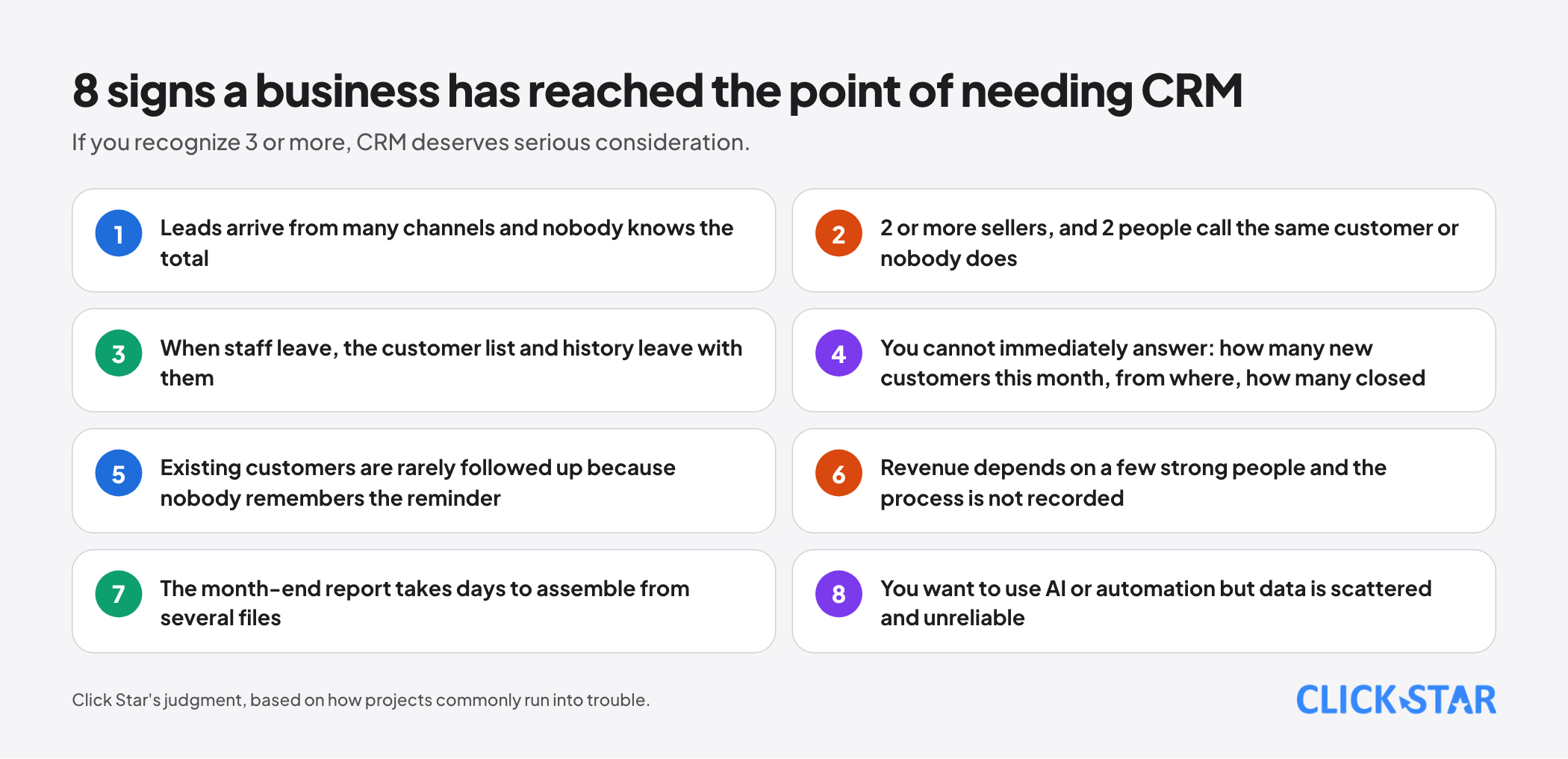
Click Star's view. If you recognize three or more of the signs below, CRM deserves serious consideration:
- Prospects arrive from many channels (website, Zalo, ads, phone, events) and nobody knows the total.
- There are two or more salespeople, and it often happens that 2 people call the same customer, or nobody does.
- When an employee leaves, the customer list and history leave with them.
- You cannot immediately answer: how many new customers this month, from which source, how many have closed.
- Existing customers are rarely followed up because nobody remembers when to remind them.
- Revenue depends on a few strong people, and the process is not recorded well enough to train new staff.
- The month-end report takes days to assemble from several files.
- The business wants to use AI or automation but the data is scattered and unreliable.
Why many CRM projects do not deliver
Click Star does not use a "failure rate" figure for CRM, because the figures in circulation usually have no clear survey source. The reasons below rest on how projects commonly run into trouble, and match what Salesforce's survey shows about data hygiene:
- Abandoned data entry: too many mandatory fields, extra steps, staff who see it as extra work and not as a tool that helps them. The quality of the entry interface decides this, as Click Star's article on UI and UX analyzes.
- Dirty data: phone numbers in many formats, one customer with 3 records, free-text fields that are not consistent.
- No owner: nobody is responsible for configuration, cleaning and training.
- Not tied to the sales process: the CRM sits apart from real work and is seen as reporting for management.
- Too big from the start: rolling out every feature at once instead of starting from one problem.
- Not measured and not used: managers do not use CRM reports in meetings and decisions, so staff see entering data as pointless.
8 criteria for choosing a CRM
- It solves the problem you identified, not bought from a feature list.
- Easy to enter data on phone and computer, with few steps.
- Stages and data fields can be configured to your process.
- Connects to the website, forms, Zalo, advertising and accounting.
- Role-based permissions and an action log.
- Supports recording consent and handling data subject requests.
- Reports and dashboards good enough, and your data can be exported.
- The vendor offers Vietnamese support and training, and total cost is clear, including the cost of adding users.
A 90-day plan
- Days 1 to 15: identify the main problem (for example slow response, lost customer history), map the current sales process, agree stages and criteria and choose an owner.
- Days 16 to 30: clean and standardize existing data (customer identifier, remove duplicates) and choose a tool against the 8 criteria.
- Days 31 to 60: configure, load clean data, train, run in parallel with the old way for a small team and collect feedback on the entry interface.
- Days 61 to 90: extend to the whole team, bring CRM reports into the weekly meeting, phase out the old spreadsheets and measure the metrics below.
Metrics to track
- Time to first response for new prospects (typical response time and share of late responses).
- Conversion rate between pipeline stages.
- Share of complete records and share of duplicates.
- Number of existing customers followed up on time and the repeat purchase rate.
- Time an employee spends on data entry each week.
- For personal data: number of data subject requests handled on time.
The Vietnamese market
According to Statista figures cited by MISA, revenue of the CRM software market in Vietnam is expected to be about USD 87.06 million in 2025, with an estimated annual growth rate of 15.18% over 2025 to 2029.
This is market revenue, not the share of businesses using CRM. Click Star has not found a reliable official survey of the share of small and medium businesses in Vietnam using CRM, and some statistics in circulation state neither the survey body nor the date, so the article does not use them.
Common mistakes
- Buying a CRM before the process and the problem to solve are clear.
- Rolling out every feature at once instead of starting from one problem.
- Letting CRM become "reporting for management" instead of a tool that helps sellers.
- Nobody responsible for clean data.
- No training and no time for data entry in the working schedule.
- Ignoring personal data: not recording consent and having no way to delete on request.
- Deciding to drop CRM after one poor rollout, without finding the real cause.
Related posts
Need tailored advice for your business?
Click Star helps you build a solution that fits your industry and scale. We answer every question during business hours.