The shift in SEO in the AI era: from optimizing rankings to being present in the answer
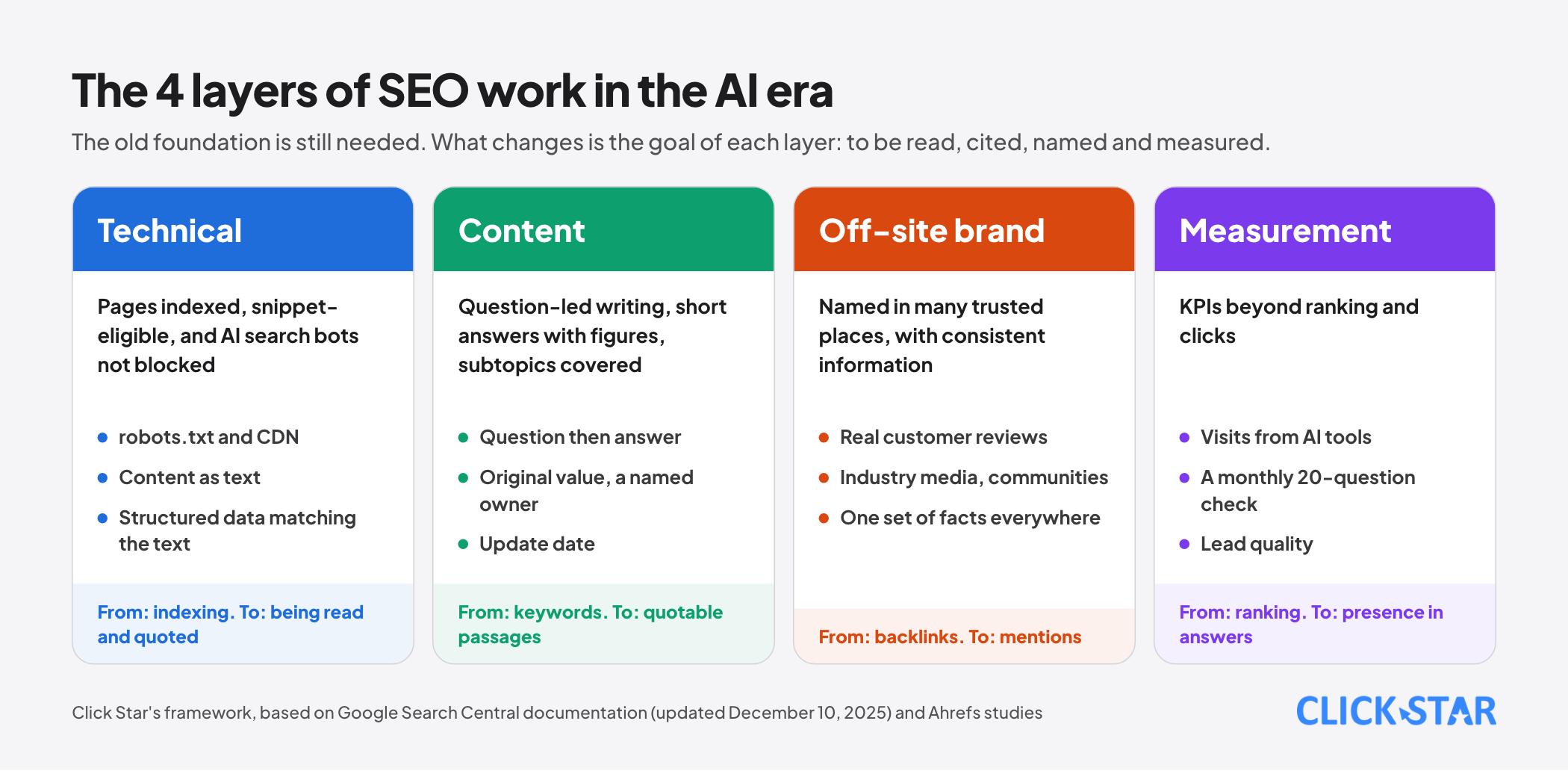
The 4 layers of SEO work changing with AI: technical, content, brand outside your website and measurement, with a 90-day plan. Figures from Google, OpenAI, Anthropic and Perplexity documentation and independent studies.
SEO is not dead, but the work of an SEO professional is changing shape. With Google putting AI Overviews and AI Mode right on the results page, and ChatGPT, Claude and Perplexity becoming places where people ask their questions, the target of optimization is no longer just a position in a list of 10 links.
The new target is whether your content is read, understood and mentioned inside the answer itself. This article describes that shift across 4 layers of work: technical, content, brand outside your website and measurement, with a 90-day plan for businesses.
The figures come from official documentation from Google, OpenAI, Anthropic and Perplexity and from independent studies, each named in the sentence that uses it and checked as of October 20, 2026. Research on AI changes very fast, so treat the numbers as a direction, not fixed values.
Key points
- The biggest shift is the goal: from "what position am I in" to "am I cited and named in the answer". The two are related but not the same.
- Google states there are no separate technical requirements to appear in AI Overviews and AI Mode: a page must be indexed and eligible to show a snippet. Classic SEO foundations remain a prerequisite.
- AI tools' bots are split by purpose (search, training, user-requested). Blocking the wrong search bot can mean your website is never mentioned in answers.
- Content needs to be written in passages that can be quoted on their own: a clear question, a short answer with figures right below it, and only then the explanation.
- An Ahrefs study of 75,000 brands found that how often a brand is mentioned across the web correlates with its presence in AI Overviews more strongly than the number of backlinks. Reputation outside your website is now a real layer of SEO.
- KPIs to add: mentions in AI answers, visits from AI tools, branded search and lead quality, alongside rankings and clicks.
What is shifting: from a list of links to a synthesized answer
According to Google Search Central's "AI features and your website" documentation (updated December 10, 2025), AI Overviews and AI Mode may use a technique called "query fan-out": from one question, the system issues several related searches on subtopics and then combines the results.
As a result, the set of links shown can be wider and more varied than in classic search. Google also says AI Overviews appear only when its systems judge they add value, so many queries still have none.
On the user side, clicking behavior has changed. A Pew Research Center study published in July 2025, tracking 900 U.S. adults across 68,879 searches, found that users clicked a traditional result in 8% of visits when the page had an AI summary, versus 15% when it did not.
Clicking a link inside the summary itself happened in only about 1% of visits. Pew is explicit that this is an observational comparison, not proof of cause.
SparkToro's 2026 figures (Similarweb data, the first 4 months of the year, U.S. Google searches) recorded 68.01% of searches ending without a click, up from 60.45% in 2024, with AI Overviews appearing on more than 20% of searches. SparkToro also acknowledges that the study does not isolate the share of the rise caused by AI Overviews.
Click Star's view. Both studies measure U.S. users on Google, and there is no equivalent measurement yet for Vietnam. But the direction is clear enough to plan on: clicks from informational queries will be harder to grow than before, while the remaining clicks tend to come from people with a clearer intent.
Businesses should re-set their goals around conversions and lead quality instead of traffic alone.
Ranking is no longer enough
A practical question is whether the pages AI cites are the pages at the top of the results.
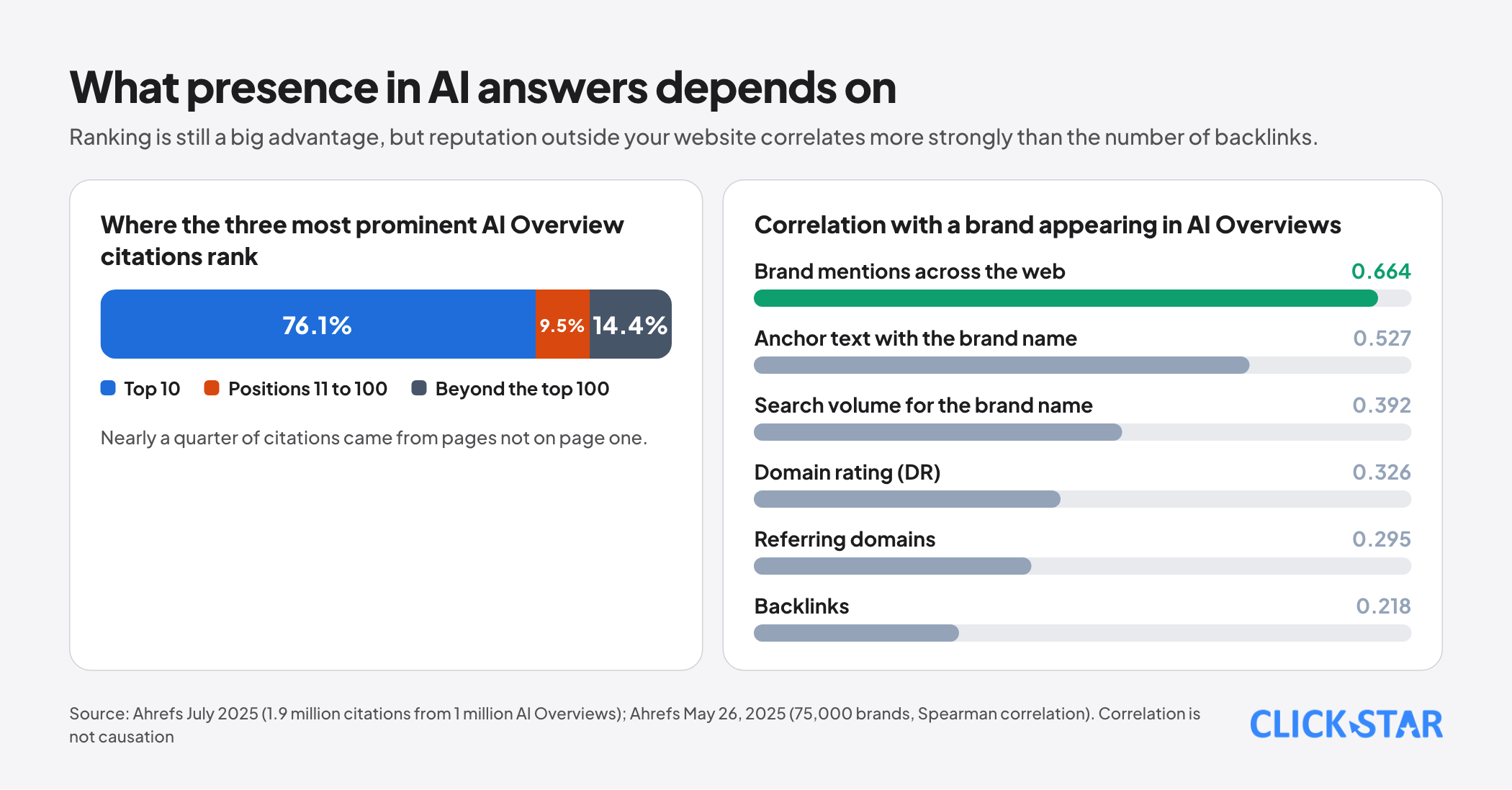
An Ahrefs study published in July 2025, covering 1.9 million citations from 1 million AI Overviews, found that among the three most prominent citations in each answer, 76.1% pointed to a page in the top 10 organic results, 9.5% to positions 11 to 100 and 14.4% to pages outside the top 100.
So good ranking is still a major advantage, but nearly a quarter of citations came from pages not on page one.
More recent studies, reported through secondary sources, suggest the share may be lower and varies with method: Conductor reports about 57% of AI Overview citations coming from pages outside the top 10, BrightEdge and Moz also report low overlap, and Ahrefs is cited as having measured a clear drop from July 2025.
The figures cannot be compared directly because they count differently. What the studies share is that overlap between ranking and citation is shrinking.
In the same 75,000-brand study (Ahrefs, published May 26, 2025, using Spearman correlation), the factors correlated with a brand appearing in AI Overviews were mentions of the brand across the web (0.664), anchor text containing the brand name (0.527), search volume for the brand name (0.392), domain rating (0.326), referring domains (0.295) and backlinks (0.218).
The authors themselves stress that correlation is not causation and that every factor is only moderate to weak.
The technical layer: conditions to be read and quoted
Google names the conditions for a page to be eligible for its AI features: the page is indexed, it is eligible to show a snippet in Search, and there are no additional technical requirements.
Google also recommends allowing crawling in robots.txt and at the CDN or hosting level, keeping important content as text, linking internally well, making structured data match the visible text and verifying the site in Search Console.
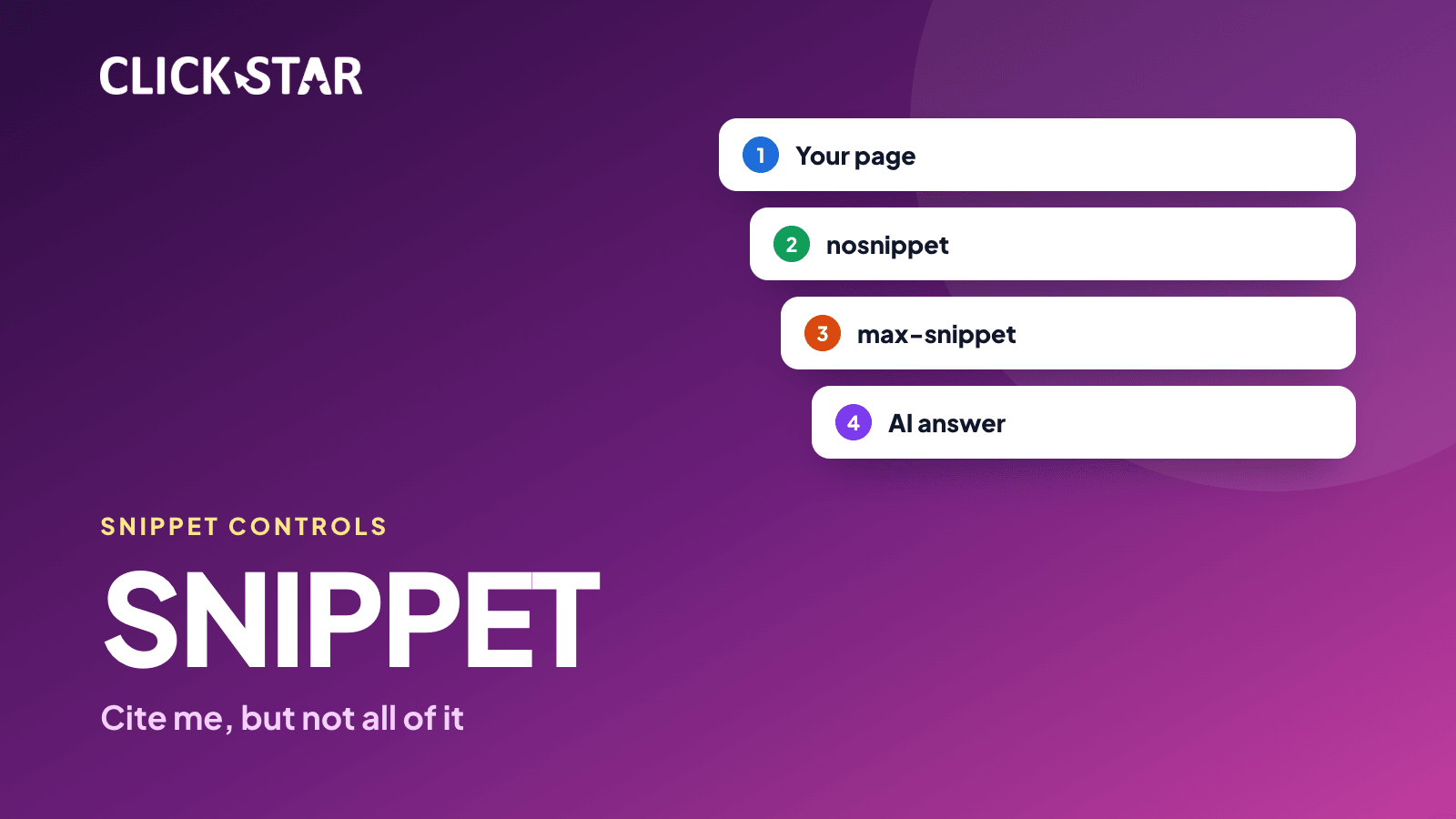
Google states plainly that no separate AI text files or special schema types are needed for these features. The nosnippet, data-nosnippet, max-snippet and noindex controls limit how much content is shown.
For AI tools outside Google, each bot has its own role, and robots.txt rules should be set by purpose:
- OpenAI: OAI-SearchBot surfaces websites in ChatGPT search results, GPTBot collects content that may be used to train models, and ChatGPT-User runs when a user asks and is not used to decide search visibility. OpenAI notes each setting is independent, so you can allow OAI-SearchBot and block GPTBot.
- Anthropic: ClaudeBot collects content that may be used for training, Claude-SearchBot indexes content to improve search answers, and Claude-User visits when a user asks. Anthropic says blocking Claude-SearchBot or Claude-User may reduce your site's visibility.
- Perplexity: PerplexityBot serves search and is not used to train foundation models, and Perplexity-User runs on a user's request. Perplexity notes changes can take up to 24 hours to take effect.
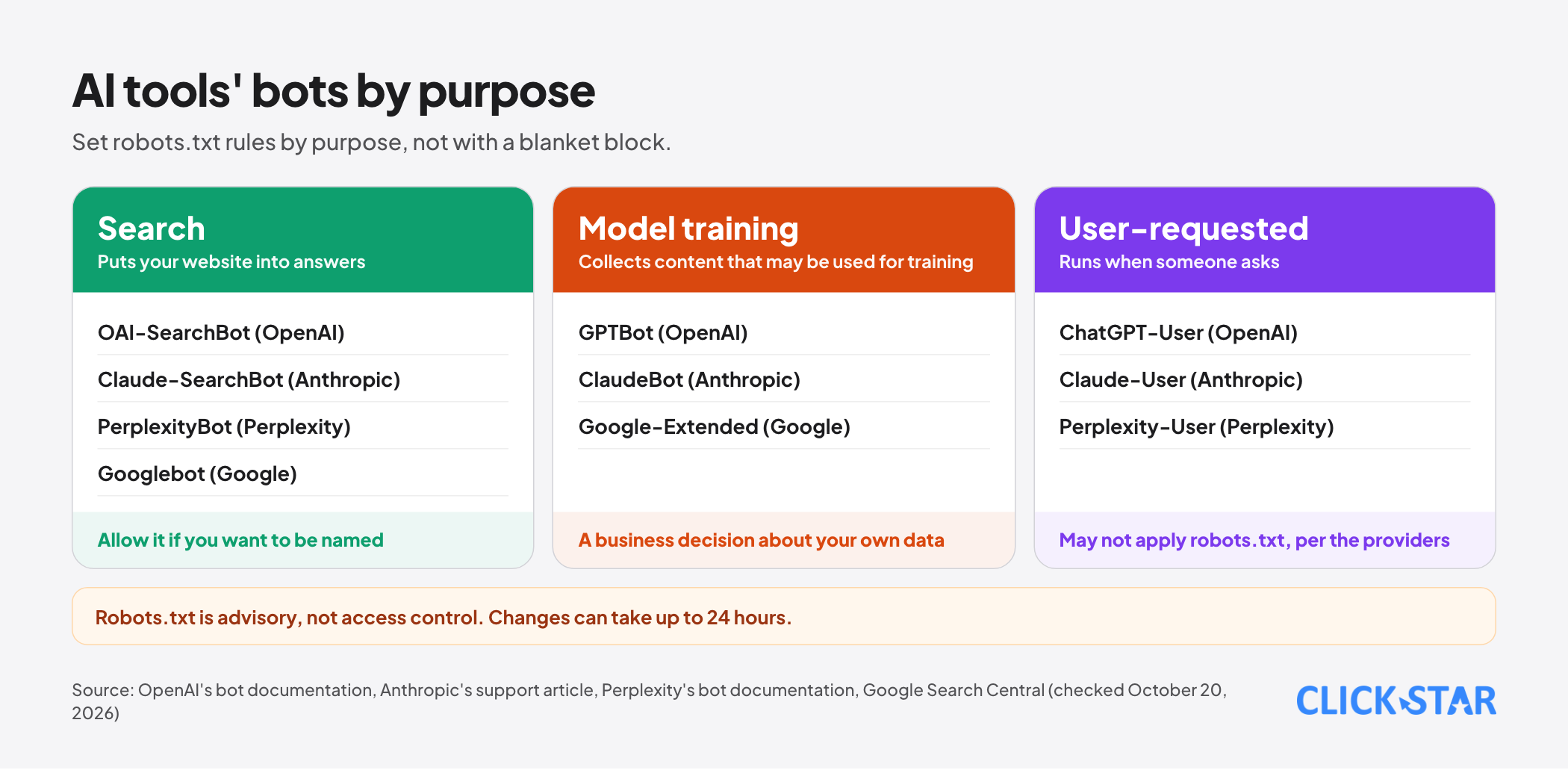
Click Star's view. For a business that wants to be named, allow the search bots and the bots that answer users directly, and treat whether to allow training bots as a business decision about your own data.
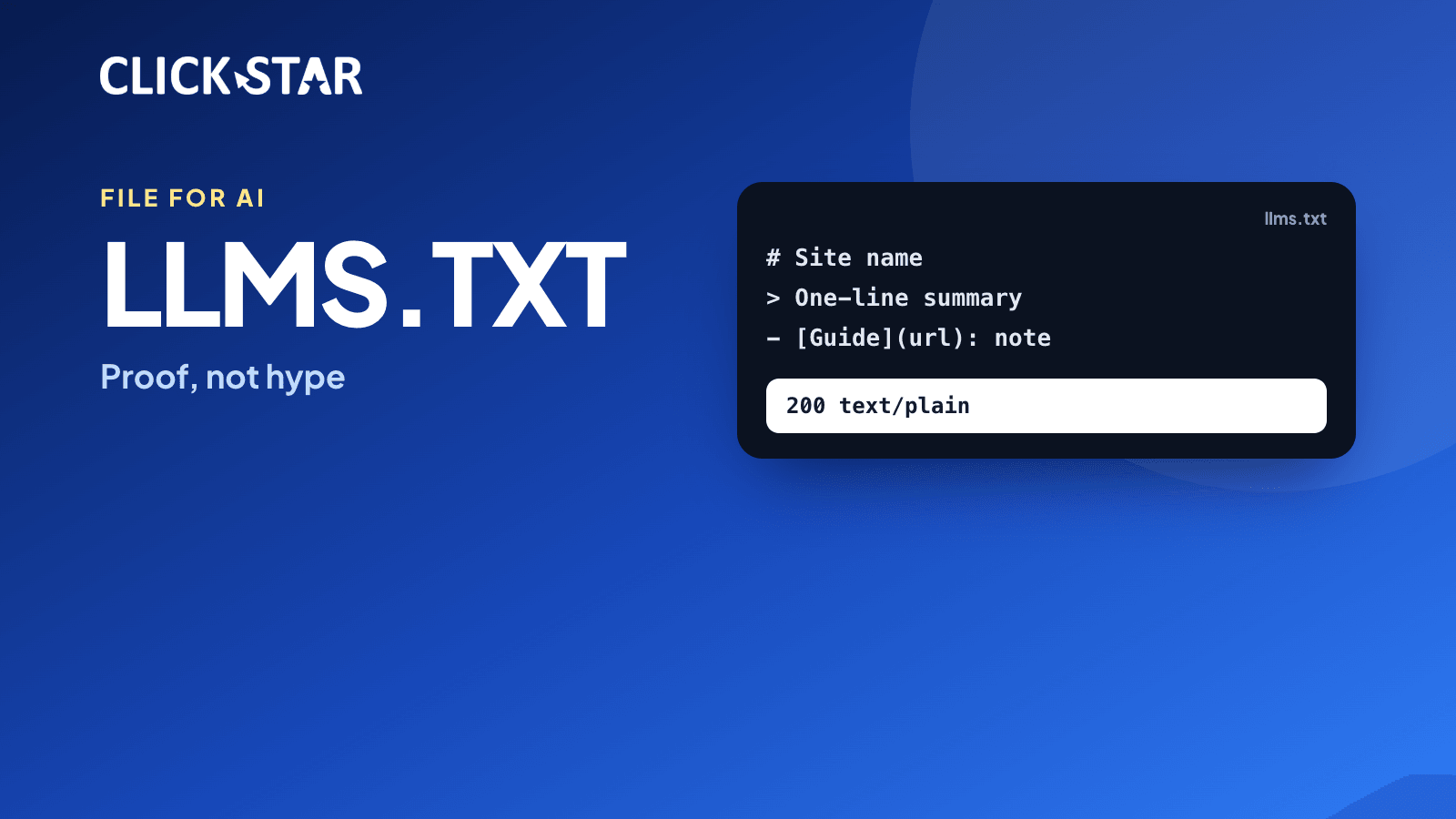
Remember that robots.txt is advisory, not access control, and that some bots that run on a user's request may not apply it, according to the providers' own documentation. As for an llms.txt file, Google says it is not needed for its features, and no major AI tool has committed to using it.
It costs very little to create, so it is fine to add, but do not expect it to replace foundational SEO.
The content layer: write for the passage, not only the page
When a system splits a question into several sub-queries and combines the results, the unit it picks is often a clear answer passage, not a whole article. So article structure needs to change in these directions:
- Each subheading is a question people really ask, and the first sentence under it answers it directly, and only then explains.
- State figures, conditions, scope and the update date inside the answer. A passage with concrete figures is more likely to be quoted than a generic one.
- Cover the subtopics around the main question (cost, time, risk, comparison, conditions), because the system will ask about these when it combines results.
- Have original value that AI cannot produce itself: your own data, real processes, real examples, expert opinion with a named person.
- Structured data (Organization, Article, FAQPage, Service) must match the visible text. Do not mark up what is not on the page.
On its own website, Click Star applies this to its service pages: each page has a frequently-asked-questions block whose first answer states time and cost directly, with FAQPage data that matches the displayed content. The question-led approach is also covered in the article on SEO thinking in the AI era that Click Star published earlier.
The off-site brand layer: reputation is built in many places
The Ahrefs correlation figures above suggest that being named in many trusted places matters as much as optimizing your own website. So the work extends beyond your own pages:
- Make your name, address, phone number and brand description consistent everywhere: website, Zalo OA, Google Business Profile and business directories. Contradictory information reduces trust for both people and machines.
- Have real customer reviews on Google and business review sites, because AI tools often quote scores and comments when comparing providers.
- Be named in industry media and professional communities, through experience-sharing articles drawn from real projects with the client's consent.
- Put a short, clear brand definition at the top of the About page, so that when asked "what is this company", the system has a clear sentence to quote.
The measurement layer: which KPIs change
Google says traffic from AI Overviews and AI Mode is included in overall search traffic and shows up in the Performance report in Search Console under the "Web" search type, not separately. So other measurements are needed:
- Visits from AI tools: filter referral sources such as chatgpt.com, perplexity.ai, gemini.google.com, claude.ai and copilot.microsoft.com in Google Analytics 4 and create a separate channel group.
- Server access logs: see which pages OAI-SearchBot, PerplexityBot, Claude-SearchBot and Googlebot are reading.
- A monthly answer check: list 20 questions real customers ask, ask ChatGPT, Gemini, Perplexity and Google, and record whether your brand is mentioned, which sources are cited and which competitors appear.
- Branded search and the conversion rate of visitors from these sources, since Google says clicks from AI Overviews pages tend to be higher quality, a claim to verify with your own data.
Note that answers from AI can differ each time, so compare monthly trends rather than individual asks.
SEO work is organized differently
SEO in the AI era is no longer one person's job. It needs 4 groups working together: content (question-led writing with original value), technical (robots, speed, structured data, bot logs), communications and customer relations (mentions, reviews) and data (measurement, answer checks).
The work cycle also shortens: review quarterly rather than yearly, because how tools display and cite keeps changing. When choosing an SEO provider, a business should ask which indicators besides ranking they use, and how they check whether the brand is mentioned in AI answers.
A 90-day plan
- Days 1 to 30, foundation: check that robots.txt and the CDN do not block Googlebot or AI search bots, verify Search Console, fix false 404s and wrongly noindexed pages, align structured data with content, and create an llms.txt file if you wish.
- Days 31 to 60, content: pick the 10 most important customer questions, rewrite the top of your service pages and best articles in a question-then-short-answer structure, add a frequently-asked-questions block, and add an update date and a named person responsible for the content.
- Days 61 to 90, reputation and measurement: align brand information everywhere, ask for real customer reviews, set up Google Analytics 4 with an AI channel group, and run the first 20-question check as a baseline.
Common mistakes
- Blocking every AI bot for fear of losing content, then being surprised that the brand is never mentioned.
- Treating a new file (such as llms.txt) or a special schema type as the solution, when Google says it is not needed.
- Writing generic content to match keywords, without figures, examples or a person responsible.
- Ignoring reputation outside the website: reviews, mentions, consistent information.
- Looking only at ranking and clicks, and not measuring lead quality and new traffic sources.
- Trusting a single study or a single number. AI studies differ in method and shift with each product update, so measure on your own data.
Related posts
Need tailored advice for your business?
Click Star helps you build a solution that fits your industry and scale. We answer every question during business hours.