Is Gen Z leaving social media or just moving? What data says
Surveys from Pew, Harris Poll, YouGov, Attest and DataReportal show a slight drop in time spent and in trust, not a mass exit by Gen Z. The article explains why the numbers differ and what Vietnam still lacks.
A 12th grader tells you she deleted Instagram, yet every night she still scrolls TikTok and watches YouTube until late. This is an illustrative scenario, not a measurement.
This article re-reads public surveys on young people and social media from Pew Research Center, Harris Poll, YouGov, Attest, GWI (via DataReportal) and DataReportal's Vietnam figures, checked on November 15, 2026.
It answers one question: is Gen Z leaving social media, using it less, or just moving around? Short answer: the numbers show a slight drop in time spent (mostly among adults in general) and in trust, not a mass exit, and surveys disagree because they ask different people different questions.
Key points
- No figure in this article shows Gen Z leaving social media in large numbers. What is measured is a slight fall in average time spent and falling trust in some platforms.
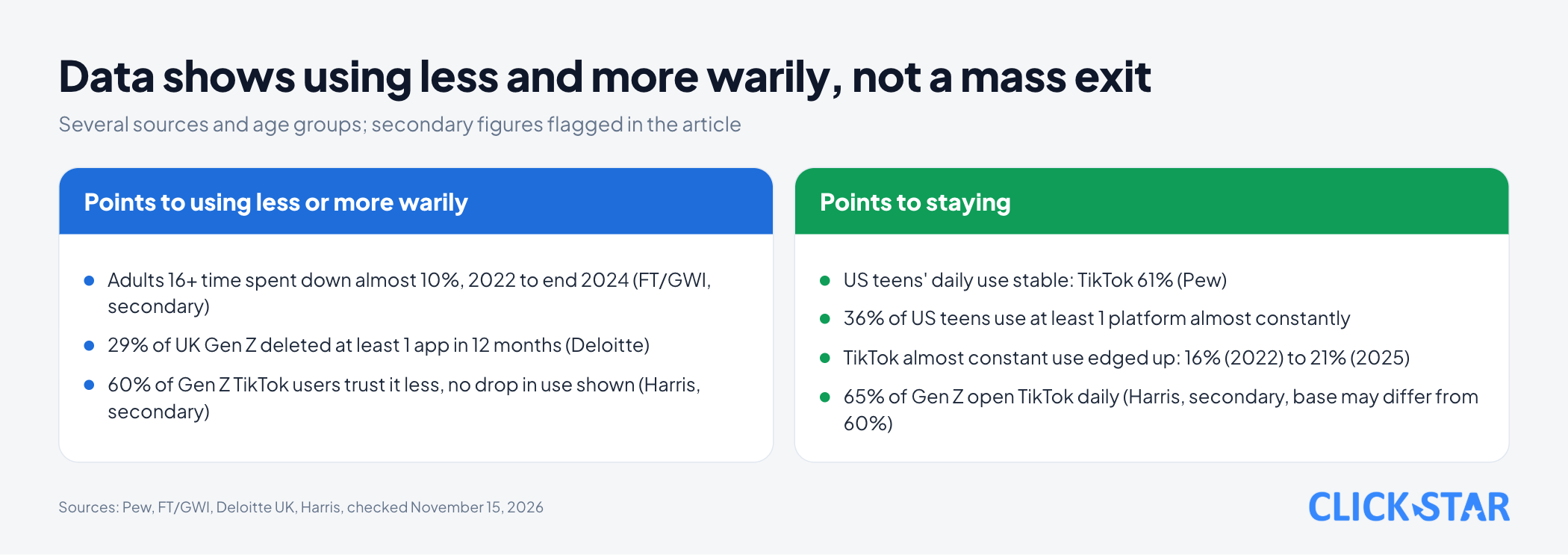
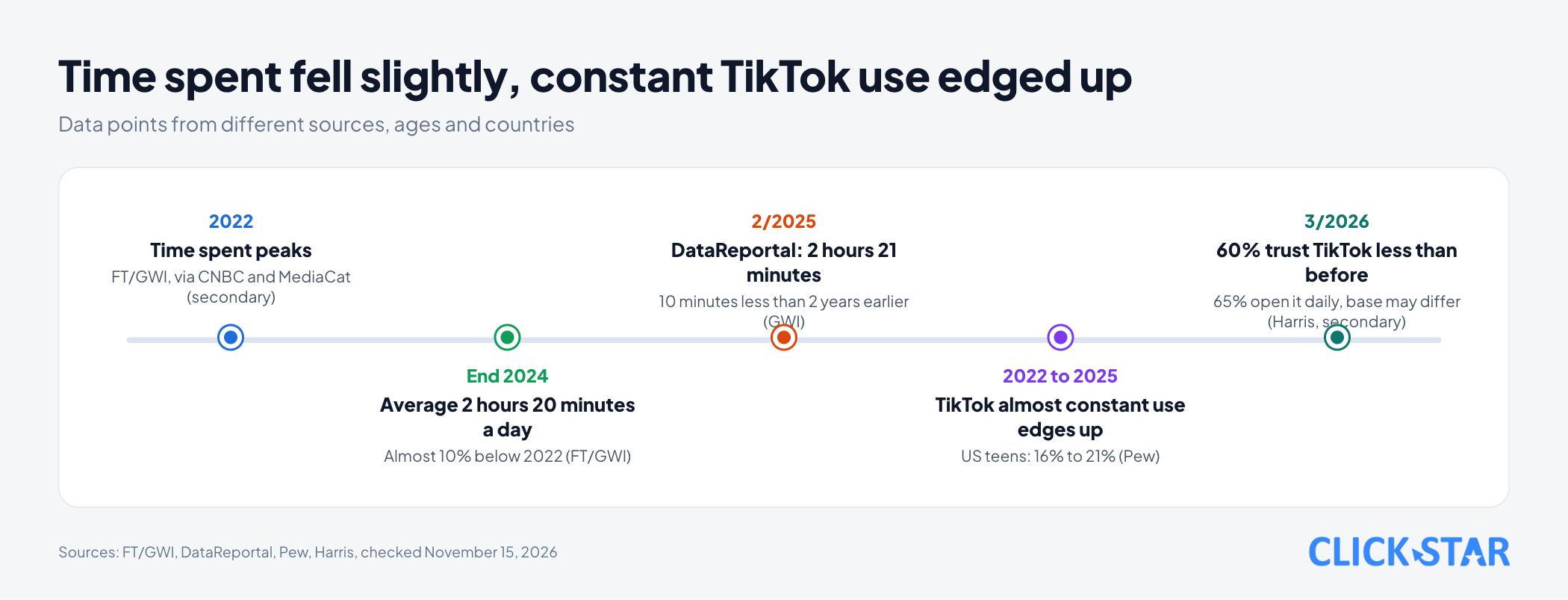
- Per a Financial Times and GWI analysis (secondary source), adults 16 and over spent an average of 2 hours 20 minutes a day on social media at the end of 2024, almost 10% below 2022.
- US teens' daily use is roughly stable per Pew (12/2025): YouTube about 3/4, TikTok 61%, Instagram 55%, Snapchat 46%, Facebook 20%.
- On daily TikTok use, 4 surveys give 65%, 61%, 56% and 41%, because of different age groups, periods and wording (the article's inference).
- Harris Poll (3/2026, via secondary press) reports 60% of Gen Z TikTok users trust the platform less than before, while 65% open it daily (the 2 figures may have different bases): less trust does not necessarily mean less use.
- Vietnam has no recent public per-platform figures for Gen Z; the latest are Decision Lab's Q1 2021, now dated. DataReportal's national totals partly exceed 100% of the population aged 18 and over and changed method.
What is happening: leaving, using less, or moving
"Gen Z quits social media" bundles 3 different things. First is deleting accounts for good. Second is spending fewer hours. Third is switching platforms while staying online.
Available data measures the second fairly well, and the first and third poorly.
An example of the first: a Deloitte UK press release (June 5, 2025; 4,150 Britons aged 16 to 75, surveyed in April 2025) reports 20% of consumers deleted 1 social media app within 12 months, and 29% among Gen Z (defined as 16 to 29).
CNBC (February 7, 2026, secondary source) cites this survey as "nearly a quarter" of consumers, which differs from the release's 20%; its "nearly a third" for Gen Z matches 29%. The article uses the release's figures. It covers deleting at least 1 app among Britons.
Time spent: a slight fall, not a collapse
The global average has fallen by minutes a day, not hours. Per DataReportal (February 5, 2025), the typical internet user spends 2 hours 21 minutes a day on social media according to GWI, 10 minutes less than 2 years earlier.
The same page says women aged 16 to 24 spend just under 3 hours a day, down 12 minutes over 2 years.
The Financial Times analysis, run with GWI and cited by CNBC (February 7, 2026) and MediaCat UK (October 3, 2025), covers 250,000 adults aged 16 and over in more than 50 countries. Time spent peaked in 2022, then fell to 2 hours 20 minutes at the end of 2024, most steeply among teens and people in their 20s.
The article could not open the original Financial Times piece, so those 2 outlets are secondary sources. MediaCat reports the US as the only country where time spent still rises, which matters for US surveys.
There is a definition trap. DataReportal's Digital 2026 Global Overview (around October 2025) says women aged 16 to 24 spend more than 3 hours 40 minutes a day on "social and video feeds". That is higher than "just under 3 hours" above. A likely reason is that it includes video, and the 2 reports also cover different periods (the article's inference).
Same question about TikTok, why 4 numbers
Ask how many Gen Z open TikTok daily and you meet 65%, 61%, 56% and 41%. No side is necessarily wrong: each asked a different group.
Harris Poll (March 2026) reports 65% on TikTok daily. Harris's own page blocked the tool (error 403), so the number comes from Tubefilter and Hypebot (secondary sources), which give no sample size, field dates or country.
Pew Research Center (published December 9, 2025) surveyed 1,458 US teens aged 13 to 17 from September 25 to October 9, 2025 through Ipsos: daily TikTok use was 61%.
Attest (February 2026 survey, page updated September 29, 2026) asked 1,000 Americans aged 18 to 27: TikTok daily 56%, YouTube 63%.
YouGov (April 6, 2026) used YouGov Profiles data from March 2025 to March 2026 for US adults, Gen Z being born roughly 1996 to 2012: TikTok daily 41%, YouTube 62%.
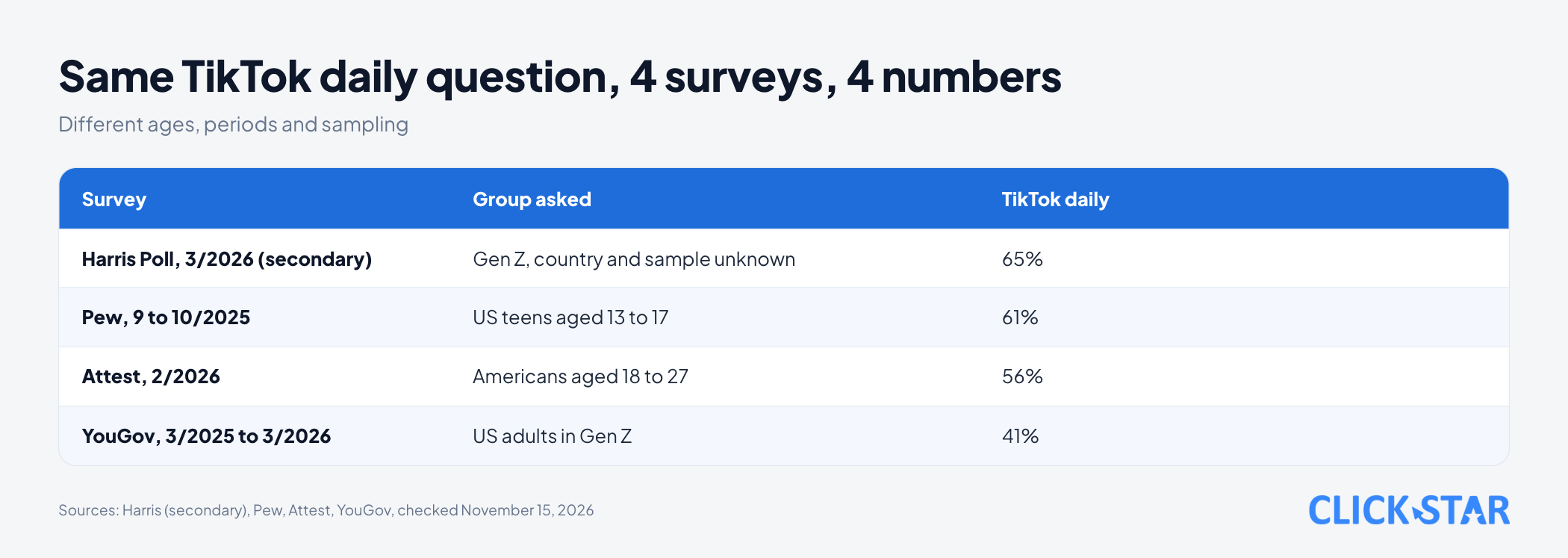
The article's inference: these 4 numbers do not line up as one trend because ages, periods, wording and sampling differ.
US teens: stable, with TikTok edging up
Pew's December 2025 report does not show US teens leaving: daily use is "relatively stable" compared with past years.
Pew reports 36% of teens use at least 1 of 5 platforms (YouTube, TikTok, Instagram, Snapchat, Facebook) almost constantly. Of these 5, only TikTok edged up: "almost constant" use went from 16% in 2022 to 21% in 2025, which Pew calls a slight increase.
Facebook fell sharply from 2014 and 2015: Pew reports about 31% of teens use it in 2025, against 71% then, but that is on par with 2022.
Pew covers only US teens living with parents and does not follow individuals.
Trust falls, habit stays: what Harris Poll shows
Trust is the easiest part to misread. Per Fortune's report (March 10, 2026) on the March 2026 Harris Poll, 60% of Gen Z TikTok users trust the platform less than before.
Fortune also reports that 72% find content staged and 43% find the app more draining. These are self-reported feelings, not behavior.
Tubefilter (March 10, 2026) reports 78% of Gen Z view YouTube favorably, and 66% of that group visit YouTube daily. That is not 66% of all Gen Z.
The 60% and 65% figures may have different bases: Fortune says 60% are Gen Z TikTok users, while Tubefilter says 65% of respondents.
On AI-generated content, Attest (February 2026) reports 41% of Americans aged 18 to 27 dislike it and 31% are wary because it is hard to tell what is real. Together that makes 72% negative or cautious, a different measure from Harris's 72% on content feeling staged.
Moving to do what: search and messaging
If there is a "move", it lies in purpose more than in app names. Per Sprout Social (press release May 29, 2025; 2,280 people in the US, UK and Australia, April 23 to May 5, 2025), 41% of Gen Z turn first to social platforms to search, 32% to search engines and 11% to AI chat tools.
GWI (blog published February 20, 2026) shows another shift: on TikTok, the number using it to message friends and family rose 58% since Q4 2021, and the number using it for brand and product information rose 71%.
Vietnam: national totals, dated Gen Z numbers
The latest figures cover all users, not Gen Z, and some need careful reading.
Per DataReportal's "Digital 2027: Vietnam" (November 5, 2026), social media user identities were 99.7 million in October 2026: 97.5% of the population, 133.5% of those aged 18 and over, and up 26.3% from late 2025.
The page flags a "change in reporting methodology" and publishes figures above 100% as is, so this is not 26.3% more Vietnamese joining social media.
Also on that page: Facebook has 77.6 million ad audience, down 1.8% in 12 months, but Meta changed how it reports, so it is hard to compare with the earlier period.
From survey respondents: per GWI Q2 2026, among internet users aged 16 and over, 83.2% used Facebook in the past month, 80.8% Zalo, 77.6% TikTok, 72.4% YouTube, 70.0% Messenger and 45.4% Instagram. This covers everyone 16 and over, not Gen Z alone.
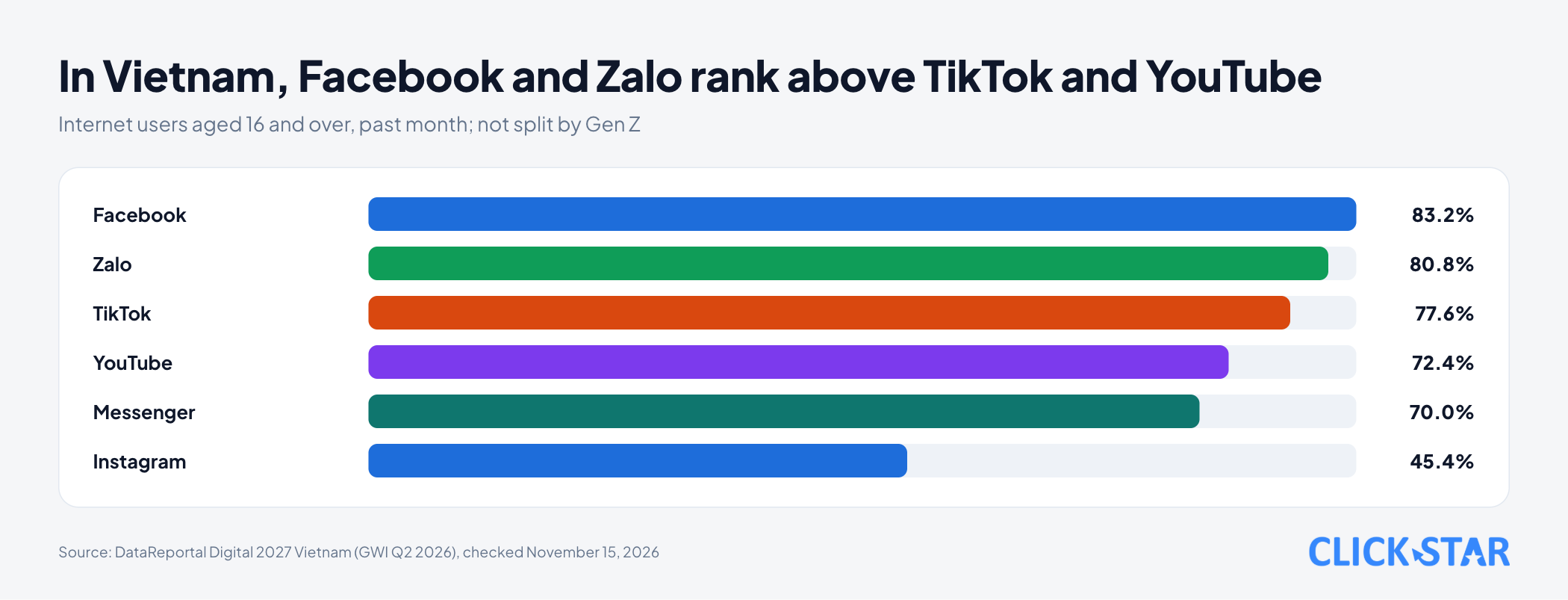
On Gen Z alone, the public per-platform figures the article found are Decision Lab's (the page "Gen Z's social distraction gives new platforms hope in Vietnam", Connected Consumer report, Q1 2021; no date or sample size on the page, read November 15, 2026): Gen Z aged 15 to 23 used daily Facebook 97%, YouTube 87%, Zalo 75%, Instagram 66%, TikTok 55%.
For the recent direction, Decision Lab ("Vietnam's digital dynamics", Q4 2025 report, no date on the page, read November 15, 2026) says Facebook is losing appeal with Gen Z and Zalo overtook YouTube among its top 3 "must-have" apps. No sample size or percentages are given, so it is only a hint.
Different readings: leaving, moving or recalibrating
The first reading is "leaving", based on deletions and falling hours. The evidence for a slight drop is real, but not for quitting entirely.
The second reading is "moving", based on YouTube's popularity and TikTok's use for search, messaging and news. It fits the purpose data, but no survey follows the same people to show they switched.
The third reading is "recalibrating": young people still use platforms but more warily. It fits Harris's trust figures, but those are secondary and self-reported, and do not show that social media causes fatigue.
What this means for users and society
The article's inference: if the main trend is "using less and more warily", the biggest change is in the quality of attention, not headcount. A platform that stays crowded but is trusted less may struggle to keep long-term influence.
What to watch
- What each survey asks and whom: age, country, "ever use", "every day" or "almost constantly".
- How time spent is defined: whether video such as YouTube and TikTok counts, or only social networks.
- Vietnam figures by age: a DataReportal or GWI table for ages 16 to 24 would be the newest and most direct indicator, replacing Decision Lab's 2021 figures.
- The gap between "trust less" and "use less": if trust keeps falling, does daily use follow?
- New waves from Pew, Sprout and Harris: do the new numbers reverse those in this article.
Common mistakes
- Reading "Gen Z uses X%" without checking who was asked: teens 13 to 17, people 18 to 27 and YouGov's Gen Z are 3 different groups.
- Treating "trusts less" as "uses less": Harris reports 60% trust TikTok less and 65% open it daily, 2 figures that may have different bases (via secondary press).
- Taking US numbers as Vietnamese: the only Vietnamese Gen Z figure here is Decision Lab's Q1 2021, now dated.
- Reading DataReportal's Vietnam totals as real people: the page itself notes figures above 100%.
- Mixing different measures that share a number, such as Attest's 72% on AI content and Harris's 72% on content feeling staged.
- Inferring a mental health cause from self-reported figures.
What is not known
The article lacks Harris Poll's original methodology (the page blocked the tool), so sample size, country, field dates and the Gen Z definition are unknown. It also did not read the original Financial Times piece or Deloitte's full report (only the press release), and did not check Sprout waves newer than 2025.
No survey follows the same people over years to show which platforms young people leave, where they go, and whether they return.
There is no recent public per-platform measurement of Gen Z in Vietnam and no time series; the latest is Decision Lab's Q1 2021. The relationship between social media use and mental health also cannot be drawn from the figures in this article.
Related posts

Need tailored advice for your business?
Click Star helps you build a solution that fits your industry and scale. We answer every question during business hours.