Google update on October 20, 2026: no new ranking update yet, the confirmed milestones and how to respond
Checked against the Search Status Dashboard on October 20, 2026: no ranking update is recorded for that date, with the 7 confirmed events of 2026, a 7-day process when traffic moves and how to tell spam updates from core updates.
Many site owners ask "what did Google just update on October 20?" whenever traffic changes direction. The honest answer, after Click Star checked the Google Search Status Dashboard and the Google Search Central blog directly on October 20, 2026, is that no Google ranking update dated October 20, 2026 has been recorded.
The most recent one is the September 2026 spam update, which started on September 24, 2026 and completed on October 8, 2026. This article gathers what Google has confirmed in 2026, separates ranking updates from changes to policies, guidance and reports, and gives a 7-day process for finding out whether your website was affected.
Every date is checked as of October 20, 2026; Google can announce a new update at any time, so check the status page again before you conclude anything.
Key points
- As of October 20, 2026, the ranking history on the Search Status Dashboard has no incident or update dated October 20, 2026, and the post list on the Search Central blog has no core update or spam update post for October 2026.
- The most recent ranking update is the September 2026 spam update: started September 24, 2026, completed October 8, 2026, lasting 13 days 16 hours, the longest of the 4 spam updates in 2026.
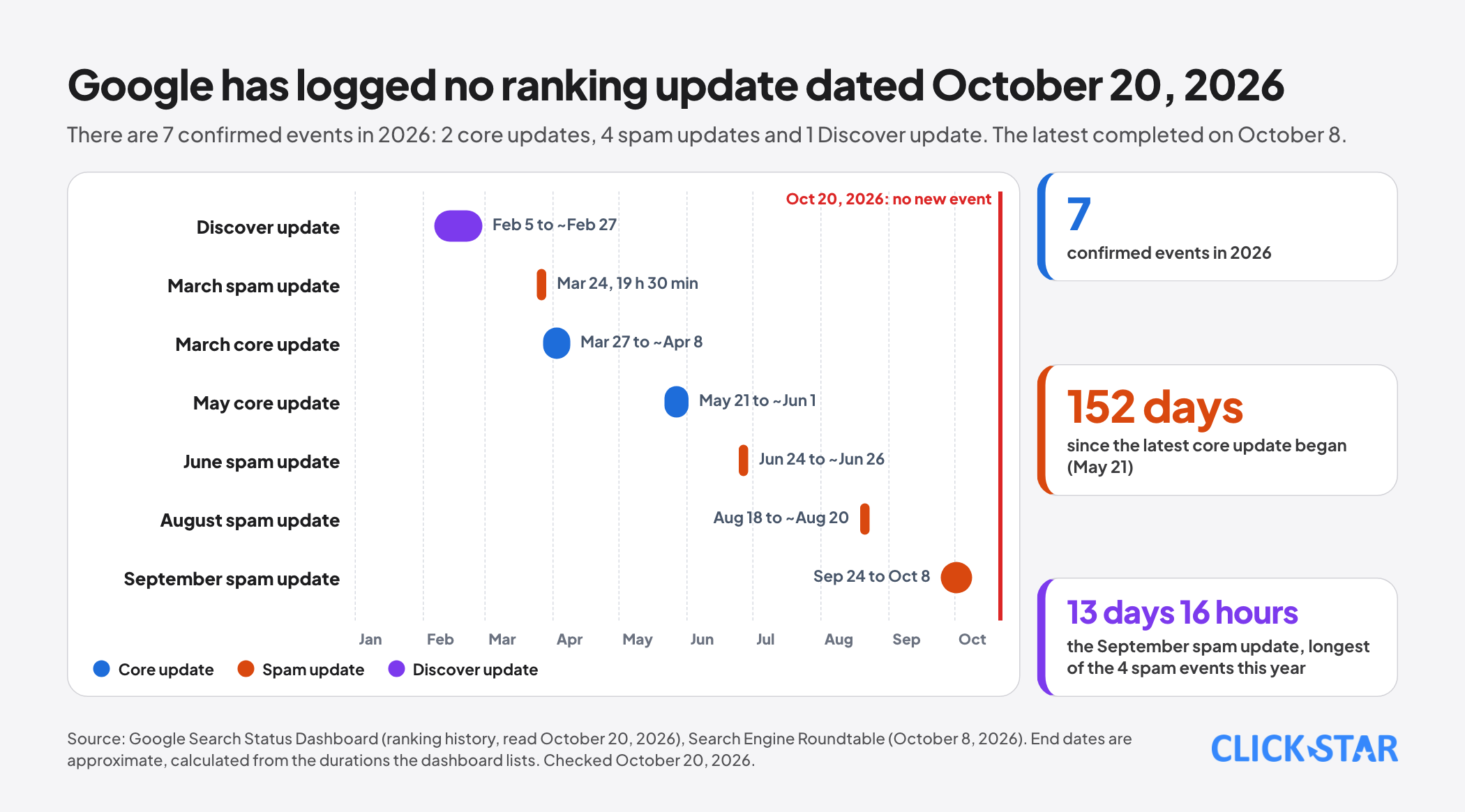
- So far in 2026 Google has logged 7 events: 2 core updates (March 27 and May 21), 4 spam updates (March 24, June 24, August 18, September 24) and 1 Discover update (from February 5). The latest core update began 152 days ago.
- Changes you see today usually have another cause: aftershocks of the spam update that just ended, changes to AI results, seasonality, or a technical fault on your own website.
- Google's rule for analysis: wait at least 1 week after a core update completes, then compare in Search Console with the week before it began. For an unconfirmed rumor, the right move is a technical check, not mass content edits.
What Google has confirmed as of October 20, 2026
The official source is the Google Search Status Dashboard, where Google records the start date, end date and type of each ranking update. According to the history read on October 20, 2026, 2026 has had the following events (end dates are approximate, calculated by Click Star from the durations the dashboard lists):
- February 2026 Discover update: started February 5, 2026, running to about February 26 to 27, 2026. This is a change specific to Discover, not to ordinary search results.
- March 2026 spam update: started March 24, 2026, lasting about 19 hours 30 minutes, the shortest of the year.
- March 2026 core update: started March 27, 2026, completed around April 8, 2026.
- May 2026 core update: started May 21, 2026, completed around June 1, 2026.
- June 2026 spam update: started June 24, 2026, completed around June 26, 2026.
- August 2026 spam update: started August 18, 2026, completed around August 20, 2026 (sources differ slightly on the end time, so treat it as "2 to 3 days").
- September 2026 spam update: started September 24, 2026, completed October 8, 2026.
Before that, the December 2025 core update ran from December 11, 2025 to about December 29, 2025. 2 points stand out in this chain.
First, the gap between the start dates of consecutive core updates in 2025 to 2026 ranges from 55 days (March 27 to May 21, 2026) to 164 days (June 30 to December 11, 2025), so the date of the next one cannot be inferred from history. Second, spam updates in 2026 are far more frequent than core updates: 4 against 2.
The September 2026 spam update: what the latest one says
According to Search Engine Roundtable's report of October 8, 2026, Google announced that this update "applies globally and to all languages," could take up to 2 weeks, and described it on LinkedIn as a normal spam update.
It began around 12:00 pm US Eastern time on September 24, 2026, and Google confirmed completion at 4:37 am on October 8, 2026 (same time zone). The report's author noted the clearest periods of movement as September 25 to 27, September 30 and October 4 to 6, with the caveat that this assumes no other changes overlapped.
Google did not say which behavior the update targeted or what share of queries it affected, and the report suggests it does not appear to target link spam.
For websites in Vietnam, the point to remember is that a spam update applies to all languages and regions, so Vietnamese-language content is not outside its scope. Google reminds sites that see movement to review its spam policies; a site that violates them can rank lower or not appear at all, and recovery can take many months.
Google's spam policies page (updated August 28, 2026) now lists 16 categories, including scaled content abuse, the site reputation policy, expired domain abuse and back button hijacking.
Click Star's view. For businesses that produce content with AI, 4 spam updates in 9 months is the clearest signal of the year: Google does not ban AI-assisted content, but it targets creating pages in large numbers with little value, however they are made.
If your website publishes many near-identical pages to cover keywords, that is a bigger risk than any "October 20 update."
Why it is easy to think there is a new update
News of an update often appears before confirmation, and the cause usually sits in 4 places:
- Aftershocks of the spam update that just finished. Movement after the completion date can still happen as systems settle, and Google says periodic refreshes will occur.
- Third-party tracking tools. Tools that measure the "volatility" of search results only show that results are changing a lot; they do not show whether Google released an update. Only the Search Status Dashboard is official confirmation.
- Changes to AI features. Google can adjust AI Overviews or AI Mode without it being a ranking update; impressions and clicks change even when blue-link positions do not.
- Your own website changing: a redesign, URL changes, an error that blocks crawling, a campaign ending, seasonality. This is far more common than a Google update.
If you are reading this because you heard about an "October 20 update," ask where the news came from: does it point to the Search Status Dashboard or only to a volatility tool? Only the first is enough to change your work plan.
Other Google changes in 2026 worth knowing
Not every Google change is a ranking update. The post list on the Search Central blog shows these additional changes in 2026; Click Star describes in detail only the parts it could read in full, and for the others gives only the post titles:
- May 15, 2026: Google published the guide "Optimizing your website for generative AI features on Google Search" (the documentation page was last updated July 10, 2026). The core points: AI features rely on existing ranking and quality systems, no llms.txt file or special schema is needed, content does not have to be cut into small pieces for AI, and visibility should be measured with the Generative AI report in Search Console. Click Star will publish a separate article on an SEO workflow built on this guide.
- June 3, 2026: Google introduced the Search Generative AI performance report in Search Console, currently released to a subset of websites. The report covers impressions, pages, countries, devices (Search only) and dates; according to the ppc.land report, it does not yet include clicks and does not describe position data.
- April 2026: a new spam policy on "back button hijacking." August 2026: the post "Update to the Site Reputation Policy." September 2026: the post on web multimodal Search performance reporting in Search Console. Click Star has read only the titles of these posts, not the full text.
A 7-day process when traffic moves
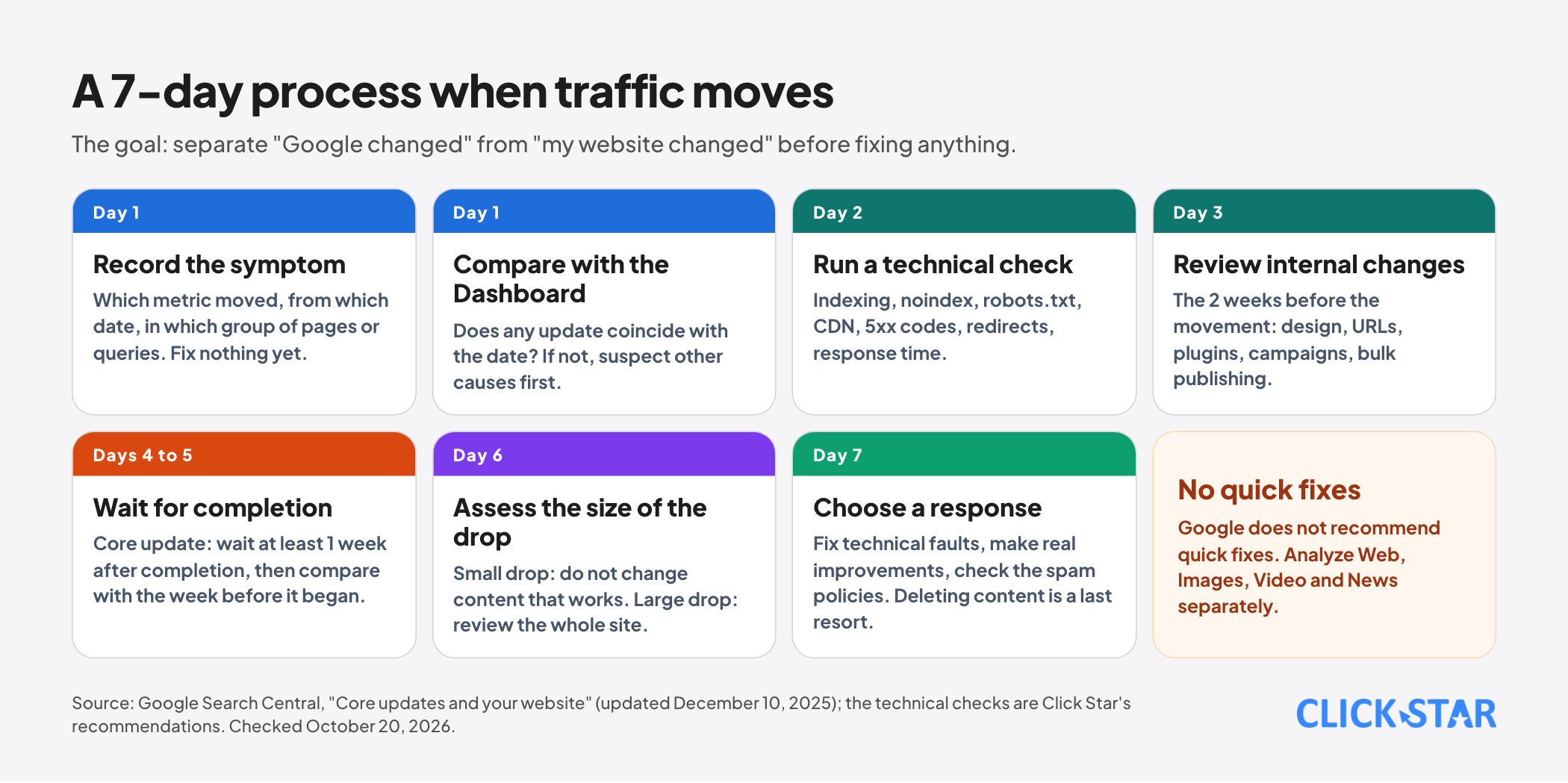
The goal of the process is to separate "Google changed" from "my website changed" before fixing anything.
- Day 1, record the symptom: which metric moved (impressions, clicks, average position), from which date, in which group of pages or queries. Fix nothing yet.
- Day 1, open the Search Status Dashboard and compare the date of the movement with the events above. If none coincides, suspect other causes first.
- Day 2, run a technical check: important pages still indexed, robots.txt and the CDN not blocking Googlebot, 5xx responses, response time, recent URL changes or redirects, a noindex tag added by mistake during a site update.
- Day 3, review internal changes in the 2 weeks before the movement: a redesign, a change to the link structure, a plugin change, an ad campaign turned off, a batch of new content.
- Days 4 to 5, if an update coincides, wait until Google records it as complete. For a core update, Google recommends waiting at least 1 week after completion before analyzing in Search Console, comparing with the week just before the update began, and analyzing web search, images, video and news separately.
- Day 6, assess the size of the drop. According to Google, a small drop (for example from position 2 to 4) needs no drastic action and content that performs well should not be changed. A large drop (for example from position 4 to 29) calls for a site-wide review against Google's self-assessment questions.
- Day 7, choose a response: fix the technical fault if there is one; make real improvements for users if a core update affected you; check against the spam policies if a spam update coincides. Google does not recommend quick fixes and treats deleting content as a last resort.
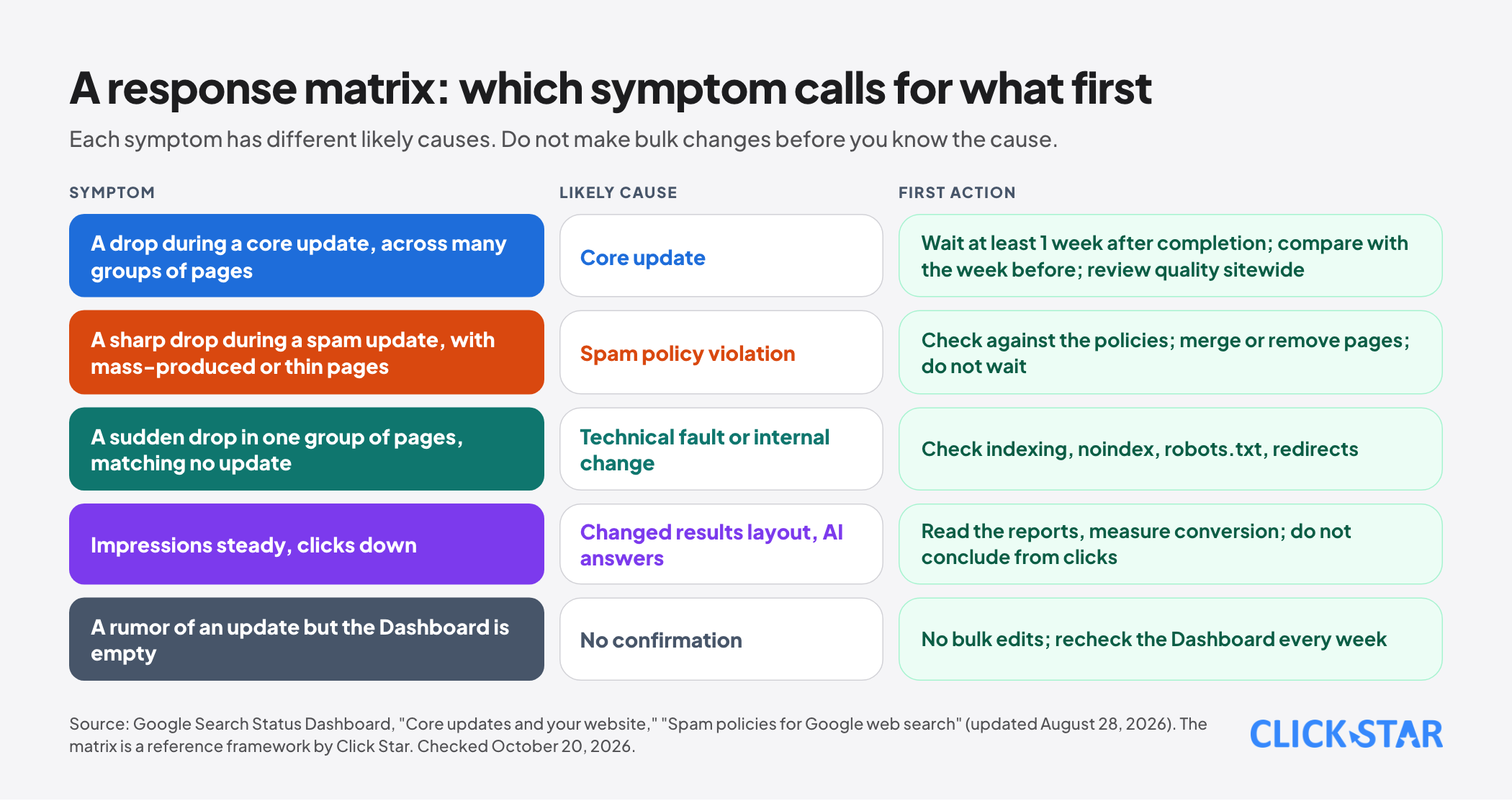
Telling spam updates from core updates so you respond correctly
The 2 types of update need different responses.
A core update is a broad change to the ranking systems. According to Google's guidance page (updated December 10, 2025), a core update does not target any specific website or page, and a page moving down does not mean it is "bad": other content may simply be judged a better fit for the query.
Recovery after improvements can take several months, and if no effect appears, the next core update may be when the systems reassess. So the right response is lasting improvement in value for users, not a rushed fix.
A spam update targets behavior that violates the spam policies. If a website drops sharply exactly while a spam update runs and shows signs of violation (mass-produced content, thin pages, misleading redirects, bought links), the violation needs to be dealt with at the root rather than waited out.
Google says the policies are enforced by automated systems, with manual review possible when needed.
Click Star's view. In consulting practice, most websites fall into neither situation but see clicks drop because AI answers take up the space or because of an internal technical fault. That is why the process above puts the technical check before guessing what Google meant.
What to do in the next 30 minutes
- Open the Search Status Dashboard and save the list of the most recent updates as a reference.
- In Search Console, export the last 3 months by page and by query, and note the days your own website changed significantly.
- Check your 10 most important pages: indexed, not noindexed by mistake, loading reliably, not redirected unexpectedly.
- Review the pages published in bulk over the last 6 months; plan to merge, rewrite or remove any that are near-identical or have no value of their own.
- Schedule a look at the Search Status Dashboard every week and the Search Central blog every month, instead of following rumors daily.
What is not known
Google has said nothing about the specific target of the September 2026 spam update, so any guess about which group it "targeted" has no basis. There is no equivalent measurement for the Vietnamese market of how much each update affected sites.
History also does not allow predicting the next core update: in the 2025 to 2026 chain, the gap between updates ranges from 55 to 164 days. Finally, the Generative AI report in Search Console has so far been released only to a subset of websites, so many readers may not see it yet.
Common mistakes
- Editing content in bulk the moment a rumor appears, then being unable to tell which change produced which result.
- Using a volatility tool as evidence of an update Google has not confirmed.
- Analyzing data while the update is still rolling out; according to Google, wait at least 1 week after a core update completes.
- Assuming a drop means a violation; a core update does not target specific websites.
- Deleting many old pages as the first reaction, when Google treats deleting content as a last resort.
- Ignoring internal technical faults (noindex, bot blocking, redirects) because of too much focus on guessing the algorithm.
Related posts
Need tailored advice for your business?
Click Star helps you build a solution that fits your industry and scale. We answer every question during business hours.