Website Content Planning Under Google's People-First Guidance: Helpful, Reliable, Reviewed
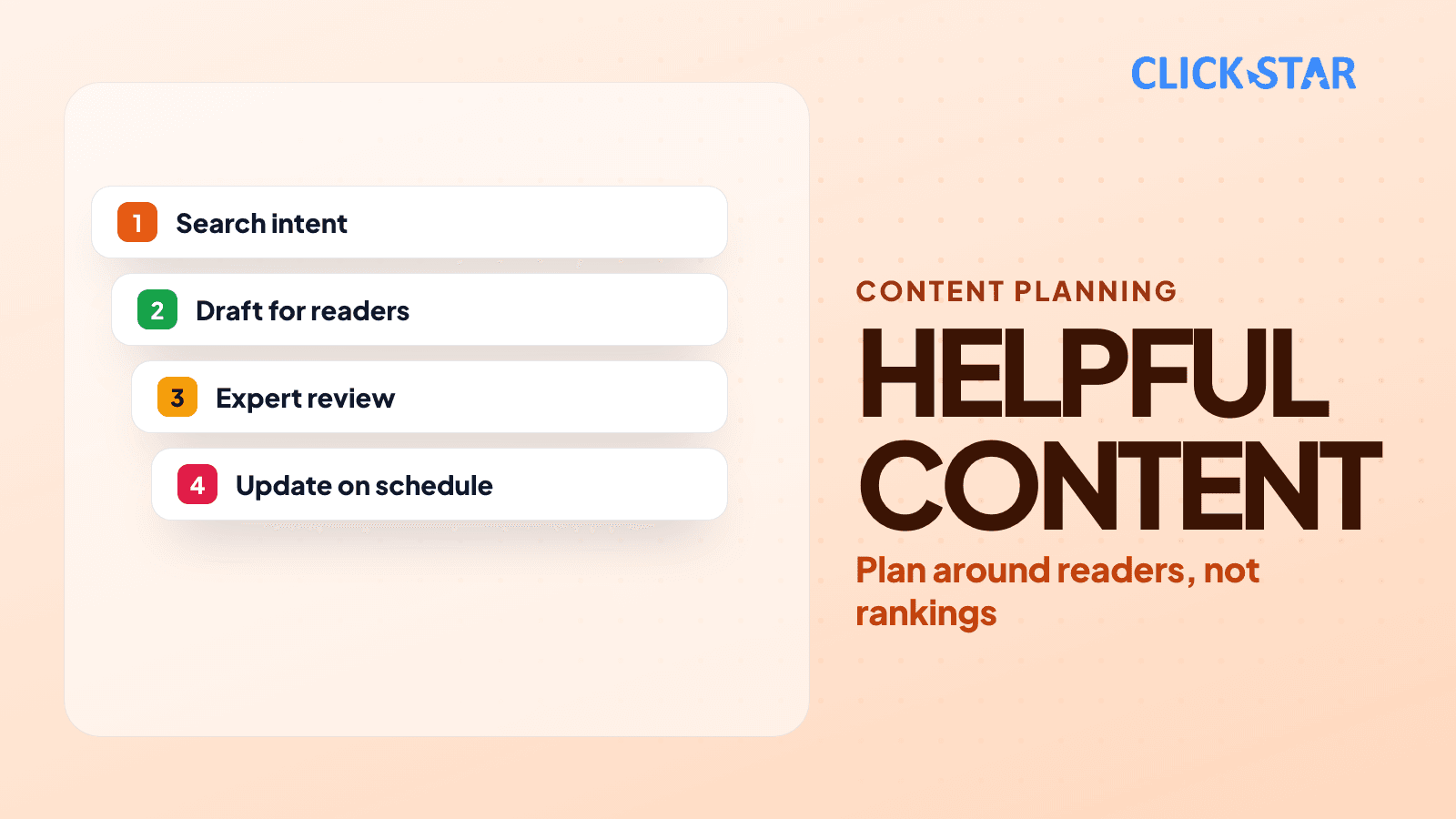
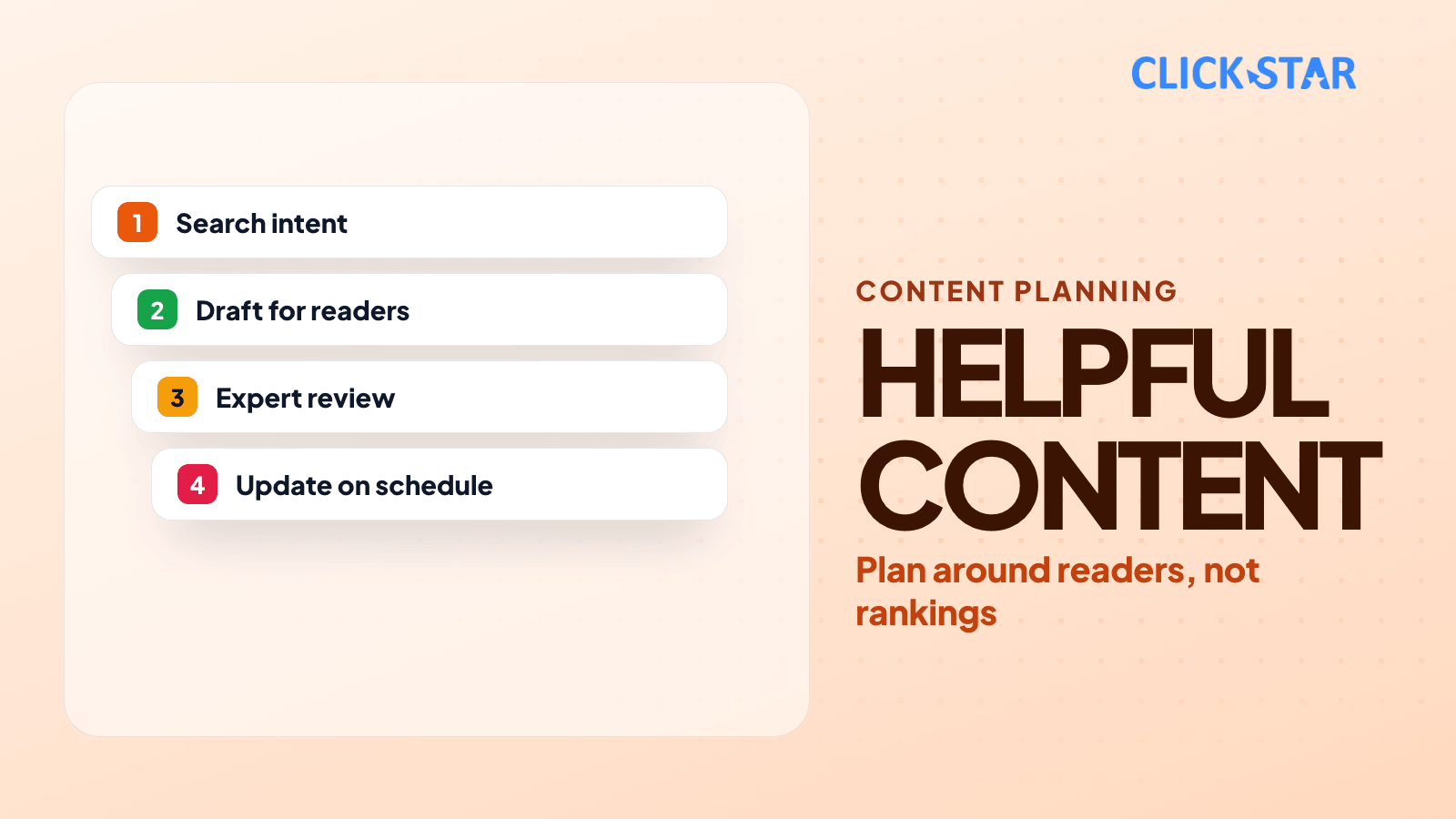
A content planning process built from real customer questions, based on Google's helpful content guidance, spam policies and E-E-A-T documents, with review and measurement steps.
Many content plans start with a keyword list and end with a publishing calendar. Google has already published self-assessment questions for this.
This article draws on Google Search Central (helpful content, spam policies, AI content), the Search Console and GA4 help pages, and the public Search Quality Rater Guidelines, checked as of October 22, 2026.
It covers the process of planning and reviewing content. Click Star already has separate articles on SEO in the AI era and on SEO thinking, so that theory is not repeated. Topic clusters and the review rhythm are Click Star frameworks, not Google standards.
Key points
- Google publishes self-assessment questions on content, expertise and search engine-first warning signs (updated October 5, 2026). Use them to vet each brief before writing.
- According to the same page, E-E-A-T is not a specific ranking factor; trust is the most important of the 4 components.
- A plan should start from real customer questions in the CRM, messages, calls and Search Console, not from a keyword list.
- Topic clusters and pillar pages are a Click Star framework. According to Google (July 10, 2026), more pages do not make a website higher quality.
- AI assistance is allowed. Google treats generating many pages with no added value as spam, so people must verify content and metadata.
- Measure with impressions and clicks (Search Console) and engagement time (GA4). The sources read give no standard threshold, so compare against your own site.
What Google asks when you assess your own content
The page "Creating helpful, reliable, people-first content" (updated October 5, 2026) says Google's ranking systems prioritize helpful, reliable information made for people, not to manipulate rankings. It recommends self-assessment and feedback from people outside the website.
Click Star counted 4 groups of questions:
- Content and quality (12 questions): original information or analysis, no copying of other sources, a title that avoids exaggeration.
- Expertise (4 questions): clear sourcing, information about the author, written or reviewed by someone who knows the topic.
- People-first (5 questions): a defined audience, first-hand experience, and readers who reach their goal.
- Search engine-first warning signs (11 questions): answering "yes" means rethink your approach.
The warning group asks about writing on many topics hoping a few will perform, extensive automation, only summarizing others, writing because a topic is trending, writing to a word count.
The page also asks about changing dates to look fresh when the content has not changed, and adding or removing large amounts of content to make a site seem "fresh". It says the latter does not help rankings.
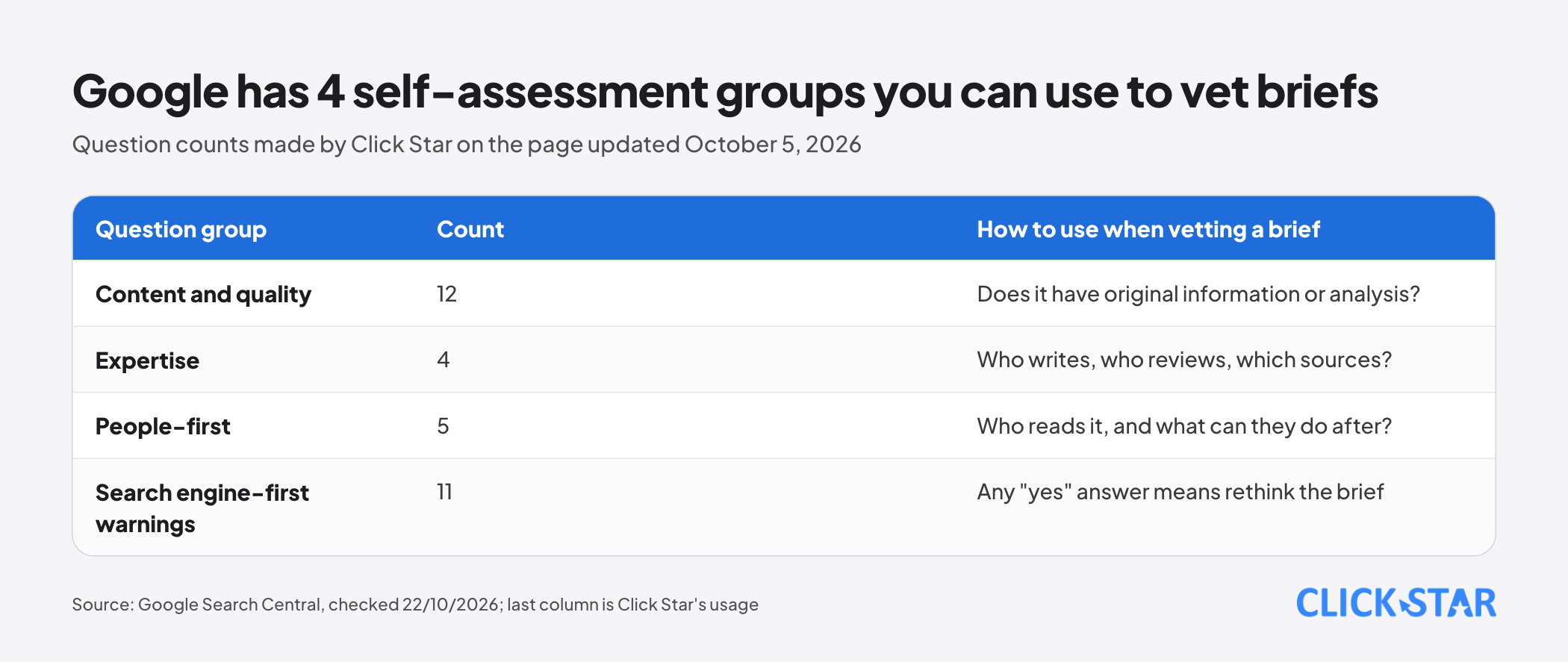
How to use them (a Click Star suggestion): turn the questions into a brief review template. Each brief must say who will read it, what they need, and what the post adds that ranking pages lack.
What E-E-A-T is and how to use it as the documents describe
E-E-A-T stands for experience, expertise, authoritativeness and trust. According to Google's guidance page, trust is the most important; the others contribute to it.
The same page states that E-E-A-T itself is not a specific ranking factor. Google's systems use a mix of factors to identify content with good E-E-A-T, and weigh it more for topics that could significantly affect health, financial stability, safety or societal well-being (the YMYL group).
The Search Quality Rater Guidelines (public version dated September 11, 2025) are a document for Google's search quality raters. It names 3 places to look for evidence (section 3.4, page 27): what the website says about itself, what others say about it, and what is visible on the page.
For planning: treat E-E-A-T as a list of evidence a page should carry, not a score to optimize.
From real customer questions to a topic list
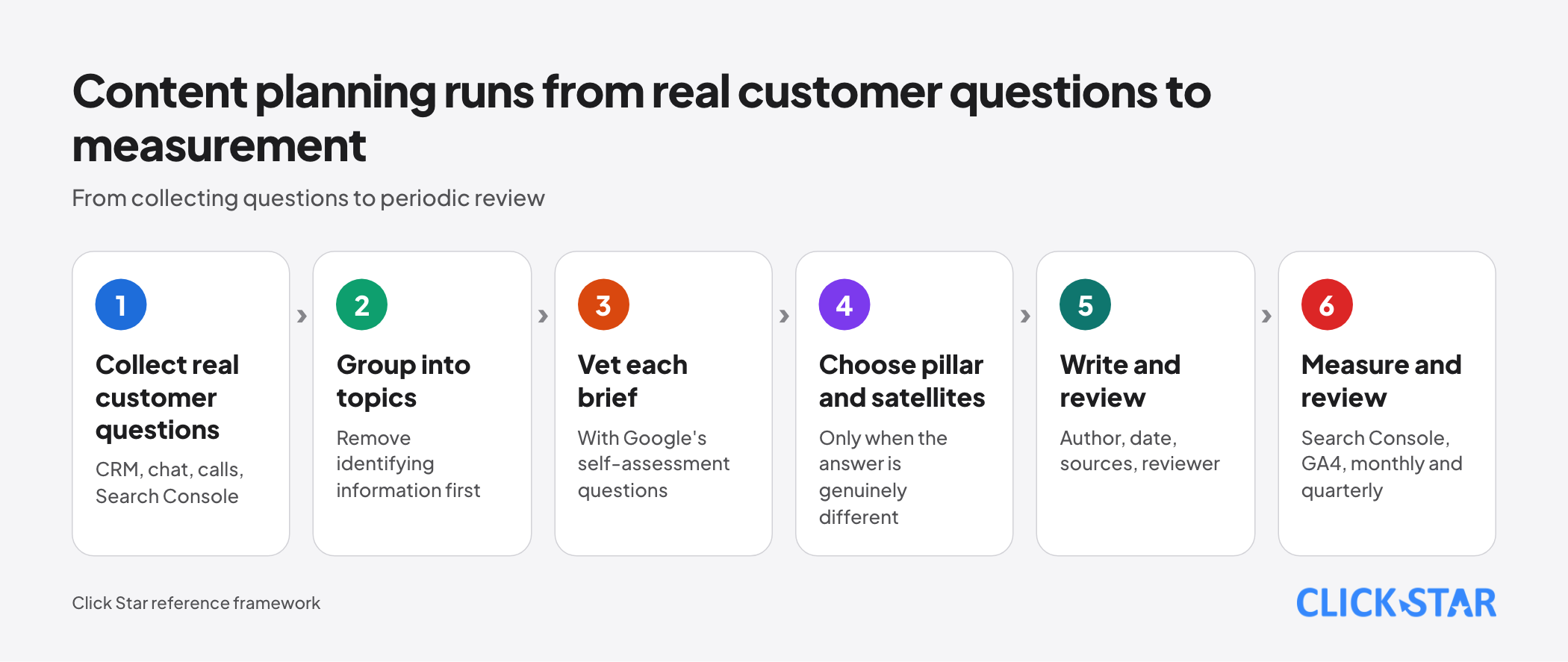
Take questions from where customers actually asked:
- CRM: consulting notes, reasons customers have not bought, repeated questions.
- Messages and chat (website, Zalo, Facebook): how customers phrase the problem themselves.
- Consulting calls: only with a legal basis and appropriate notice. Click Star already has a separate article on the legal conditions for recording calls.
- Search Console: according to Google, it shows which queries bring users to the website.
Remove names, phone numbers and emails from the questions before they enter the planning sheet. Then group similar questions into topics, 1 row per topic in a brief table (a Click Star reference template) with 7 columns: original question; reader and purpose; what the post adds; writer or reviewer; primary sources; metric; review date.
Topic clusters and pillar pages
A topic cluster is how Click Star organizes a plan: 1 pillar page gives an overview of a broad topic, satellite posts answer narrow questions, and the pages link to each other. It is not a Google standard; the Google pages read do not require it.
The caution is about satellite posts. Google's guide to optimizing for AI features (updated July 10, 2026) says creating separate content for every search variation, primarily to manipulate results, violates the scaled content abuse policy, and that more pages do not make a website higher quality.
Click Star's rule: create a satellite post only when the question has a genuinely different answer. 2 questions with the same answer go into 1 page.
Click Star's view. A volume-based calendar pushes a team to chase post counts, while a plan built on customer questions concentrates effort on fewer, deeper pages. On interests: Click Star sells digital marketing and SEO-ready website design, so this article may lean toward that approach.
Authors, dates and citations
Google asks whether a page has a byline where readers expect one and whether it leads to author information. The page encourages accurate author details and warns that fake profiles (AI-generated headshots, invented names, false credentials) are deceptive.
On dates, Google's byline guidance (updated December 10, 2025) recommends a prominently visible date with a label such as "Published" or "Last updated", plus datePublished and dateModified in structured data. The displayed date and the structured-data date must match, and must not be in the future.
On sources, Google asks whether the content has clear sourcing, and says crediting other sources does not replace original effort. Click Star's approach: name the source and date inside the sentence, prefer primary sources, and separate opinion from data.
Updating old posts and the review rhythm
Google's SEO starter guide (updated December 10, 2025) says to update published content when needed, or remove it if no longer relevant, but gives no review rhythm.
Click Star's framework, not from an outside source:
- Monthly: look at pages with high impressions but low clicks, pages losing position, and broken links.
- Quarterly: review posts containing figures, prices or regulations, then keep, update, merge or remove them.
- By event: when Google changes its documents, a law changes, or the company's product changes.
Change the date only when the content changes substantially. Google's core updates page (updated December 10, 2025) advises waiting at least 1 week after an update finishes before comparing data, and no drastic action if the drop is small.
AI-assisted content and human review
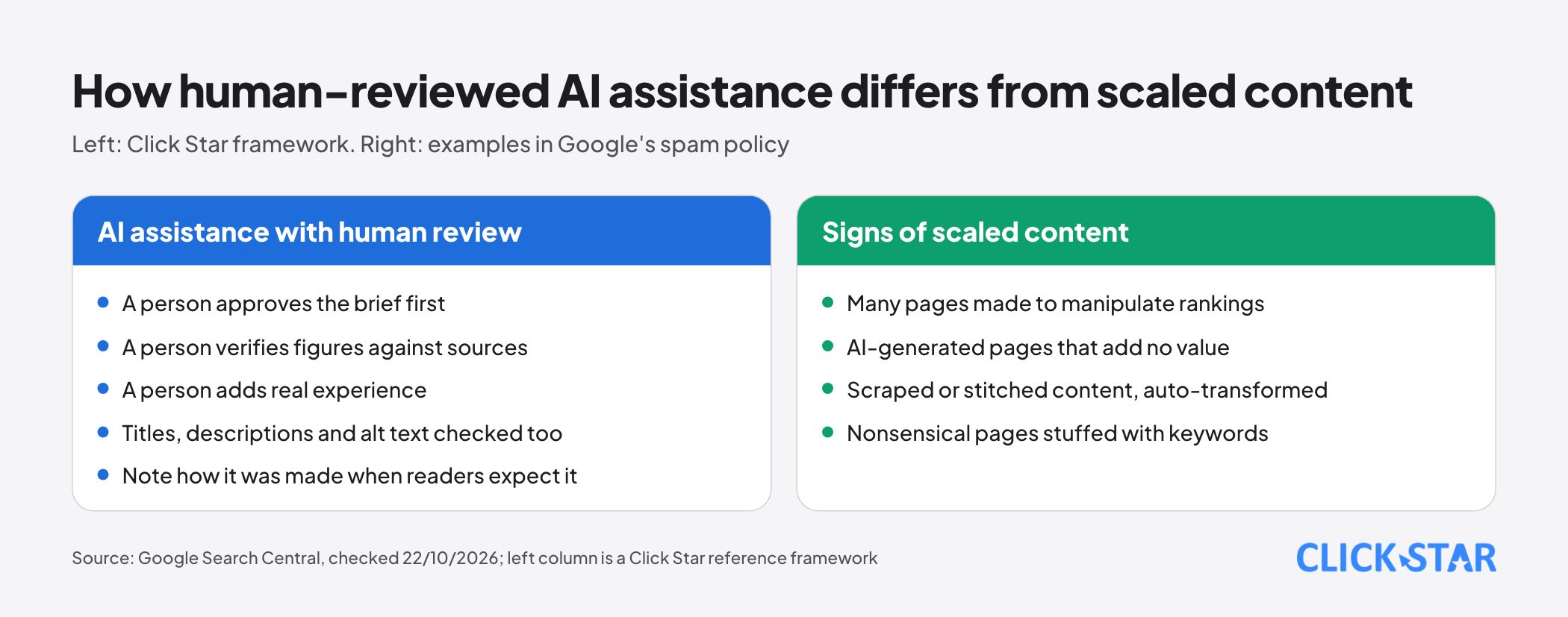
Google's page on generative AI content (updated October 1, 2026) says generative AI can help with researching a topic and adding structure to original content. Using it to generate many pages without adding value may violate the scaled content abuse policy.
The spam policies (updated August 28, 2026) define scaled content abuse as many pages generated primarily to manipulate rankings, no matter how they are created.
Google stresses manual fact-checking of all AI-generated content before publishing, including titles, descriptions, structured data and alt text.
Human review process (a Click Star framework, not from an outside source):
- A person approves the brief before any AI assistance.
- AI only assists with research, outlining and proofreading.
- A person opens the original sources to verify every figure, name and date.
- A person with experience adds the practical parts AI does not have.
- A person checks the title, description, image alt text and structured data.
- Note how the content was created when readers might expect it (Google's "How" section).
What not to do
The items below are based on the Google documents read:
- Mass production: Google advises excluding such content from Search if the website hosts it.
- Keyword stuffing: repeating words unnaturally, or inserting blocks of text listing cities you want to rank for.
- Content with less value than the pages already ranking: Google's self-assessment questions ask whether the page describes the topic fully and adds substantial value compared with other results.
- Doorway pages (doorway abuse): many pages targeting individual cities that all lead to 1 page.
- Hosting third-party content mainly to borrow the website's ranking reputation (the site reputation policy). Examples Google does not treat as violations include wire service news and forum content.
How to measure whether the plan works
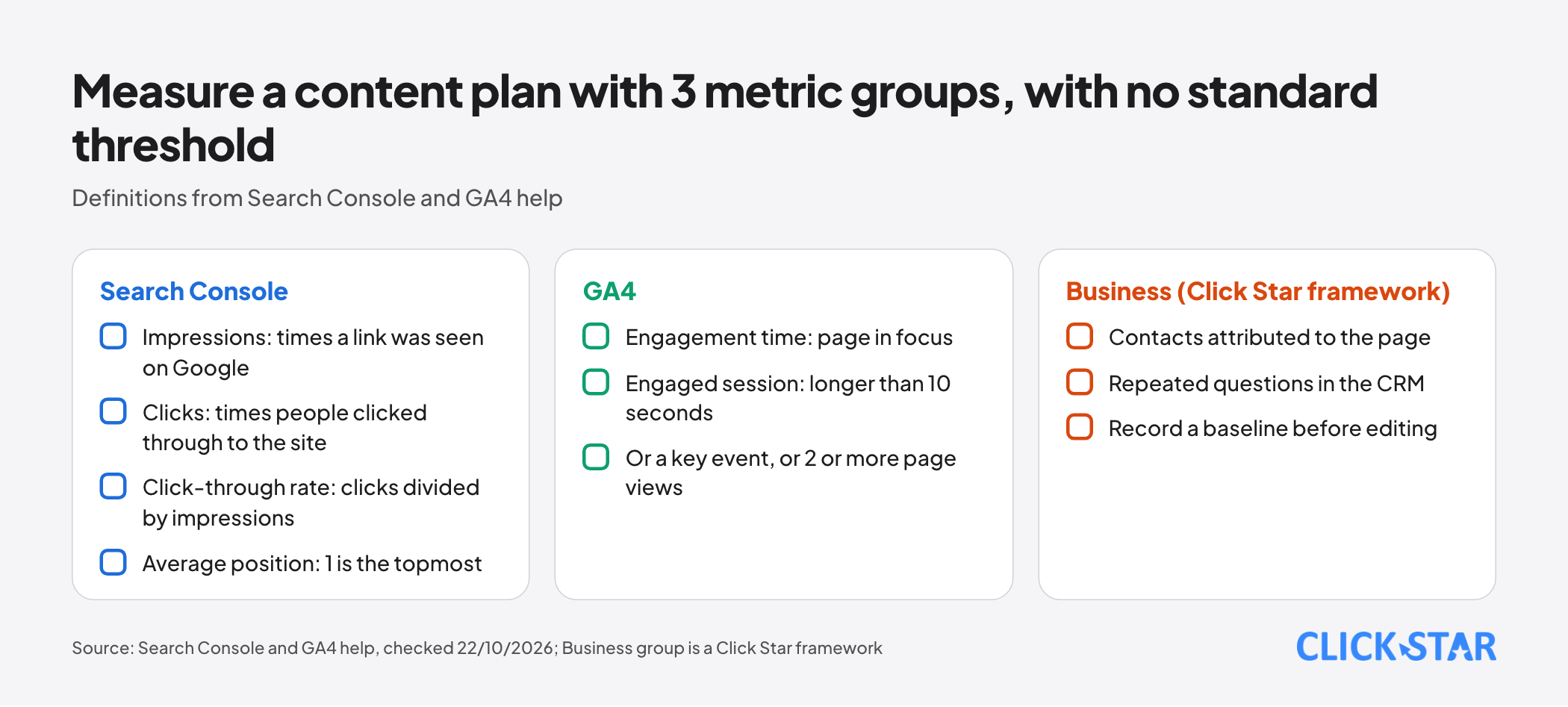
According to Search Console help, an impression is how often someone saw a link to the website on Google, a click is how often someone clicked through to it, and click-through rate is clicks divided by impressions. Average position is a relative ranking where 1 is the topmost.
According to GA4's "User engagement" page, engagement time is the time a user spends with the page in focus. According to "Engagement rate and bounce rate", a session counts as engaged if it lasts longer than 10 seconds, has a key event, or has 2 or more page views.
No source Click Star read gives a standard threshold for click-through rate or engagement time, so compare each page group with itself over time. A Click Star suggestion: add business metrics such as contacts from the page and repeated CRM questions.
30-day roadmap
A Click Star framework, not from an outside source:
- Week 1: collect questions from the CRM, chat, calls and Search Console; remove identifying information.
- Week 2: group them into topics, choose 1 topic as the pillar, and vet briefs with Google's question set.
- Week 3: write or update the pillar and satellite posts, each with an author, date, sources and reviewer.
- Week 4: build Search Console and GA4 reports by page group, record baselines, and set the review schedule.
Common mistakes
- Building a volume-based calendar first, and inventing topics afterward.
- Writing because a topic is trending, not because your customers are asking.
- Creating satellite posts for every phrasing of the same question.
- Treating E-E-A-T as a score or a tag to optimize, instead of a list of evidence on the page.
- Letting AI draft a post and publishing it without anyone opening the sources to verify figures and metadata.
- Changing the updated date or editing in bulk to look "fresh".
- Measuring with 1 number only, or against an unsourced "industry standard" threshold.
What is not known
In the documents read, Google does not publish weights for individual content factors, so Click Star does not know how much improving E-E-A-T or topic clusters changes rankings. Click Star found no independent measurements for Vietnam on the effectiveness of topic clusters or review rhythms.
The review rhythm, brief table and human review process are Click Star suggestions with no outside validation. The Search Console and GA4 help pages show no update date. As of October 22, 2026, the public version at the official address of the rater guidelines is still dated September 11, 2025, and its change log also ends in September 2025.
Related posts
Need tailored advice for your business?
Click Star helps you build a solution that fits your industry and scale. We answer every question during business hours.