Writing hundreds of articles with AI: what does Google treat as spam?
This article reads Google's spam policy on scaled content abuse, the consequences per its documents, and a process for AI-assisted writing with named accountability. Sources are Google Search Central and Search Console Help.
A hypothetical travel company uses AI to write 300 "tour + province name" articles in 1 month, nearly identical except for place names. Would Google treat that batch as spam, and on what basis?
This article reads Google's spam policies, especially "scaled content abuse" (creating many pages mainly to manipulate rankings). Sources are Google Search Central and Search Console Help pages, checked on November 2, 2026.
It answers 3 questions: what Google prohibits, what the consequences are, and what process a business should follow when using AI to write. Click Star already has articles on SEO thinking in the AI era and on helpful content planning, so this one does not repeat them.
Key points
- Per Google, the problem is not using AI but creating many pages mainly to manipulate rankings without helping users, however they are produced.
- Google lists 5 examples of abuse, including using AI tools to generate many pages without adding value for users.
- Consequences: lower rankings or no appearance in results. After a manual action, the owner must fix every affected page, then submit a reconsideration request.
- The pages read state no threshold for articles or articles per day, so no number can be called safe.
- AI-assisted content needs human fact-checking first, including title tags, descriptions, structured data and image alt text.
- Click Star proposes a 6-step process, 9 self-check questions and a 14-day plan. All 3 are Click Star frameworks, not from outside sources.
Does Google ban AI-written content?
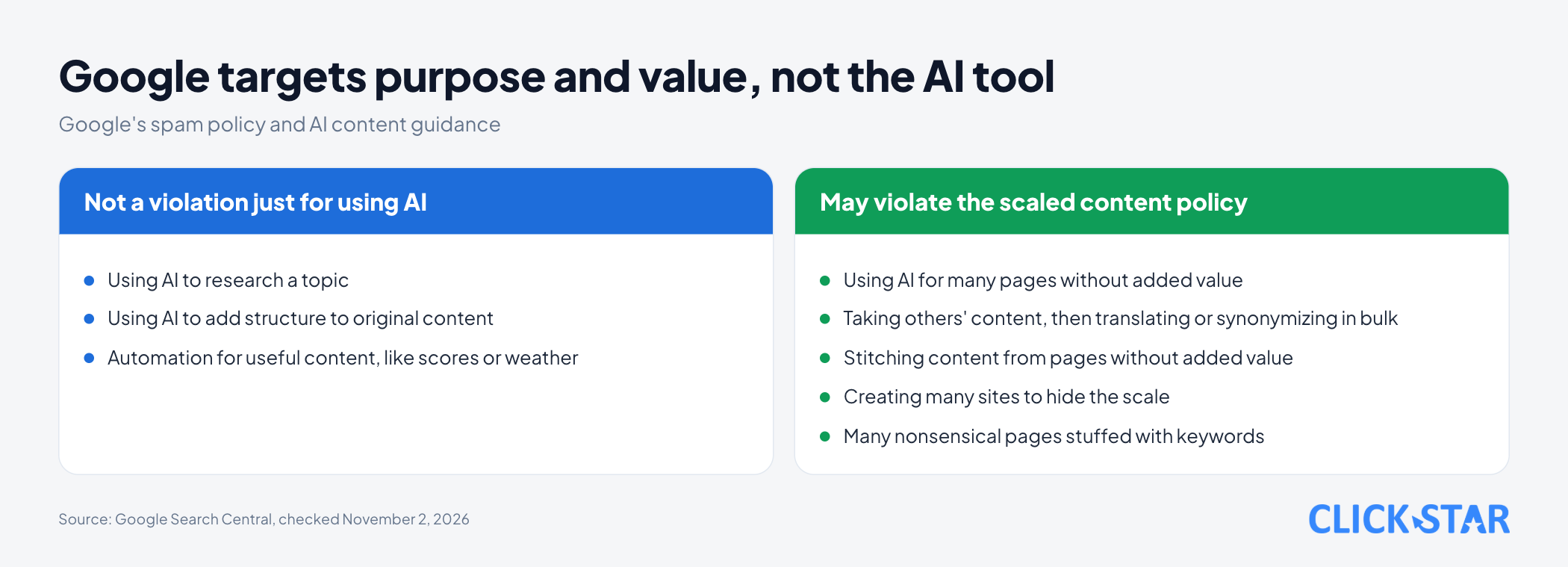
No. According to Google, using AI is not a violation by itself. What is penalized is using automation, including AI, to create content with the primary purpose of manipulating rankings.
Google's Search Central blog post of February 8, 2023 says not all automation is spam, for example sports scores or weather forecasts. If you see AI as a cheap, easy way to game rankings, Google advises against it.
The current guidance page on generative AI content (last updated October 1, 2026) says AI is useful for researching a topic and adding structure to original content. But generating many pages without adding value for users may violate the scaled content abuse policy.
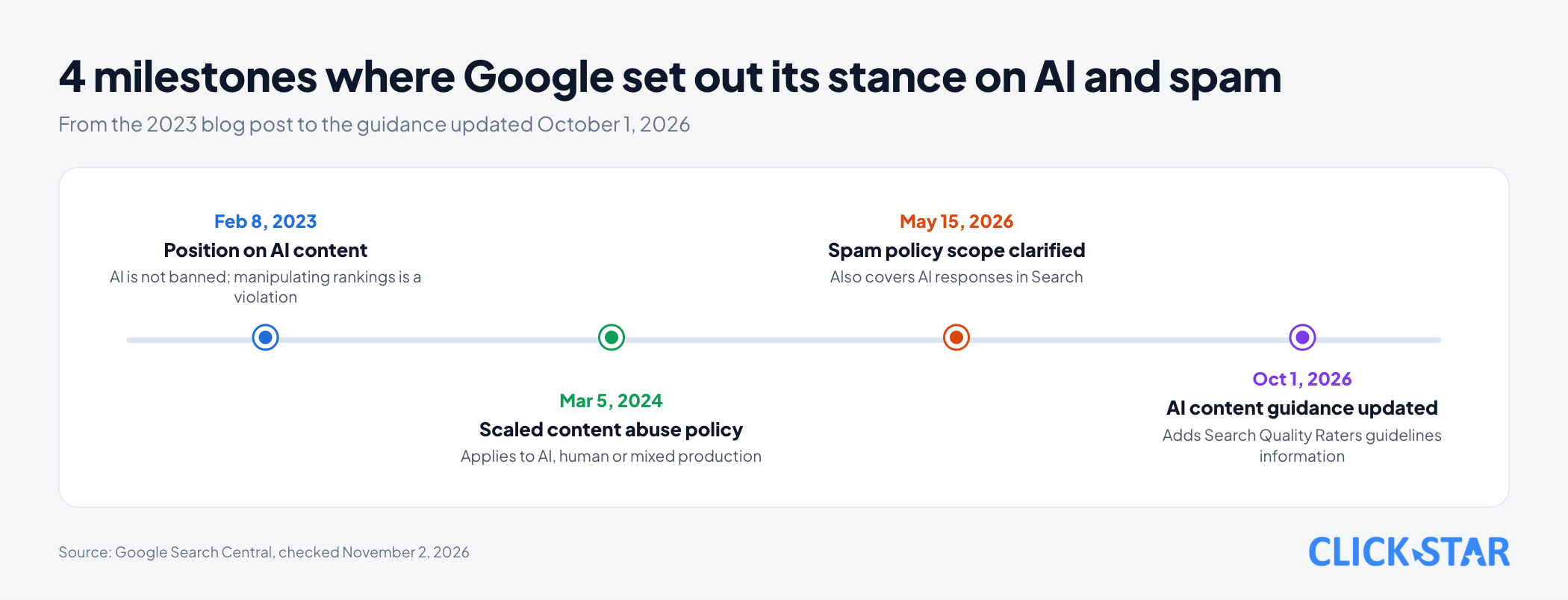
Later milestones: on March 5, 2024 Google announced the scaled content abuse policy. On May 15, 2026 it clarified that the spam policies also apply to generative AI responses in Google Search. On October 1, 2026 the AI content guidance was updated with Search Quality Raters guidelines information.
What is scaled content abuse, and which examples does Google give?
According to Google's spam policies page (last updated August 28, 2026), it means creating many pages whose primary purpose is manipulating rankings rather than helping users: typically large amounts of unoriginal, low-value content, "no matter how it's created".
The March 5, 2024 blog post says Google can act whether content comes from automation, human effort or a mix. Click Star reads this as meaning 300 articles written by people just to fill space are no safer than 300 written by AI, if the batch exists mainly to manipulate rankings.
The policy page lists 5 examples and says the list is not exhaustive:
- Using AI or similar tools to generate many pages without adding value for users.
- Scraping feeds, search results or other content to generate many pages, including through automated transformations such as synonymizing or translating, where users get little value.
- Stitching together content from different pages without adding value.
- Creating multiple sites to hide the scaled nature of the content.
- Creating many pages that make no sense to readers but contain search keywords.
If a site hosts such content, the policy page advises excluding it from Search. Click Star reads the 300 province-swap pages in the opening as matching the first example. That is Click Star's judgment, not a Google conclusion.
What Google looks at: purpose, value and effort
Google gives no number, but its page "Creating helpful, reliable, people-first content" (last updated October 5, 2026) lists warning questions. Answering "yes" to several is a sign to rethink how content is made.
Some come close to mass AI use: is the content made mainly to attract search visits, do you cover many topics hoping some will perform, do you use extensive automation across many topics.
That page also describes what Search Quality raters are trained to evaluate: AI-generated text in large amounts without manual oversight or curation represents little to no effort, and crediting sources does not replace original effort. Rater data is not used directly for ranking.
Click Star groups these into 3 axes (Click Star's reading, not a Google classification):
- Purpose: was the article written to help readers or to catch keywords.
- Value: does it have information, experience or analysis that other pages lack.
- Oversight: does a qualified person review, edit and take responsibility before publishing.
On creating separate pages for every query variation, Google's guide to AI features in Search (last updated July 10, 2026) says a high quantity of pages does not make a site higher quality or more relevant to users.
Consequences per the documents: lower rankings or a manual action
According to the spam policies page, Google detects violations through automated systems and, as needed, human review that can lead to a manual action. Violating sites may rank lower or not appear in results.
The Search Console Help page "Manual actions report" (no date shown, read November 2, 2026) describes a manual action as a decision by a Google human reviewer. Most cause pages or sites to rank lower or be omitted with no visible sign to users. Google notifies the owner in the Manual actions report and message center.
The "Major spam problems" action names scaled content abuse directly.
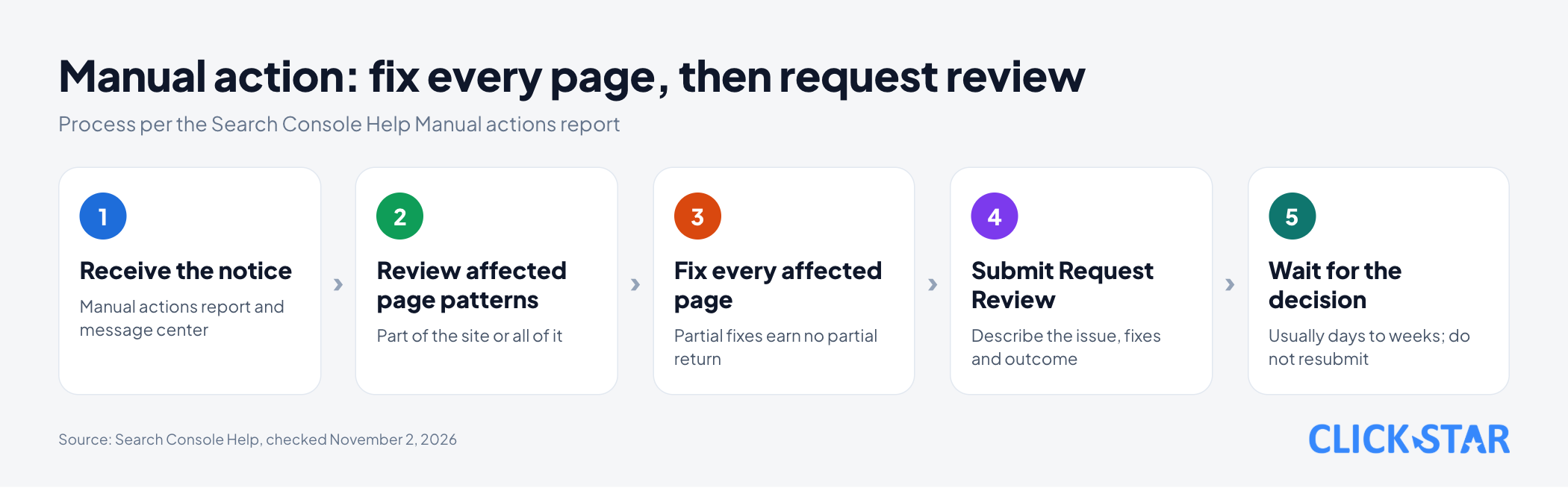
The owner reviews the affected page patterns, which can be part of the site or all of it. Every affected page must be fixed, because fixing only some earns no partial return. Pages must also be reachable for Google to recheck, not blocked by robots.txt or noindex.
Then select Request Review and describe the problem, the fixes and the outcome. Most reviews take several days or weeks, and a request should not be resubmitted before a decision.
What this means for businesses in Vietnam
Click Star found no measurement of Vietnamese sites penalized under this policy. The cases below are hypothetical.
- Buying a "100 articles per month" package without reviewing the content. The site owner still bears the consequences.
- Auto-translating other people's English articles in bulk. The policy page lists translating as an automated transformation of content taken from elsewhere.
- A shop using AI to write product descriptions. Per the AI content page, Google Merchant Center has its own policies: AI-generated images need IPTC TrainedAlgorithmicMedia metadata, and AI-generated product titles and descriptions must be specified separately and labeled. This applies only if you use Merchant Center.
A safe process for AI-written articles: 6 steps (Click Star reference framework)
This framework follows the Who, How and Why questions in Google's guidance. It cannot promise safety because Google publishes no threshold.
- Choose topics from real customer questions (messages, calls, search reports), not from a long keyword list.
- Have a qualified person add real experience: examples, opinions, internal figures that may be shared. AI helps with outlines and drafts.
- Verify every number, name and quotation against the original source. Google notes that generative models predict likely words rather than retrieve facts. Check title tags, descriptions, structured data and image alt text too.
- Name the responsible person with a real byline and author page. Google warns that fake author profiles, including AI headshots, are deception.
- Explain how the article was made when readers may wonder, such as where AI helped. Images must be legally usable; the pages read do not discuss copyright.
- Publish in small, planned batches and review the earlier batch's results before scaling up.
9 self-check questions before publishing (Click Star reference framework)
The questions draw on Google's self-assessment list. If any answer is "no", fix or drop the article first; that stop rule is Click Star's.
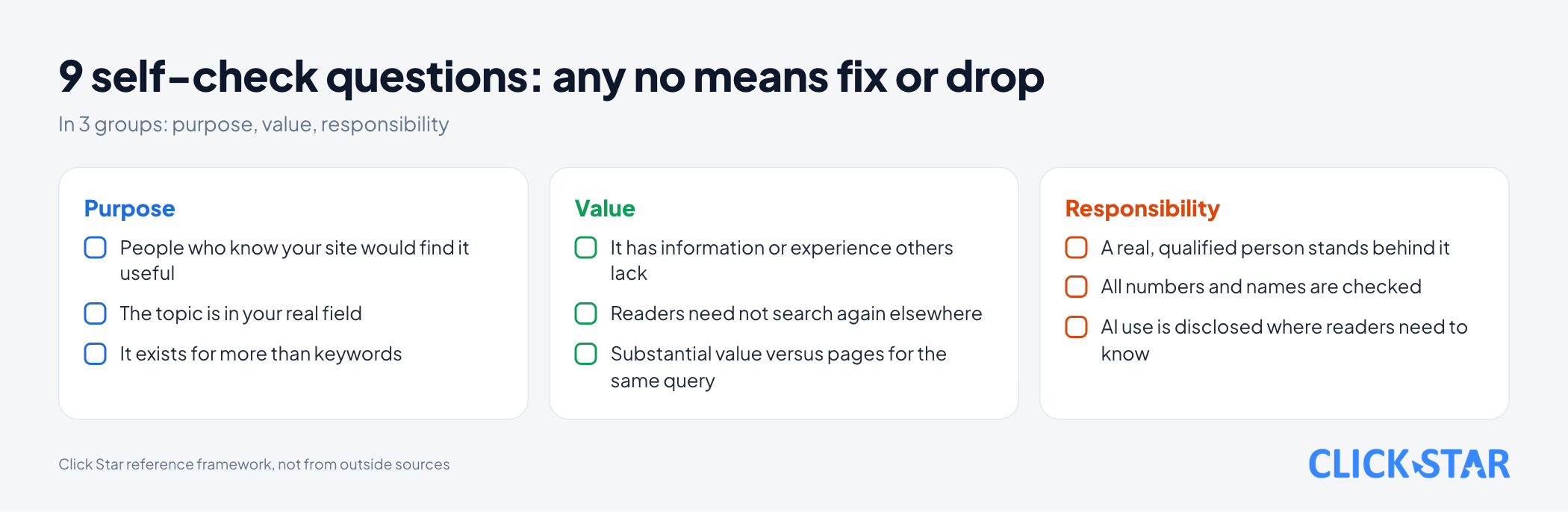
- Purpose: would people who know your site find it useful; is the topic in the business's real field; does it exist for more than keywords.
- Value: does it have information or experience other pages lack; will readers need to search again elsewhere; does it add substantial value versus pages for the same query.
- Responsibility: is a real, qualified person behind it; are all numbers and names checked; is AI use disclosed where readers need to know.
Click Star's view. The main risk lies in the production model, not the tool: many pages, few viewers, nobody accountable. A named approver and small batches are easier to defend than hundreds of articles at once.
Click Star offers AI integration, digital marketing and SEO-standard website design, so it has an interest here. This is a technical judgment, not a ranking promise.
What to measure (Click Star reference framework)
The pages read name no Google metric that says "now safe". Click Star suggests tracking a few early signals.
- The share of articles that pass all 9 questions before publishing.
- Pages published versus pages indexed in the Page indexing report.
- Impressions and clicks per batch of articles.
- The Manual actions report, checked weekly.
- The share of articles edited or dropped after review.
A 14-day plan (Click Star reference framework)
For businesses that already have a batch of AI-made or template articles.
- Days 1 to 2: list every AI-made or template article with publish date and reviewer. Open the Manual actions report.
- Days 3 to 5: score each article with the 9 questions, then sort into keep, fix, merge or drop.
- Days 6 to 9: fix the "fix" group with a qualified person. Consider removing the "drop" group or excluding it from Search.
- Days 10 to 12: write the 6-step process as an internal document naming the responsible person.
- Days 13 to 14: set a small-batch publishing schedule and choose the metrics to track.
Common mistakes
- Believing "someone read it" is enough, even if that person has no expertise and changes nothing.
- Chasing a monthly article count although Google states no threshold.
- Building template pages that only swap a province or product name.
- Citing sources and treating that as enough, although Google's rater criteria say credit does not replace original effort.
- Checking only the body text and skipping title tags, descriptions, structured data and image alt text.
- Creating fake author profiles or AI headshots for "experts" who do not exist.
What is not known
The pages read state no threshold for article count, publishing speed or share of AI content that counts as abuse. Click Star also has no measurement of how Vietnamese sites are treated.
It is unclear whether a specific batch would be demoted by automated systems, receive a manual action or be left alone. The Manual actions page describes manual actions only.
Click Star did not check the Search Quality Rater Guidelines directly. Per Google's AI content page, section 4.6.5 covers scaled content abuse and section 4.6.6 covers main content with little effort, originality or value.
Copyright and Vietnamese rules on AI are outside the pages read.
Related posts

Need tailored advice for your business?
Click Star helps you build a solution that fits your industry and scale. We answer every question during business hours.