Analysis of the Claude models: Fable 5.1, Opus 5.5, Sonnet 5.5, Haiku 5.5 and how to choose
Compares the 4 current Claude models by price, effort, caching and lifecycle, with a one-request cost example, a 14-day trial process and what to check when switching models, based on Anthropic's official documentation.
This article analyzes the lineup of Claude models available as of October 20, 2026: how each model differs in the ways that matter for cost and operations, which model to start testing for each job, and what to check when switching models.
One thing needs saying plainly at the start: according to Anthropic's release notes page, the newest entry is dated October 15, 2026, and there is no entry dated October 20, 2026; Anthropic's news page also shows no model announcement in these days.
So the "October 20, 2026 update" in this article is the state checked on that date, not a new release. The figures come from Anthropic's official documentation (the models overview, the pricing page and the documentation on effort, prompt caching and token counting).
Click Star already has a separate article on the changes from September 22 to October 15 with the benchmark figures Anthropic published; this one does not repeat those numbers and goes into how to compare and choose.
Key points
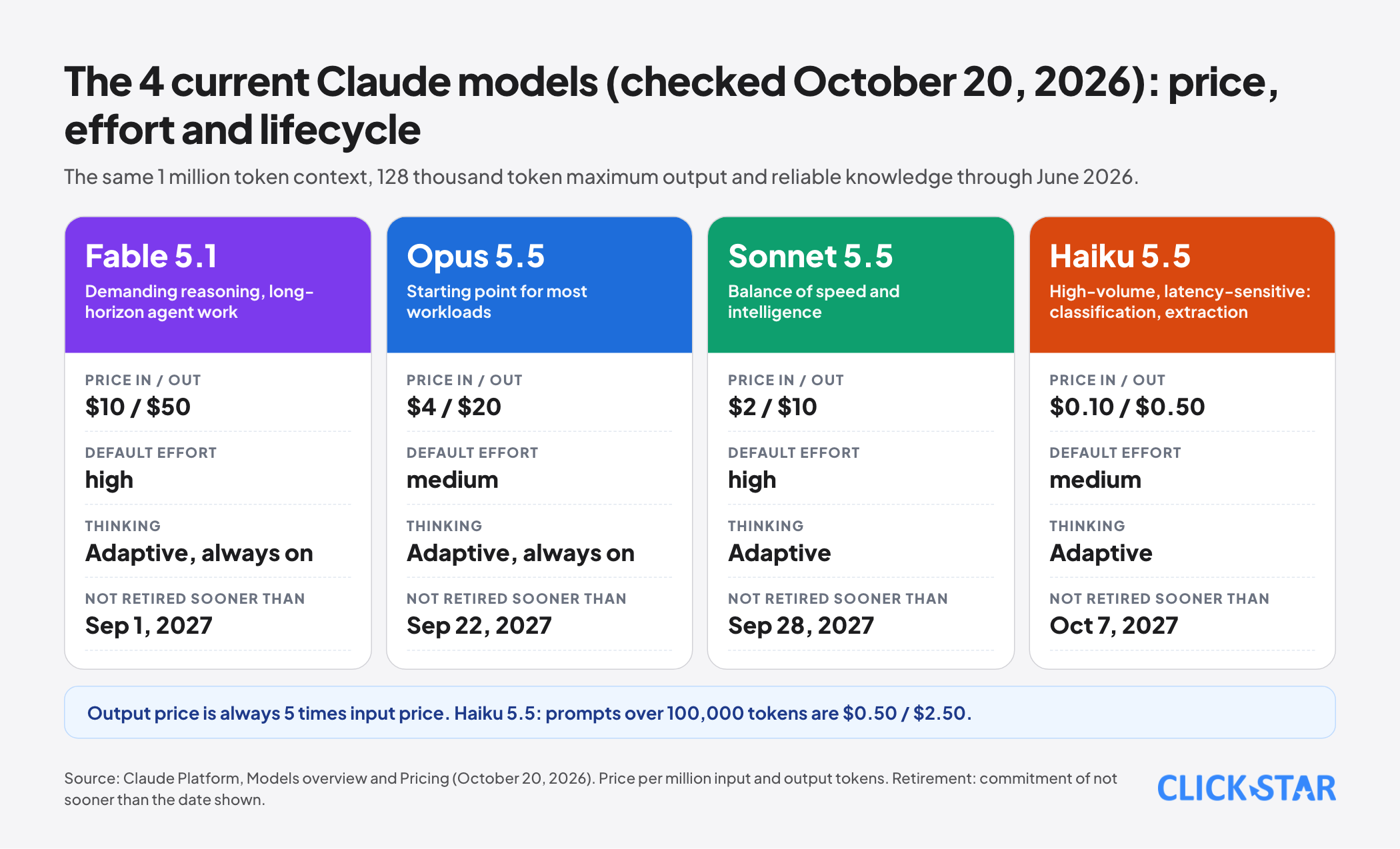
- The current lineup has 4 models: Fable 5.1 (US$10 and US$50 per million input and output tokens), Opus 5.5 (US$4 and US$20), Sonnet 5.5 (US$2 and US$10) and Haiku 5.5 (US$0.10 and US$0.50 for prompts up to 100,000 tokens); all 4 have a 1 million token context window, a 128 thousand token maximum output and a reliable knowledge cutoff of June 2026.
- On all 4 models, the output price is exactly 5 times the input price, so when caching reduces the input side, output becomes the main cost.
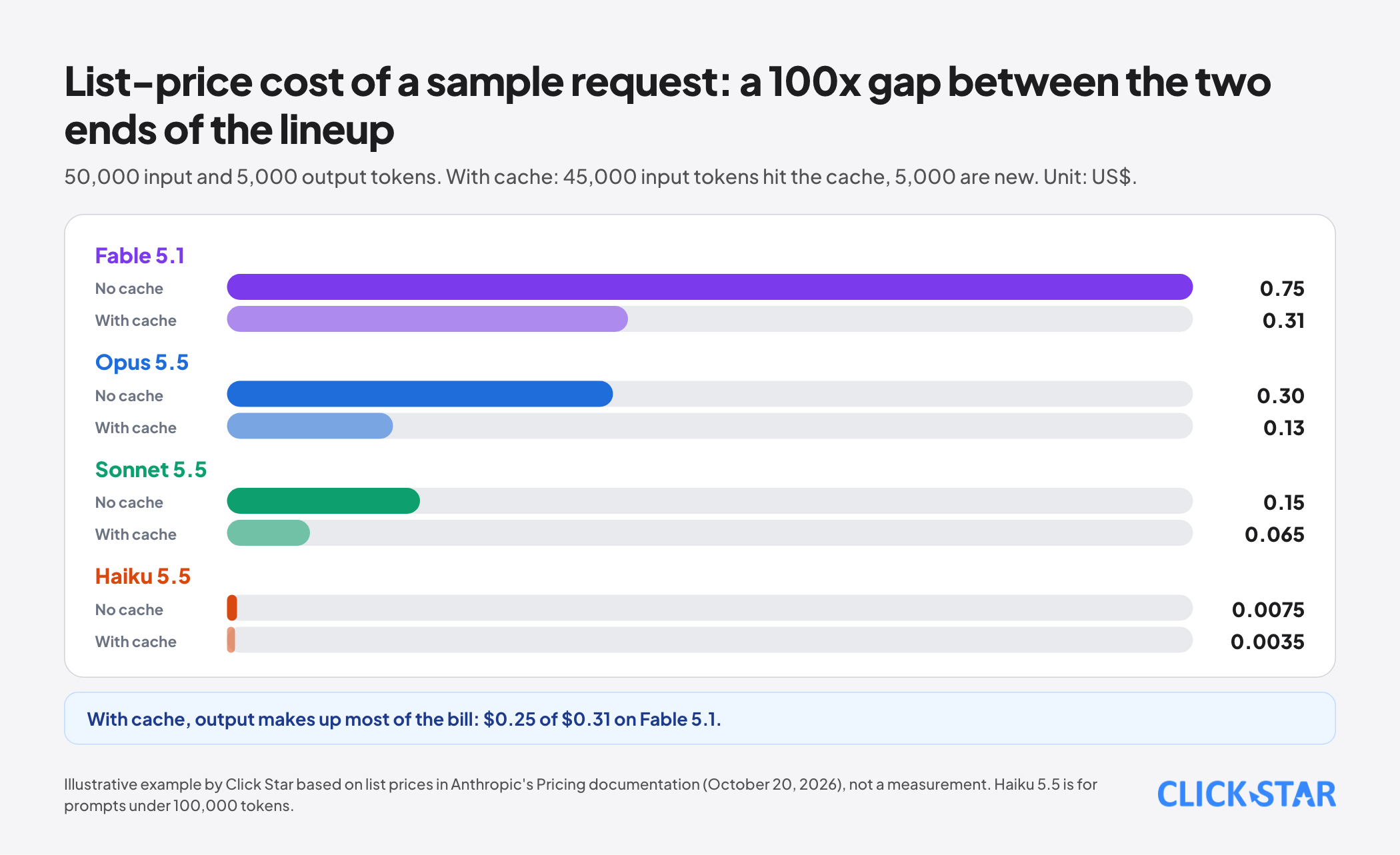
- A sample request of 50,000 input tokens and 5,000 output tokens costs about US$0.75 at list price on Fable 5.1, US$0.30 on Opus 5.5, US$0.15 on Sonnet 5.5 and US$0.0075 on Haiku 5.5: a gap of up to 100 times between the two ends of the lineup.
- The default effort levels differ: Fable 5.1 and Sonnet 5.5 default to "high", while Opus 5.5 and Haiku 5.5 default to "medium", so the same request with no effort parameter runs at different thinking levels on different models.
- Switching models trips teams more often than choosing them: old parameters such as budget_tokens, temperature, top_p, top_k and prefill can return 400 errors when moving from Haiku 4.5 to Haiku 5.5, and the text tokenizer from Claude 4.7 onward produces about 30% more tokens for the same text.
- Anthropic's lifecycle commitments for the 4 current models are "not sooner than" dates from September 1, 2027 to October 7, 2027, so model selection plans should include a transition within about a year.
The "October 20, 2026 update": what was checked
Click Star read the Claude Platform release notes and Anthropic's news page on October 20, 2026. The release notes have entries for October 1, 5, 6, 7, 8, 9, 14 and 15; there is no entry for October 20, and none announcing a model retirement in October.
The news page has announcements for October 14 (the Singapore office and a memorandum of understanding with the Government of Singapore), October 15, October 18 and earlier days, with no new model announcement. If a release comes after this date, the article will need updating; check the release notes page before deciding.
The models available
4 current models. Anthropic positions Opus 5.5 as the starting point for most workloads, Fable 5.1 for demanding reasoning and long-horizon agent work when results on Opus 5.5 at higher effort still fall short, Sonnet 5.5 as the balance of speed and intelligence, and Haiku 5.5 for high-volume, latency-sensitive tasks such as classification, extraction and routing.
All 4 support text and image input, text output, multiple languages and tool use.
Claude Mythos 5.1. It has the same price as Fable 5.1 but is only for organizations verified through Anthropic's programs such as the Cyber Verification Program, so it is not an ordinary option for a business.
Older models still available. Fable 5, Opus 5, Opus 4.8, 4.7, 4.6, 4.5, Sonnet 5, Sonnet 4.6 and Haiku 4.5. Some older models (Opus 4.1, Opus 4, Sonnet 4, Haiku 3.5) have been retired on Anthropic's own platform and remain only on some partner clouds.
Opus 5 and Sonnet 5 are priced at or above the 5.5 generation; Sonnet 5 in particular had an introductory price of US$2 and US$10 through August 31, 2026, and Anthropic says the planned increase to US$3 and US$15 on September 1, 2026 will not occur.
5 real differences between the models
1. Thinking and default effort. All 4 models use adaptive thinking, where the model decides how much to think, and effort is the main way to steer it. Anthropic notes that effort affects every output token, including explanations, tool parameters and thinking content.
Defaults: Fable 5.1 is high, Opus 5.5 is medium, Sonnet 5.5 is high, Haiku 5.5 is medium.
On Opus 5.5 and Fable 5.1, thinking is always on, and a request to disable thinking on Opus 5.5 returns a 400 error at every level; on Sonnet 5.5, the lowest option is "between_tools" (turning off up-front thinking), while Haiku 5.5 allows disabling entirely at high effort or below.
2. Price structure, not just unit price. The output price is always 5 times the input price. The price to read from the cache is 0.025 times the input price on Fable 5.1 (US$0.25 per million tokens), 0.05 times on Opus 5.5 (US$0.20) and Sonnet 5.5 (US$0.10), and 0.1 times on Haiku 5.5 (US$0.01).
The Batch API gives a 50% discount on both input and output, and according to the pricing page the caching and batch multipliers stack. Haiku 5.5 is priced by prompt length: above 100,000 tokens the price rises to US$0.50 input and US$2.50 output.
Fast mode for Opus 5.5 left research preview on October 15, 2026 at US$8 and US$40, double the standard price, and cannot be used with the Batch API.
3. The minimum prompt length for caching. All 4 models need only 512 tokens (while earlier models typically needed 1,024 to 4,096), so shorter system prompts can also benefit from caching.
4. The text tokenizer. From Claude 4.7, Anthropic uses a newer tokenizer that produces about 30% more tokens for the same text than earlier models (the real increase depends on content).
That means the token count of a task can rise when moving to a newer model even if the price per token stays the same or falls; recount tokens with the model you plan to use. Anthropic states that token counting is free, with a requests-per-minute limit by usage tier.
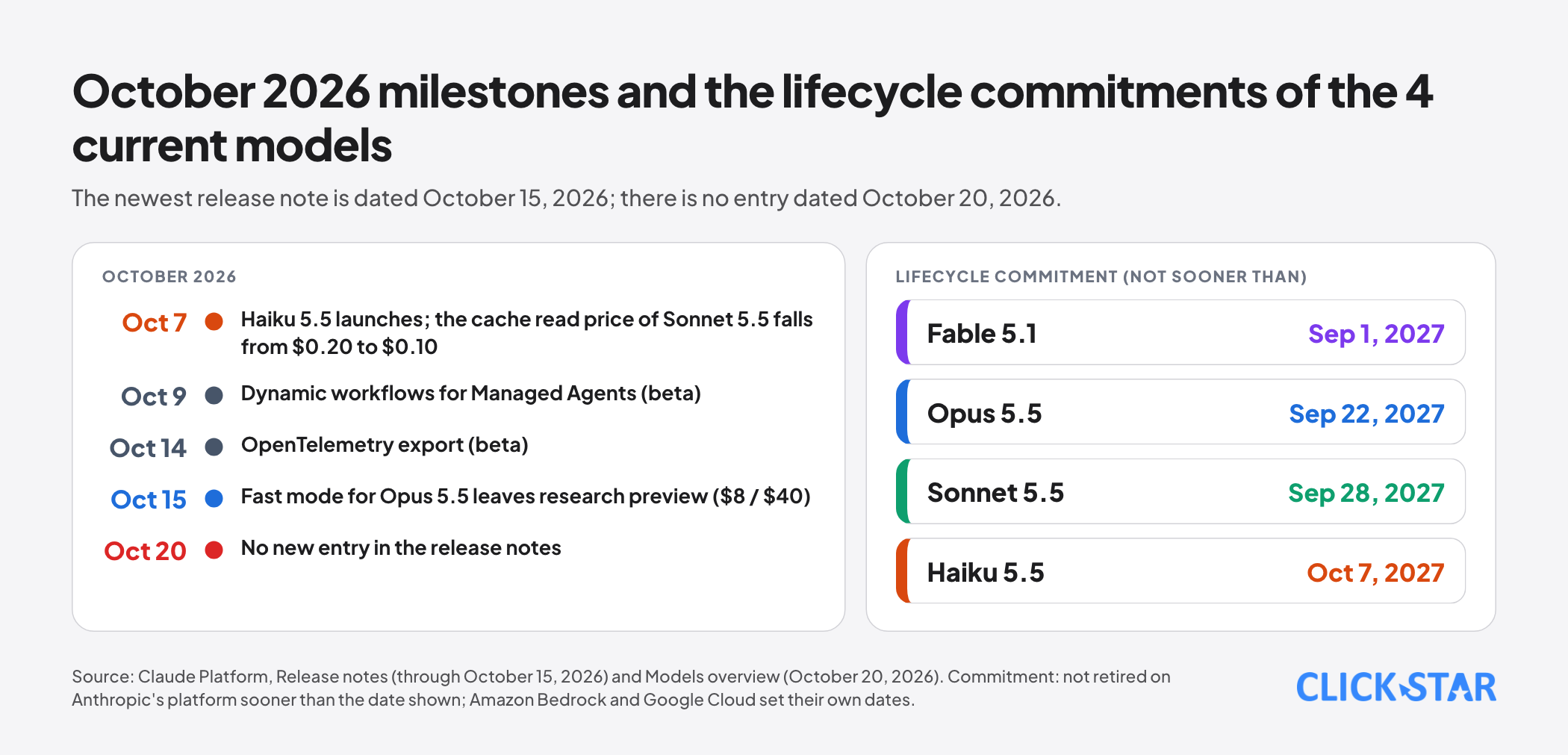
5. Lifecycle. Anthropic commits not to retire models on its own platform sooner than: Fable 5.1 on September 1, 2027, Opus 5.5 on September 22, 2027, Sonnet 5.5 on September 28, 2027 and Haiku 5.5 on October 7, 2027. Amazon Bedrock and Google Cloud set their own dates.
Cost of one task: caching flips the cost structure
This is an illustrative example by Click Star based on list prices, not a measurement, and it ignores variation in token counts between runs. One request with 50,000 input tokens and 5,000 output tokens.
- No cache: Fable 5.1 about US$0.75 (US$0.50 for input and US$0.25 for output); Opus 5.5 about US$0.30; Sonnet 5.5 about US$0.15; Haiku 5.5 about US$0.0075 (prompt under 100,000 tokens).
- With cache, 45,000 input tokens hitting the cache and 5,000 new tokens: Fable 5.1 about US$0.31; Opus 5.5 about US$0.13; Sonnet 5.5 about US$0.065; Haiku 5.5 about US$0.0035.
Two observations. First, the gap between Fable 5.1 and Haiku 5.5 is 100 times with no cache and about 90 times with cache, so choosing the model often has a larger effect than any other optimization trick.
Second, with cache hits, output makes up most of the bill (US$0.25 of US$0.31 on Fable 5.1), so limiting output length and choosing a lower effort level is worth more than trimming input further.
Click Star's view. The right question is not "which model is strongest" but "what minimum quality does this job need, and which is the cheapest model that reaches it".
For most repetitive work (classification, extraction, first-line replies), Haiku 5.5 or Sonnet 5.5 is a reasonable place to start testing; Opus 5.5 and Fable 5.1 should be reserved for work where a wrong result costs more than the price difference.
How to choose: a 14-day trial process
- Days 1 to 2: pick 30 to 50 real task samples (with personal data removed), with clear pass criteria and a grader.
- Days 3 to 7: run the sample set on 3 models (one small, one medium, one large) at default effort; record real tokens, time and cost per passing task.
- Days 8 to 10: with the cheapest model that meets the criteria, try lowering effort; with the most expensive model, try a higher level if tasks still fail.
- Days 11 to 13: add caching for the fixed part of the prompt and measure again; add the Batch API for tasks that are not urgent.
- Day 14: settle the model for each kind of work and record the criteria so you can come back to evaluate when a new model arrives.
Anthropic recommends running an effort sweep on your own test set instead of carrying settings over from an older model, because each model's effort levels are calibrated differently.
What to check when switching models
- Old parameters that cause 400 errors: moving from Haiku 4.5 to Haiku 5.5, Anthropic warns that budget_tokens, temperature, top_p, top_k and pre-filling the assistant's answer (prefill) can return 400 errors; the computer_20250124 tool does too.
- A lower default effort: Opus 5.5 defaults to medium while Opus 5 and earlier Opus models default to high, so a request with no effort set runs one level lower than before.
- Turning off thinking: a thinking disabled request on Opus 5.5 returns a 400 error at every level, and Fable 5.1 always has adaptive thinking on; on Sonnet 5.5 use between_tools.
- More tokens: recount with the exact new model ID before estimating cost or checking context fit.
- Invalidated cache: changing tool definitions, the system prompt, the speed (fast or standard) or the request-level effort between calls loses the cache; choose an effort level at the start of a session and keep it, or use the per-message effort change (in beta) on models that support it.
Lifecycle and the October changes
The October 2026 release note milestones that bear directly on cost and operations: on October 7, Haiku 5.5 launched and the cache read price of Sonnet 5.5 fell from US$0.20 to US$0.10; on October 9, dynamic workflows for Managed Agents entered beta; on October 14, OpenTelemetry export entered beta; on October 15, fast mode for Opus 5.5 left research preview.
Over the longer term, the 4 current models have lifecycle commitments to at least September and October 2027, so a plan that pins one model will need a transition within about a year.
What to do this week
- List every place you call a Claude model (applications, automations, tools) and the model used at each.
- For each place, note the lifecycle commitment date of the model in use and decide whether a transition is needed.
- Run the 14-day trial for the 1 task with the largest cost, instead of testing everything at once.
- Review old parameters (temperature, top_p, top_k, budget_tokens, prefill) in code if you plan to switch models.
- Record real tokens and cost per passing task in a tracking sheet so you can compare when a new model arrives.
Common mistakes
- Choosing a model by a general ranking instead of testing on real task samples.
- Comparing cost by unit price only and ignoring token differences caused by different tokenizers.
- Not setting effort explicitly, so the same code runs at different levels on different models.
- Keeping old parameters when switching models and hitting 400 errors in production.
- Changing effort or tools between requests of the same session and losing the cache.
- Not tracking lifecycle commitment dates and being caught off guard when a model is announced for retirement.
- Using the largest model for everything "to be safe" and paying 100 times the cost for simple classification.
Related posts



Need tailored advice for your business?
Click Star helps you build a solution that fits your industry and scale. We answer every question during business hours.