Why businesses should use a CDP in online marketing operations: 6 reasons, prerequisites and when to wait
6 reasons to use a CDP in online marketing operations based on Meta's and Google's documentation, plus when not to yet, 5 readiness questions, a 90-day roadmap and data risks.
Most articles about CDPs (customer data platforms) stop at the question "what is a CDP and how does it differ from a CRM," which Click Star has already answered in its separate article on CRM and CDP. The question that people running online marketing actually need answered is different: where does everyday work change when you use a CDP, when is it worth doing, and when should you not yet do it?
This article follows that question, based on Meta's official documentation on the Conversions API, Google Ads documentation on enhanced conversions, Google's Privacy Sandbox announcement of October 17, 2025, and Vietnam's personal data protection framework as covered in Click Star's earlier articles.
All figures are checked as of October 21, 2026. On quantitative evidence, it needs saying plainly: the CDP return-on-investment studies Click Star could find are mostly sponsored by vendors or self-reported surveys, so the article does not use them to set expectations.
The rest rests on the mechanisms the documentation describes, and Click Star's own judgments are labeled separately.
Key points
- A CDP is most valuable when a business runs several channels (advertising, website, email, Zalo, stores) and data about the same customer sits in many places that do not match. With one channel and a few hundred customers, a spreadsheet or a CRM is usually enough.
- The most practical reason is conversion signals: Meta's Conversions API connects data from a server, a CRM or offline events into Meta's systems, while Google's enhanced conversions use first-party data that has been normalized and hashed with SHA256. A CDP is where clean, consistent data is produced to send to several platforms at once.
- The message "third-party cookies are about to disappear" needs to be understood correctly: on October 17, 2025 Google confirmed that Chrome keeps its current approach of letting users choose about third-party cookies, and retired a series of Privacy Sandbox technologies such as Topics, Protected Audience and Attribution Reporting. That does not make first-party data any less important: with the cookie-replacement technologies retired, advertisers have to rely on their own data.
- The Law on Personal Data Protection (in effect since January 1, 2026) turns managing consent and data-subject requests in one place into a real operational benefit, but also makes a CDP a point of concentrated risk without access control and logs.
- A CDP does not clean data by itself: messy input gives messy output. According to a reported survey, the biggest difficulty for CDP users is integrating data from many sources (57%).
- A sensible way in is step by step: one measurable goal, 2 to 3 data sources, one activation channel, then expand.
What a CDP means in marketing operations
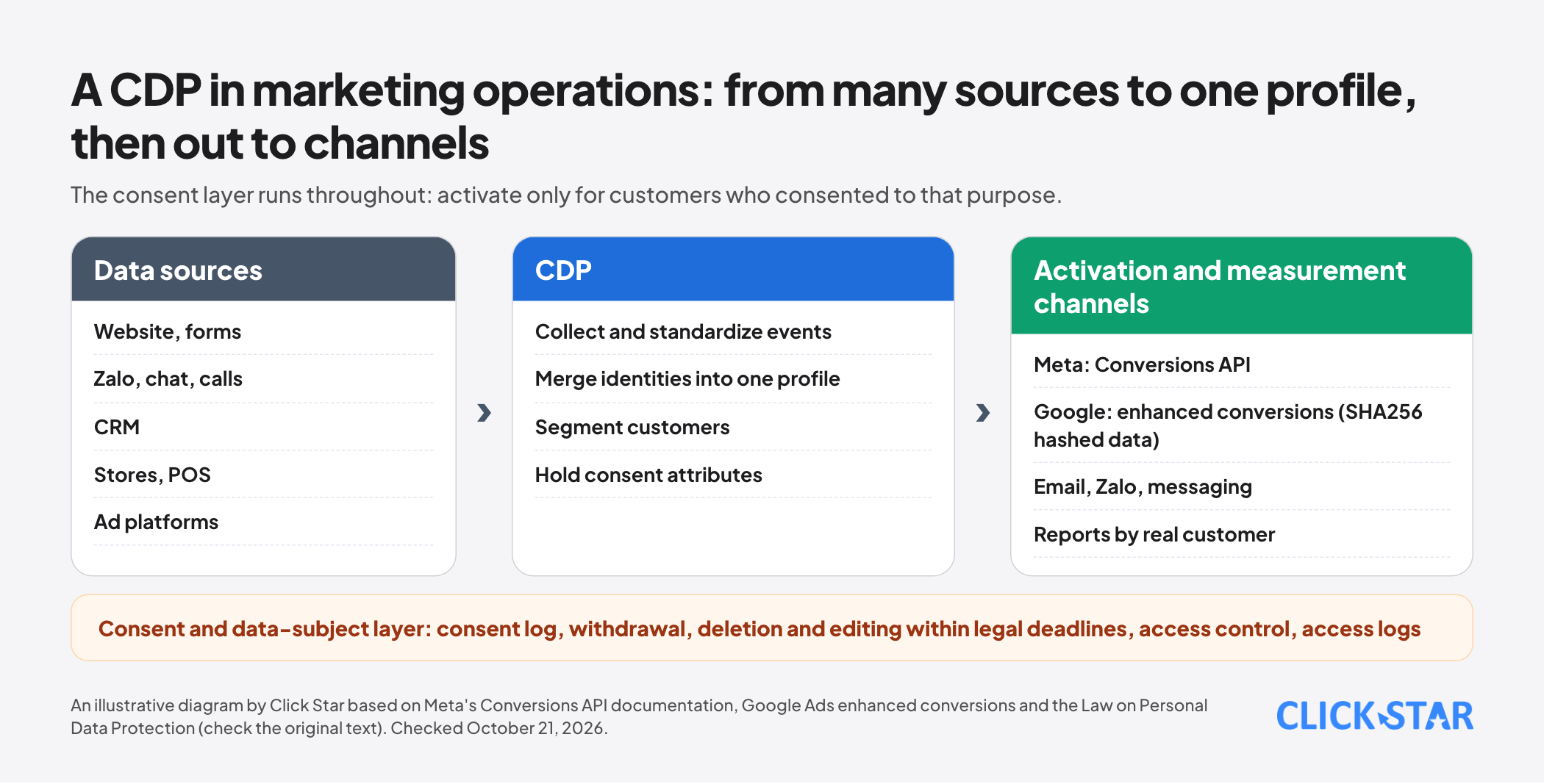
According to the widely used wording of the CDP Institute that many sources quote (Click Star could not read the institute's original), a CDP is packaged software that creates a unified, persistent customer database that other systems can access.
Three key words: "packaged" means software bought for the marketing team to run rather than a custom development project; "unified" means connecting all data belonging to the same customer; "persistent" means the system keeps its own copy of data to track behavior over time.
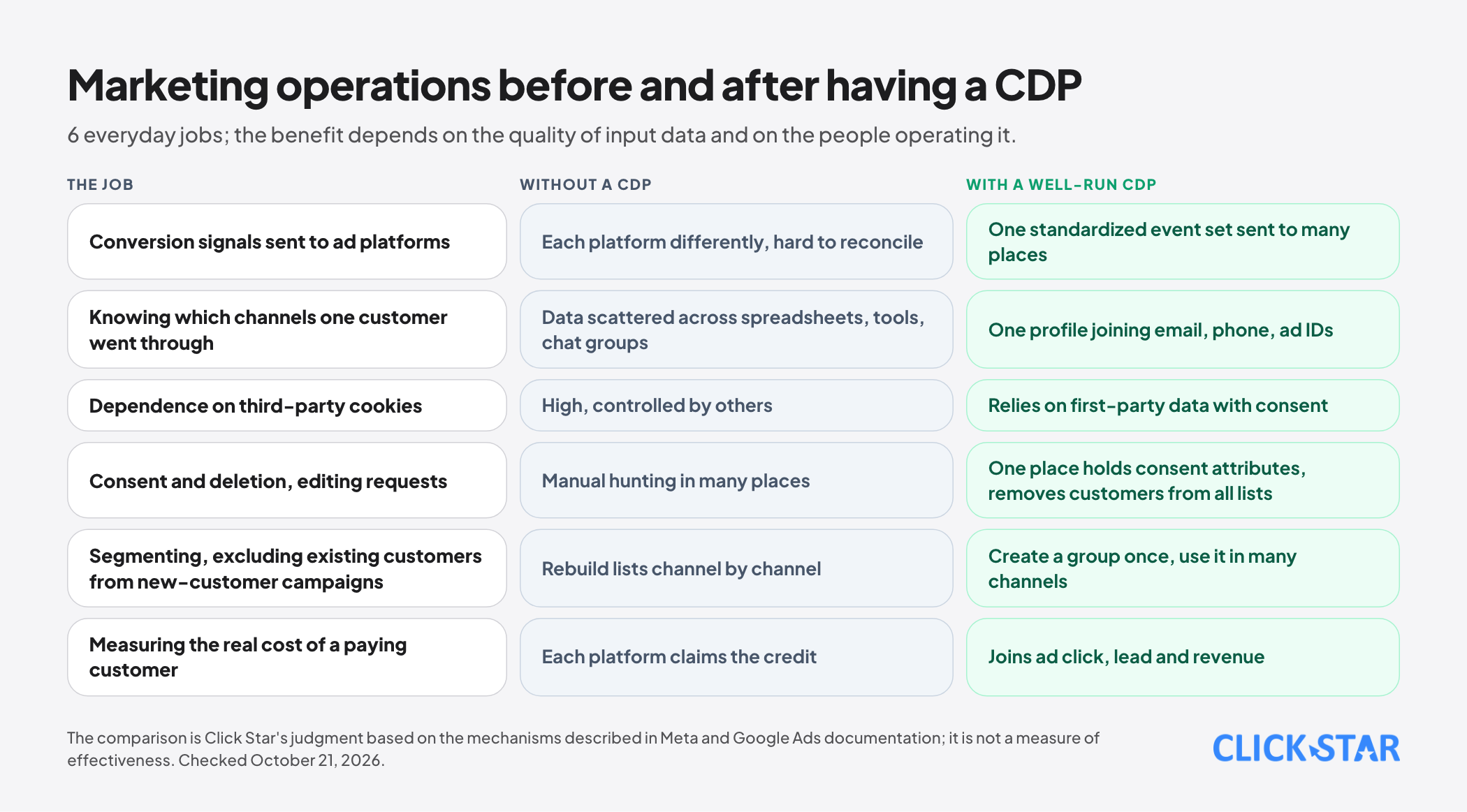
In operations, that translates into 4 concrete jobs: collect data from many sources, attach it to one customer profile, split it into groups, and push the results out to channels. The 6 reasons below are the 6 places where these 4 jobs make a difference to operations.
6 reasons a business should use a CDP in online marketing operations
1. Send standardized conversion signals to ad platforms
According to Meta's documentation, the Conversions API creates a connection between an advertiser's marketing data (events from a website, an app, business messaging and offline events) and Meta's systems, from a server, a website platform, a mobile app or a CRM. The events are processed like events sent through the Meta Pixel and used for measurement, reporting and optimization.
Meta lists benefits including optimizing targeting, lowering cost per result, measuring outcomes and fewer separate integrations; Click Star found no independently verified figures for these benefits.
On Google's side, the Google Ads documentation describes enhanced conversions as supplementing conversion data with hashed first-party data: email, names, addresses and phone numbers are normalized (trimmed of spaces, lowercase, phone numbers in E.164 format) and then hashed with SHA256, a one-way algorithm, before being sent, and matched to the Google account that was signed in when the user engaged with the ad. Google says it reports only privacy-safe conversions.
The CDP's role here is as the single source of truth. If each platform receives a differently normalized set of events, reconciling the figures is hard. When the CDP normalizes events and identifiers once, then pushes the same clean data to Meta, Google and other channels, the discrepancies between reports shrink.
Meta's documentation mentions deduplication only as an item to verify during setup, so when using both the Pixel and the Conversions API, check event deduplication carefully.
2. Merge identities into one customer profile
One customer can appear as 4 people: the person who filled in a form with an email, the person who messaged on Zalo with a phone number, the person who clicked an ad with a browser ID, and the person who bought in a store with a member number.
A CDP joins these identifiers into one profile, so you know which channels the customer interacted through and what it really cost to acquire them. Caution is needed: a wrong match (merging 2 people into 1) does as much harm as no match.
Matching rules should start with certain identifiers (an email, a verified phone number), and matching based on inference should be marked with a confidence level.
3. Do not bet on third-party cookies
According to the October 17, 2025 announcement by Anthony Chavez, VP of Privacy Sandbox at Google, Chrome keeps its current approach of giving users a choice about third-party cookies.
At the same time Google retired these technologies: the Attribution Reporting API, IP Protection, On-Device Personalization, Private Aggregation, Protected Audience, Protected App Signals, Related Website Sets, SelectURL, SDK Runtime and Topics. CHIPS, FedCM and Private State Tokens continue to be supported.
The post names no replacement technology or migration guidance for advertisers, and gives no specific date for the retirements.
Click Star's view. The reasonable conclusion is not "cookies are dying" but "do not depend on any identification mechanism controlled by someone else." Third-party cookies remain a user's choice and can be refused, while the alternatives Google proposed have been retired. First-party data with consent, which belongs to the business, is the most stable asset.
4. Manage consent and data-subject requests in one place
According to Click Star's earlier article on the Law on Personal Data Protection (compiled from law-firm and press analyses, and needing to be checked against the original text), a business must keep a consent log, respond to data-subject requests within 2 working days, carry out viewing or editing within 10 days and deletion within 20 days (30 days if a processor is involved), and report breaches within 72 hours.
If customer data is scattered across spreadsheets, email tools, ad tools and chat groups, these deadlines are very hard to meet.
When a CDP holds the customer profile with consent attributes (consent for which purpose, when, through which channel), removing customers who withdrew consent from every list and campaign becomes one operation instead of a hunt.
The flip side: a CDP gathers data in one place and so gathers risk too. It needs role-based access, access logs, encryption, and a review of the obligations on transferring data abroad if the platform is hosted abroad (an impact assessment file, notification to the Ministry of Public Security and an agreement binding the recipient, according to the summaries).
5. Segment and activate across channels from the same list
Once profiles are merged, you create a group once (for example "viewed the pricing page in the last 14 days, left no contact" or "customers on their second or later purchase") and use that group in email, messaging and ads.
One concrete application related to Meta: Meta's Customer Lifecycle Strategy tool recommends excluding existing customers from campaigns seeking new customers (as Click Star summarized in its article on Meta's 2026 updates); that requires you to have a correct, current list of existing customers, and the CDP is where that list is kept.
It is a clear way to save budget: do not pay for ads that look for customers among people who have already bought.
6. Measure by real customers, not by each platform
Each platform reports in its own way and each wants the credit. When the CDP connects an ad click to the lead in the CRM and to the revenue of the order, you can measure the real cost of acquiring a paying customer by channel, including customers arriving from new sources such as AI tools.
Click Star suggested in earlier articles measuring traffic from ChatGPT, Gemini, Claude and Perplexity separately in GA4; a CDP helps follow that visit through to the order.
When not to use a CDP yet
A CDP is not the first step for every business. Signs that it is too early:
- There are only 1 or 2 channels and little customer data, while a CRM or a well-structured spreadsheet already meets the need.
- There is no accurately measured conversion event on the website or app; putting dirty data into a CDP only multiplies the error.
- There is no data owner: nobody is responsible for quality, identity and consent.
- There is no measurable goal: "having a CDP" is not a goal.
- There is not enough operating capacity: integrating sources, identity-matching rules and quality checks need people working on them regularly; according to a reported survey, data integration is the biggest difficulty (57% of CDP users).
On evidence of benefit, the figures often cited, such as the 802% return in the Forrester Total Economic Impact study sponsored by Treasure Data, or the 92% of marketers reporting increased ROI in Advertiser Perceptions' 2020 survey linked to a vendor, are all materials connected to a vendor or self-reported (according to search results Click Star checked, without reading the originals).
Click Star recommends not using them to set expectations for your business.
Readiness questions and a 90-day roadmap
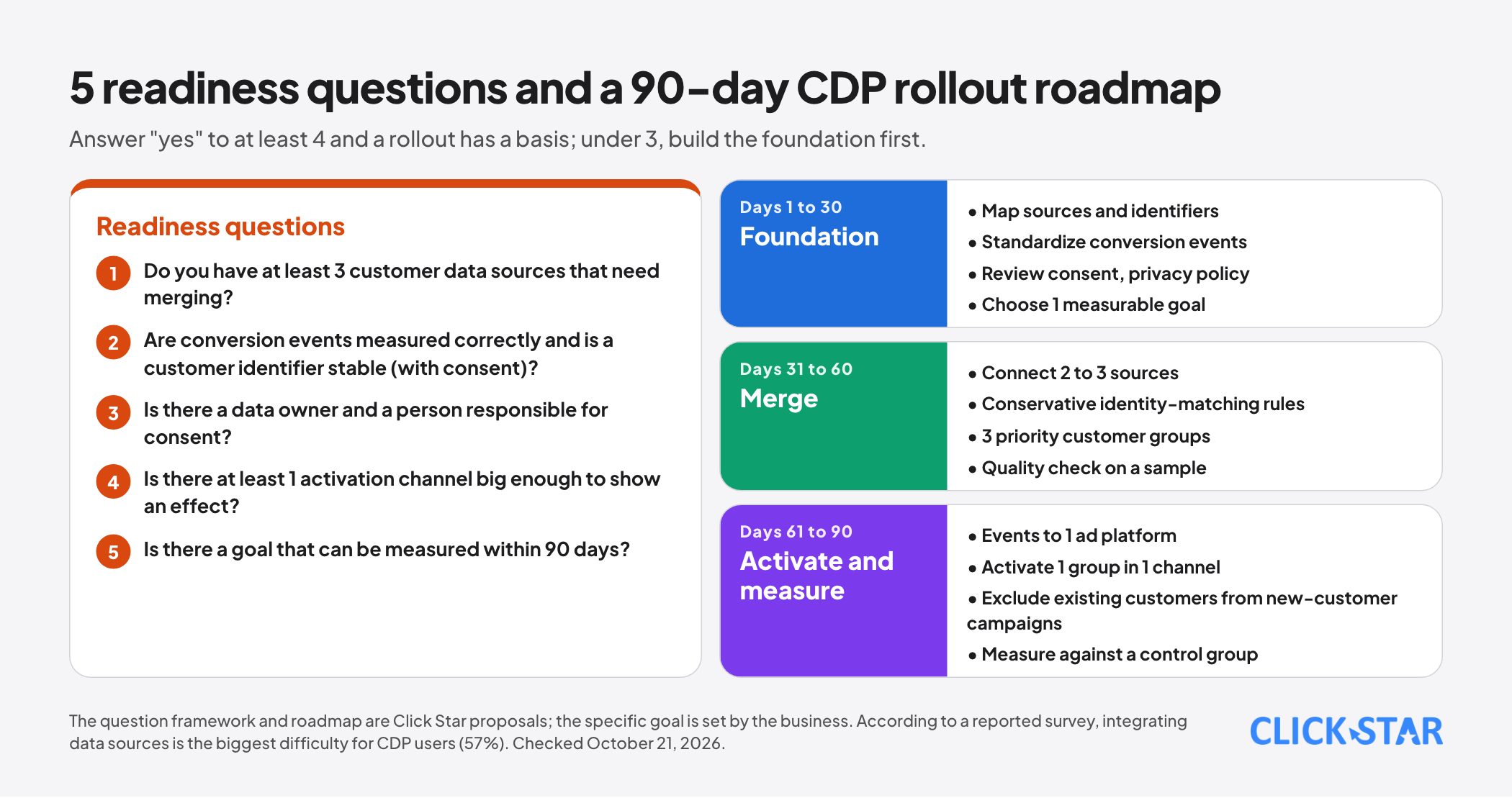
5 readiness questions (Click Star's framework): (1) do you have at least 3 sources of customer data that need merging; (2) do you have conversion events measured correctly and a stable customer identifier (an email or phone number with consent); (3) do you have a data owner and a person responsible for consent; (4) do you have at least one activation channel big enough to show an effect (email, Zalo, ads); (5) do you have a goal that can be measured within 90 days.
If you answer "yes" to at least 4, a rollout has a basis; under 3, build the foundation first.
A suggested 90-day roadmap:
- Days 1 to 30, foundation: map data sources and identifiers, standardize conversion events, review consent and the privacy policy, choose one measurable goal (for example, cut the cost per real lead by 15%, a figure the business sets itself).
- Days 31 to 60, merge: connect 2 to 3 sources, set conservative identity-matching rules, build the 3 priority customer groups, check quality on a sample.
- Days 61 to 90, activate and measure: push the conversion events to one ad platform, activate one group in one channel, exclude existing customers from campaigns seeking new customers, and measure against a control group.
Choices for implementation
There are 3 common directions, and this is Click Star's judgment rather than a measurement: buy a packaged CDP (fast, full-featured, dependent on the vendor and priced by scale), use a CRM with CDP functions (simple, but usually weak on many sources and ad integrations), or build on your own data warehouse (flexible, but needs an engineering team).
The points to ask about in any direction: where the data sits, who owns it and whether it can be exported, the ability to delete on request, the level of access control and logs, and the cost as the number of profiles grows.
What is not known
Click Star has no independent measurement of how much a CDP improves cost or revenue for Vietnamese businesses. The benefits Meta lists for the Conversions API have not been independently verified in the sources read. The 57% figure on integration difficulty comes from a reported survey whose original has not been checked.
How the obligations on transferring data abroad apply to a specific CDP platform needs legal advice. Meta's and Google's documentation on parameters, deduplication and data matching has many subpages that this article has not read in full.
Common mistakes
- Buying a CDP before having standardized conversion events and a measurable goal.
- Merging identities too aggressively, joining 2 people into 1 because a phone number is shared.
- Pushing data to ad platforms without checking consent, then running into obligations on the purpose of processing.
- Using both the Pixel and the Conversions API without checking event deduplication.
- Treating the CDP as a storage place, with nobody operating the identity-matching rules and data quality.
- Believing vendor-sponsored ROI figures instead of measuring with a control group.
- Gathering all data in one place without access control, logs or encryption.
Related posts
Need tailored advice for your business?
Click Star helps you build a solution that fits your industry and scale. We answer every question during business hours.