SEO thinking in the AI era: from winning rankings to becoming the cited source
What Google says about AI Overviews and AI Mode, what independent studies measured, and how to change your SEO thinking: technical foundations, question-led content, original value, AI crawlers and measurement.
When Google and AI tools answer right on the results page, the question for anyone doing SEO is no longer only "what position are we in" but also "are we cited as a source, and is our name remembered".
This article separates 3 layers of information: what Google says officially, what independent studies have measured, and what is Click Star's own recommendation. The goal is a way of thinking about SEO that still holds as the search interface keeps changing.
Key points
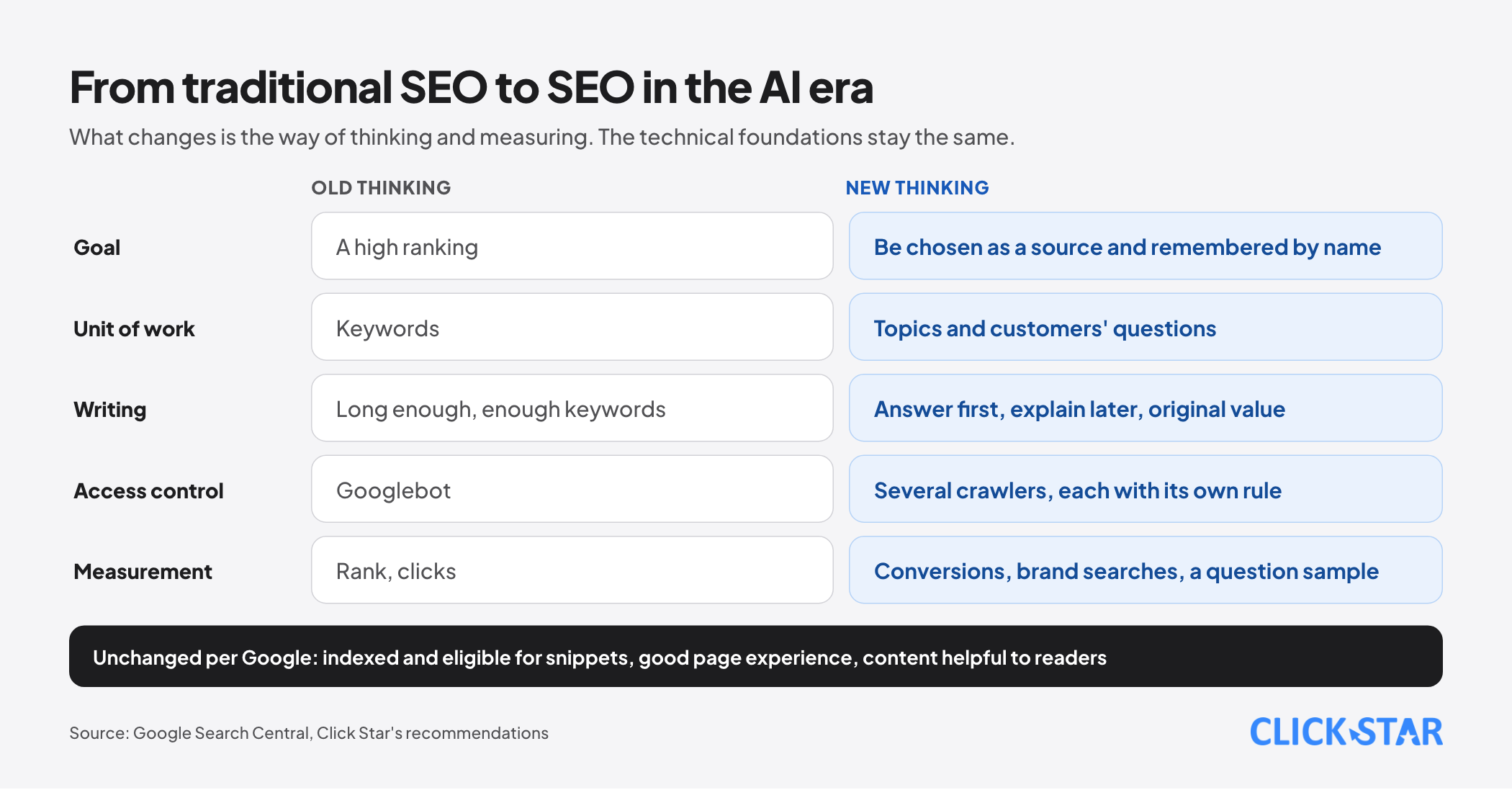
- According to Google, no special optimization or markup is needed to appear in AI Overviews and AI Mode. A page must be indexed and eligible to be shown with a snippet, and the foundational SEO principles still apply.
- Clicks fall when an AI summary appears. According to Pew Research (900 US adults, March 2025 data), users clicked a traditional result in 8% of visits with an AI summary, versus 15% without one. Ahrefs estimates that the click-through rate at position 1 drops by about 58% when an AI Overview is present (data through December 2025).
- Mass-produced AI content that adds no value falls under "scaled content abuse" in Google's spam policy.
- OpenAI separates 3 crawlers (OAI-SearchBot, GPTBot, ChatGPT-User), each with its own purpose and its own controls.
- Measure conversions, brand searches and the number of target questions in which your brand is cited, not just rank and clicks.
1. What has changed and what has not
According to Google. The Google Search Central page "AI features and your website" says AI Overviews appear only when its systems judge them additive to classic Search, so they often do not trigger. AI Mode suits queries that need exploration, reasoning or complex comparison.
Both may use a technique called "query fan-out": issuing several related searches across subtopics to build an answer, which can show a wider and more diverse set of links than a single classic search. Traffic from these features is counted in the overall Search Console Performance report under the Web search type.
Google also states that clicks from AI Overviews are higher quality, with users spending more time on the site. That is Google's own assessment.
According to outside measurements. Pew Research Center found that users clicked a traditional result in 8% of visits with an AI summary versus 15% without one, and clicked a link inside the summary itself in only about 1% of visits.
Ahrefs compared 150,000 keywords that trigger an AI Overview with 150,000 informational keywords that do not, using Search Console data from December 2023 to December 2025. The average click-through rate at position 1 for informational keywords fell from 7.6% to 3.9%, and for keywords with an AI Overview it fell from 7.3% to 1.6%.
The "58%" figure is an estimated gap against a forecast of what would have happened without AI Overviews, not a direct measurement. Ahrefs also notes that part of the decline comes from other features of the results page and the long-running trend toward searches that need no click.
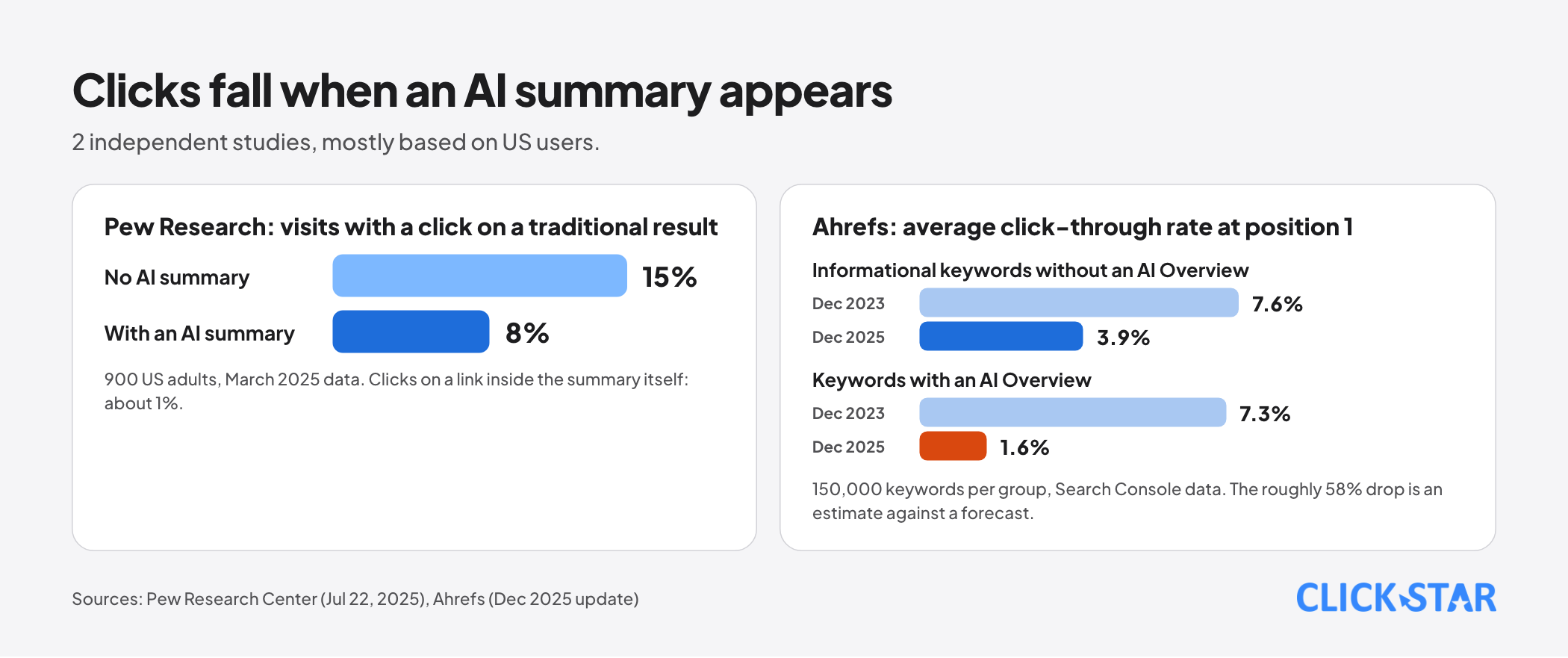
Both studies rely mainly on US user data and have not been verified separately for the Vietnamese market. A reasonable reading is to treat them as signs of direction, not as figures to apply directly to your own website.
2. Technical foundations are still the entry ticket
Google writes that there are no additional requirements to appear in AI Overviews or AI Mode, and that all the foundational SEO principles remain worthwhile. For a page to be a supporting link, it must be indexed and eligible to be shown with a snippet, and Google notes that indexing and serving are not guaranteed. The to-do list from this guidance:
- Allow crawling in robots.txt, and at the CDN or hosting layer too.
- Make pages easy to find through internal links.
- Keep the page experience good.
- Keep important content in text form.
- Support the text with quality images and video where relevant.
- Keep structured data matching the visible content on the page.
- Keep Merchant Center and Business Profile information current, if you have them.
- Verify the site in Search Console to catch technical issues.
If a page is blocked or not indexed, every bit of writing effort behind it is meaningless to Google.
3. Write around topics and questions, not just keywords
Because the system may send several sub-searches to assemble one answer, a page built around a single keyword easily misses related questions. These are Click Star's recommendations, based on how Google describes these features, not a confirmed ranking factor:
- From one main topic, list 8 to 15 questions real customers ask, then split them across pages or clearly headed sections.
- Open each section with a direct answer in 2 to 3 sentences, then give the explanation, evidence and caveats.
- Use headings written as questions or specific noun phrases, and avoid vague ones such as "Overview".
- State the conditions: for whom, in which case, as of what date.
This structure helps readers get what they need faster, and it also helps search systems quote the right passage.
4. Original value: what AI cannot produce on its own
Google's helpful content guidance poses self-assessment questions such as whether the content provides original information, reporting, research or analysis, and whether it is written or reviewed by someone who demonstrably knows the topic.
On E-E-A-T (Experience, Expertise, Authoritativeness, Trust), Google says trust is the most important of the four, that E-E-A-T itself is not a specific ranking factor, and that it carries more weight on topics that can affect health, finances or safety.
How to turn that into work:
- Original data: figures from your own operations (when you may publish them), small surveys, test results.
- First-hand experience: photos, processes you have run, mistakes you have made.
- A named reviewer: state who wrote the piece, who reviewed it for expertise, and when it was last updated.
- A grounded point of view: state a position and the reason for it, instead of only restating what everyone has already written.
On using AI to produce content, Google does not ban it. Google's spam policy defines "scaled content abuse" as generating many pages for the primary purpose of manipulating rankings, and lists using generative AI tools to produce many pages without adding value for users as an example. Google also suggests disclosing automation where readers would expect to know.
5. Many tools now answer, each with its own rules
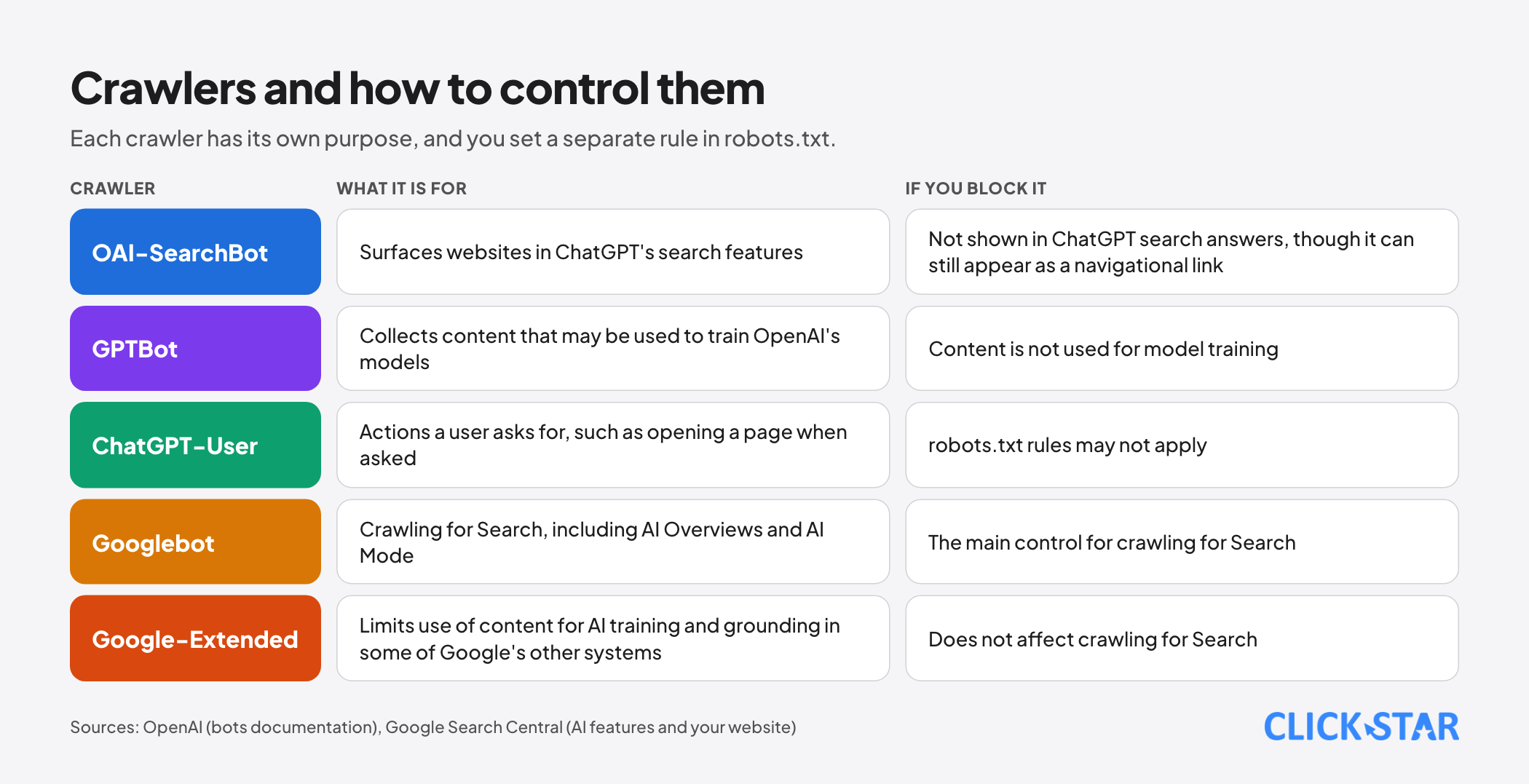
Search is no longer only Google. For ChatGPT, OpenAI describes 3 different kinds of access and lets you set a separate rule for each in robots.txt:
- OAI-SearchBot: surfaces websites in ChatGPT's search features. If you block it, your pages will not appear in ChatGPT search answers, though they can still show up as navigational links.
- GPTBot: collects content that may be used to train models. Blocking GPTBot means your content should not be used for training.
- ChatGPT-User: handles actions a user asks for, such as opening a page when asked. robots.txt rules may not apply to it, and it does not decide whether a page appears in search.
The settings are independent, for example allowing OAI-SearchBot while blocking GPTBot. OpenAI says robots.txt changes can take about 24 hours to take effect in its search systems. For Google, Googlebot in robots.txt is the main control for crawling for Search, while Google-Extended limits the use of content for AI training and grounding in some of Google's other systems.
Recommendation: decide on purpose. If you want to appear in ChatGPT answers, do not block OAI-SearchBot. Whether to let GPTBot train on your content is a decision about your business's content policy.
6. Redefine what success looks like
If you only watch rank and clicks, you will see a decline without knowing whether your brand is still being mentioned. Google suggests tracking conversions and time on site in your analytics tool. Click Star recommends adding:
- Conversions from organic search: contacts, signups, calls, in place of raw visits.
- Brand searches: the number of searches containing your brand name in Search Console, viewed by month.
- A sample of target questions: pick 20 to 30 questions real customers ask. Each month, ask them on Google and a few AI assistants, and record whether your brand is mentioned or cited, which page is cited and whether the information is correct.
AI results vary from one ask to the next, so look at the trend over several months rather than a single measurement.
7. A 30-day plan
- Week 1, technical: check robots.txt and the CDN, verify Search Console, review whether key pages are indexed and show snippets, and decide the settings for OAI-SearchBot and GPTBot.
- Week 2, questions: choose 10 core customer questions and write or update 3 pages using an answer-first, explain-later structure.
- Week 3, original value: add original data, real photos, the names of the writer and reviewer, and update dates to those pages.
- Week 4, measurement: set up tracking for conversions and brand searches, and run the 20-question sample for the first time to get a baseline.
What you do not need to do
- Create special files for AI. Google states you do not need to create new machine-readable files, AI text files or special markup, and that there is no schema.org structured data specific to these features. Structured data, if you use it, must match the visible content.
- Mass-produce pages with AI. The policy risk is the one described in section 4, and these pages rarely carry original value.
- Write for machines instead of people. Google's guidance asks whether a reader will leave feeling they have had a satisfying experience.
Related posts
Need tailored advice for your business?
Click Star helps you build a solution that fits your industry and scale. We answer every question during business hours.