Is a high email open rate real? 5 metrics to use instead
The email open rate can be inflated when Apple Mail preloads the tracking image. Based on documents from Apple, Mailchimp, Klaviyo, Brevo and Google, with a framework of 5 replacement metrics.
An online shop sends a promotion newsletter to 10,000 people. The report shows a 60% open rate, yet the number of orders coming from email barely moves. This is an illustrative example, not a real measurement.
This article draws on documents from Apple, Mailchimp, Klaviyo, Brevo and Google, plus the secondary source Litmus, checked on November 3, 2026. Brevo's page blocks Click Star's tools, so it was read through the help center's public API.
The short answer: the 60% may be inflated when recipients use Apple's Mail app, and the platforms read cannot separate real people from automatic downloads. The article offers 5 replacement metrics. Click Star already has articles on consent-based email marketing, SPF DKIM DMARC, A/B testing and UTM.
Key points
- An email "open" in a report is usually the download of 1 small invisible image. If the image does not load (images off, text-only email), no image load is recorded; Mailchimp still counts a click as an open.
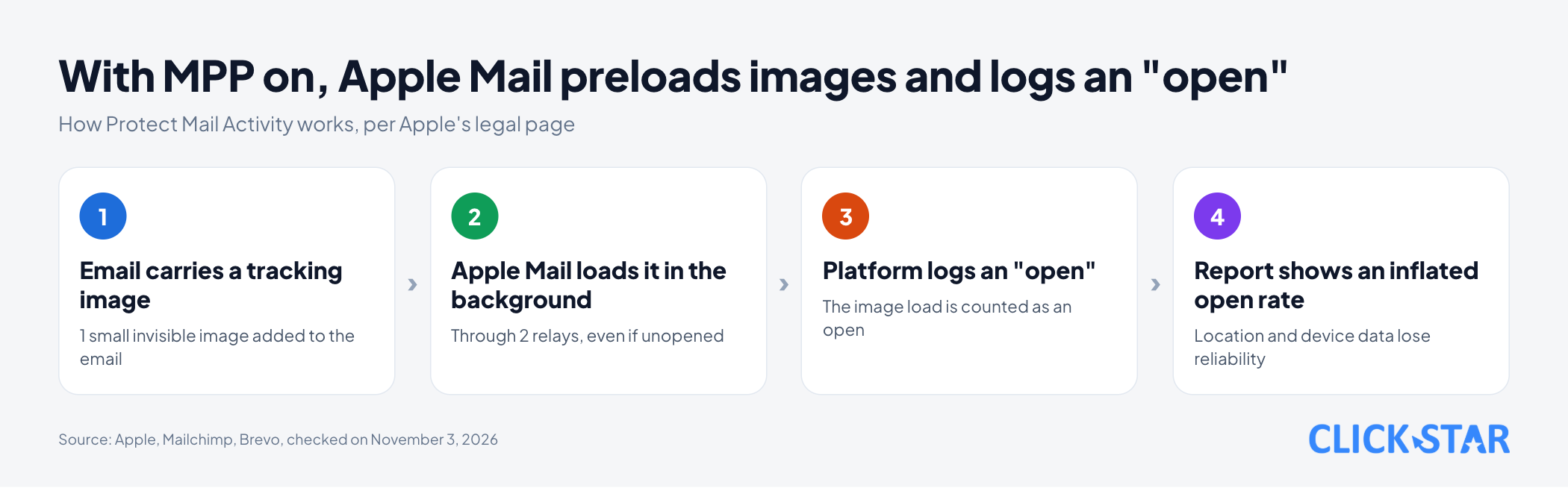
- Per Apple, Protect Mail Activity (part of Mail Privacy Protection, or MPP) downloads remote content in the background once on, whether or not the recipient engages. An open can be recorded before anyone reads.
- Mailchimp, Klaviyo and Brevo can filter or flag MPP opens. Klaviyo says it cannot tell a real person's open from an automatic download.
- Google says senders can sometimes still know that an email with images was opened in Gmail, and that it scans images before mail arrives. It is unclear whether this scan creates opens.
- Click Star's framework of 5 replacement metrics: clicks, landing-page conversions, unsubscribes, spam reports and bounces.
- Do not pick an A/B winner or trigger automation by opens. Google sets the spam-report rate at below 0.1% and never reaching 0.3%.
How an email "open" is measured
An open is an image download, not proof that someone read the email. According to Mailchimp's page "About Open and Click Rates" (no date shown, read November 3, 2026), the system adds 1 tiny transparent image to each email and counts how often it is downloaded.
This image is called a tracking pixel. The method errs both ways. Mailchimp's page "Use Open Tracking in Emails" (no date shown, read November 3, 2026) says opens cannot be measured in text-only emails, or when the recipient does not display images.
The same page says Mailchimp counts a click as an open even if the image did not load. So the open rate can be lower than reality for people with images off who do not click, and higher when images load automatically.
What Apple Mail Privacy Protection changes
Since iOS 15, Apple Mail users can stop senders from tracking whether they read an email. Apple's press release of June 7, 2021 says MPP stops senders from using invisible pixels and masks the IP address.
Apple's legal page "Mail Privacy Protection & Privacy" (2025-12-12 shown at the bottom, read November 3, 2026) lists what senders could learn without it: when and how many times an email was opened, whether it was forwarded, and the IP address.
The same page says that once on, Protect Mail Activity downloads remote content in the background, regardless of whether the recipient engages. This is the root of the "phantom" open.
Content passes through 2 relays run by 2 parties, and neither knows both the IP address and the content. Users can turn Protect Mail Activity off in Mail settings; Hide IP Address is a separate option.
According to Litmus (article "What Mail Privacy Protection Means for Email Marketers", 2021, secondary) and Brevo, MPP applies by app, not by provider: a Gmail or work address opened in Apple Mail is still affected, while the Gmail app on an iPhone is not.
How inflated is the open rate
Litmus's market share page says MPP affects roughly 55 to 60% of opens (per unnamed "studies", secondary source, scope and date not stated). That is the share of opens affected, not the inflation of the open rate, which depends on your share of Apple Mail users and how many have MPP on.
An indirect gauge is Litmus's September 2026 email client report, based on over 1.5 billion opens (secondary source, global). The "Apple" group accounts for 76.56% of recorded opens, Gmail 16.10%, desktop Outlook 3.48% and Yahoo Mail 2.35%.
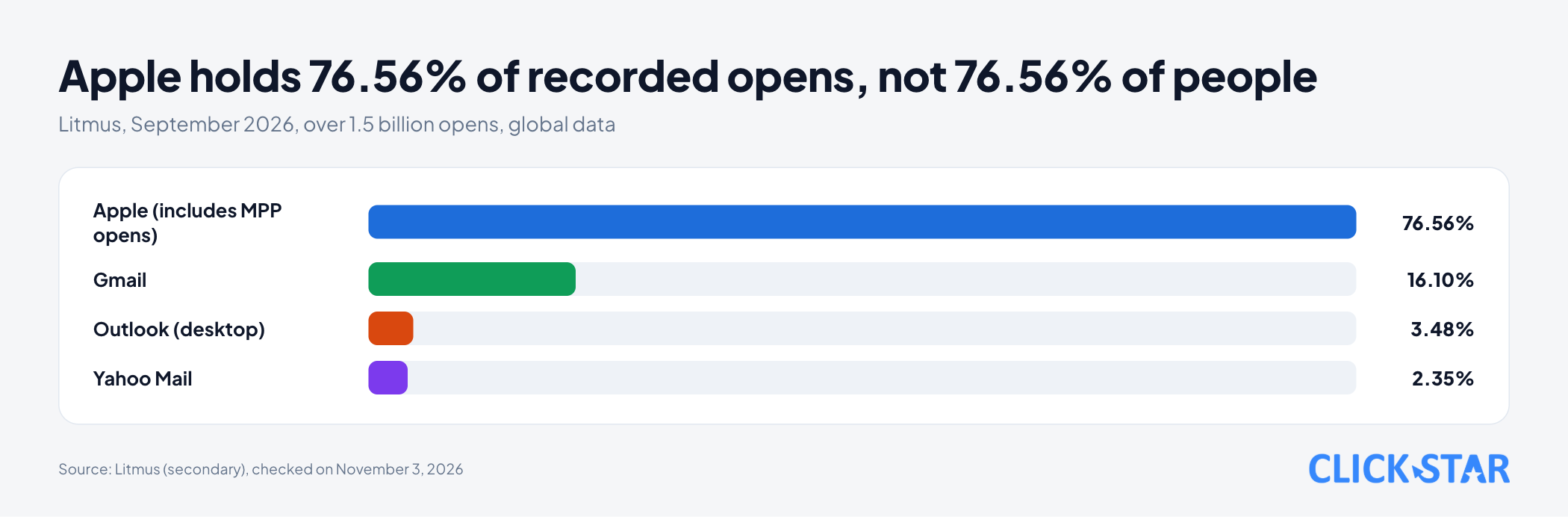
This figure measures opens, not people. Litmus says the Apple group includes MPP opens and treats them as unreliable, so the 76.56% already contains inflation. There is no equivalent figure for Vietnam.
Brevo says otherwise: Apple Mail users may be a small part of a list, without a number.
An illustrative example, not a measurement and unrelated to Litmus's figure: a list delivers 10,000 emails, 4,500 are logged with MPP opens and there are 1,500 other opens. By the formula on Brevo's help page, counting MPP gives (1,500 + 4,500) divided by 10,000, or 60%.
Excluding MPP gives 1,500 divided by (10,000 minus 4,500), about 27.3%. This describes only the group without the MPP flag.
Gmail, bots and clicks
Gmail's page "Turn images on or off in Gmail" (no date shown, read November 3, 2026) says images show automatically by default. Google scans images first, and senders cannot get information about the device or location, but sometimes still know the email was opened.
The page does not say whether the scan creates opens, and the help pages read describe no separate Gmail flag. So Gmail's effect on opens is unclear. A Gmail address opened in Apple Mail is still subject to MPP.
Clicks can also be inflated. According to Mailchimp, bots include antivirus scanners, spam filters, MPP and link-preview tools, often opening emails or clicking links before recipients do.
How email platforms handle it
All 3 platforms can separate MPP opens, with different defaults.
- Mailchimp: bot filtering (page "About Bot Activity and Bot Filtering", no date shown, read November 3, 2026) is on by default, and filtered data for MPP opens exists from July 10, 2024. Opens and clicks drop significantly with filtering.
- Klaviyo: the page "How to identify iOS15 Mail Privacy Protection opens" (updated August 5, 2025) describes the Apple Privacy Open property on open events from November 20, 2021. True means the open came from a device with MPP on, not necessarily a real open.
- Brevo: from February 6, 2025 the open rate includes MPP opens, and from July 8, 2025 bots as well, but both can be filtered in settings.
Decisions that should not rest on the open rate
The 2021 Litmus article lists what is affected: segments by last open date, flows waiting for an open, A/B winners chosen by opens, send-time optimization.
Brevo says automation steps based on opens do not work for MPP users, and subject-line A/B tests and optimal-time sending are unreliable too. Mailchimp suggests considering a move of automation and segment criteria from opens to clicks, because clicks and purchases are stronger signals (page "Apple Mail Privacy Protection Resources", no date shown, read November 3, 2026).
Click Star's view: once opens are unreliable, judge "still interested" by clicks, purchases, replies or page views.
How to check your own data
Click Star's reference framework, not from outside sources, not run on real data.
Step 1. Find the MPP flag in your platform and see whether reports count or exclude those opens.
Step 2. Calculate the share of emails with MPP opens out of delivered emails.
Step 3. Compare opens with clicks and visits. High opens while clicks and UTM-tagged visits barely change across campaigns is a reason to doubt the opens.
Step 4. Compare the hourly distribution of opens of the flagged and unflagged groups, if timestamps can be exported. Opens bunched right after sending fit preloading.
Step 4 is only a weak signal. The 2021 Litmus article describes Apple loading images at irregular times, immediately or days later; in Litmus's testing, this happened only on a wireless network with Mail running in the background.
5 replacement metrics
Click Star's reference framework, not an industry standard. Each metric answers a different question and none depends on the tracking image.
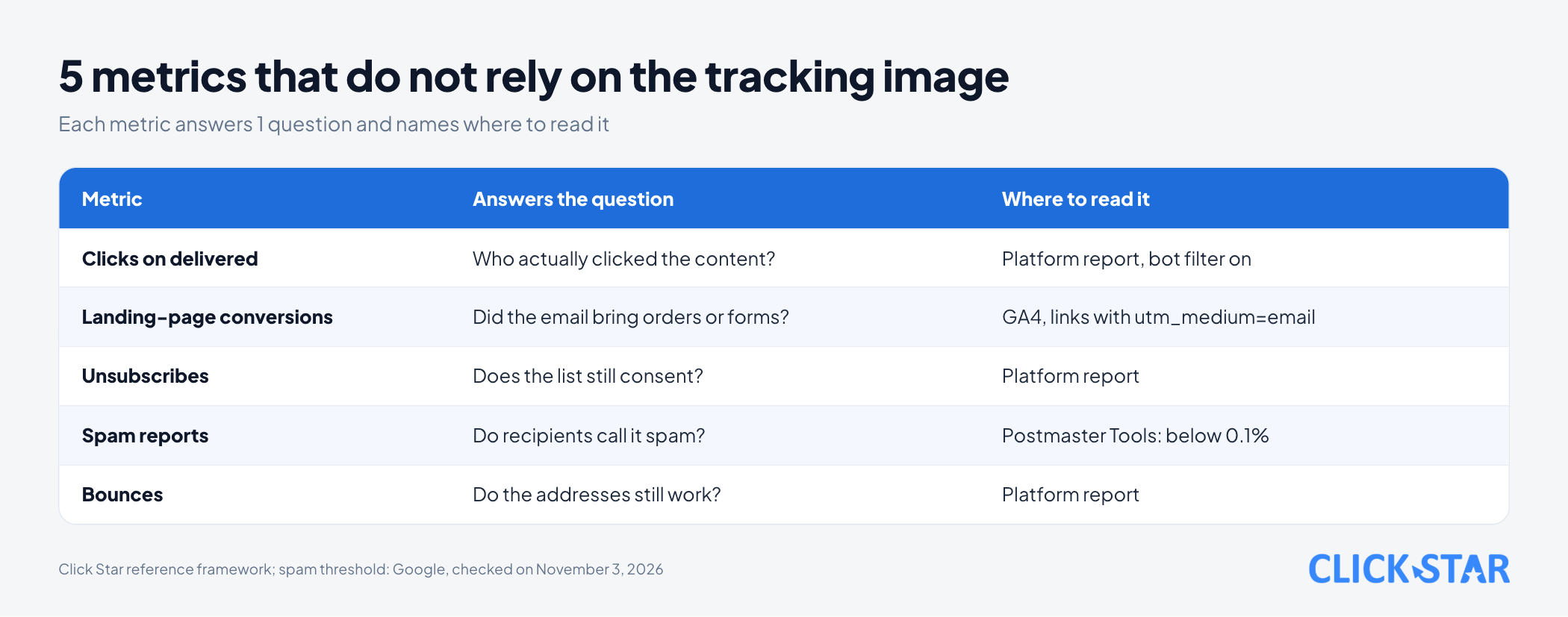
1. Click rate on delivered emails. According to Mailchimp, this is the percentage of delivered emails with at least 1 click. Read it together with bot filtering.
2. Landing-page conversions. Add utm_medium=email to every link, then read orders or forms in GA4. Google Analytics' page "URL builders" (no date shown, read November 3, 2026) advises using utm_source, utm_medium and utm_campaign together.
3. Unsubscribe rate. It shows whether the list still consents. Brevo says this metric is not affected by MPP.
4. Spam-report rate. According to Google's "Email sender guidelines FAQ" (no date shown, read November 3, 2026), keep it below 0.1% and never let it reach 0.3%. Bulk senders above 0.3% are ineligible for mitigation, and become eligible again only after 7 consecutive days below 0.3%.
5. Bounce rate. It shows whether addresses still work. No source read gives a threshold, so set your own baseline from your data.
Postmaster Tools, Google's spam-report tool, has limits. According to its page "Postmaster Tools dashboards" (no date shown, read November 3, 2026), data covers only personal Gmail, is not real time and can be missing on low-volume days.
What this means for Vietnamese businesses
Click Star found no public measurement of Apple Mail usage or MPP adoption in Vietnam. Count them in your own list.
Click Star's view. The open rate does not disappear, but it moves from the main yardstick to a secondary signal. Decisions that involve money, such as picking a winner or segmenting customers, should rest on clicks and conversions.
Click Star offers digital marketing, CRM and CDP services, so it has a related interest.
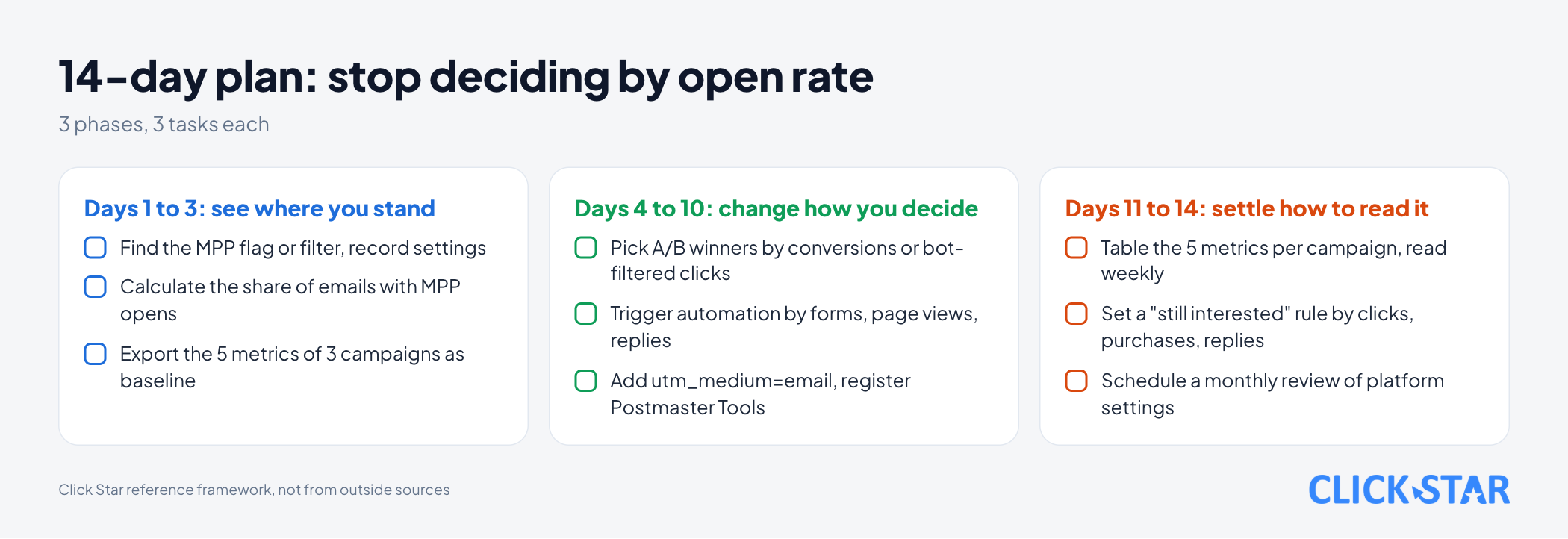
What to do: a 14-day plan
Click Star's reference plan, not an industry standard.
Days 1 to 3: see where you stand
- Find the MPP flag or filter in your platform and record the current settings.
- Calculate the share of emails with MPP opens in the last 3 campaigns.
- Export the 5 metrics for those 3 campaigns as a baseline.
Days 4 to 10: change how you decide
- Pick A/B winners by conversions or bot-filtered clicks, not opens.
- Trigger automation by form submissions, page views or replies, not by opens or clicks alone (per Brevo, bots also click).
- Add
utm_medium=emailto every link, and register Postmaster Tools if you send much to Gmail.
Days 11 to 14: settle how to read it
- Build a table of the 5 metrics per campaign and read the trend weekly.
- Set a "still interested" rule based on clicks, purchases or replies.
- Schedule a monthly review of platform settings.
Common mistakes
- Reporting a rising open rate as an achievement without checking the MPP share.
- Choosing the A/B test winner by open rate.
- Triggering automation or cleaning the list by last open date.
- Comparing the open rate before and after a platform changes its calculation, as Brevo did on February 6, 2025.
- Believing every click is a real person, although bots click too.
- Copying an "industry average open rate" from a blog as a target.
- Watching only opens and ignoring spam-report, unsubscribe and bounce rates.
What is not known
It is unclear whether MPP is on by default: Brevo says it is; Klaviyo, Mailchimp and Litmus describe users opting in; Apple's page does not say. The actual adoption rate is unknown too.
There is no measurement of the open-rate inflation or of Vietnam, and it is unclear whether Google's image scan creates Gmail opens.
Click Star has not read Vietnamese legislation on email open tracking. The 60% and 27.3% figures are illustrative, and the 4-step check has not been run.
Related posts
Need tailored advice for your business?
Click Star helps you build a solution that fits your industry and scale. We answer every question during business hours.