Digital marketing trends for the next 5 years: 6 changes to prepare for from 2026 to 2031
The 6 best-supported changes in digital marketing to 2031 and how confident each one is, based on Gartner, Dentsu, WARC, Google and e-Conomy SEA, with a 5-year roadmap and a 90-day plan.
For most businesses, the marketing budget is barely moving, yet where the money goes and how buyers find a business are changing fast. This article does not try to predict which feature each platform will ship next.
It uses data published up to October 20, 2026 to identify the 6 best-supported changes in digital marketing between now and about 2031, states how confident each one is, and offers a roadmap for small and medium businesses in Vietnam.
The figures come from Gartner's CMO survey, the ad spend forecasts of Dentsu and WARC, the e-Conomy SEA 2025 report by Google, Temasek and Bain, Google's announcement on cookies, DataReportal and other sources, each named in the sentence that uses it.
Click Star says clearly which parts are measurements, which are third-party forecasts and which are only judgment.
Key points
- Marketing budgets are not growing as hoped: according to Gartner's survey of 401 CMOs (January to March 2026, mostly companies with more than US$1 billion in revenue in North America, the UK and Europe), marketing spend is 7.8% of revenue in 2026 against 7.7% in 2025, and 56% of CMOs say they lack the budget for their strategy.
- Digital advertising already accounts for about 69% of global ad spend in Dentsu's mid-2026 forecast, so growth comes from reshuffling channels, not from moving from traditional to digital.
- Dentsu forecasts (per press coverage) that algorithm-run ad spend will reach 75% in 2028, so the advantage shifts from manual tuning to data quality, creative work and measurement standards.
- Third-party cookies did not disappear from Chrome as once announced: on October 17, 2025 Google said it would keep the user-choice approach and retire a series of replacement technologies, so the biggest constraint in Vietnam is the personal data law, not browser engineering.
- Customers increasingly search and buy through AI answers, video and conversation: the e-Conomy SEA 2025 report forecasts video commerce at 25% of Southeast Asian e-commerce value, and 68% of consumers in the region say AI recommendations influence their purchase decisions.
- Only 30% of CMOs report mature AI readiness and 70% say internal processes are not yet mature enough to scale AI (Gartner), so differences between businesses will lie in data, process and people more than in tools.
Context: where the money flows and who holds the budget
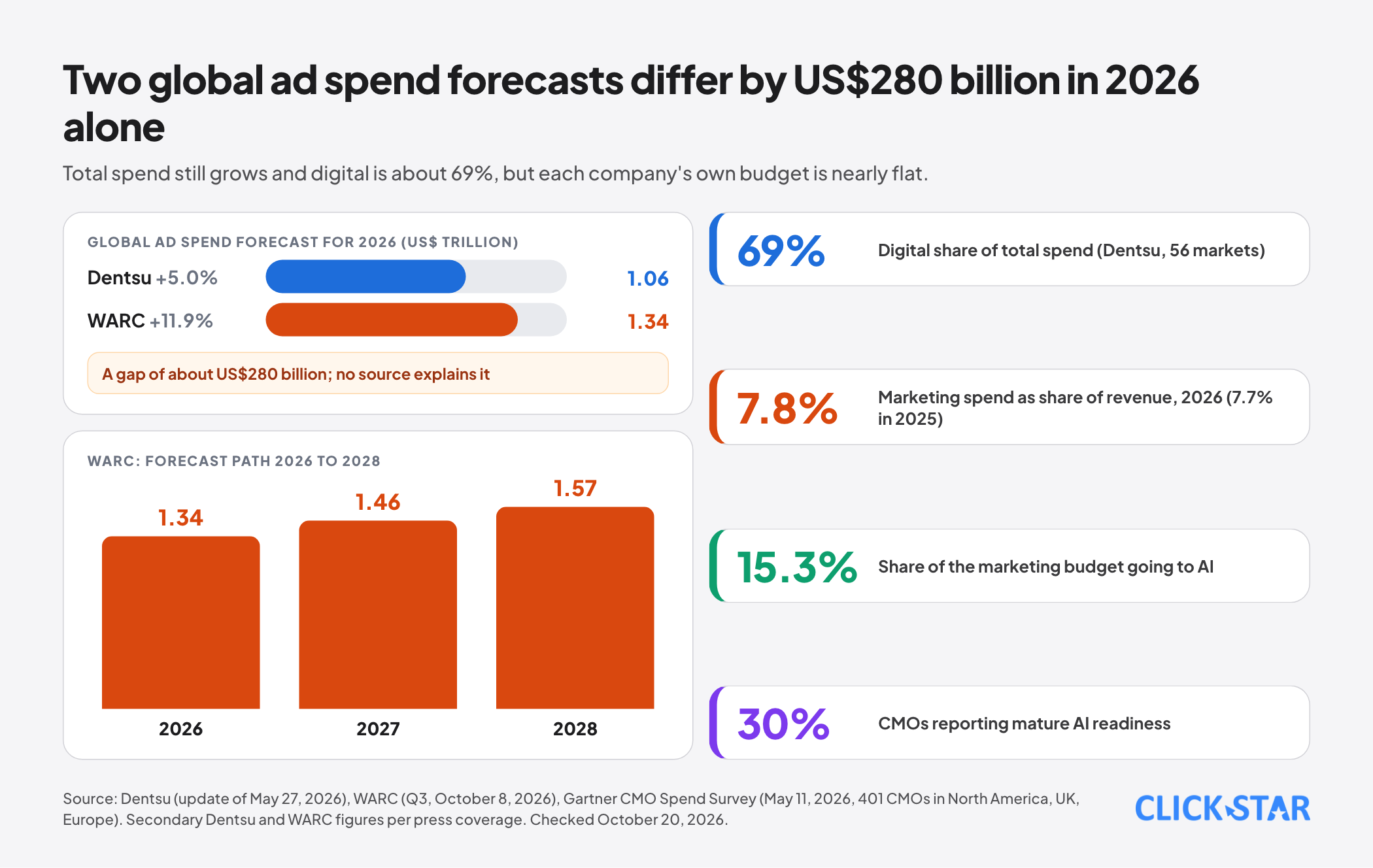
Total ad spend is still rising, but the two major forecasts disagree. Dentsu, in its mid-year update published on May 27, 2026, forecasts global ad spend growing 5.0% in 2026 to about US$1.06 trillion and 5.5% in 2027, with digital at about 69% across 56 markets (the secondary figures come from press coverage of the report; Click Star could not open the full text).
WARC, in its third-quarter forecast published on October 8, 2026 (also per press coverage; the original could not be opened), estimates global ad spend rising 11.9% to about US$1.34 trillion in 2026, then 8.4% to US$1.46 trillion in 2027 and 7.9% to US$1.57 trillion in 2028.
A gap of about US$280 billion between the two is too large to be a simple update; Click Star found no source explaining it and suspects differences in market scope and definitions. Click Star also found no global ad spend forecast for 2029 to 2031 in these 3 sources, so anything after 2028 in this article is inference.
Individual company budgets are nearly flat. According to Gartner (press release of May 11, 2026), average marketing spend is 7.8% of revenue in 2026, up slightly from 7.7%; the group with mature AI capability spends 8.9%. The average share going to AI is 15.3% of the marketing budget, and 21.3% among the more ready group.
The sample is large companies in North America, the UK and Europe, so it cannot be treated as a measurement for small and medium businesses in Vietnam.
Vietnam has a large base. DataReportal (Digital 2026: Vietnam) records 85.6 million internet users at the end of 2025, equal to 84.2% of the population, and 79.0 million social media user identities in October 2025, equal to 77.6% of the population (one person may hold several accounts).
The e-Conomy SEA 2025 report estimates the digital economy of the 10 ASEAN countries at more than US$300 billion in transaction value in 2025, of which e-commerce is about US$181 billion, up 16% (regional figures; the summaries Click Star could read do not break out Vietnam).
Click Star's view. For most businesses, the question of the next 5 years is not "how much more budget" but "how to re-split the budget when the total does not grow". Overall market growth is good news for ad platforms, not necessarily for each ad buyer.
Trend 1. Algorithms buy and optimize ads, the advantage moves to data and creative
When platforms choose the audience, placement and bid themselves, manual tuning loses value. Dentsu forecasts (per press coverage) that algorithm-run ad spend reaches 75% in 2028.
What buyers still decide are 4 inputs: the conversion signals sent back to the platform (the right event, the right value, fast enough), a creative library varied enough for the algorithm to test, the offer and landing page, and budget boundaries.
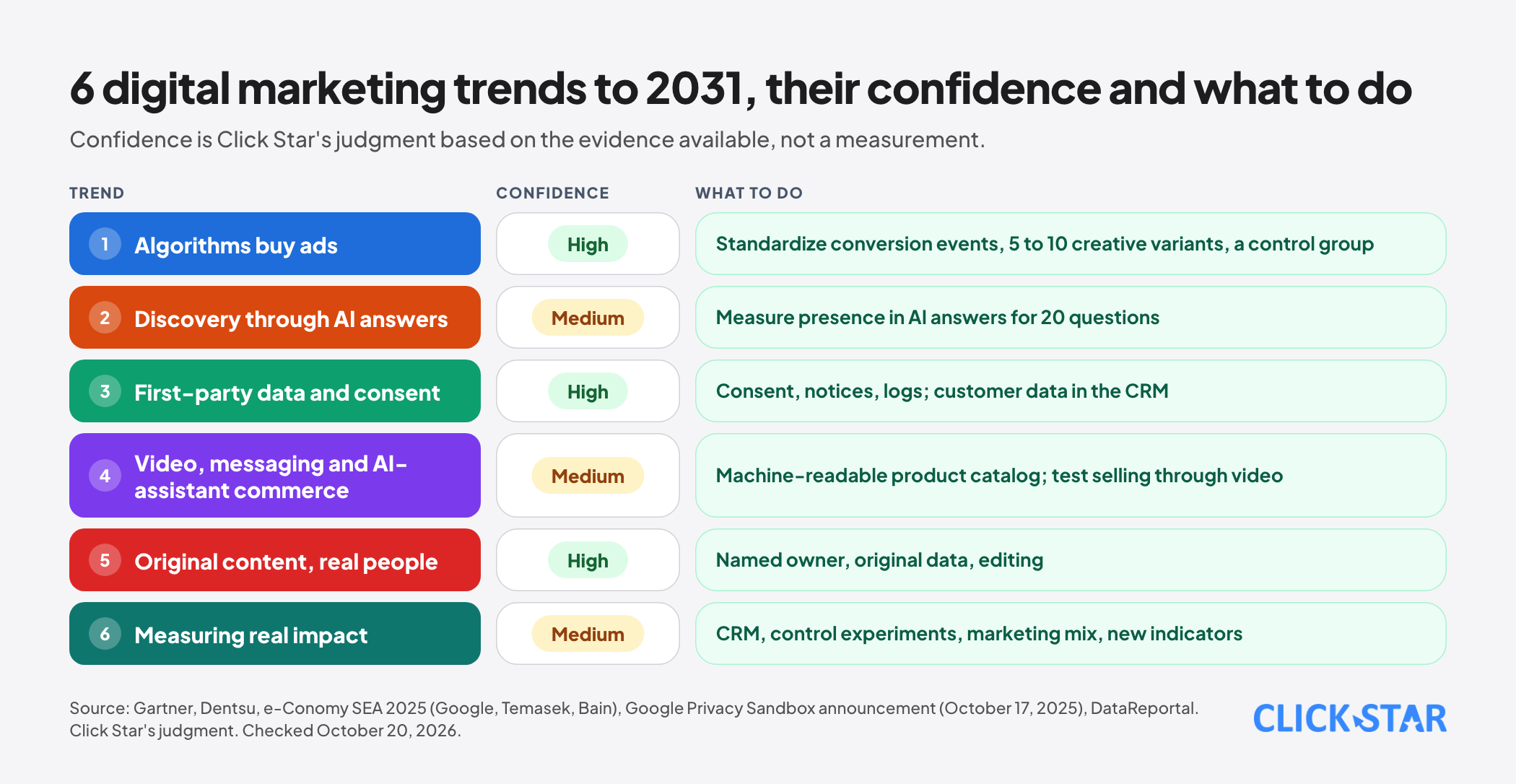
What to do: standardize conversion events (real orders and qualified leads, not just form submissions), send real values back to the platform, produce 5 to 10 creative variants per campaign from different angles, and keep a control group that sees no ads to know the true lift. The biggest risk is optimizing for an easy but wrong metric (cheap clicks, plentiful junk leads).
Trend 2. Customers discover through AI answers
Users read the answer instead of clicking through. Pew Research Center (July 2025) recorded US users clicking a traditional result in 8% of visits when an AI summary appears, against 15% when it does not; SparkToro recorded 68.01% of US Google searches in the first 4 months of 2026 ending without a click.
In Southeast Asia, e-Conomy SEA 2025 reports that 68% of consumers say AI recommendations influence their purchase decisions. A study by the IBM Institute for Business Value (January 2026, per press coverage) says about 45% of consumers have used AI for part of the buying journey; this is a secondary figure measured in another market.
Click Star has analyzed this in depth in its articles on the shift in SEO in the AI era and on user search trends. The point to keep for a 5-year plan: the new metric is presence in answers, next to ranking and traffic, and content with figures, sources and a named responsible person has a better chance of being cited than generic content.
Trend 3. First-party data and consent become assets
On October 17, 2025, Google announced on the Privacy Sandbox site that Chrome keeps its approach of giving users a choice about third-party cookies and retires technologies such as Topics, Protected Audience and Attribution Reporting because of low adoption.
That means the "cookies disappear" scenario that was prepared for over several years did not happen on Chrome, and cookie-based targeting, retargeting and measurement remain usable.
But the cost of using data is shifting from engineering to law: the Law on Personal Data Protection and Decree 356/2025/ND-CP have been in force since January 1, 2026, and Penalty Decree 330/2026/ND-CP since August 19, 2026, setting requirements on consent, notices and cross-border transfers.
Click Star has separate articles on this law and on databases in online operations; the legal figures in them should be checked against the original text before being applied.
Click Star's view. First-party data (collected by the business itself, with clear consent) is the most durable asset of the next 5 years, because it does not depend on the decision of one browser or one platform, and because the AI layers on top (personalization, prediction, sales assistants) are only as good as the data beneath them.
Gartner points to a similar risk: CMOs buy AI tools faster than they build the data, processes and governance that go with them.
Trend 4. Video commerce, conversation and shopping through AI assistants
e-Conomy SEA 2025 forecasts video commerce at 25% of total Southeast Asian e-commerce value. In Vietnam, where nearly 4 in 5 people hold a social media identity, selling through short video, live streaming and messaging is a main channel, not a side one.
Behind it is the trend of shopping through AI assistants: surveys run by payment companies in the UK and US (such as Checkout.com) find 33% of consumers expect at least 10% of their purchases to be driven by AI within a year, but these are vendor figures from another market, measuring intent rather than behavior.
Retailers whose product, price, stock and return-policy data is clear and machine-readable will be easier for AI assistants to recommend.
What to do: standardize the product catalog and store information (name, attributes, price, stock, real reviews) in one place and sync it to every channel; test selling through video and messaging with a small budget and a clear metric; prepare AI-assisted customer replies with human review before scaling.
Trend 5. Content: from producing more to original value and real people
The cost of producing text and images is falling toward zero, so volume is no longer an advantage. Google states plainly that its spam policy does not distinguish how content is produced: generating many pages that add no value for users is a violation.
In Dentsu's December 2025 forecast (per press coverage), online video and social media are among the fastest-growing digital channels (about 11.5% and 11.4% in 2026), so video formats and real people on camera carry great weight.
What is harder to copy than fluent text is the business's own data, real experience, named experts, real reviews and verifiable results.
What to do: every pillar piece has a named responsible person, original data or examples, and an editing and verification process before publishing; use AI to draft and check, not to publish in bulk without editing.
Trend 6. Measurement: from tracking every click to measuring real impact
When part of the journey happens inside AI answers, messaging apps and video, the "click, convert, record" model misses a lot. Google also said (on October 17, 2025) it will keep working on an interoperable attribution standard through the W3C because the demand for measurement at scale remains strong.
For a business, the practical direction is to combine 4 layers: real sales data from the CRM, experiments with control groups, time-based allocation models (marketing mix) for channels that are hard to track, and new indicators (branded search, presence in AI answers, lead quality by source).
What is more certain and less certain through 2031
Click Star groups them into 3 levels by the evidence available (this is Click Star's judgment, not a measurement).
- More certain: digital advertising keeps the majority of ad spend (about 69%, Dentsu); algorithms run more and more of ad buying; consented data is a must in Vietnam; commerce through video and messaging grows in Southeast Asia.
- Supported but with many variables: the share of customers who discover through AI answers, the speed of shopping through AI assistants (current figures come mostly from vendors and the US and UK), and the cost and pricing of ads inside AI answers.
- Not enough basis: the size of the advertising market in 2029 to 2031 (the two existing forecasts already differ by up to US$280 billion in 2026 alone), and the ranking of individual platforms after 2028.
Budget and team: how to re-split
With a flat total budget, Click Star proposes a 70-20-10 split (a Click Star reference framework, not an industry standard): 70% for what has been proven by real sales data, 20% for experiments with a clear metric and deadline, 10% for foundation work such as data, consent, measurement and training.
On the team side, the roles gaining value are data and measurement people, editors who take responsibility for content, designers of AI workflows, and people who handle customer relationships. Gartner records 54% of CMOs saying they lack resources, so priority order matters more than a wish list.
A 5-year roadmap for small and medium businesses
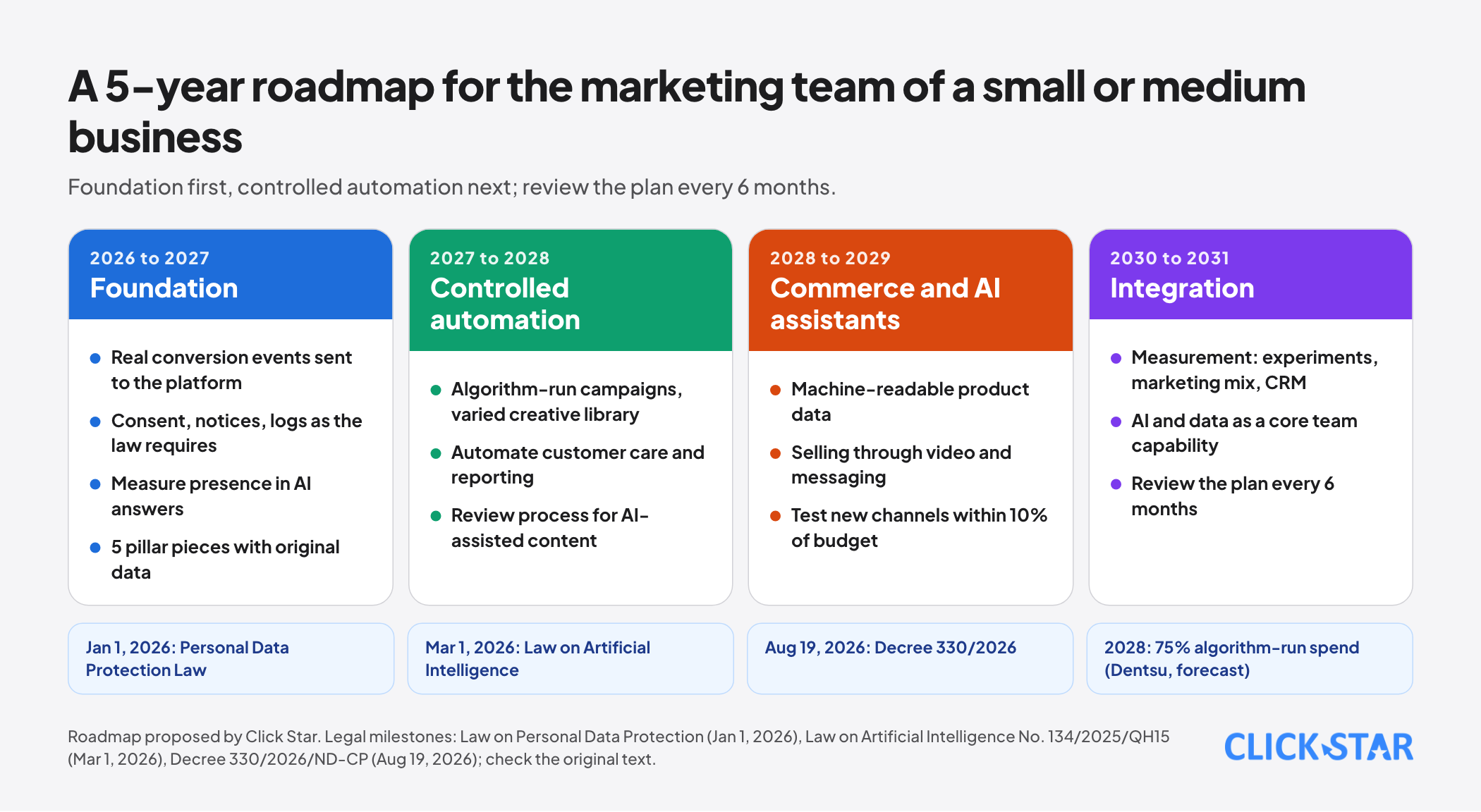
- 2026 to 2027, foundation: standardize conversion events and customer data in the CRM; have consent, notices and logs as the law requires; measure presence in AI answers for 20 questions customers often ask; rewrite 5 pillar pieces with original data and a responsible person.
- 2027 to 2028, controlled automation: use algorithm-run campaign types with a varied creative library; automate customer care and reporting; set up a review process for AI-assisted content. The Law on Artificial Intelligence (Law No. 134/2025/QH15, in force since March 1, 2026) has a transition period for systems already running, which law firm summaries put at 12 months for ordinary systems and 18 months for health, education and finance; check the implementing documents before applying.
- 2028 to 2029, commerce and AI assistants: machine-readable product data, selling through video and messaging, testing new channels within the 10% budget.
- 2030 to 2031, integration: measurement that combines experiments, allocation models and the CRM; a team that runs AI and data as a core capability; review the plan every 6 months because forecasts change quickly.
What to do in the first 90 days
- Days 1 to 30: list every place customer data is collected and check consent, notices and logs; identify 3 real conversion events and send them to the ad platform; list 20 customer questions and record which brands are mentioned in AI answers.
- Days 31 to 60: build a set of 5 to 10 creative variants for the main campaign; run one experiment with a control group; pick 5 pillar pieces to rewrite in a question-and-answer structure.
- Days 61 to 90: compare results with the experiment; re-split the budget by the 70-20-10 framework; choose one new channel (video or messaging) to test with a small budget.
Metrics to track
- Cost and revenue per real order (not just per click or form).
- True lift against the control group for the main campaigns.
- Presence in AI answers for 20 important questions, measured monthly.
- Branded search and the share of qualified leads by source.
- The share of data collection points with consent and complete logs.
- The share of content edited and verified before publishing.
Common mistakes
- Waiting for a perfect forecast before acting, when the foundation work (data, consent, measurement) pays off in every scenario.
- Optimizing for easy metrics such as clicks and form submissions without linking them to real orders.
- Buying AI tools before having clean data and a review process; Gartner calls this the CMO's biggest risk.
- Treating cookies still working in Chrome as a reason to skip building first-party data and consent.
- Investing in the volume of content instead of original value and a responsible person.
- Generalizing figures from the US, UK or a vendor into a Vietnam trend without measuring it yourself.
- Not reviewing the plan: forecasts from major organizations already differ by up to US$280 billion in the same year.
Related posts
Need tailored advice for your business?
Click Star helps you build a solution that fits your industry and scale. We answer every question during business hours.