Zalo OA and ZNS for business: transactional messages, conditions, costs and rules
ZNS is now ZBS Template Message tied to a Zalo OA. This article reads Zalo's official pages on conditions, templates, costs, API and rules, and flags where its price pages disagree.
Many businesses know "ZNS" as a way to send automated Zalo messages to a customer's phone. In 2026 its name, price list and rules changed, and Zalo's current documentation calls it ZBS Template Message, tied to a Zalo Official Account (OA).
This article reads official Zalo Official Account and Zalo Business Solutions pages, checked on October 22, 2026. The developers.zalo.me site needs JavaScript and could not be read.
Key points
- Since January 1, 2026, ZBS Template Message merges ZNS with the 2 older UID message types. "ZNS" survives in many URLs, but the new documentation uses ZBS Template Message.
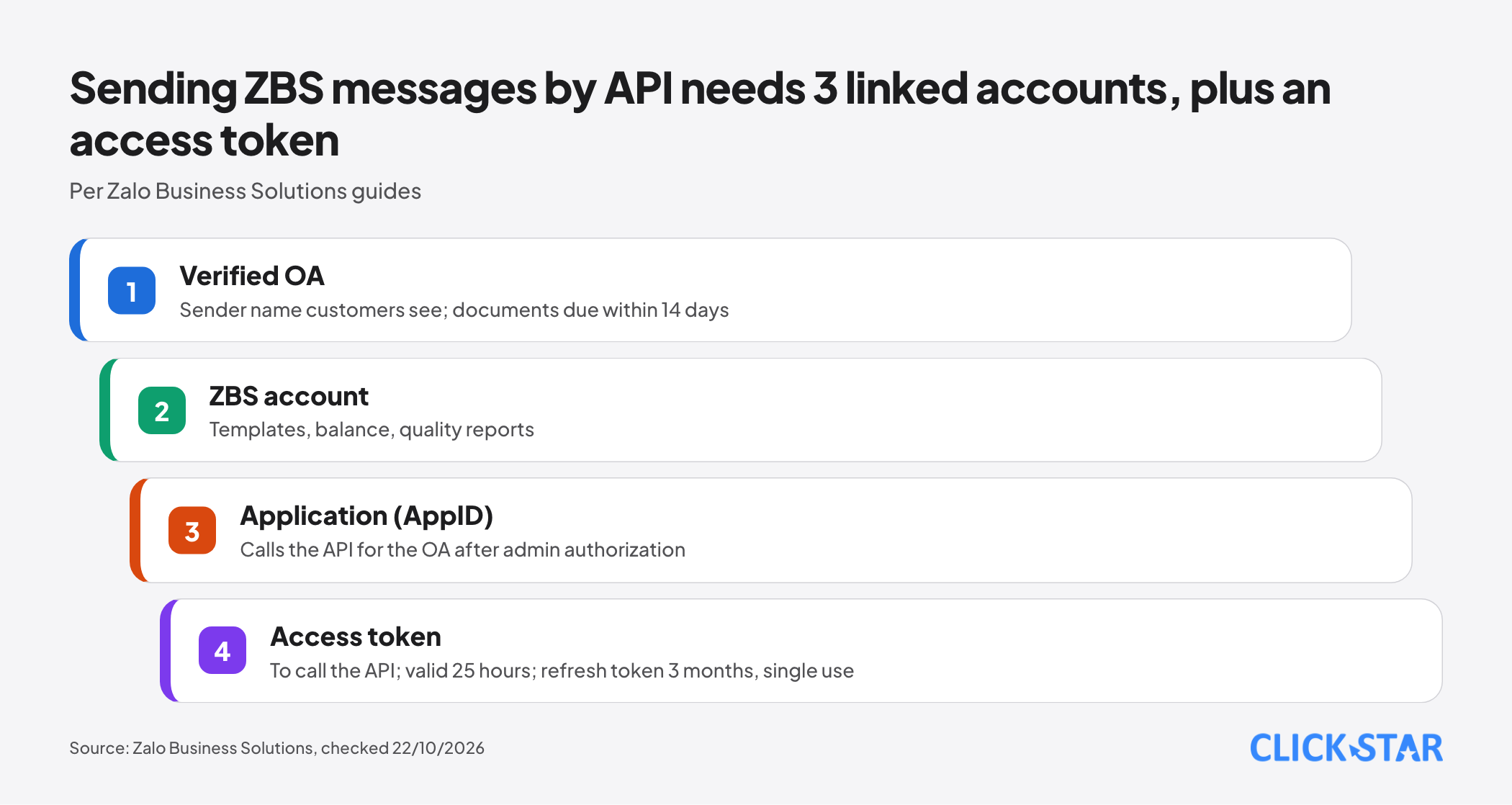
- Sending through the API needs 3 linked accounts: a verified OA, a ZBS account and 1 application (AppID), plus an access token to call the API. The OA plan must be Growth (Tăng trưởng) or Comprehensive (Toàn diện).
- Each message uses a template Zalo has approved (about 2 to 3 working days) and goes only to people who have already transacted with the business. Templates fall into 3 groups: Transaction, Customer care, Promotion.
- Zalo's pages disagree on price: the Pricing page (undated) lists 200 to 300 VND per message, while the terms (updated July 9, 2026) and a notice (effective from March 16, 2026) list 300 to 400 VND. Neither includes VAT.
- A new OA starts at 20,000 messages per day; Zalo suggests keeping the daily report rate below 0.1%.
- Decree 91/2020/ND-CP requires prior consent for advertising messages, but its Article 1 lists only SMS, MMS, USSD, email and phone calls, not Zalo. Ask a lawyer about your case.
How ZNS, ZBS Template Message and OA differ
According to the OA introduction page (no date shown), a Zalo Official Account is a business's official account that supports 2-way messaging with customers who have interacted before, voice calls, chatbots and articles.
ZNS is 1 way an OA sends messages. A Zalo Business Solutions notice dated January 22, 2026 says ZBS Template Message has merged UID transaction messages, UID communication messages and ZNS since January 1, 2026, sent by phone number or UID.
The business must link 3 accounts: a ZBS account (templates, balance, reports), an OA (the sender name customers see) and an AppID application (which calls the API for the OA).
Zalo OA: verification, plans and cost
Under the OA registration and use policy (no date shown), the administrator must submit verification documents within 14 days of creating the OA, with a result in 2 to 3 working days. ZBS's getting-started roadmap page says only a verified OA can be linked to a ZBS account.
The OA price list (prices include 10% VAT, from June 1, 2026) shows: Standard (Tiêu chuẩn) costs 1,000,000 VND per year. Growth costs 1,400,000 VND per 6 months or 2,500,000 VND per year. Comprehensive costs 3,400,000 VND per 6 months or 6,000,000 VND per year. Basic (Cơ bản) is where an OA falls back when a plan expires.
The FAQ on the same page says sending through the API is available only to verified business OAs on the Growth or Comprehensive plan.
The 3 content groups that are allowed
Under the template review rules (updated October 2026), every template carries 1 of 3 groups (Tags). Tag 1, Transaction, covers verification codes, balance changes, order or appointment confirmations, transaction status and payments.
Tag 2, Customer care, covers policy updates, service surveys, renewal reminders and loyalty benefits. Tag 3, Promotion, covers promotion, upsell, cross-sell, renewal invitations and birthday greetings with a gift.
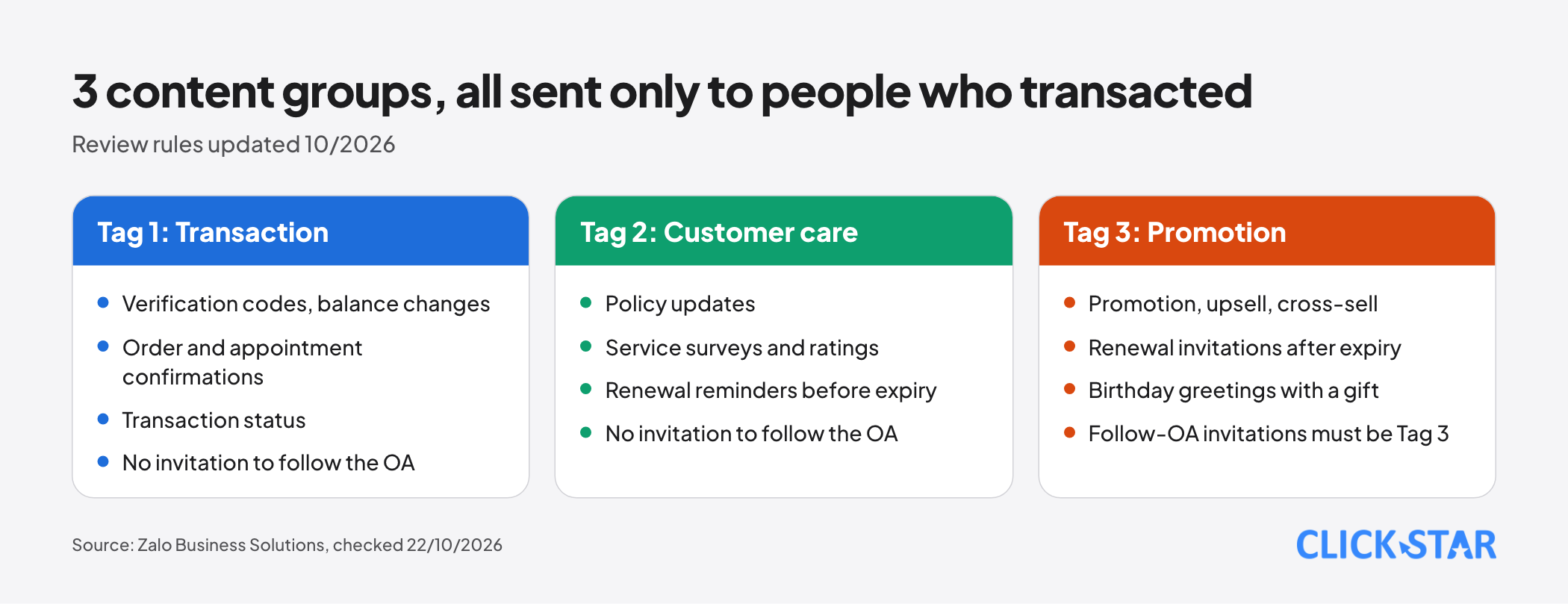
The same page says the service currently supports only users who have transacted with the business, except a verification code for a customer creating a new account. Tags 1 and 2 may not invite users to follow the OA; a template with that invitation must be Tag 3.
How a template gets approved
The ZBS introduction page says templates take about 2 to 3 working days. Under the terms (clause 6.1), any change from an approved template must be registered again. The review rules page lets Zalo reject a template without a clear context or purpose. Links and phone numbers must sit in the action button (CTA), not in the body.
Per the "requirements by purpose" table on the review rules page, Tags 1 and 2 need the customer's name or 1 personalization parameter, plus at least 1 identifying parameter such as an order code. Tag 3 needs only 1 personalization parameter.
Discount codes must use the Voucher template, with exceptions such as sending more than 1 voucher, or the customer getting the code in an app through a button.
What ZBS Template Message costs
For messages sent by phone number, the pricing mechanism page says a fee applies only if the message reaches the device within the set time: 15 seconds for verification, 7,200 seconds for the rest. A message sent by UID is charged when Zalo's server processes it.
The ZBS pricing page (no date shown) lists unit prices excluding VAT: verification, voucher, transfer request and coach ticket (Beta) templates cost 300 VND; journey templates for special industries from 200 VND; all other types 200 VND.
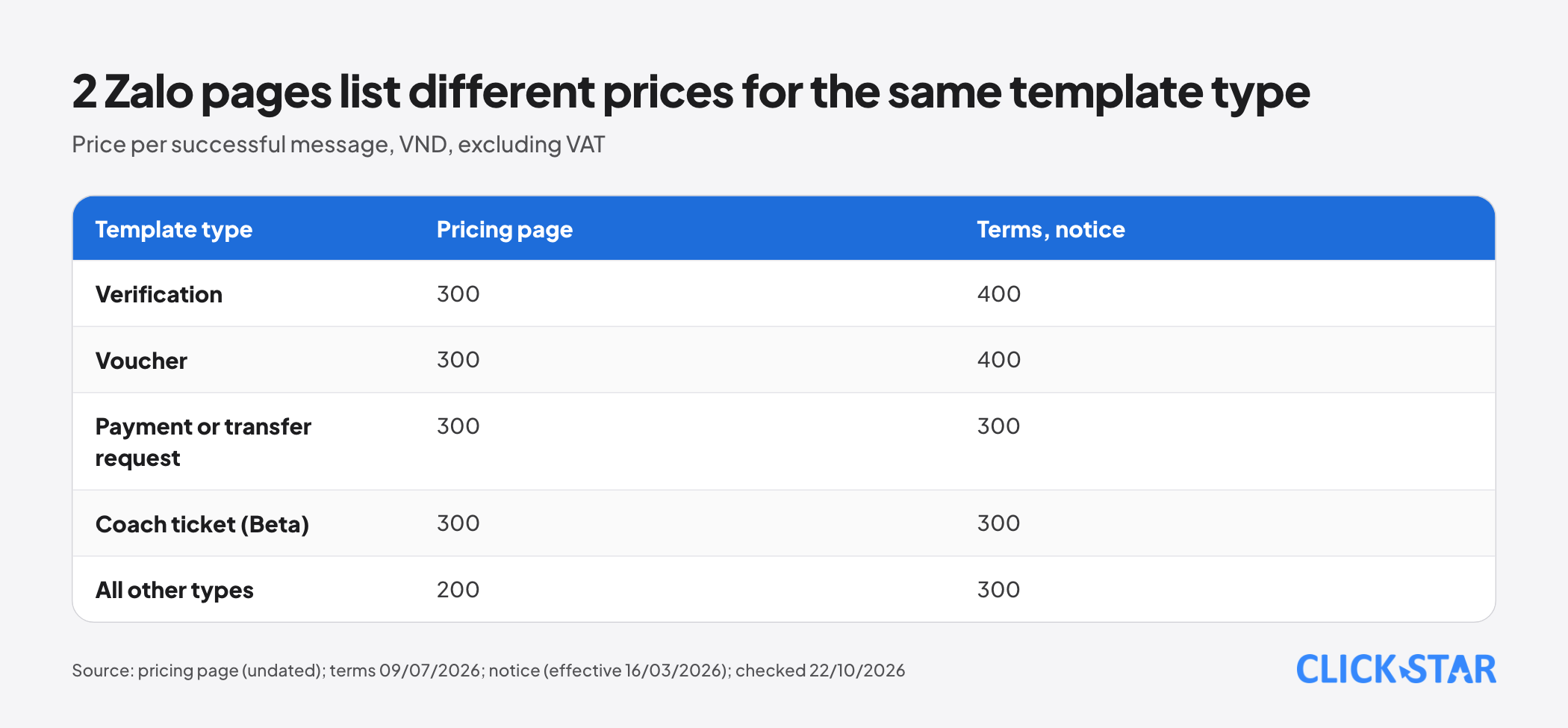
The terms (updated July 9, 2026, clause 5.1) instead list: verification and voucher 400 VND; payment request, coach ticket and other types 300 VND; adding an image 300 VND; journey templates for special industries from 200 VND.
A Zalo Platforms notice (the page shows August 3, 2026) lists the same figures, calling the 3rd type a transfer request. It sets dates: new templates from March 16, 2026 and older ones from March 24, 2026 (expected) move to this list, unless the customer chooses "Reject update".
The 2 sets differ. The 300 to 400 VND set has a published notice with application dates already past, and the terms updated July 9, 2026 list the same figures. The 200 to 300 VND set appears only on the undated Pricing page, which has display errors (the image price reads "NaN", the action-button table is empty).
Even so, Click Star does not know which set applies to each account, because the sources do not say; an older template may keep its old price if the customer rejected the update. Check the template screen or ask for a written quote.
Technical connection: tokens, API and webhook
The ZBS API guide describes 5 steps. First, get an access token with API Explorer (no coding) or OAuth v4. The access token is valid for 25 hours and the refresh token for 3 months. ZBS's application authorization guide adds that a refresh token works only once and comes with a new one.
Next, the system sends a POST to business.openapi.zalo.me/message/template with the access_token in the header. The body holds the phone number (84...), template_id, template_data and a tracking_id set by the business for reconciliation.
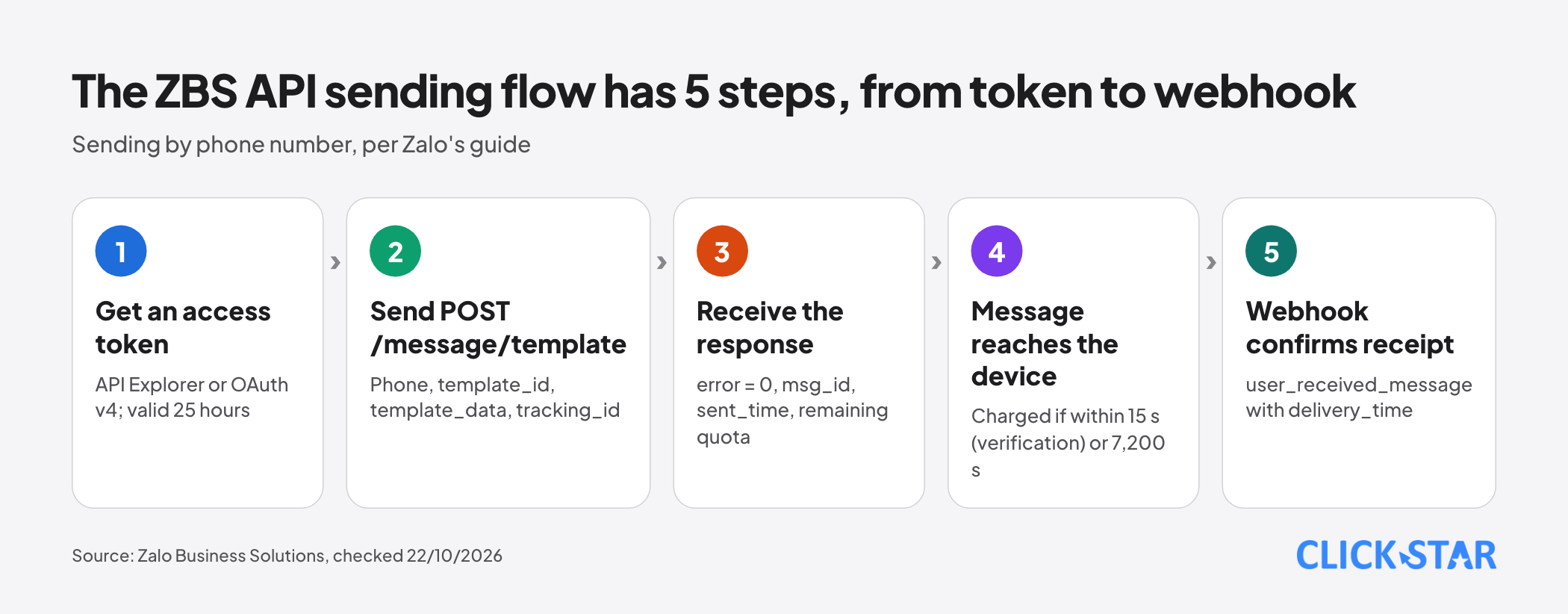
A successful response has error equal to 0, msg_id, sent_time and the remaining daily quota. When the message reaches the phone, Zalo sends a user_received_message event to the webhook, with delivery_time and tracking_id. The receipt time is delivery_time, not the moment the webhook arrives.
Recipient consent and anti-spam rules
On the law, Click Star read Decree 91/2020/ND-CP (issued August 14, 2020, effective October 1, 2020) through a copy on luatvietnam.vn. Article 3 classes an advertising message sent without prior consent as spam. Article 11, clause 2 lists ways to consent, such as filling in an online registration form.
Article 1 sets the scope as advertising by SMS, MMS, USSD, email and phone calls, without mentioning Zalo. Click Star found no provision on whether a ZBS Tag 3 message falls within scope, and this is not legal advice.
A comparison of a draft replacement decree from the Ministry of Public Security (September 2026) proposes adding messages through OTT apps to the scope. It is only a draft; Click Star does not know whether it has been issued.
Recipient data also falls under the Personal Data Protection Law; Click Star has a separate article on it.
Sending quality and how to measure
On the quality page, the daily quota has tiers of 1,000, 5,000, 20,000, 50,000 and unlimited. A new OA starts at 20,000. The quota rises when quality over the last 7 days is Good and successful messages reach 2 times the current quota, and falls when it is Poor.
Quality rests on the report rate; Zalo suggests below 0.1% per day. If total reports in a day exceed 2% of the quota, the OA drops 1 tier, and a template with a high report rate is locked on its own.
The page "When is a message recorded as reported?" says reports made more than 48 hours after receipt do not affect OA quality. Reporting and blocking an OA are 2 independent actions; sending to a user who blocked the OA returns error -141. Report counts appear in the ZBS quality report.
On the business side, Click Star suggests 3 self-computed metrics (its own framework, not from outside sources, no standard threshold): the share of requests with error equal to 0, the share of requests with a user_received_message event, and the report rate over received messages. Match records by tracking_id.
Which option to choose
The API sending guide lists 2 ways to send: the API for large volumes, needing technical staff; or a campaign using an Excel file uploaded to the ZBS account, with no coding and a limited volume. The ZBS introduction page also mentions Zalo agents but no price.
Click Star's view. Campaigns suit small tests; the API suits messages triggered from a CRM or sales system. For small and medium businesses, the practical condition is clean transaction data rather than the API call: every message must tie to 1 real transaction, with the right phone number and status.
Start with 1 to 2 Tag 1 templates, watch the report rate, then open Tag 2 and Tag 3. Disclosure: Click Star sells CRM integration and AI automation.
What to do: a 6-step plan
Click Star reference framework, not from outside sources; the day counts are only suggestions.
- Day 1: pick 1 to 2 transaction events, check phone numbers and transaction codes.
- Days 2 to 4: verify the OA, pick an OA plan for the API, create the ZBS account and AppID.
- Days 3 to 5: draft templates under the October 2026 rules, with links in the CTA button; submit.
- Days 6 to 8: get a written quote, compare it with the template screen, top up a small balance.
- Days 8 to 10: get a token, send a test, enable the webhook, store tracking_id and delivery_time.
- From day 11: send small batches, read the quality report daily, add templates while reports stay low.
Common mistakes
- Sending promotions to people who never transacted, against the rule that only transacting users are supported.
- Putting a link or phone number in the template body instead of the action button, which gets it rejected.
- Budgeting from 1 price list without checking the template screen and a quote, while Zalo's pages show 2 sets.
- Adding the OA plan price (VAT included) to the message price (VAT excluded) as if on 1 tax basis.
- Not saving the new refresh token after each refresh, which breaks sending once the old one expires.
What is not known
- Which price set applies to an account: the Pricing page (200 to 300 VND) or the terms and notice (300 to 400 VND). The notice page shows August 3, 2026 but sets dates from early 2026; its real publication date is unknown.
- The price of the Basic OA plan and of UID sending: Click Star found no figure on the pages it could read.
- The current validity of Decree 91/2020/ND-CP, whether the draft replacement has been issued, and how the law applies to ZBS Tag 3 messages. Click Star has not read the original on an official portal.
- Delivery or response rates for Vietnamese businesses using ZBS: no published measurement that Click Star could read.
Related posts
Need tailored advice for your business?
Click Star helps you build a solution that fits your industry and scale. We answer every question during business hours.