Analysis of changing user behavior in the AI era (2026): 6 shifts and how businesses adapt
6 shifts in user behavior in 2026 from Similarweb, Pew, Adobe and Metric: adding AI tools, the generational gap, visitors from AI, livestream shopping in Vietnam, price and trust, with a 4-stage map and what to do.
When traffic, messages or orders change direction, many businesses first ask "what did the algorithm change," while the cause often lies on the customer's side: the way they research, compare, trust and buy has already changed.
This article analyzes 6 shifts in user behavior in 2026, each based on sourced figures and stated limits: users add AI tools without leaving Google, the generational gap is very large, visitors from AI are few but convert better, shopping in Vietnam is concentrating on video, livestreams and platforms, price and promotions still decide, and trust has not kept up with usage.
Figures are checked as of October 20, 2026, drawn from Similarweb, Pew Research Center, Adobe Analytics, Metric and Q&Me (through VnExpress International); any figure from a secondary source is labeled in the sentence.
Click Star already has articles on user search trends in the AI era and on trends in AI usage; this one extends to shopping, trust and measurement.
Key points
- Users add tools rather than abandoning old ones: according to Similarweb, 461 million of ChatGPT's 494 million users (March to May 2026) also used Google in the same period.
- The age gap is very large: according to Pew (February 2026), 61% of Americans aged 18 to 29 have used ChatGPT, against 19% of those 65 and over. Your customers may be at different stages.
- Visitors from AI are still few but high quality: Adobe records AI-sourced visits to US retail websites up 62% year over year (July 2026), converting 60% higher than other sources, the 11th month in a row.
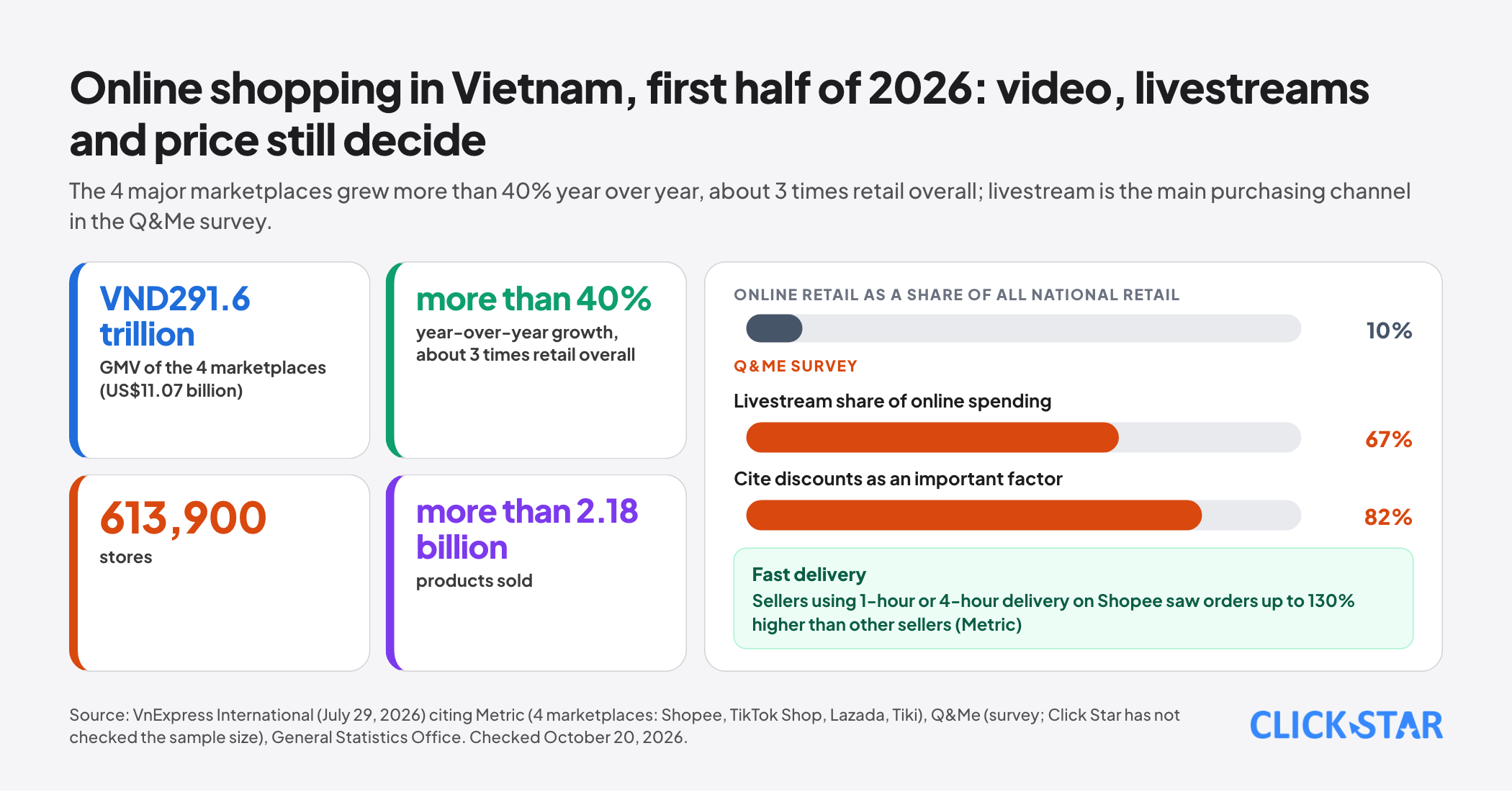
- Online shopping in Vietnam is concentrating on video and platforms: in the first half of 2026, the 4 major marketplaces grew more than 40% year over year, GMV was VND291.6 trillion, and according to a Q&Me survey, 67% of online spending by respondents went to livestreams.
- Price and promotions still decide: 82% of consumers in the Q&Me survey cite discounts as an important purchase factor; fast delivery raised orders by up to 130% for sellers using 1-hour or 4-hour delivery (per Metric, on Shopee).
- Trust has not kept up with usage: reports on Pew's surveys show people using AI more but staying concerned; brands need evidence and a clear human channel.
Shift 1: adding tools, not leaving Google
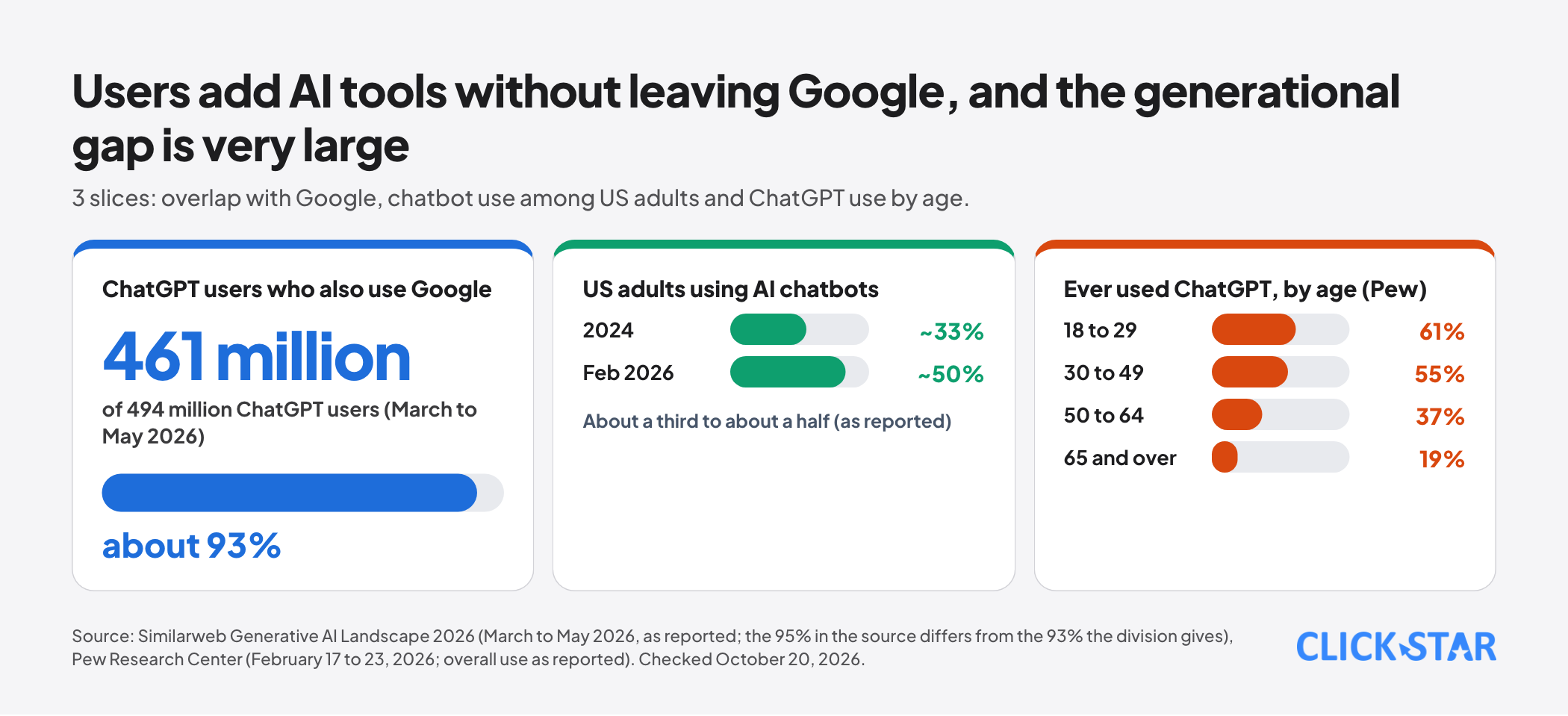
AI users are not leaving search engines. Similarweb's 2026 Generative AI Landscape report, as reported, records 461 million of ChatGPT's 494 million users also using Google between March and May 2026.
The reporting source states 95% although the division gives about 93%, and does not explain the difference, so Click Star treats it as "more than 9 in 10." The same report records traditional search at about 3.3 billion average monthly unique visitors (June 2025 to May 2026).
On the scale of chatbot use, according to reports on Pew's survey (February 17 to 23, 2026, 5,119 US adults), about half of US adults use AI chatbots, up from about a third in 2024.
Click Star's view. The meaning for businesses is that the customer journey is longer and has more touchpoints: they ask AI to understand the problem, search Google to verify and compare, watch videos or read reviews, and only then make contact. A brand needs to appear consistently in many places rather than optimizing for one channel.
Shift 2: the generational gap
Chatbot use differs widely between age groups. According to Pew (survey of February 17 to 23, 2026), the share of US adults who have used ChatGPT is 61% among ages 18 to 29, 55% among 30 to 49, 37% among 50 to 64 and 19% among 65 and over. Gemini is 30%, 34%, 20% and 11% respectively; Claude is 10%, 9%, 4% and 1%.
Pew notes that not all differences are statistically significant, and this is data for US adults.
There is no equivalent measurement by age for Vietnam. But a gap this large suggests something more certain than any specific figure: your target customers may be at very different stages, so ask them directly instead of inferring from the general trend.
Shift 3: visitors from AI are few but convert better
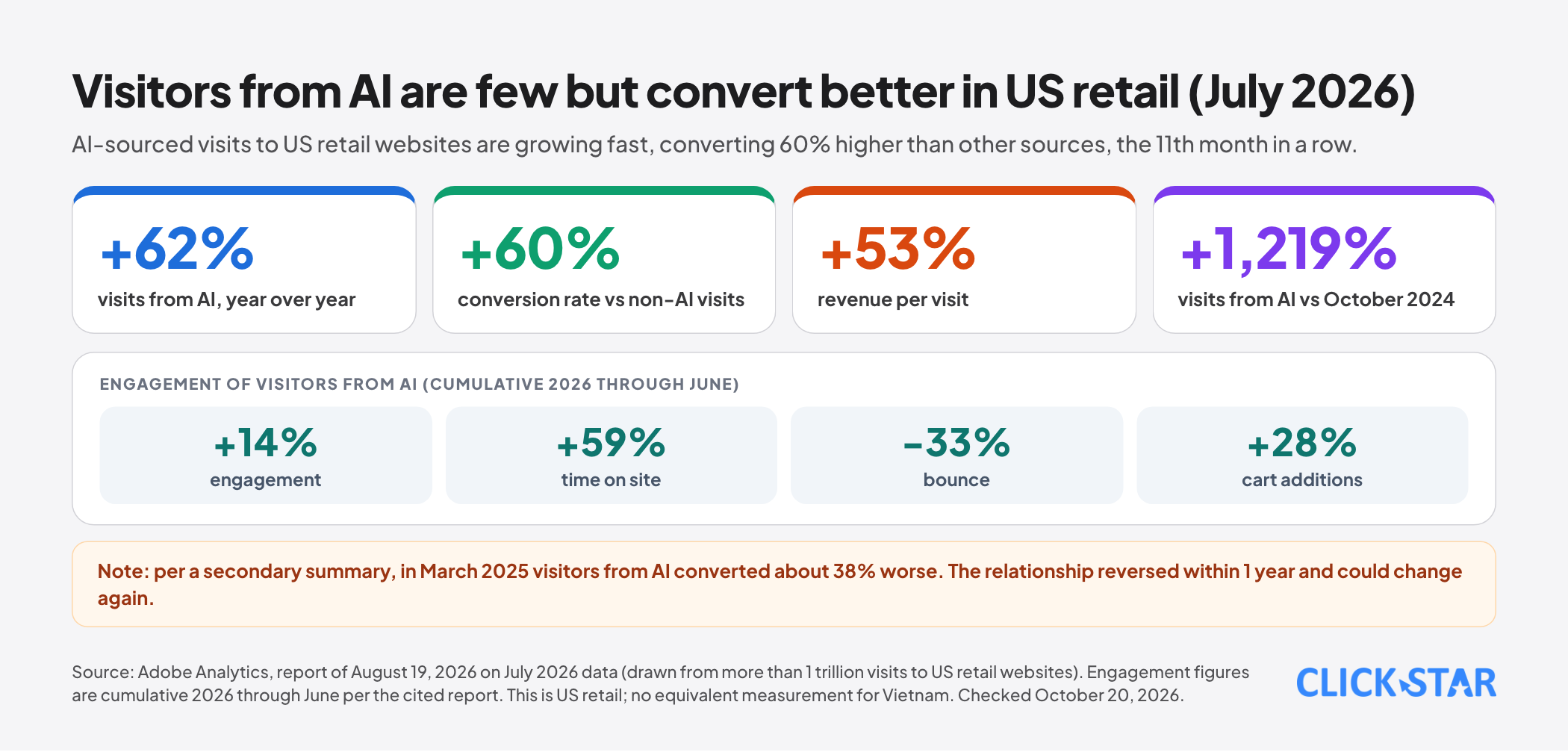
Adobe Analytics records, according to a report of August 19, 2026 on July 2026 data, AI-sourced visits to US retail websites up 62% year over year and up 1,219% against October 2024; these visits converted 60% higher than non-AI visits, the 11th consecutive month, and produced 53% more revenue per visit.
In the cumulative 2026 figures through June (per the cited report), visitors from AI showed 14% more engagement, stayed 59% longer, bounced 33% less and added 28% more to the cart. Adobe says its data is drawn from online transactions across more than 1 trillion visits to US retail websites.
2 limits to remember. First, this is US retail, with no equivalent measurement for Vietnam. Second, a secondary summary says that in March 2025, visitors from AI converted about 38% worse; the relationship reversed within a year and can change again, so it should not be treated as a fixed law.
Click Star suggested in the article on SEO in the AI era: measure AI sources separately with a channel group in Google Analytics 4 to know your own numbers.
Shift 4: shopping in Vietnam is concentrating on video, livestreams and platforms
According to VnExpress International (July 29, 2026), based on Metric's first-half 2026 data, online retail sales on the major marketplaces (Shopee, TikTok Shop, Lazada, Tiki) grew more than 40% year over year, about 3 times the growth rate of retail overall.
Total GMV reached VND291.6 trillion (US$11.07 billion) across 613,900 stores and more than 2.18 billion products sold; on average users spent about VND1.6 trillion per day. Nationwide retail sales in the first half were more than VND2.94 quadrillion, up 12.5% (General Statistics Office), so online retail is about 10%.
According to a Q&Me survey cited in the article, livestream is the main purchasing channel for online shoppers, accounting for 67% of respondents' online spending. One brand named in the article says more than half of its TikTok Shop sales come from livestreams.
The article also has 1 point needing care: the way it phrases the growth rates for stores, GMV and products does not make clear which figure belongs to which metric, so Click Star uses only the general growth of "more than 40%."
Shift 5: price and promotions still decide
Even as tools change, reasons to buy change little. Also according to the Q&Me survey in the article above, 82% of consumers cite discounts as an important factor; livestream-exclusive vouchers and time-limited offers push immediate purchase decisions.
Fast delivery raises orders significantly: sellers using 1-hour or 4-hour delivery on Shopee saw orders grow by up to 130% compared with other sellers (per Metric).
Meanwhile Shopee and TikTok Shop have raised fees for sellers, some sellers have raised selling prices, and the National Competition Commission has asked the platforms for a report on the impact, yet consumers still expect lower prices, faster delivery and more promotions.
Click Star's view. The implication for sellers: a lasting advantage is unlikely to come from discounting, because platforms and margins limit that race.
The evidence in these figures suggests that factors beyond price (fast delivery, livestream content that builds trust, clear product information) are where a business can differentiate. For B2B and service businesses the equivalents are response speed, cost transparency and proof of capability.
Shift 6: more use, but trust has not kept up
Reports on Pew's survey published June 17, 2026 (Click Star has not checked the original report, and the reports do not phrase it identically) show that only about 16% of Americans expect AI to have a positive effect on society over the next 20 years, while about 40% expect a negative effect; most do not trust the government or companies to manage AI safely. Using something a lot does not mean trusting it a lot.
For a brand, this means AI's answer about your business will be checked by customers against other sources: the official website, reviews, acquaintances or a direct message. Consistent information everywhere, sourced figures, a named person responsible and a channel for talking with a human (phone, Zalo) are therefore more important than before.
What this means for Vietnamese businesses: a 4-stage map
A reference framework from Click Star (this is a judgment, not a measurement):
- Discovery: short video, livestreams, social media, AI answers. Goal: be seen and be mentioned.
- Understanding and comparing: asking AI, reading in-depth articles, viewing reviews. Goal: content that answers real questions, with figures and conditions of application.
- Verification: searching Google, asking acquaintances, viewing the official website. Goal: consistent information, evidence, real reviews.
- Action: messaging on Zalo, calling, ordering. Goal: fast response, transparent price, few steps.
What to do
- Ask directly: interview your last 10 customers about how they found you and whether they asked AI or watched a video before contacting you. This is more valuable data than any market report.
- Add 1 self-reported question to forms and consultation calls: "How did you hear about this business?", and store it in the CRM.
- Measure traffic from chatgpt.com, gemini.google.com, claude.ai and perplexity.ai in GA4 and compare its conversion rate with other sources on your own website.
- Standardize product information, price and terms everywhere: website, marketplaces, Google Business Profile, social media.
- Test 1 video or livestream channel for 30 days with a clear goal, measured by real orders and leads, not only views.
- Review response speed and cost transparency: average reply time, visible price, conditions.
- Schedule a quarterly review, because behavior and platforms change quickly.
What is not known
There is no equivalent measurement for Vietnam of the share of visitors from AI and their conversion. The Similarweb, Pew and Adobe figures measure the US or the world.
The Q&Me figures on livestreams and discounts come from a survey cited in a news article, and Click Star has not checked the survey's original (sample size and sampling method). Finally, the trust figures rely on reports rather than the original report.
Common mistakes
- Explaining every fluctuation by the algorithm without asking customers.
- Dropping old channels to chase new ones, when users are using both.
- Treating US figures as Vietnamese figures, especially on AI.
- Racing to discount instead of finding other advantages (fast delivery, transparency, proof).
- Measuring livestream or video by views instead of real orders and leads.
- Assuming customers already trust AI's answer about you without checking that information is consistent everywhere.
Related posts
Need tailored advice for your business?
Click Star helps you build a solution that fits your industry and scale. We answer every question during business hours.