How users search in the AI era: 7 shifts businesses need to know
7 search trends in the AI era: conversational queries, follow-ups, deciding from the answer, image search, many platforms and Vietnamese users, with a 30-day plan.
People are searching differently than before. They type long sentences as if talking, ask follow-ups instead of starting over, take a photo instead of typing, read a synthesized answer and decide without necessarily clicking any page, and use several places to find the same thing: Google, ChatGPT, Gemini, TikTok, YouTube.
Understanding these changes matters more than learning another SEO trick, because it tells you where your customers ask their questions, in which words, and what they trust.
This article compiles 7 search trends among users in the AI era, drawing on Google documentation, studies by Pew Research Center, SparkToro and Adobe, Google's Gemini Southeast Asia report, Sensor Tower data and DataReportal for Vietnam.
Each figure names its source in the sentence and is checked as of October 20, 2026, with a note where a figure comes only from secondary reports or a vendor survey.
Key points
- Queries are longer and more conversational: people describe their situation, budget and constraints instead of typing a few keywords.
- One search often leads to a chain of follow-up questions. Google describes AI Mode as built for queries that need deeper exploration, reasoning or complex comparison.
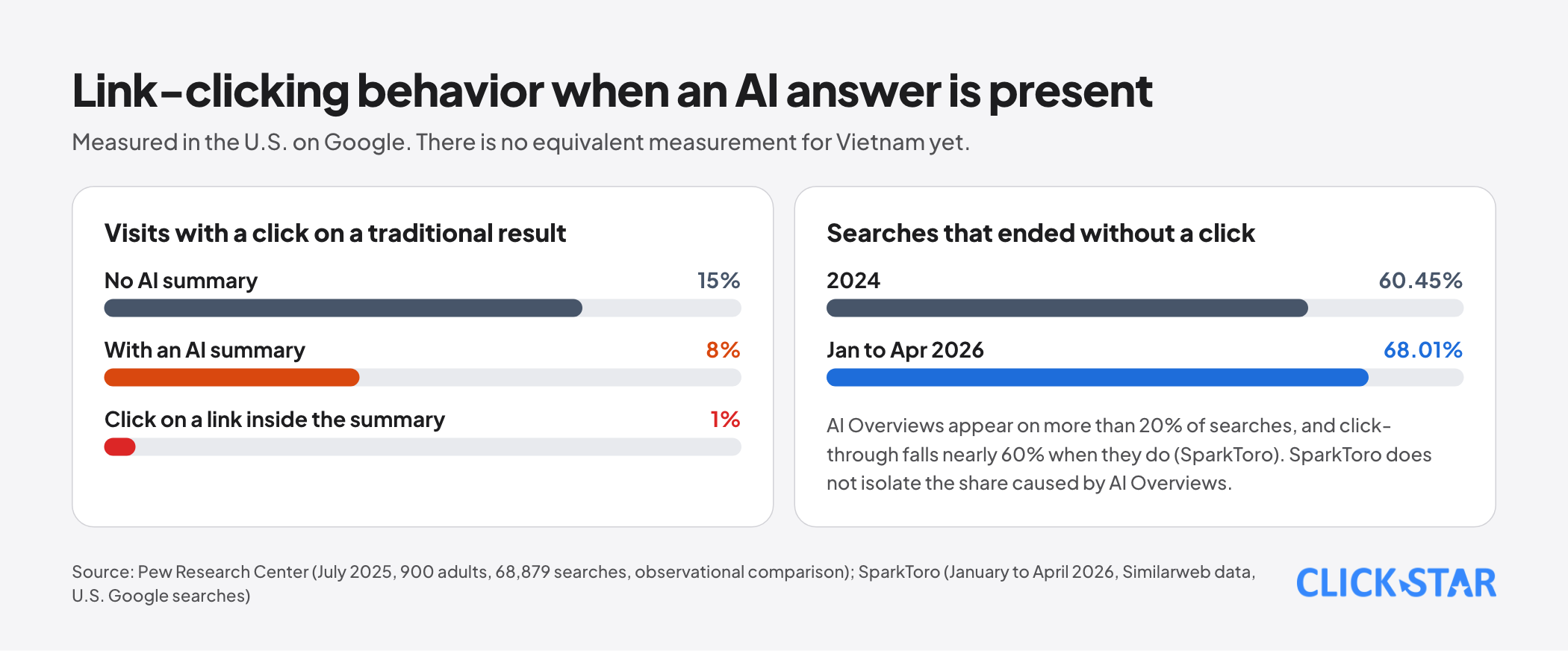
- When an AI summary is present, clicks on traditional results fall: Pew recorded a click in 8% of visits versus 15% when there was no summary. A brand can be seen inside an answer without receiving a click.
- Search by image, voice and screen is growing, including in Vietnam, where a local AI assistant reports that its most-used feature is asking with a photo.
- People no longer rely on one tool: an Adobe survey found 49% of U.S. consumers have used TikTok as a search engine, while Google is still rated most helpful.
- Vietnamese users use AI in Vietnamese, for learning and work: according to Google, 89% of Gemini prompts in Vietnam are written in Vietnamese, the highest share in Southeast Asia.
- Businesses should move from keyword-led optimization to question- and situation-led optimization, and be named in the many places where people search.
Longer queries that read like conversation
In a classic search engine, people learned to shorten what they type into a few keywords. When talking to AI, they write as if asking a knowledgeable person: stating the situation, the goal and the limits.
According to articles citing Google's AI Mode report (Click Star has not been able to check the original), queries in AI Mode are about 3 times longer than ordinary search queries. Another roundup cites a January 2026 SOCi survey as saying prompts sent to chatbots average about 23 words.
These are secondary figures, so take the direction rather than the exact number.
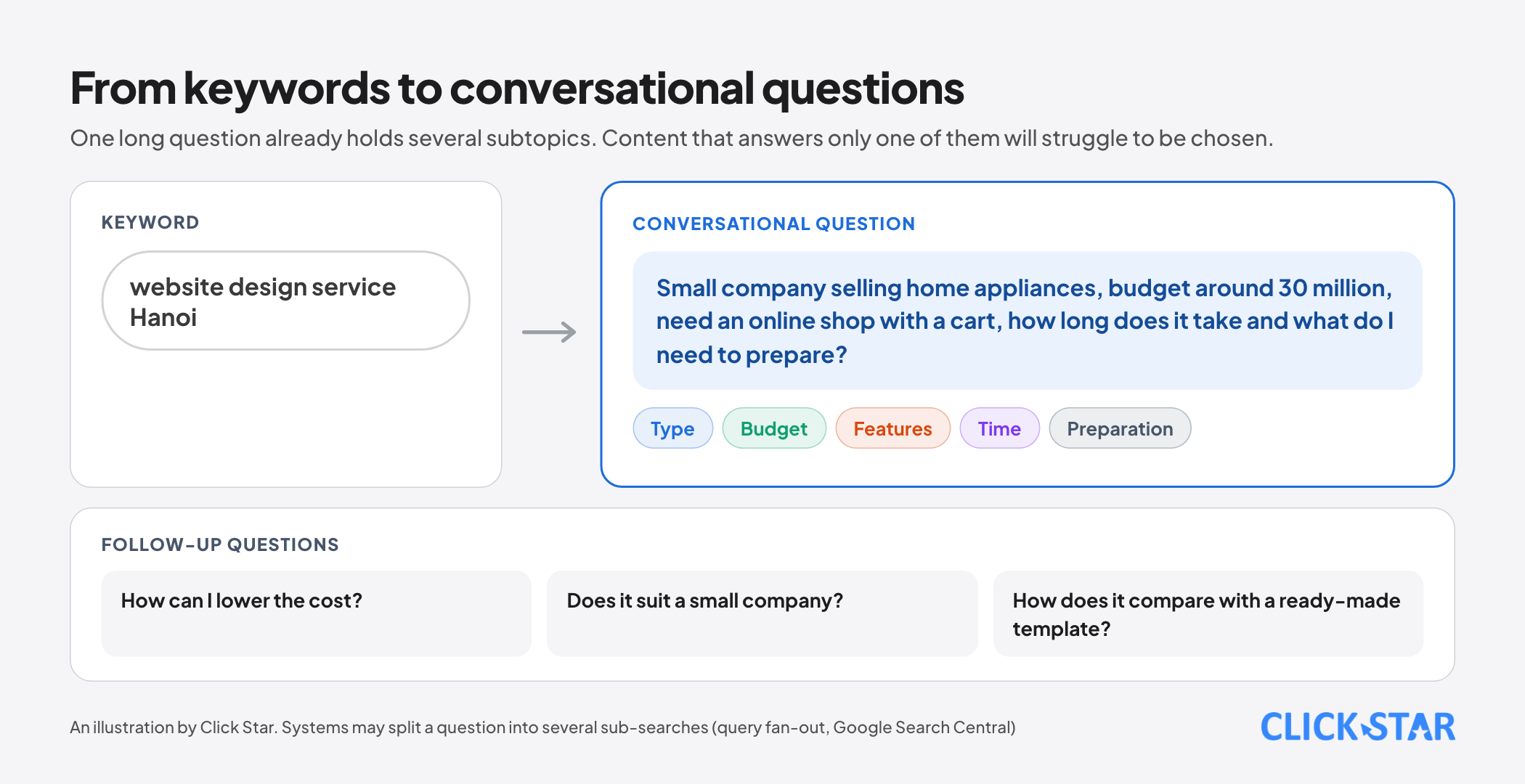
The practical consequence is that the way customers describe their need has changed. Instead of "website design service Hanoi", they might ask "small company selling home appliances, budget around 30 million, need an online shop with a cart, how long does it take and what do I need to prepare".
The second question already holds 4 subtopics: type, budget, features, time. Content that answers only one of the four will struggle to be chosen.
Click Star's view. Businesses should list the questions real customers ask by phone, on Zalo and in consultations, then write content that answers the accompanying subtopics fully, instead of sticking to one keyword phrase.
Follow-up questions instead of searching again from scratch
AI users rarely stop at the first question. They ask on to narrow the options: "which one is cheaper", "does it suit a small business", "how does it compare with the other way".
Google describes AI Overviews and AI Mode as able to use "query fan-out", meaning one question spawns several related searches on subtopics, and AI Mode as especially helpful for queries needing deeper exploration, reasoning or complex comparison (Google Search Central, "AI features and your website", updated December 10, 2025).
This changes how to think about a single "search": it is a whole conversation, and a brand can appear or disappear at any turn. Content needs to anticipate the next question and lead the reader onward with clear internal links.
Reading the answer, then deciding
Click data shows the clearest change. A Pew Research Center study (published July 2025, tracking 900 U.S. adults across 68,879 Google searches) found users clicked a traditional result in 8% of visits when the page had an AI summary, versus 15% without one.
Clicking a link inside the summary itself was only about 1% of visits, and browsing sessions ended after a page with an AI summary in 26% of cases, versus 16%. Pew states this is an observational comparison, the sample is U.S. users who opted into a tracking app, and it covers Google only.
SparkToro's 2026 data (based on Similarweb data, January to April 2026, U.S. Google searches) shows 68.01% of searches ending without a click, up from 60.45% in 2024, and AI Overviews appearing on more than 20% of searches, with click-through falling nearly 60% when they appear.
SparkToro also states that the study cannot isolate the contribution of AI Overviews and excludes Google's mobile search app.
Click Star's view. These figures measure U.S. users, and there is no equivalent measurement for Vietnam yet. But they raise a question worth answering for your own business: if customers read the answer and decide right there, does your brand get named, and in what words. Clicks are no longer the only measure of being seen.
Searching by image, voice and screen
Multimodal search is growing. According to articles citing a June 2026 Think with Google analysis (a source published by Google and not independently audited), Google Lens handles more than 25 billion visual searches a month, up from about 20 billion in 2024, and roughly one in five has commercial intent.
Google's Gemini Southeast Asia report (published July 14, 2026, surveying usage from January to March 2026 across 6 markets) found users in the region increasingly use voice, images and video, not only text.
In Vietnam, VnExpress International (August 8, 2026, citing Sensor Tower) reported that AI Hay, a local AI assistant ranked third by monthly users at the end of Q1 2026, has as its most-used feature asking with images: photographing documents to translate them, photographing homework for step-by-step help, and scanning bills or notices for the key points.
For businesses, this means product photos and documents are also search content. Images need to be sharp, with file names and alt text that match the content, and information shown in an image should have a text version alongside it so machines can read it.
One need, many places to search
People are no longer tied to one tool. An Adobe Express survey (data from January 2026, 807 U.S. consumers, vendor-funded and skewed toward millennials) found 49% have used TikTok as a search engine, up from 41% in the 2024 report.
Asked which source is helpful, Google still led with 85%, followed by Reddit at 29%, ChatGPT at 26%, YouTube at 24% and TikTok at 16%. In other words, the other places add to Google rather than replace it.
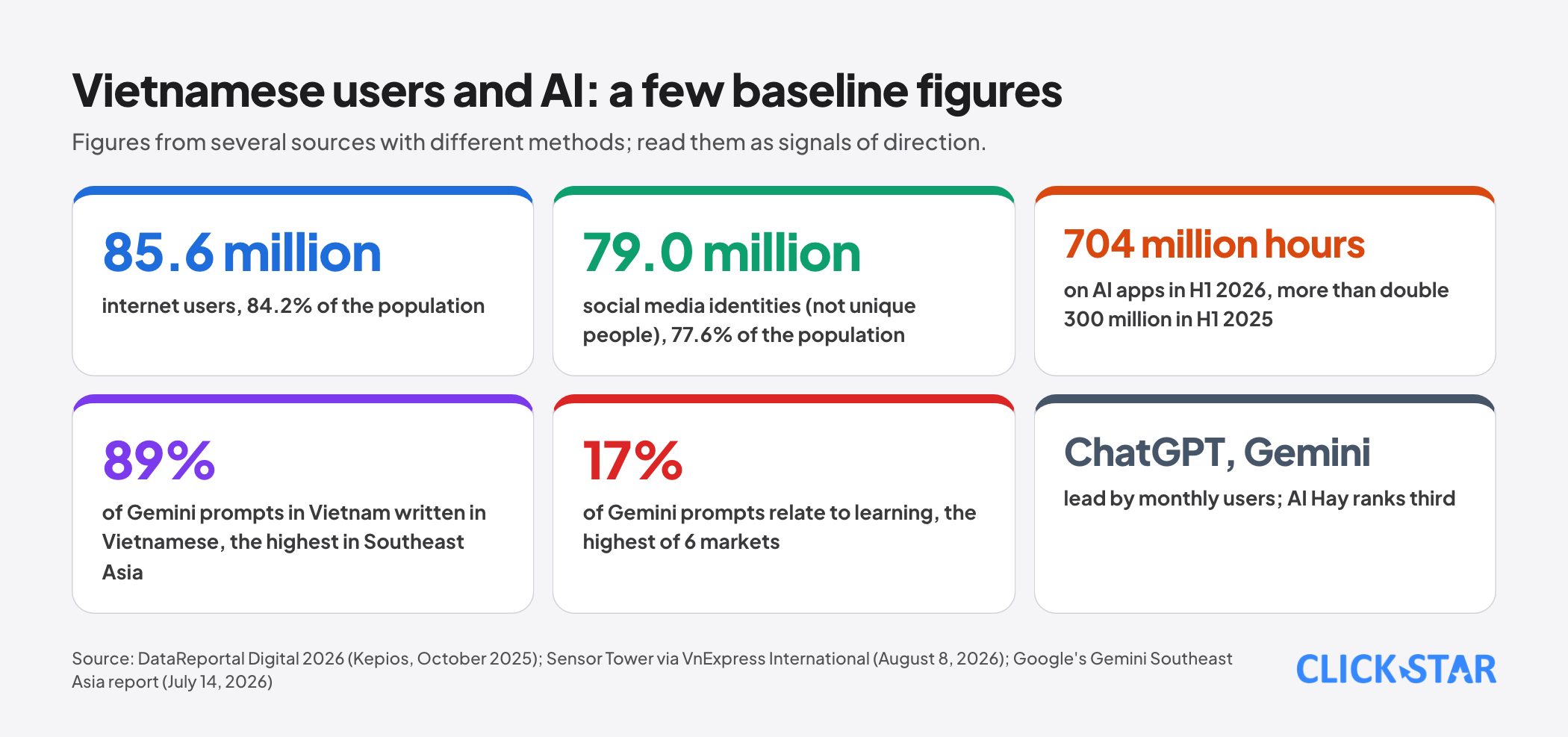
In Vietnam, DataReportal (Digital 2026, Kepios data to October 2025) recorded 85.6 million internet users, 84.2% of the population, and 79.0 million social media user identities, equal to 77.6% of the population, with 92.3% of internet users on at least one social platform.
An identity count is not a count of unique people, but it shows that social media and video are where Vietnamese customers spend much of their time and are most likely to run into a brand.
A reference frame from Click Star (this is Click Star's assessment, not a measurement): customers often discover through video and social media, compare through AI tools, verify through Google and other users' reviews, and only then message on Zalo or call to close. A brand needs to appear consistently at all 4 stages, not just one.
Vietnamese users use AI in Vietnamese, for learning and work
Google's Gemini Southeast Asia report says 89% of prompts from Vietnamese users are written in Vietnamese, the highest share in the region, and 17% of prompts relate to learning, also the highest among the 6 markets.
Vietnam uses translation and localization features more than any other surveyed market, and nearly a third of interactions happen on desktop, above the regional average. Google does not publish a sample size in the article Click Star checked.
On scale, Sensor Tower (via VnExpress International) recorded Vietnamese users spending 704 million hours on AI apps in the first half of 2026, more than double the 300 million hours in the same period of 2025, with ChatGPT and Gemini leading by monthly users.
Use is shifting from chat toward productivity: translating technical documents, analyzing data, coding and summarizing reports.
Click Star's view. Because people ask in natural Vietnamese, Vietnamese content that is clearly written, uses the right terminology and is structured around questions is an advantage.
What businesses should do
- Collect real questions: from Zalo messages, consultation calls, chatbot logs and Search Console reports (long queries), instead of only using keyword tools.
- Write around situations and questions: each page answers a group of related questions, the first sentence answers directly, with figures and conditions of use.
- Cover the subtopics around the main need: cost, time, risk, comparison, preparation.
- Have multi-format content for the same topic: articles, short video, sharp images with descriptions, and a text version of videos.
- Be present where customers search: the website, Google Business Profile, video channels and review sites, with consistent brand information.
- Keep a seamless path from answer to action: clear internal links, short forms, Zalo and phone easy to find.
- Measure with new indicators: visits from AI tools, branded search, lead quality, and a monthly check of whether the brand is mentioned in AI answers for your 20 most important questions.
- Review every quarter, because both search products and user behavior change quickly.
A 30-day plan to start
- Week 1: gather 30 questions customers really ask, grouped by stage: discover, compare, decide.
- Week 2: pick the 10 most important questions, ask ChatGPT, Gemini, Perplexity and Google, and record which brands and competitors appear.
- Week 3: rewrite or write new content for the gaps, in a question-then-short-answer structure with real figures.
- Week 4: align brand information everywhere, set up measurement of traffic from AI tools and schedule the monthly check.
Common mistakes
- Concluding from a single study or a single number. The figures above measure U.S. or regional users, by different methods, and do not fully reflect the Vietnamese market.
- Assuming users have left Google. The surveys available show they are adding tools, not dropping the old one.
- Writing for one keyword phrase and ignoring follow-up questions.
- Ignoring images and video as a form of search content.
- Measuring only clicks and ignoring whether the brand is named in the answer.
- Treating different platforms as one. Each place has its own behavior and display rules, so check each separately.
Related posts
Need tailored advice for your business?
Click Star helps you build a solution that fits your industry and scale. We answer every question during business hours.